A sci-fi short story set in the Mariana Trench a few years from now. Minnow, Walrus, Auntie and Shoes are made up. However, the science is real: in November 2026, scientists said a robot sub near the Challenger Deep had found the deepest volcanic blast rocks ever seen, and nobody knows where they came from. Read about the real discovery. (For another story from the Pacific, read Bring It Home Clean.)
Six Hundred Bars
The knocking started on our first dive, and it kept perfect time.
Two knocks. A long wait. Then two knocks again.
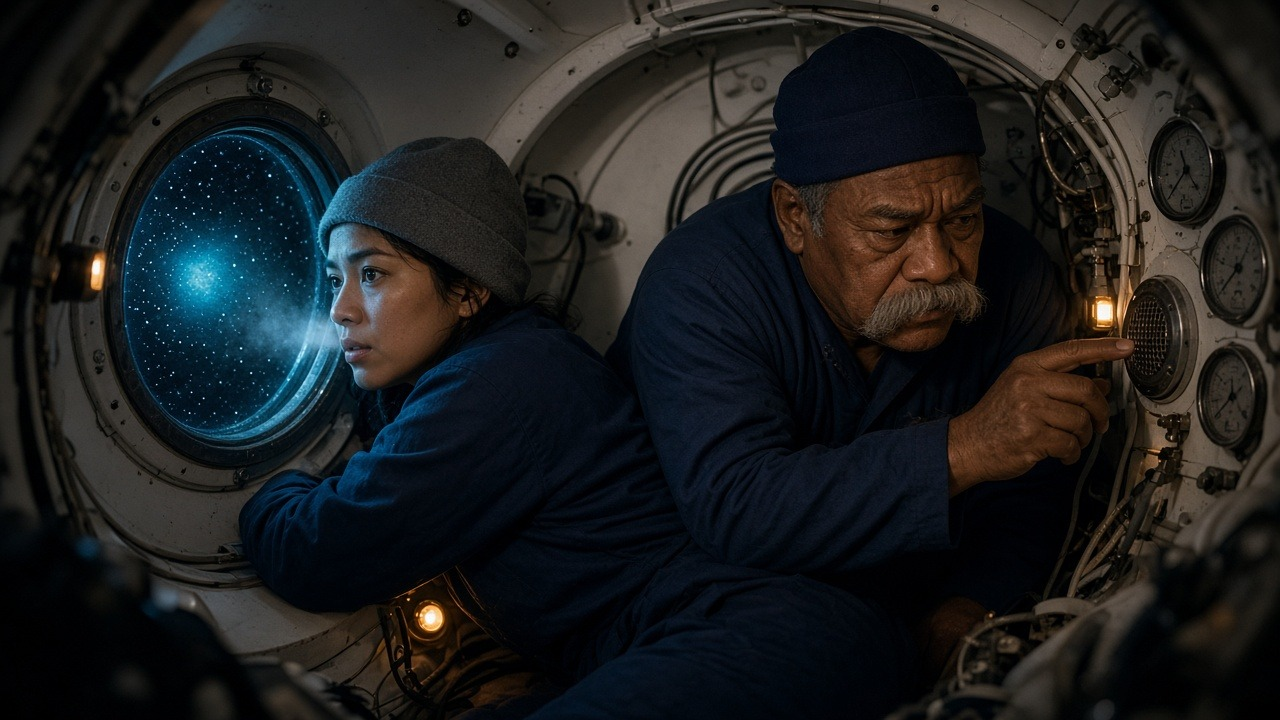
We were five thousand meters down in the Mariana Trench, inside a white ball of metal smaller than a closet. Outside, the water pressed on every inch of us like a pickup truck parked on a postage stamp. Inside, it was so cold I could see my breath.
"Whale," said the man on the phone from the ship.
Walrus didn't answer him. Instead, he tapped the speaker with one thick finger and listened.
"Whales don't knock on time," he said.
I was twenty-six that year, and I was the co-pilot. Everybody on the ship called me Minnow, because I was the smallest person on board and also the newest. Walrus named me on the first day. He said that every big fish starts as a minnow, although most of them get eaten. Then he laughed for a long time at his own joke.
The Egg
Our sub was called the Egg, because that is exactly what it looked like. It was a ball of titanium two meters wide, with three tiny windows and a lot of lights. We lay inside it on our knees and elbows, like two people in a phone booth that had tipped over.
Walrus was sixty-two, from Honolulu. He had a big gray mustache that hung over his mouth, and that was where the name came from. He had been a Navy diver for twenty years. After that, he built the Egg with his own money. Actually, he built it with half his own money, because the bank owned the other half.
"Talk to me, girl," he said to the Egg every time we closed the hatch. Then he patted the wall like a horse.
Inside, the Egg smelled like rubber and old coffee. We wore wool hats and two pairs of socks, and still the cold came up through the floor. Besides that, there was no bathroom, so on dive days I never drank my coffee. Walrus always drank his, and then he complained for six hours.
Before every dive, he told me the same old story. In 1960, two men rode a sub called the Trieste to the very bottom of this trench. Near the bottom, almost ten kilometers down, there was a huge bang, and the whole sub shook. One of the windows had cracked.
"And what did they do?" he would ask.
"They kept going," I would say.
"They kept going." He nodded as if we were in church. "Then they sat on the bottom for twenty minutes and ate a chocolate bar. Or so I tell it."
A Job in the Mariana Trench
The ship was small and rusty, and it smelled like coffee and diesel. It sailed out of Guam, and the captain was a short, loud woman everybody called Auntie. She called everybody "baby," even the Navy men who came by to look at the Egg.
Our job came from a mining company. A few years earlier, a robot sub had found strange black rocks on the wall of the trench near the Challenger Deep, the deepest spot in any ocean. They sat more than six kilometers down. They were the deepest volcanic blast rocks anyone had ever found. Still, nobody had found the vent they came from, because the robot could only go so deep.
Now the company wanted to dig near there. In three weeks there was a big auction in Washington for the right to mine this part of the sea floor. The new rules said a crewed sub had to dive and look before the sale. So the company hired the cheapest deep sub in the Pacific, and that was us.
The Map
The company also sent a man to ride along. His real name was on his badge, but we called him Shoes. He wore shiny brown leather shoes on a rusty ship, and he wiped them every night with a little white cloth.
To be fair, Shoes was not a bad man, I think. He was young, he got seasick, and he had a photo of a baby girl taped inside his phone case. Mostly, he was a man with a boss.
On the first morning, Shoes unrolled a map on the galley table. It was a sonar map of the trench wall, all blue and green and purple.
"East," he said, and tapped it. "Dead rock, nice pictures, home by Friday."
I studied the map for a long time. On the west side, near a V-shaped dent in the wall, there was a flat shelf. Across the shelf ran two thin straight lines, side by side, as if somebody had drawn them with a ruler.
"What are those?" I asked.
Walrus leaned over to look, too. "Old cable," he said. "Phone company, probably."
Shoes rolled the map up fast. "Probably."

Dive One
It takes about two hours to fall six kilometers, so the first part is mostly waiting. You don't feel the fall at all. The water outside the window just goes from blue to dark blue to black, and then it stays black forever.
Nobody ever gets used to the Mariana Trench, not even Walrus. Then the snow starts. Of course, it is not real snow. It is tiny bits of dead things drifting down from the sea above, and our lights caught it like a snow globe.
At five thousand meters, the knocking began.
Two knocks. A long wait. Two knocks.
Our listening gear turned every sound in the water into something a human ear could hear, and this one came through loud and clear.
"Topside, are you hearing this?" Walrus asked into the phone. Our phone was not a real phone, since it sent sound through the water. Every answer took four seconds to come back.
"Whale," Shoes said again. "They carry for miles down there. Keep going east."
So we went east. We landed at sixty-one hundred meters, on gray, dead, boring rock. I took two hundred nice pictures, as ordered. Meanwhile, the knocking went on and on, somewhere to the west.
When we came up that night, Walrus sat on the deck in the dark for a long time.
"Thirty seconds," he said finally.
"What?"
"Between the knocks. Exactly thirty. I counted." He scratched his mustache. "I never met a whale that owned a watch."
The Bank Owns Half
That night I couldn't sleep, so I went up for some air. Shoes was on the back deck, on the satellite phone, with his back to me.
"No, they're staying east," he said. "Nobody goes near the V… Because I said so. The sale is in three weeks. I need clean, boring pictures, and I need this crew on a plane home."
I stepped back into the dark before he turned around.
Up on the bridge, Auntie was still awake, drinking tea. I asked her if she had ever worked this spot before.
"Not me, baby. But a big company ship sat right out here all last spring." She shrugged. "Doing weather, they said. Funny place to do weather."
The next morning, I told Walrus everything. He listened while he chewed his toast.
"Minnow," he said, "the bank called me yesterday too. If I don't pay by January, they take the Egg." He looked out at the gray sea. "This job pays it all. Every cent. Plus a bonus if Shoes likes our pictures."
"So we stay east?"
He didn't answer. Instead, he got up and went to check the batteries.
I understood him, though. My mom ran a little taco stand in San Diego, and I grew up counting her money on a paper plate. Besides, I needed five more deep dives for my pilot's ticket. If Walrus lost the Egg, I lost my ticket too.
A Call Home
Before the second dive, I used ten of my satellite minutes to call my mom. It was morning in San Diego, and I could hear the grill hissing behind her.
"Are you scared down there, mija?" she asked.
"No," I lied. Then, because she always knows, I said, "A little."
"Good," she said. "Scared people look where they're going." After that she told me about a man who had paid for three tacos with a two-dollar bill, and I laughed so hard Auntie poked her head in to see.
Dive Two
The second dive was east again. More gray rock, more nice pictures.
This time, however, I timed the knocks myself, with the clock on the wall. Thirty seconds, then thirty, then thirty again. It never missed once.
After a while I noticed something else. Whenever Walrus turned the Egg to the west, the knocks got a little louder. When he turned back east, they got softer.
"It's over there," I said quietly. "By the V."
"I know where it is," Walrus said.
By the time we came up, the weather was turning. Auntie came down from the bridge with her hair blowing everywhere.
"Storm in two days, babies," she said. "You get one more dive, and then we run for Guam."
Shoes smiled at that. "Then make it a nice one. East."
The Last Dive
That night Walrus came and knocked on my cabin door. Two knocks.
I didn't laugh, though.
"Tomorrow we go west," he said. "To the shelf."
"Shoes will never pay you."
"Probably not." He looked very old in the hallway light. "But I've been diving for forty years, Minnow. I never once came up and lied about what I saw. I'm not starting at sixty-two."
As soon as morning came, Shoes found out. He stood on the deck in his shiny shoes and shouted at Walrus, and then at Auntie.
Auntie just folded her arms. "This is my ship, baby," she said. "And my weather, and my divers."
Then she turned to us. "Go on. Go look."
Dive Three
We fell into the dark for two hours, and the knocking grew louder the whole way down. Halfway, Walrus took his hands off the controls.
"Your dive, Minnow," he said.
"Now? Today?"
"Today is the only one we've got." So I flew.
At six thousand meters, the rock changed. It was no longer gray. Instead, it was black and shiny, like burned sugar on a cake, and it lay in thin flat layers, one on top of the other.
"That's it," Walrus whispered. "That's the stuff from the paper."
The water outside was warmer, too. It was only half a degree, but in a place that has been cold for a million years, half a degree is a shout.

A small pale pink fish drifted past the window. It looked like a tadpole made of glass, and it didn't care about us at all.
Then I set us down on the shelf, and the whole Egg shook with a huge crack.
I couldn't breathe. Walrus grabbed the wall with both hands.
"Window?" I said. My voice came out tiny.
He checked them one by one. Finally, he let out a long breath. "No. The crust broke under the skids. We're sitting on new rock, Minnow. Rock so new it's still settling."
"The Trieste," I said.
"They kept going," he said. He grinned under the mustache. "So do we."
Two Straight Lines
The skids were stuck in the black ash. So Walrus dropped one of our steel weights, and we lifted free in a cloud of dark dust. Then we floated slowly over the shelf, our lights pushing at the dark.
That was when I saw the lines.
They ran across the sea floor, two straight grooves side by side, just like on the map. But old cable doesn't look like that. These were tracks, with little square marks inside them, the kind a big machine leaves in soft mud.
So we followed them. My hands were sweating on the controls, even in the cold. Walrus never told me to turn back, and I never asked him to.
The Knocking
By now the knocking was so loud that I could feel it in my teeth.
Two knocks. A long wait. Two knocks.
The tracks ran straight into the black ash and vanished under it, as though the sea floor had swallowed them. I turned the Egg very gently, and our lights swung across a low black hump.
Rocks don't have corners, though, and this one did.
It was a machine as big as a truck, buried right up to its roof. Hot ash had poured down the slope and covered it, the way snow covers a parked car. Only the top was still showing, with a short pole sticking out of it. On the pole, one small light was blinking.
And from that pole came the knocking. It was a rescue beacon, calling for help that was never going to come. Somebody had lowered that machine down here months ago, in secret, before any auction. Then the volcano had woken up and buried it.
Shoes had known all along. His company had known the volcano was alive. Even so, they had sent us down anyway, to take nice pictures of dead rock.
Walrus said nothing for a long time. Then he reached over and switched on every camera we had.
"Old cable," he said quietly. "Take the picture, Minnow. Take all of them."
We were not the first people on that shelf. We were just the first ones who were supposed to come home and say there was nothing there.

Leave a Reply