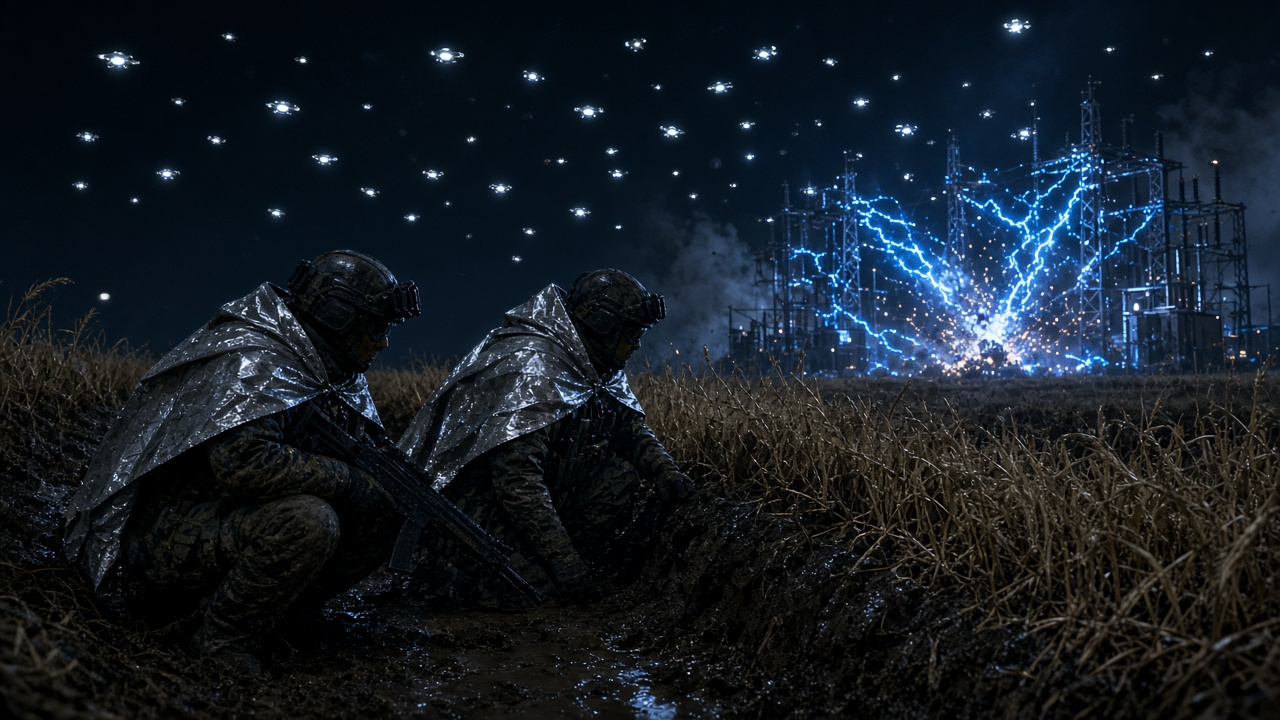
The Kailne Front, Part 1: a military science fiction short story and the start of a new serial fiction series. It is the year 3025, and two Kailne commandos, Hops and Bear, are cut off behind enemy lines after the Vilma push on the planet Ostra. They have dying batteries and a voice on the radio they badly want to trust. The worlds and people are made up. However, the future war tricks are real ones, taken from the power grid war in the news this week.
Substation Nine
My name is Tomas, but nobody calls me that. In the Kailne army, everybody gets a nickname on the first day. Since I jumped at every sound in training, they called me Hops. Of course, it stuck.
I am twenty-two, and I am a commando in the 4th Recon Group. Our planet is called Ostra. Besides that, it has two pale moons, long wheat plains, and one big problem. The Vilma want it.
The Vilma came over the northern border three years ago. At first, they used tanks. Later, they learned that tanks die fast in the age of drone warfare. So now they fight our power instead.
Every night, their drones hunt our substations, power lines, and solar fields. When the lights go out in our cities, the trams stop, and the water pumps stop too. Then people sit in the cold and wait.
Our job was to guard Substation Nine. It was a gray box of humming steel in a wheat field, ninety kilometers from the front. In fact, it fed power to the whole city of Lenka. If it went dark, a million people went dark with it.
At the time, there were twelve of us in the squad. Our captain was a short woman with a deep laugh named Ola. However, we all called her Mama, because she fed us, yelled at us, and counted us every single morning.
Mama had one rule above all others. She never used our real names, not even on the radio. "Names are for your mothers," she said. "Out here, you are Hops, and Bear, and Moth. That way, the Vilma learn nothing."
In two years, I never once heard her say Tomas.
The Night of the Great Push
The push came on a Tuesday, a little after midnight.
First, our screens went white with static. The Vilma had turned on their big jammers, the kind that sit on trucks and scream on every radio band at once. Then the sky began to buzz.
I had heard drone swarms before. Still, I had never heard anything like this. It sounded like a field of angry bees, and it came from every direction.
"Heat masks on!" Mama shouted. "Everybody into the trench!"
Quickly, we pulled our cloaks over our heads. A heat cloak is a thin silver sheet woven with cooling threads. Basically, it hides your body heat from the drone cameras, as long as you keep still. Once you move, it slips, and you glow.
After that, the first bombs hit the substation. Big blue sparks jumped across the wheat. The ground shook so hard that my teeth hurt.
Meanwhile, Bear grabbed my collar. Bear was our sergeant. He was huge, slow to speak, and the calmest man I ever met. He had a gray beard, even though he was only thirty.
"Hops," he said, "the north trench. Go."
So we ran, because there was nothing else to do. Behind us, the second wave hit. When I looked back, the whole field was burning, and the substation was gone.
Then we ran until the trench ended. Then we crawled through the wheat until our arms gave out. By dawn, the buzzing had moved south, past us.
That was when we understood. The front line had not held. It had rolled right over us in the dark. Now we were alone, two men behind Vilma lines.

Two Men and Four Batteries
We hid all day in a drainage pipe under a farm road. Also, it was wet and cold, and it smelled like old leaves. Even so, it was safe from the drones overhead.
Bear laid out everything we had on his cloak. In total, we had two rifles, two knives, one med kit, one map tablet, and four batteries.
In 3025, the battery is everything. It runs your heat cloak, your night eyes, your radio, and your map. When it dies, you are blind, loud, and warm, which means you are dead.
"Each battery lasts about a day," Bear said. "If we are careful, maybe two."
"So we have four days," I said.
"Maybe," he said. "But the walk home is seven."
Then he did the math out loud, slowly, the way he did everything. The front was now somewhere south of us. Our lines would be about one hundred and forty kilometers away. Walking at night only, we could make twenty a night. That meant a week of walking on four days of power.
"We need batteries," I said.
"We need a lot of things," Bear said. "Let's start with not dying today."
Why the Power Matters
You might wonder why batteries were so short. After all, we live in the year 3025. Surely we should have plenty of power by now.
The answer, however, was the Harra Gate.
Ostra has very little fuel of its own. Most of it comes from far away, on huge freighters that cross the Harra Gate. The Gate is a narrow lane of safe space between two moons of a gas giant, the only fast path to our part of the sky. As a result, every tanker in our region has to pass through it.
The Harrans control the Gate. And for most of this year, they had been fighting their own war with the big off-world powers. First, they had laid mines in the lanes. Then they had fired on tankers that tried to slip through with their beacons turned off.
As a result, fuel prices tripled, and then they tripled again. Only a few tankers a week made it to Ostra. So the Kailne army rationed batteries the way old armies rationed bread.
I once overheard Mama arguing with a supply officer over the radio.
"You sent me forty batteries for twelve people," she said. "For a month."
"That's what the depot gave us," the man said. "The Harra Gate is closed again. Every unit is short."
"Then tell the depot," Mama said, "that cold soldiers don't guard substations."
"I'll tell them," he said. "But they'll say what they always say. Do more with less."
She hung up, and for once, she did not laugh.
The Voice on the Radio
On the second night, we started walking south.
Of course, we moved only in the dark. Every few hundred meters, we stopped, listened, and checked the sky. The Vilma drones flew high, like hawks. Still, we could sometimes hear them, a soft whine far above the clouds.
Around midnight, Bear risked turning on the radio. Radios are dangerous behind enemy lines, especially in a future war full of listening drones. When you talk, the enemy can find your signal and send a drone straight down it. So Bear set it to listen only, and he kept it on for ten seconds at a time.
For an hour, there was nothing but static.
Then, all at once, a voice came through.
"Any Kailne unit, this is Nest. Any Kailne unit, this is Nest. Respond if you can hear me."
My heart nearly jumped out of my chest. Nest was our call sign for Mama. Above all, I knew that voice. It was deep and a little rough, exactly like hers.
Bear held up a hand to stop me. Then he pressed the button.
"Nest, this is Bear," he said quietly. "Challenge. River."
In the Kailne army, every day has a secret challenge word and a secret answer. If someone gives the wrong answer, you assume they are the enemy. The words change every day at noon, and every soldier learns them by heart before a mission.
There was a short pause. Then the voice said, "Answer. Stone."
Bear let out a long breath. It was the right answer.
"Bear," the voice said, "thank God. Who is with you?"
"Hops," Bear said.
"Good," the voice said. "Copy, Private Tomas. Stay calm. We are coming for you."
A Pickup at the Old Mill
For the first time in two days, I smiled. Mama was alive. Somehow, she had made it out, and now she was coming for us.
The voice gave us a plan. There was an old flour mill near a village called Sova, forty kilometers south. A rescue team would land there at dawn, two days from now. Until then, we only had to reach it.
"Keep radio silence until then," the voice said. "Walk at night. Trust nobody. Nest out."
After that, the radio went quiet again.
Bear stared at the map tablet for a long time. His face was hard to read, even in the green glow.
"Forty kilometers," he said. "Two nights. That we can do on our batteries."
"So we're going home," I said.
"We're going to the mill," Bear said. "That's not the same thing."
Still, I was too happy to argue. I slept well that day, curled up in the roots of a fallen tree. In my dreams, I was eating Mama's bean soup back at Substation Nine, and everybody was laughing.
The Ceasefire Nobody Told Us About
On the third night, the radio woke up on its own.
This time, the voice was not Mama. It was a news channel from the capital, sent out on a public band. A woman read the news in a flat, tired voice.
"The High Council of the Concord," she said, "announced tonight that an energy ceasefire is now in effect between the Kailne and the Vilma. Under the deal, both sides will stop striking power plants and fuel depots. Kailne leaders said they learned about the deal from the Concord's public message. The Vilma have not yet confirmed it."
The Concord was the biggest power in our part of the sky. On one hand, it sold us weapons, and it also bought Vilma fuel. Everybody knew it wanted the war over, mostly so that fuel prices would drop.
"So it's over?" I whispered.
"No," Bear said. "Listen."
The woman kept reading. "Two hours after the announcement, strikes were reported on power stations in Lenka and in the eastern hills. Officials are working to restore power."
I closed my eyes. Lenka was the city that Substation Nine used to feed.
"A ceasefire on paper," Bear said, "is just paper. Until both sides stop, nobody stops."
Then he switched the radio off, and we kept walking.
The Drone That Didn't Shoot
The next part still gives me chills.
Before dawn, we came to a wide river with one narrow footbridge. Still, we had to cross it. Unfortunately, the bridge was open ground, with no trees and no cover.
We waited in the reeds for an hour. Finally, Bear said, "Now." So we pulled our cloaks tight and walked across, slow and steady, like two gray shadows.
Halfway across, I heard the whine.
A Vilma drone was hanging above the river, maybe fifty meters up. Soon I could see its small red light blinking. It was close enough to hit with a rock.
At first, I froze. My cloak's battery light was flashing yellow. That meant less than an hour left.
The drone did not dive. Instead, it simply hovered there, watching us. Then, after a long minute, it turned and drifted away north.
On the far bank, I sat down hard in the mud and shook.
"Why didn't it shoot?" I asked.
Bear was quiet. He was looking north, where the drone had gone.
"Maybe it didn't see us," he said at last.
However, I knew Bear. When he said maybe, he meant no.

Bear's Questions
We hid that day in a burned-out barn. Through the gaps in the roof, we could see the smoke of a far village.
Meanwhile, I changed to my last battery. Bear had one left too.
He spent the whole day with the map tablet. Every so often, he asked me a question, without looking up.
"Hops," he said, "when Mama talks on the radio, how does she start?"
"Any Kailne unit," I said. "This is Nest."
"What does she call you?"
"Hops," I said. "Same as everybody."
He nodded and said nothing else.
A little later, he asked, "Who knew the challenge words for that day?"
"Everybody in the squad," I said. "We all learned them before the push."
"Everybody," Bear said. "Including anyone who got caught."
I didn't like where this was going. "Bear, it was her voice. I know her voice."
"I know you do," he said softly. "So do I. That is the problem. In 3025, a good machine can learn a voice from ten minutes of radio. The Vilma have been recording our radios for three years."
After that, I felt sick. Still, I didn't want to believe it. Mama was alive. Somebody was coming for us. That was the only thing keeping my legs moving.
"Then why did it give the right answer?" I asked.
"That," Bear said, "is the question I keep asking too."
The Old Mill at Dawn
On the fourth night, we reached the hill above Sova.
At first sight, the village was empty. Most of the houses were dark, with broken windows and doors left open. Below it, by a slow brown stream, stood the old flour mill. Its big wooden wheel was still, and its roof was half gone.
In front of the mill lay a flat, wide field of cut wheat. Indeed, it was a perfect landing place for a rescue flyer. In fact, it was too perfect.
We lay on our bellies in the bushes at the top of the hill and watched. For a while, nothing moved. There were no drones in the sky, no trucks on the roads, and no birds in the trees.
"Too quiet," Bear whispered.
"It's a ceasefire," I said, even though I didn't believe it.
My battery light turned red. I had maybe twenty minutes of cloak left.
Then the radio clicked on by itself, as if somebody knew we were close.
"Bear, this is Nest," said Mama's voice. "We see you on the hill. The flyer is two minutes out. Walk down to the center of the field so the pilot can find you. Leave your cloaks off so he can see your heat. Hurry, the window is short."
Bear did not answer. He looked at me. And, for the first time since the push, I saw fear in his calm gray eyes.
Names Are for Your Mothers
I played the voice back in my head, every word of it. Any Kailne unit, this is Nest. Thank God. Who is with you?
Then I heard it again, the part I had been too happy to notice.
Copy, Private Tomas.
My stomach dropped through the ground.
In two years, Mama had never once called me Tomas. Not on the radio, not in the trench, and not even on my birthday. Names are for your mothers, she always said. Out here, you are Hops.
But someone with a list would know my real name. For example, a person who had our squad's papers. Or a person who had captured our radio and our challenge words.
In other words, someone who had captured Mama.
"Bear," I whispered. "It's not her."
He closed his eyes for a second. "I know," he said. "I've known since the bridge. That drone didn't shoot, because they wanted us to walk here."
Down in the field, nothing moved. Still, now I could see it. The cut wheat was not flat. Here and there, small round humps sat under the stubble, every few meters, in neat rows.
Then I understood. They were drone nests, buried and waiting.
"Leave your cloaks off," the voice said again, sweet and patient. "We're almost there, Hops. Mama's almost there."
Then, from the trees right behind us, someone whispered my nickname in a voice that was not a machine at all.
"Hops. Don't move."

About The Kailne Front
The Kailne Front is a sci-fi war story series on nowwn.com, released as serial fiction. In the year 3025, Kailne commandos Hops and Bear fight to survive behind enemy lines on the planet Ostra after the Vilma push past Substation Nine. Meanwhile, the Concord's paper energy ceasefire and the mined Harra Gate shape every battery, drone and choice in this military science fiction tale.
Part 2 of The Kailne Front releases Wednesday, November 11, 2026 at 9:00 AM ET. Subscribe if you want new releases.

Leave a Reply