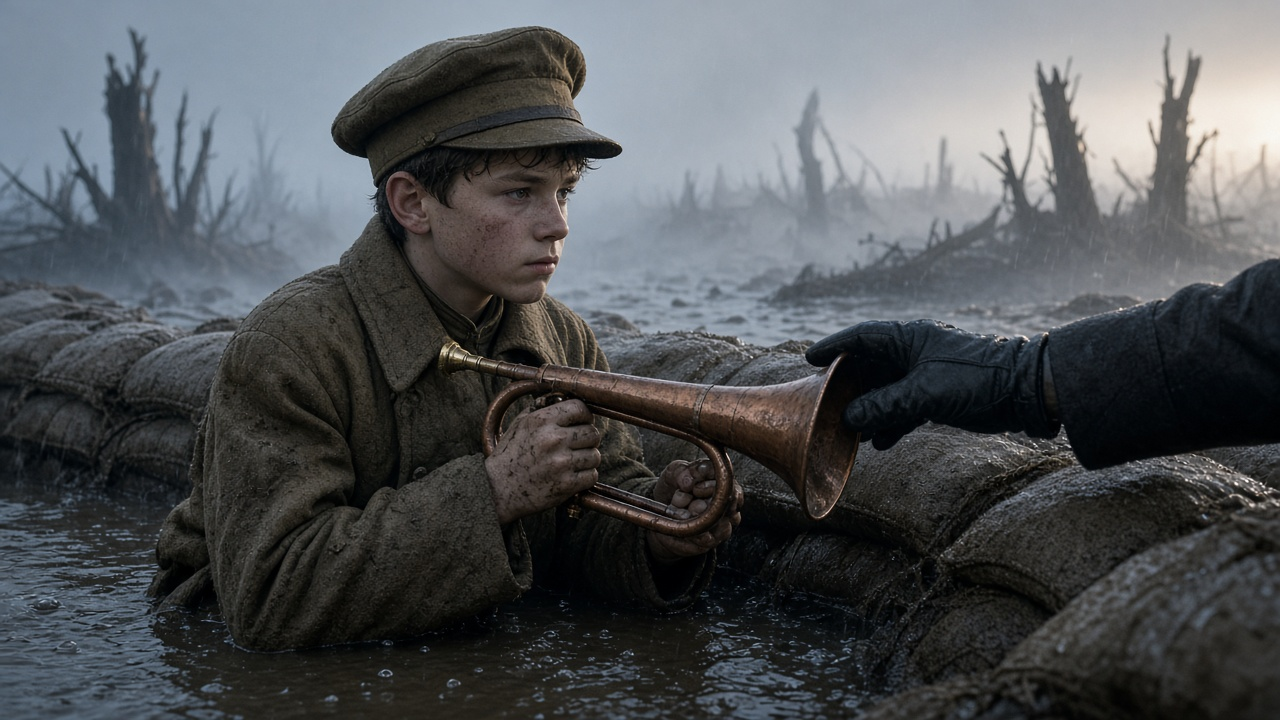
A WW1 story set in the Ypres Salient in the winter of 1915, told as a short story. Toot, the Owl, Granny, Spud and their battalion are made up. However, the ground is real. This autumn, archaeologists finished a long dig at the De Palingbeek golf course near Ypres. They found a French trench from 1914, German tunnels, a French officer's sabre and a British bugle. This story imagines the boy who carried one like it.
Fifty Yards
On my first morning in the line, I lifted my bugle to blow Reveille.
I did not even think about it. For five months, every morning in camp had started with that call, and my hands knew it better than my head did. So I stood up in the gray light, wet to the knees, and put the cold brass to my lips.
Then a hand closed over the bell.
It was the captain. He did not shout. Instead, he leaned close, so close I could smell his tea, and he spoke very softly.
"Fritz is fifty yards that way, Toot. He can hear you sneeze. You will never blow that bugle again. Not in this trench. Not in this war."
He let go. After that, he walked away down the trench as if nothing had happened.
I wanted to cry, and I was too old to cry, so I did neither. I wrapped the bugle in my spare socks and pushed it deep into my pack.
The captain was right, of course. I never did blow it again. Still, I kept it all that winter, for one reason. And it took longer than anyone could have guessed for that reason to work.
Why I Tell This WW1 Story
I came from Leeds. Mum sewed khaki in a big clothing factory near the river, and she came home every night with green fluff in her hair. My dad had been a bugler in the Light Infantry. He blew his calls in South Africa, came home with a fever he never shook off, and died when I was nine.
The bugle was the only thing of his I had. It was copper with a brass mouthpiece, and it had a dent near the bell from a fall off a cart in the Transvaal. Dad taught me every call on it before I could ride a bike.
In September 1914, I walked into the recruiting office and told the sergeant I was nineteen. In fact, I was fifteen. He looked at me for a long time. Then he winked and wrote it down. Because I could play, they made me a bugler in Dad's old regiment. Mum did not know until I wrote to her from camp.
I have had a long time to think about that winter. Longer than you would believe. Nowadays, men in bright shirts walk over that field and hit little white balls across it. They shout "Fore!" when one goes wild. It sounds a bit like a bugle call, if you squint your ears.
Every WW1 story I ever heard as a boy had a bugle in it, blowing the charge. Mine is different. In mine, the bugle stays quiet.
The Old French Trench
We took over from the French at the end of January. Their trench ran through a little wood south of Hill 60, between the railway and the old canal. Hill 60 was on our left. The canal was on our right. The French had dug it in a hurry the autumn before, and it zigzagged at strange angles, like a crack in a plate.
It was not much of a trench, either. Dig down two feet in that clay and the hole filled with water. So we built walls of sandbags and stood behind them, up to our knees in brown soup. Our boots never dried. Neither did our socks, our feet, or our tempers.
The French had fought hard for that ground. Some of them were still there. They lay in the walls, under the sandbags, where their friends had buried them in the middle of the fighting. We did not dig in those places. When we passed them, some of the older men touched their caps.
Meanwhile, the Germans were close. In one spot, near a hump of earth we called the Molehill, their sandbags were only fifty yards from ours. At night we could hear them cough. We could hear them laugh. Once, we heard one of them play a mouth organ, badly, for nearly an hour.
They shelled us twice a day, once at breakfast and once at tea. You could almost set a watch by it. Then the sky would go quiet again, and the rain would come back.
Granny's Rule
Granny was the oldest man in our platoon. He was forty-one and had lied about that too, only the other way. He had a gray mustache like a scrubbing brush, and he knitted socks in every spare minute. Nobody ever saw who he gave them to. Somehow, though, the youngest lads always had dry ones.
On my third night, he sat down next to me on the fire step. He watched me polish the bugle with my sleeve.
"Got your name on that, Toot?"
"No, Granny."
"Then put it on." He did not look up from his knitting. "Out here, the ground keeps lads. It keeps them a long time. Paper rots. Cloth rots. Even boots rot, in this muck. However, copper keeps. So you scratch your name on something that won't rot, and your mum's street too. That way somebody can send you home."
I thought he was being gloomy. Even so, I did what he said. That night, by the light of a candle stub, I took a nail and scratched the inside of the bell, where the brass curls in.
J. WARD. TANNER ST. LEEDS.
It took two hours, because my hands were cold. When I was done, I put the bugle back in my socks. Granny nodded once, and that was all he ever said about it.
The Owl

We called the captain the Owl. He had round glasses, and he never seemed to sleep. Every hour of the night, you would turn around and find him behind you, peering at the dark over the sandbags.
He was not cruel. Actually, he was the kindest officer in the battalion. He wrote to the mother of every man we lost, in his own hand, and some nights that took him until stand-to. Even so, he never once let me take the bugle out where the Germans might see it.
"Bugles are for parade grounds," he told me. "Out here, they are a target. The first man a sniper looks for is the man with the bugle. Then the man with the whistle. Then the man with the glasses." He tapped his own and almost smiled. "So I am third in line. You would be first."
In the line, we passed orders by word of mouth. Stand-to was a whisper that ran from man to man along the trench at dawn and dusk. If an attack came, the officers had whistles. Nobody needed a boy with a bugle.
So I became a rifleman like everybody else. I filled sandbags. At night, I carried rations up from the canal bank. Most evenings, I stood sentry in the rain. My best mate Spud, a Liverpool lad with ears like jug handles, stood next to me and complained about the food, the rain and the French, in that order.
Spud's Guess
"Go on, then," Spud said one night. "Why d'you keep it?"
We were on sentry together. The rain had stopped, and the stars were out over the German line. Everything smelled of wet earth and cold smoke.
"Keep what?"
"Your trumpet. You can't play it. You carry it everywhere. It weighs as much as a tin of jam."
"It's a bugle," I said. "Not a trumpet."
"Same thing, but shinier. So why?"
I thought about it for a while. "For one reason," I said. "I'll tell you when it works."
Spud snorted. Then he leaned his chin on the sandbags and thought it over.
"I know," he said at last. "You're saving it for the last day. When it's all over, you'll jump up on the top and blow the Cease Fire. So the whole of Belgium knows. Right?"
I did not answer. Honestly, I had not thought of that. It was a lovely idea, though. I pictured it: the sun coming up, the guns stopping, and me on the parapet, blowing the Cease Fire so loud they heard it in Leeds.
"Maybe," I said.
"Knew it." Spud grinned in the dark. "Just make sure I'm awake for it, Toot."
Paper Takes Six Weeks

In the second week of February, Mum's letter reached the colonel.
I did not see it. Instead, I heard about it, which in a trench is the same thing. I was carrying a jar of rum down to the company dugout when I heard voices behind the blanket that hung over the doorway. So I stopped and listened, even though I knew better.
"She sent a birth certificate," the Owl was saying. "The boy turned fifteen in August, sir. He is a child."
"He is a rifle," the colonel said. His voice was tired, not hard. "Brigade wants a raid on the German sap before the end of the month. I am forty men short already. You know the rule. If the boy can do the work, he stays. I can't send home every lad whose mother writes."
"Then send this one."
"I'll send the paper up the chain. It goes to Division, then to the War Office, then back again." The colonel sighed. "Paper takes six weeks. Until then, he's a rifle. And Brigade still won't give us timber for those walls, so don't ask me again."
I crept away before they came out. Then I sat on a box of bully beef in the dark, and I did not know what I felt.
Part of me wanted to go home more than anything. Mum. Tanner Street. A dry bed, a hot bath, and the smell of the bakery on the corner. Another part of me felt sick. Spud would still be here. So would Granny, and the Owl, and all the others. Running home to Mum while they stood in the water felt like a kind of lie.
In the end, I decided nothing. Six weeks was a long time. Anything could happen in six weeks.
The Tapping
Around then, we started hearing the tapping.
It came at night, mostly, when the guns were quiet. If you lay down in the dugout and put your ear to the clay, you could hear it. Tap. Tap. A pause. Then tap, tap again, slow and patient, somewhere under the ground.
"Rats," said Spud.
"Rats don't use picks," said Granny.
Everyone knew what it meant. The Germans were digging a tunnel toward us. If they got under our trench, they would pack it with explosives and blow us into the sky. Nobody said that out loud. Even so, after the tapping started, men slept with their boots on.
The Owl went to Brigade twice. He asked for miners, and they told him miners were still in England. He asked for timber to hold up the walls, and they told him there was none to spare. Meanwhile, the rain kept falling, and the old French walls kept sagging, one sandbag at a time.
Granny knitted faster. Spud stopped joking about the food. As for me, I lay awake listening to the tapping and thought about the bugle in my pack. I thought about the name I had scratched inside it.
I am not sure I believed Granny yet. Still, I was glad I had done it.
The Rain
On the twentieth of February, it rained from dawn to dusk. It was the hardest rain we had seen. The trench filled to our thighs, and the sandbags turned soft as wet bread.
The evening shells came late that day. Usually they came at tea. That night they came after dark, while Spud and I were on sentry near the Molehill. The first ones fell behind us, out by the canal. Then they walked closer.
"Get down!" the Owl shouted, somewhere to our left.
I got down. In fact, I curled up against the old French wall with my pack in my arms, the bugle inside it. I was not thinking about Germans or orders. Instead, I was thinking that Dad's bugle must not get another dent.
There was a sound like a door slamming in a giant's house. Then the wall above me let go.
It did not hurt. That is the strange part. It came down soft and heavy and almost warm, like a blanket pulled over my head on a cold night in Leeds. Everything went dark and very quiet. I could still feel the bugle against my chest.
Far above me, I heard Spud shouting my name. He shouted it again and again. I heard the scrape of his hands in the mud, and the Owl's voice, and Granny's. They dug for a long time.
Then more shells came. I heard the Owl order them back. I heard Spud say no, and then I heard him go.
After that, I didn't hear anything for a while.
One Hundred and Eleven Years
They never found me. Not that night, and not that winter, and not in all the years after.
That is the thing nobody tells you about a WW1 story. Sometimes the boy does not come home, and nobody knows where to look. The army wrote my name down as missing. Later, they carved it on the big white gate in Ypres, with more than fifty thousand other names of men the ground had kept. Every evening at eight, firemen stand under that gate and play the Last Post. On still nights, when the wind is from the town, I can hear it.
Granny was right. The ground keeps lads a long time.
One morning in November 1918, the guns stopped at eleven o'clock. Nobody blew the Cease Fire from our old trench. So I lay there and listened to the quiet, and I thought of Spud.
Then the farmers came back. I heard their ploughs, their cows and their children. Years later, an old man stood on the grass above me for a long time. His voice sounded like Spud's with gravel in it.
"Hello, Toot," he said. "Still waiting for that Cease Fire, la."
After that, the golfers came, with their bright shirts and their little white balls. Then, one wet spring morning, a girl with a trowel knelt down in the clay right above my head.
The One Reason
They had been digging for a long time by then. They had found the German tunnel that made all that tapping. It turned out the Germans never finished it. It stopped fifty-five meters short of our line. All those nights with our boots on, and they never even reached us.
They found the old French trench too, and the French lads in the walls. Then the girl with the trowel found the bugle.
She did not pull it out. Instead, she brushed the clay away with a little paintbrush, very slowly, the way Mum used to brush my hair. She called the others over. Somebody shone a torch into the bell, where the brass curls in.
"There's writing," she said. "J. Ward. Tanner Street, Leeds."
After that, everything went quickly. They found my name in the old army books, under the missing. They found my sister Annie's great-granddaughter, who still lives in Leeds. She sent a little tube of spit to a laboratory, and the girl with the trowel laughed when she told me about it, as if I could hear her.
I could.
So next spring, I am getting a grave of my own, with my real name on the stone. Annie's great-granddaughter is coming over from Leeds. She has asked for a bugler.
The Owl said I would never blow my bugle again, and he was right. However, I didn't keep it to blow. I kept it so that one day, when I couldn't speak for myself, it could tell them who I was and where to send me.
Granny's rule. Copper keeps.



Leave a Reply