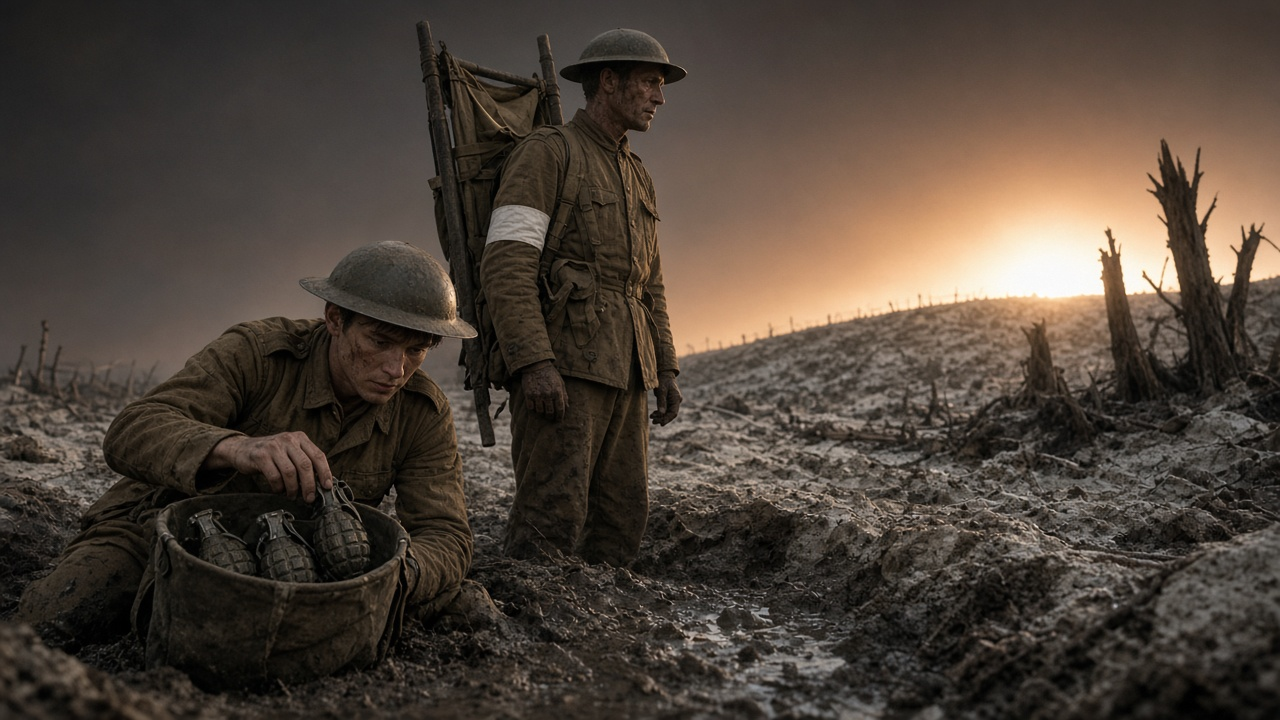
A WW1 short story, told as a short story: a young Australian bomber is sent to clear the dugouts under the first German guns that Australians ever captured in France. This WW1 short story is fiction, so the soldiers in it are made up. However, the battle, the night and the guns are real. In September 2026, Flinders University reported that its dig near Pozieres had found that German gun battery, an unknown trench, and eleven live Mills bombs still in the ground.
Twelve in the Bucket
I had twelve bombs in a canvas bucket, and I counted them every ten minutes.
That was the only way I knew to stay calm. Back in Kalgoorlie, Mum counted the rent money the same way, on the kitchen table every Friday night. She would line up the coins and touch each one. So I touched each bomb. They were Mills bombs, heavy and cold, cut into squares like a little iron pineapple.
"Count your bombs, Bucket," Sarge said as he went past in the dark.
"Twelve, Sarge."
"Good. Keep it that way till I say."
My real name is Billy. Still, nobody in the 11th Battalion had called me that since France. Because I carried the bucket, I was Bucket. That's the Army. Everybody gets a name, but nobody gets to pick it.
It was the night of July 22, 1916. We were lying out in a ditch south of a village called Pozieres, near the river Somme. Before the war, I had never heard of it. Now it was the only word anybody said.
A Bearer Called Stretch
Stretch lay next to me in the ditch. Since he was the tallest man in the company, of course they called him Stretch. Besides, he carried stretchers. So the joke made itself.
He came from Fremantle, where he had worked the wharves, lifting bags of wheat onto ships all day. He had big, gentle hands, and he wore a white armband with two red letters on it, SB. That meant stretcher-bearer. It also meant he didn't carry a rifle. Instead, he carried bandages, a water bottle, and a folded stretcher on his back.
Whenever Stretch was scared, he hummed. It was always the same old song, "Home, Sweet Home." Moreover, he always went flat on the high note, every single time. It drove me mad.
"You're flat," I whispered.
"I'm Fremantle," he said. "We're all flat down there."
Then the guns behind us started up again, and the sky went white and orange over the hill. For days, our side had shelled Pozieres, so there was nothing left of it now but brick dust and broken trees. In fact, the whole ridge looked like the moon.
The Night Before Pozieres
"Bucket," Stretch said, "you ever get lost out there?"
"Not yet."
"I did, at Armentieres. It was pitch dark, and I couldn't find our line for an hour." He tapped his tin water bottle with one finger. "So now I've got a rule. If I'm lost, I go where the light is. Somebody's always got a lamp or a candle. After all, bearers can always find a lamp."
"And if it's a German lamp?"
He grinned in the dark. "Then they get a very tall visitor."
I counted my bombs again. Twelve.
Most of us were not old soldiers. By then, the Gallipoli men were thin on the ground. On my papers I was eighteen, but in truth I was seventeen. Mum didn't know I'd gone until I wrote her from the ship. Stretch was twenty-two, so to me he was ancient.
Behind us, a signaller we called Wires was running a telephone cable back along the ditch. While he worked, he swore at it softly the whole way, like a man talking to a bad horse.
Twelve Thirty
At twelve thirty in the morning on July 23, we went.
First of all, we crept out into no man's land while our own shells were still falling ahead of us. That was the plan. You walked close behind the barrage, so close that the dirt rained on your tin hat. Then, when the guns lifted, you ran.
I hated it. Even so, I walked. The bucket banged against my knee with every step, so I held it tight to stop the clank.
Halfway across, somebody on our left started calling for help. It was a thin voice, like a kid's. Stretch stopped.
"Not now," I said. "Stretch, not now. Wait for the lift."
"He can't wait," Stretch said. Then he was gone, bent over, running sideways into the smoke toward the voice.
Right after that, the barrage lifted. Somebody blew a whistle, and we all ran at once.
I don't remember much of the next hour. Mostly, I remember noise. There was a trench full of smashed timber, and a machine gun was firing from a heap of bricks. I threw one bomb at that gun, but I never saw where it went. Soon the gun stopped, and we went on.
When it got quiet for a minute, I sat in a shell hole and counted. Eleven.
The Belgian Guns
By three in the morning, we had pushed past the first German trench. Sarge found me sitting in a hole, and he pulled me up by the strap of the bucket.
"Come on," he said. "The Skipper wants bombers."
We went along a German trench that our maps called Copse Alley. It used to run through a little wood. Now there were no trees, only stumps like burnt matches.
Then, in a hollow at the end of it, we found the guns.
There were four of them, big and squat and ugly. Our own shells had smashed their wheels to splinters, but the fat short barrels still pointed up at the sky. Since one of the men from another company knew about guns, he crouched down and whistled.
"Those aren't German," he said. "Look at the old breeches. They're Belgian fortress guns. Fritz must have taken them in 1914 and dragged them all the way here."
Sarge ran his hand along one barrel as if it was a horse he wanted to buy.
"First guns," he said. "Boys, these are the first German guns any Australian has taken in France. Do you know what that means?"
Nobody did.
"It means they'll stand in a park in Perth one day," he said. "With our number on them, too."

Chalk Before Dawn
Wires had dragged his cable all the way up behind us. So the Skipper crouched in the gun pit with the phone pressed to his ear. Because I was sitting on the sandbags with my bucket, trying not to shake, I could hear every word.
"Yes, sir. Four guns. Belgian, we think. Yes, sir, wrecked but complete." He listened for a while. "I understand, sir. Before first light."
There was a long pause.
"Sir, I've got the 3rd right next to us. If they get their chalk on them first, Brigade will give them the guns." Then he listened again, and he rubbed his eyes with his free hand. "Yes, sir. Counted, chalked, and the dugouts cleared. I know the papers at home want guns."
When he hung up, he just sat there in the dark for a moment. After all, he wasn't a hard man, the Skipper. He was a schoolteacher from Bunbury who had been made a captain because the last two captains were dead.
"Sarge," he said finally. "There's a dugout under this battery. The gun crew went down when our shelling started, and they're still down there."
"Yes, sir."
"Brigade wants it cleared before the light. As soon as the sun's up, the German guns will find this place. So we can't sit here and wait for anybody to come out."
The Kind of WW1 Short Story the Papers Liked
At first, Sarge didn't answer. Then he looked straight at me.
I knew what clearing a dugout meant. Everybody did. You stood at the top of the stairs, and you rolled a bomb down, and then another. Afterward, you went down with a bayonet and a torch. That was the job of a bomber, and I was a bomber.
"The papers at home love this stuff," said Nobby, a tough little private from Albany. He chewed on his chin strap while he talked. "My mum sends me the Kalgoorlie Miner. Every week there's a story in it about some brave lad taking a gun, and every bloke in it is a hero."
"Shut up, Nobby," Sarge said.
"I'm just saying, Bucket'll be in the paper."
I didn't want to be in the paper, though. Honestly, I wanted Stretch. He had been gone three hours, and nobody had seen him. Normally, bearers came and went all night with their stretchers, and they always passed the word. But not tonight. Tonight, there was no word at all.
So I counted the bombs again, mostly to give my hands something to do. Eleven.
The Rumor
The rumor came along the trench just before four.
It came the way rumors always did, passed from man to man in the dark, while each one added a little. A runner told a corporal, who told Nobby, who then told everybody.
"Bearer got done by the gun crew," Nobby said. "Here, in the copse. A tall bloke, went out after a wounded kid. They say the gunners came up out of the dugout and shot him, armband and all."
I felt the cold go right down into my boots.
"Who says?" Sarge asked.
"Everybody says."
"Everybody's an idiot," Sarge said. However, he didn't look at me when he said it.
A tall bloke. Out after a wounded kid. I sat very still on the sandbags, because inside my head I could hear Stretch saying it. Bearers can always find a lamp.
After a while, I stood up, and I picked up the bucket.
"I'll do it, Sarge," I said. "I'll clear it."
He looked at me for a long time. Then he nodded.
"Two bombs down the stairs," he said. "Then wait for the bang, and then we go down together. Don't be a hero, Bucket. Just be quick."
The Stairs
The dugout door was at the back of the gun pit, under a heap of timber and sandbags. A set of steep wooden stairs went down into the chalk, maybe twenty steps. Because the Germans dug deep, our shells hadn't touched it.
Across the bottom of the stairs, a gray blanket was nailed up. That was a gas blanket, to keep the gas out. Around the edges of it, though, I could see a thin yellow line.
There was a light down there. Somebody had a candle.
I knelt at the top of the stairs with the bucket beside me. Sarge knelt behind me with his rifle, and Nobby was behind him. Meanwhile, the sky over Pozieres was going from black to gray. We didn't have long.
I took out a bomb. Then I put my finger through the ring of the pin.
That's when a voice came up the stairs.
"Kamerad!" it called. "Kamerad! Nicht werfen! Please. Do not throw."
"They all say that," Nobby said.
"Quiet," Sarge said. Yet he didn't tell me to stop.

Count Your Bombs
My finger was on the ring, and my hand was shaking so hard that the bomb rattled. I had pulled pins before. Back in Egypt, in practice, I had done it a hundred times. You pulled the pin, you held the lever down tight, and then you threw. After that, it was out of your hands.
I thought about the tall bloke in the rumor. Then I thought about Mum, counting coins on the kitchen table, touching each one.
"Bucket," Sarge said quietly. "It's getting light."
Suddenly, from somewhere under the blanket, somebody started to hum.
At first it was very faint. Then a shell came over and burst far behind us, and I lost it. When it came back, it was a slow, old tune that I knew better than my own name.
And it went flat on the high note.
Eleven
I put the bomb back in the bucket. Since my fingers didn't want to let go of the ring, I had to do it one finger at a time.
"Bucket," Sarge said. "What are you doing?"
I didn't answer him. Instead, I took the bombs out one by one, and I set them down on the top step in a row, the way Mum lined up the coins. One. Two. Three. I touched every one. Four, five, six, seven. By then, my hands had stopped shaking. Eight, nine, ten.
Eleven.
Then I stood up with nothing in my hands.
"Coming down," I called. "Australian. I've got no bombs. Coming down."
Behind me, Sarge swore very softly. Even so, he didn't stop me. Instead, he came down right after me, step by step, with his rifle pointed at the floor.
At the bottom, I pulled the gas blanket aside.
The Bottom of the Stairs
The dugout was low and warm, and it smelled of candle smoke and wet chalk. There were bunks along both walls, and a table made from an ammunition box.
Three German gunners were in there. They were not young. In fact, they were old men, gray in the face, with their hands up high and empty. One of them had a thin gray mustache and very tired eyes. He was the one who had called up the stairs.
"Please," he said in good English. "In London, I was a waiter. Please. Your man."
And there, on the bottom bunk, with his long legs hanging off the end, was Stretch.
His leg was tied up neatly in a German bandage, and his face was the color of the chalk. However, his eyes were open, and he was alive. The old waiter was holding Stretch's own tin water bottle to his mouth.
When Stretch saw me, he tried to grin.
"Took you long enough, Bucket," he whispered. "I went where the light was."
I couldn't speak. For a long moment, nobody did.
"They found me out in the wire," Stretch said. "The kid was already gone, but they dragged me in here anyway. Then they carried me down twenty stairs and gave me their last water. Somebody up top must have seen them grab me." He looked at the bucket in my hand. It was empty. "So, did you count your bombs?"
"Eleven," I said.
Three Prisoners
Later, two of the old gunners carried Stretch up the stairs and all the way back to our lines on his own stretcher. The Skipper wrote it down as three prisoners taken and one of ours recovered. Before the sun came up, the guns got our chalk on them, too. The war diary called it a battery captured. It said nothing about the stairs, and that was fine by me.
Nobody ever went back for the bombs on the step.


Leave a Reply