A WW2 bomb, told as a short story: in Essen, Germany, a young city trainee must get a stubborn old man out of his garden before the bomb is defused. This is fiction, so the people and the garden colony are made up. However, the danger is real. In fact, on October 8, 2026, Essen evacuated about 1,050 people so experts could defuse a British WW2 bomb found during probing work, and nobody was hurt.
The Clock Has Two Watches
My name is Lena, but everybody calls me Leni. I am twenty-four, and I am a trainee at the city order office in Essen.
On paper, the job sounds boring. Mostly, I check market stalls, noise complaints, and parking signs. Then, on Wednesday afternoon, my boss walked into our office and clapped her hands once.
Everyone calls her the Clock. She wears two watches, one on each wrist, because she says one watch can lie. Also, she is fifty-five, very tidy, and never late.
"We have a dud," she said. "British, five-hundredweight. About two hundred and fifty kilos. It's at the edge of a garden colony up north."
My stomach dropped. Here in the Ruhr, people say bombs are normal, since workers find them all the time. Still, I had never worked one.
"Defusal is tomorrow at nine," the Clock said. "Evacuation starts at eight. Everybody inside three hundred meters goes out. That includes the campus, two tram lines, and a whole garden colony full of old people who do not like leaving."
Then she looked straight at me. "Leni, you take the colony."
A WW2 Bomb at the Garden Edge
The colony is called Sunny Corner. It is a long strip of small gardens behind a railway wall, and each one has a tiny hut, a water barrel, and a fence painted a different color.
Next to it, a builder named Mr. Brandt is putting up student flats. Honestly, Essen needs them, because students sleep on sofas all over the city.
Before anyone digs deep in this region, the builder must ask for an aerial photo check. So Brandt had applied through our office. After that, the state bomb disposal team in Duesseldorf looked at old Allied photos from the war. In fact, they keep about two hundred and thirty thousand of them.
In one photo from March 1945, they found a tiny dark dot at the colony edge. A dot like that can mean a bomb went into the ground and never went off.
Therefore, Brandt's crew probed the spot with a magnet sensor. On Tuesday evening, the sensor screamed. Then on Wednesday, they dug down by the hedge between plot 13 and plot 14, until they saw a rusty tail fin. That was enough to know what it was. Since the bomb had gone in at a slant, as they often do, the rest of it ran deeper, away from the hedge.
So somewhere under that colony sat a WW2 bomb that had waited eighty-one years. I printed fifty flyers, grabbed my orange vest, and took the tram north.
Opa Willi's Gate
At first, everything went well, because most people at Sunny Corner were kind. For example, an old lady gave me a pear. Meanwhile, a man with a parrot asked if the parrot could come too. Of course, I told him. Parrots can come.
Then I reached plot 14.
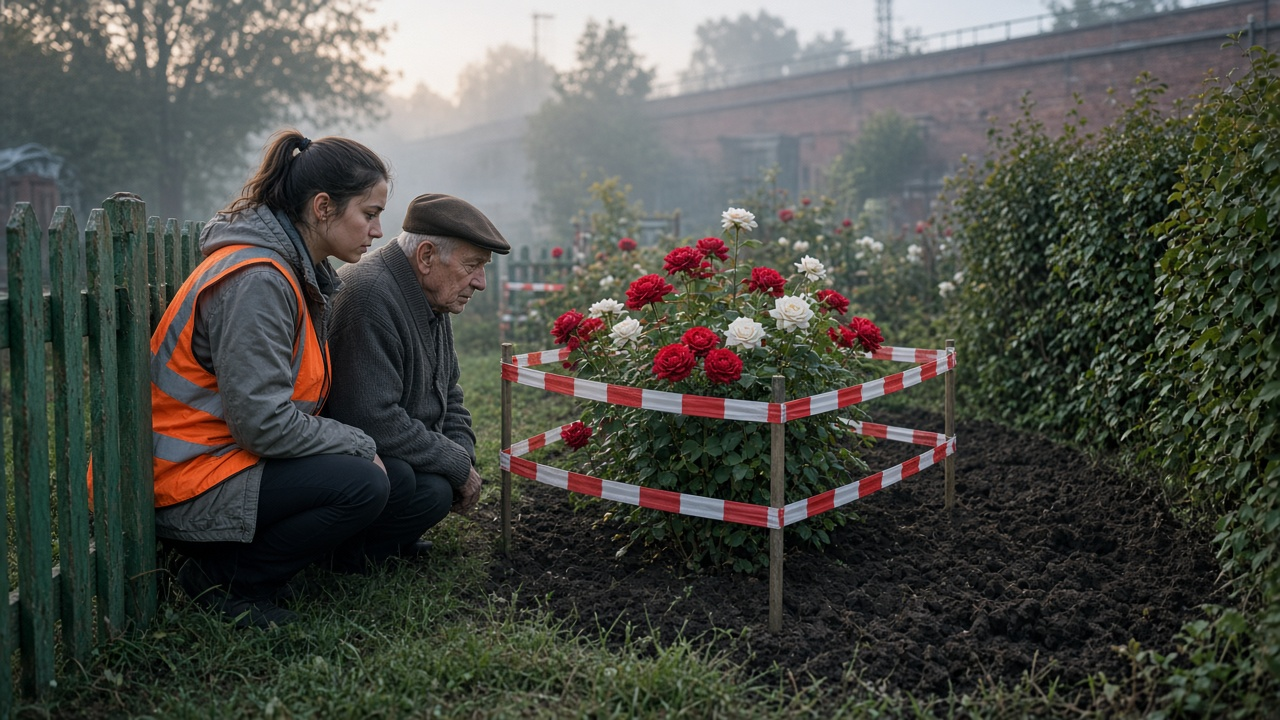
The fence there was green and very straight. Behind it stood a small wooden hut, a rain barrel, and a bed of roses planted in a perfect circle. They were red and white, still blooming in October, and the circle was so neat it looked measured.
An old man knelt at the edge with a pair of clippers. He was thin, with big ears and a flat cap.
"Good evening," I said. "I'm Leni from the city. Tomorrow at eight, everybody has to leave."
"I know," he said. "I heard. However, I'm not leaving."
His name was Willi. He was eighty-six, and he had kept this same plot since he was a little boy. Everyone in the colony called him Opa Willi, even people who were almost as old as he was.
"It's only for a few hours," I said.
"Last time I left for a few hours," he said, "somebody dug up my beans."
I laughed, and then I stepped closer to show him the flyer. Unfortunately, my boot went into the soft soil of the rose bed.
Not in the Roses
Suddenly, Opa Willi was on his feet. "Not in the roses!" he shouted. "Never in the roses!"
I jumped back while my face went hot.
For a moment he breathed hard. Then he softened. "Sorry," he said. "Papa planted these in '46. He said roses keep a secret better than people do. Later, my Hilde loved them too."
Hilde, I guessed, was his late wife. Because of that, I did not ask more.

Brandt Counts the Days
On my way out, I passed the building site. Brandt stood by the fence in a clean yellow jacket, talking on his phone.
He is not a monster. In fact, he had been polite all week, and he had followed every rule. Even so, his voice carried over the fence.
"Every day this costs me four thousand," he said. "Machines, men, the crane, the whole thing. When it's out, the roses go too. The colony board has my offer. Besides, they need the money for the new water pipes, so they will sign."
When he saw me, he lifted a hand, a little embarrassed.
I nodded back, although I felt sick. Also, Opa Willi's lease was up for renewal next month. If the board sold the strip, plot 14 would become a bike shed.
That night, I lay awake and thought about the roses. First, there was the perfect circle. Next, there was a man who shouts when you step inside it. And finally, there was a papa who planted them in 1946.
Something about it bothered me. Still, I could not say what.
The Clock Wants Eight Thirty
At six on Thursday morning, the Clock met me in the office car park.
"Status?" she asked.
"Everyone in Sunny Corner is going," I said. "Except one."
She checked both watches. "Name?"
"Willi. He's eighty-six. His roses are right next to the dig."
"Leni," she said, "the campus stays closed until we finish. Also, the trams are stopped, and the job center has fifty appointments today. One stubborn old man is not a reason to close a city."
"I know."
"If he won't go, the police will carry him out. Gently, of course. But they will carry him."
I imagined two officers lifting that thin old man away from his roses. Consequently, I asked for one more try.
Finally, she sighed. "You have until eight thirty. After that, he is not your problem anymore."
Tank Brings Coffee
The bomb disposal team arrived at seven in a white van. Their leader climbed out first, and I understood his nickname right away.
Tank was fifty-eight and as wide as a door, with a gray beard and a voice like a slow river. In one hand, he carried a thermos of coffee with four sugars in it.
"So you're the colony girl," he said. "Good. My job is easy. Your job is hard."
"Easy?" I said.
He only shrugged. "Bombs don't argue. People argue."
Then he explained it to me slowly, because I asked. A British five-hundredweight bomb is about half explosive. If it goes off, nobody within fifty meters survives. Even without a single splinter, the pressure alone would kill you. Worse, some old fuses get more dangerous with time, not less.
"So everyone goes," he said. "Even the parrot."
After that, his crew went back to the hole by the hedge. They followed the slant of the bomb slowly, with small spades, a few centimeters at a time.
Under the Circle
By half past seven, the hole had moved. It had moved away from the hedge and into plot 14.
Finally, Tank came to the green fence and took off his cap. "Sir," he said to Opa Willi, "the nose runs under your roses. Right under the middle. And the fuse we need is in the nose."
This time, Opa Willi did not shout. Instead, he went very quiet and gripped the fence with both hands.
"We have to lift them," Tank said. "I'm sorry."
So I knelt beside Opa Willi. "Tank," I said, "can you take them out by hand? Roots and all? Then wrap them in wet sacks, so they can go back in?"
Tank looked at the roses, and then at the old man. "We can do that," he said. "Still, it costs ten minutes."
"The Clock will hate ten minutes," I said.
"The Clock doesn't dig," Tank said.
So the crew lifted the roses one by one. Next, they wrapped each root ball in a wet sack and laid it in a row on the grass. Meanwhile, Opa Willi watched every one, and tears ran down into his collar.

What Willi Remembered
"We were bombed out in March 1943," he told me quietly. "I was three. After that, Mama and I lived here, in this hut, because our flat was gone. Lots of families lived in garden huts then."
"And your papa?"
"He came home in spring 1946, from a prisoner camp in England. By then he was so thin. Every day he dug potatoes here, because we were hungry. Then one day, he stopped digging in this corner. Just stopped. After that, Papa planted roses here instead, from cuttings. And he made me promise, never dig in the roses."
"Why?" I asked.
"At first, I thought it was for Mama. She loved roses." He wiped his face. "Later, Papa said roses keep a secret better than people do. So I thought he was being a poet. But he wasn't a poet. He was a miner."
Suddenly, something cold went down my back. A man stops digging in one corner. Then he plants a perfect circle, and he makes his son promise.
"Opa Willi," I said carefully, "do you think your papa knew?"
He turned on me so fast I flinched. "Papa would never let his family sleep next to a bomb. Never. You didn't know him."
So I did not argue. After all, he was right. I didn't know him.
Eight Twenty-Nine
At eight twenty, the loudspeaker van rolled past the railway wall. "A bomb dud has been found in your area. Please leave the building immediately."
Right then, my phone buzzed. It was the Clock. "Zone status?"
Instead of answering, I looked at Opa Willi. "They saved every rose," I told him. "Tank promised they go back in. But you have to go now, or two policemen will carry you, and I don't want that."
For a long time, he looked at the row of sacks on the grass. Then he picked up his flat cap.
"You come with me," he said.
"I'm coming with you," I said.
So we walked out of the colony gate together at eight twenty-nine. As soon as we were past the tape, I typed one word to the Clock. "Clear."
She wrote back, "Good. One minute early."
The Sound of the Fuse
The care point was a school gym two streets past the edge of the zone. There, volunteers handed out coffee, rolls, and blankets. Meanwhile, the hazard phone rang all morning at the city office, and the man with the parrot told everyone that the parrot was very brave.
Meanwhile, Opa Willi sat on a gym bench with his hands on his knees. Even though the rolls were warm, he did not eat. Instead, he watched the door.
At ten past ten, we heard a sharp bang in the distance, and a few people gasped. Soon after, a fireman stepped into the gym and smiled.
"The fuse is out and destroyed," he said. "All clear. You can go home."
Then everybody clapped. Opa Willi did not clap, though. Instead, he stood up and said, "My roses."
Forty Centimeters Down
When we got back to Sunny Corner, the pit in plot 14 was deep and wet. The WW2 bomb lay on a pallet, rusty and fat and silent. Later, a truck would take it to Huenxe, where it would be cut apart.
Brandt stood by the fence, and for once his phone stayed in his pocket.
Meanwhile, Tank climbed out of the hole and walked straight to me. In his big hands, he held a small rusted tin, the kind people used for biscuits long ago.
"We found this at forty centimeters, right in the middle of the circle," he said. "It was wrapped in oilcloth. But the rule is, nothing leaves the pit until we're done." Then he held it out. "I think it belongs to him."
Carefully, Opa Willi took the tin with shaking hands. Because the lid was stuck, Tank opened it with a screwdriver, very gently, as if it were a second bomb.
What Papa Planted
Inside lay a folded piece of brown paper, dry as a leaf, and a child's drawing.
First, Opa Willi unfolded the paper. The handwriting was square and careful, in a miner's pencil. So I read the German slowly out loud, while everyone listened.
"Here lies a bomb. I reported it to the police on 6 May 1946. They say they will come when they can, but there are too many. Until then, roses. No child digs here. Keep the circle. Karl Hoff."
For a moment after that, nobody spoke.
"He reported it," I said softly. "Your papa reported it. The crews just never came."
Still, Opa Willi stared at the paper. His lips moved, but no sound came out.
Then he picked up the drawing. It was a red crayon rose, a little crooked, with a green stem and a sun in the corner. At the bottom, in big wobbly letters, it said WILLI 6.
"I made this for him," he whispered. "For the first rose. All my life, I thought he lost it."
Keep the Circle
Slowly, he looked at the empty pit, and then at the row of rose sacks on the grass.
"He didn't plant roses for Mama," he said. "He planted a fence. A fence for me."
At last, Brandt cleared his throat. For a long time, he looked at the tin. Then he took off his clean yellow jacket and laid it over the wet roots, against the wind.
"Plot 14 stays out of my offer," he said quietly. "The pipes can wait. The roses go back in tomorrow, exactly as they were."
Tank nodded once, as if that settled it. Just then, the Clock arrived at the gate. She looked at both watches, and yet, for the first time since I have known her, she said nothing about the time.
Then, the next morning, Tank's crew filled the pit. Afterwards, Opa Willi and I replanted every rose by hand, in a perfect circle, and nobody stepped inside it.
That evening, he opened the hut door and set the tin on his little table, lid open, so the last light could reach it.



Leave a Reply