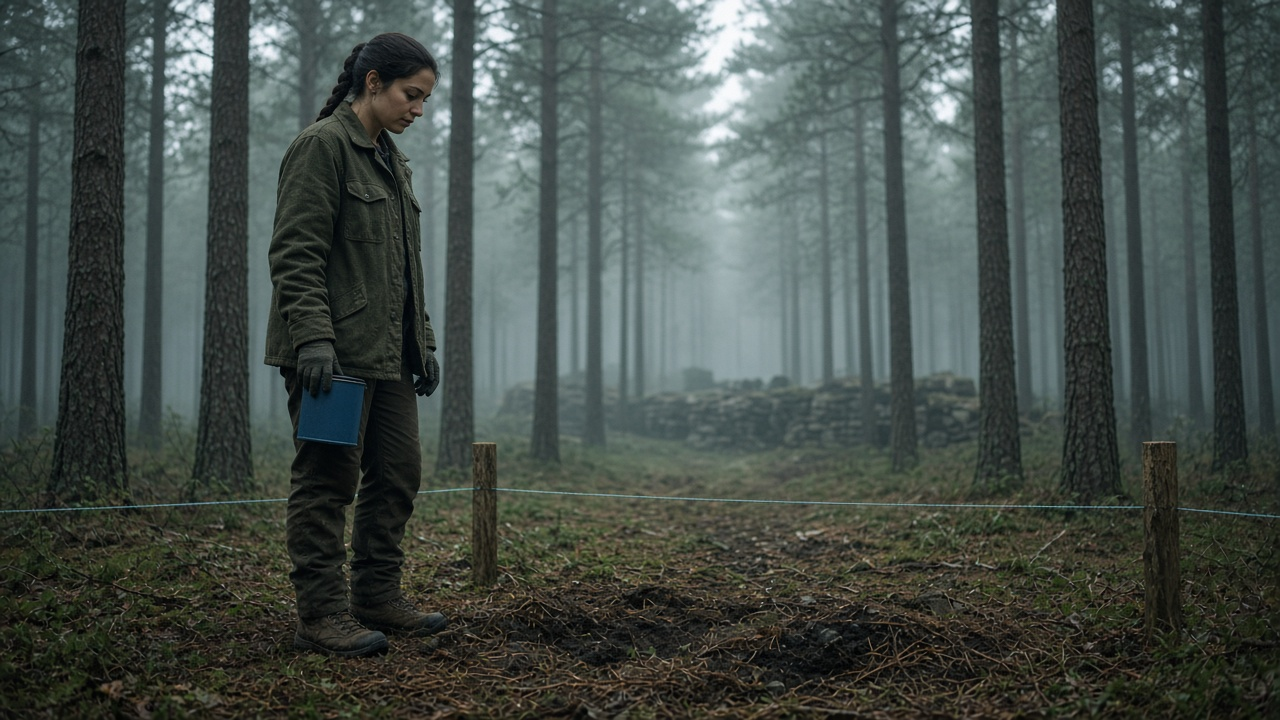
A roman temple, told as a short story: in the Taunus forest north of Frankfurt, a young forestry intern marking trees for a timber sale must stop the cut when diggers find a shrine to Mars. This is fiction, so the people and the timber stand are made up. However, the fort, the forest floor, and the find are real. In fact, in late September and early October 2026, archaeologists announced a small temple to Mars and a Victory statue just under the pine needles beside the Kapersburg Roman fort.
Three Pines and a Paint Can
My name is Samira, but everybody calls me Sam. I am twenty-six, and I mark trees for a living.
Not forever. Instead, it is only for this autumn. I am a state forestry intern in Hesse, and my job is basically simple on paper. First, I walk a stand of pines near Rosbach and Wehrheim. Then I paint a blue band on every tree the county wants cut. After that, the timber man comes with his crew, and the money from the wood pays for my internship and for the trail budget. Without the cut, my program folds. Without the cut, the muddy trail to the old fort stays muddy.
The stand sits on the eastern edge of the Taunus foothills, about sixteen miles north of Frankfurt. Generally, the forest smells like wet bark and cold air. Between the trunks, you can still see low stone lines from the Kapersburg fort, which formerly guarded the Roman border. Now the Limes is a UNESCO site, so the fort itself is safe. Our timber stand, though, sits just outside the marked dig zone. At least, that is what the maps said on Monday.
Opa and the Bread Stamp
On Sunday, before I started, I walked the path with Opa Rolf.
Opa is my grandpa. He is eighty-four, thin as a rake, and he still walks the same three pines every Sunday. They stand in a rough square with a fourth stump, and he always stops there.
"Don't cut the square," he told me, tapping the stump with his stick. "Your great-grandma said the ground remembers."
Then he opened his lunch tin. Inside was a thick slice of bread with a stamp pressed into the top. The mark looked almost like a tiny wing, or maybe a leaf. Likewise, I could not tell which.
"Sixty years I have used this stamp," he said. "My grandmother found a clay one in these woods when she was a girl. I copied it in wood. Bread should carry a blessing."
I laughed, because Opa always talks like that on our walks. Still, I looked at the stamp again before I left. It really did look a little like a wing.
Blue Paint and Spoil Heaps
On Monday morning, I shook my paint can and started marking.
The trees were straight and tall. For a while, though, the work felt clean and easy. Then I came over a low rise and saw the dig.
Plastic tape fluttered between posts. Beyond it, a team from the state office had already opened neat squares in the forest floor. Indeed, the dirt started right under the pine needles, because no plow had ever ruined these layers. Beside the trench sat a spoil heap of dark earth, brick chips, and gray bits of slag.
I stopped walking. Instead of spear tips and armor scraps, the heap held oven brick and blacksmith waste. In other words, the pile looked more like a craft yard than a battlefield.
"You can look, but don't step in," said a woman in a wool hat. She wiped her hands on her trousers and smiled. "I'm Doc. Dig lead for the state office. So you're the paint girl?"
"Sam," I said. "Forestry intern. I'm marking the stand for Friday."
Doc's smile faded a little. "Friday is soon. We found something under that edge of your stand. Consequently, we need a pause."
Keller Wants the Trees Down
Mr. Keller is the timber contractor. He is fifty, loud in a friendly way, and always checking the sky for rain before he starts. His autumn window is short. Obviously, wet wood is heavy wood, and heavy wood costs him money.
He found me at the tape line before noon, as usual.
"Sam, paint faster," he said. "I need this stand down by Friday. After that, diggers can dig all they want."
"Doc says they found something," I said.
"They always find something," Keller said. "One day it is a coin. Another day it is a nail. Sometimes it is only a pretty rock. Meanwhile I pay six men and two machines to sit in a yard."
Later, I overheard him on the phone behind his truck. His voice was not friendly then.
"Every day of rain and Romans costs me six thousand," he said. "Paint the trees. Tell the girl to finish. The county already promised me the stand."
My paint can suddenly felt heavy. After all, his contract paid my internship. If I slowed him down, I might also slow myself out of a job.
The Pause Rule
Later that afternoon, Doc walked me to the edge of an open square.
"State archaeology can pause forestry work when a find appears," she said calmly. "The fort and the Limes are protected. Finds stay with the state office or the museum in Rosbach. Your stand is next to our zone, not inside it. Still, if the find runs under your trees, we stop the cut until we know."
"How long?" I asked.
"Maybe days. Maybe longer." Then she pointed at a flat stone half out of the dirt. "This is the corner of a small building. Not a house. Too careful. Therefore, we think it is a shrine."
I looked at the spoil heap again. Notably, it held oven brick and slag. Almost no weapon scraps.
"Does it look like a soldiers' place?" I asked.
Doc shrugged. "Particularly near a fort, everyone assumes a shrine belongs to soldiers. However, the craft remains are thicker than the spear tips so far. We will know when we read the stone."
The Warrior Temple Flyer
On Tuesday morning, a man from the tourism office arrived with a folder and a bright smile.
"We drafted a flyer," he said. "Warrior Temple on the Limes. Visitors love Mars. Specifically, can we shoot a photo once the roof line is clear?"
Doc did not take the folder. "We have not confirmed a dedication yet," she said. "Please wait until we know."
Nevertheless, the flyer was already printed in draft. On the cover, a cartoon soldier raised a sword over a tiny temple. Under it, big letters said WARRIOR TEMPLE. Shortly after that, Keller saw the flyer and laughed.
"See?" he told me. "Even tourism wants this done fast. Paint, Sam. Friday."
I painted more trees that day. Even so, I left the three pines in Opa's square alone. The stump still sat there like a quiet warning.
A Roman Temple Under the Needles
By Wednesday, the team had cleared more of the small building. The walls were low and carefully set, unlike a shed. Inside, they found broken stone with letters, plus a wing tip no bigger than my thumb.
Doc held the wing tip in her palm. "Victoria," she said softly. "Victory. Palm branch and laurel wreath, if the rest matches. Additionally, we have fragments that may belong to Mars."
A young digger lifted another piece. It was a stone face, cracked, with a stern mouth. Around it, the soil still smelled like old fire and bread ovens from long use.
I thought of Opa's stamp again. Similarly, it looked almost like a tiny wing.
Soon after that, Keller's truck rolled up, tires grinding the wet needles.
"Friday," he said from the window. "I have buyers waiting. If you leave those pines standing because of a broken doll, I lose the week."
Doc answered before I could. "It is not a doll. It is a find. Until we finish, the cut waits."
Keller looked at me. "Your internship money comes from this wood, Sam. Certainly, remember that."
I did remember. Indeed, that was the problem.
Before I left, Doc set the wing tip beside the oven brick on a tray. As a result, the roman temple no longer felt like a cartoon sword on a flyer. Instead, it felt like work, heat, and waiting.

Paint the Trees
Thursday dawned gray and damp. Meanwhile, Keller met me at the trailhead with a fresh can of blue paint.
"Finish the square," he said. "Those three pines too. According to the county map, they sit in my stand."
"Opa asked me not to cut them," I said.
"Opa is not signing my contract." Keller set the can in my hand. "Paint the trees. Diggers can dig after we cut. Regardless, the roots won't care."
I walked to the square alone. The three pines stood quiet in the mist. Under them, the needles looked thicker than elsewhere, as if the ground had been left alone on purpose for a long time.
My phone buzzed. It was a text from the tourism man: Need warrior temple photo by Monday for Limes weekend. Can you clear a sightline soon?
I sat on the stump and did not open the paint at all.
Instead, I called Doc.
"If I mark those three," I said, "Keller cuts them tomorrow. What is under them, then?"
"We do not know yet," Doc said. "But the wall line points that way. Give me until Sunday, at least. Please."
So I put the closed can back in Keller's truck and walked away. He shouted something about six thousand a day. Nevertheless, I kept walking.
Friday Without a Cut
Friday came wet. Consequently, the machines stayed in the yard. Keller stood at the tape line with his arms folded, counting raindrops like coins while he waited.
"You cost me a week," he told me sharply.
"I cost you a pause," I said. "The state can pause a cut for a find. That is the rule, after all."
He shook his head. "Rules don't buy diesel, though."
Doc's team worked under tarps. Subsequently, more letters came out of the dirt, little by little. Meanwhile, the Victory pieces fit together on a tray: one wing, part of a palm branch, a curve of wreath. Beside them lay oven brick and slag, just as the spoil heap had promised from the start.
Toward evening, Doc finally waved me over to the tray.
"Look," she said. "The palm matches. Equally, the wreath matches. Victoria stood inside."
I looked. Sure enough, the tiny wing on Opa's bread stamp rose in my mind again. However, I still did not say that out loud yet.

The Names on the Stone
"We have enough of the dedicatory text," Doc said next. Her voice was steady, but her eyes were bright. "It names Mars. That part is true. However, it does not name a unit or a commander."
"Then who paid?" I asked.
She pointed at two names cut shallow in the stone. "A baker. And a smith. From the craft quarter. After a hard winter. Namely, they thank the war god for bringing the patrol home."
For a moment, nobody spoke. Meanwhile, rain tapped the tarp. Somewhere, a crow laughed once and went quiet.
So the shrine was not a soldiers' clubhouse after all. Rather, ordinary people had paid for the roman temple. People who baked bread and fixed iron. Likewise, people who waited for a patrol in the cold and then spent what they had to say thank you.
Keller heard it too. He stared at the stone for a long time before he spoke.
"Craft workers," he said finally. "Not legion boys at all."
"Not legion boys," Doc agreed.
The tourism man looked at his flyer and slowly folded it shut. "I will change the title," he said. "Maybe Craft Temple. Or Thankful Temple. Overall, Warrior is wrong."
What the County Kept
On Saturday, the county confirmed the pause in writing. As a result, the three pines stayed up. Moreover, my internship, oddly enough, stayed too. The trail budget would wait one season, and Keller got a revised stand deeper in the county woods where no dig ran under the roots either.
He was still angry. Even so, he shook Doc's hand before he left the hill.
"Next time, tell me on Monday," he said. "Not Thursday again."
"Next time, look at the spoil heap," Doc said gently. "Oven brick before spear tips. That is already a hint."
I walked home through the wet pines and thought about bakers and smiths for a while. About a temple paid for by people who never wore armor. Especially about how easy it is to put a sword on a flyer when the truth is a loaf of bread.
Of course, I also thought about Opa's stamp. Since Monday, that tiny wing had been waiting for me to understand it.
Sunday Lunch Under the Square
On Sunday, I met Opa at the three pines, as always. Then he opened his lunch tin and handed me the stamped bread.
"They found a roman temple," I told him. "To Mars. But bakers and smiths paid for it. Not the soldiers this time."
Opa nodded, as if I had told him the weather. After that, he turned the bread so the stamp caught the light.
Up close, the mark was clear. It was not a leaf. Instead, it was a tiny palm branch inside a rough wreath. The same shape as Victory's palm on Doc's tray. Similarly, it was the same blessing his grandmother had pressed into clay a lifetime ago, copied from something she found in these woods as a girl.
"She said the craft folk left their mark on the hill," Opa said. "I thought she meant bread only."
He smiled, soft and proud as ever.
"She did," I said quietly.
We sat on the stump and ate. Under our boots, just beneath the pine needles, the bakers and smiths were still saying thank you. And on top of the loaf in my hands, their Victory palm had never left the hill at all.



Leave a Reply