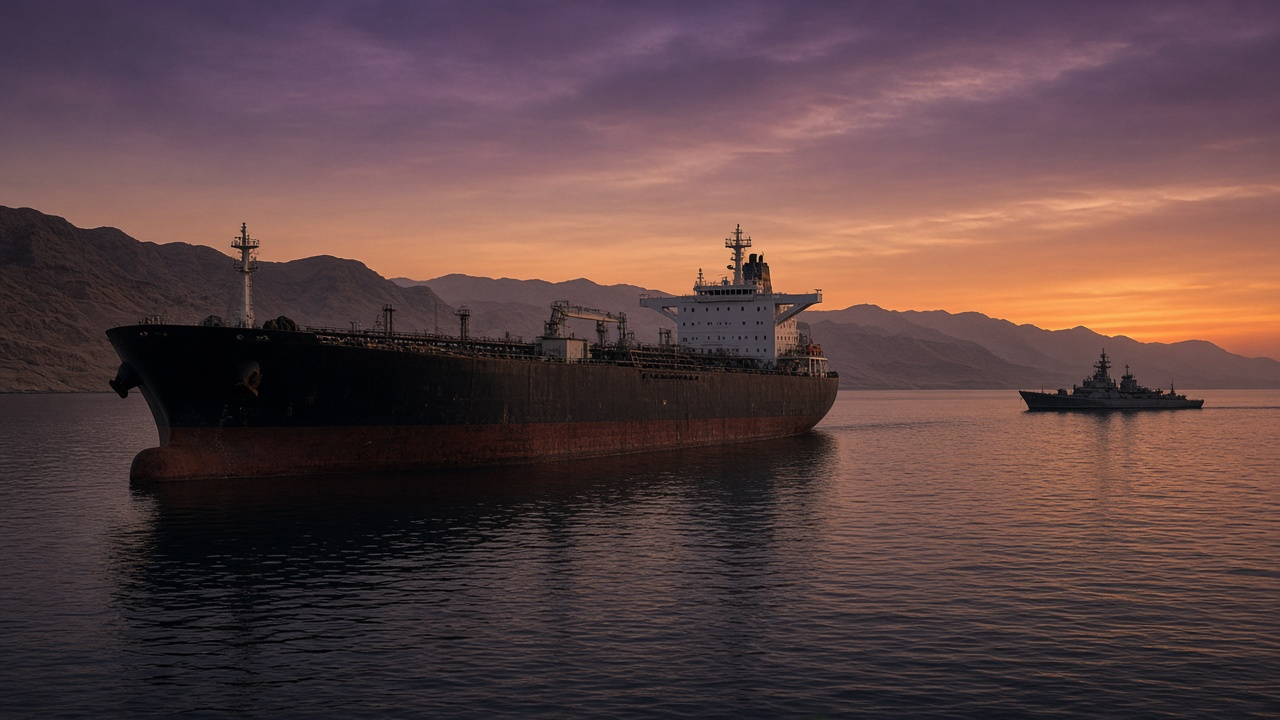
A Strait of Hormuz story: stuck in the Gulf for seven months, a tanker crew watches their screens put them in the desert. The food boats keep shrinking, the bosses want them gone, and the only man aboard who can sail blind learned how in 1987.
More fiction from Nowwn: read our latest stories.
Crop Circles
On our 218th day at anchor, the Ocean Grace sailed through Dubai airport.
I had the dawn watch, the one cadets get, so I saw it first. The chart screen showed our supertanker sliding down a runway at eleven knots. She went right past the terminal and out into the sand. Then she turned in a slow circle and came back. Outside the windows, however, nothing moved. The anchor chain hung straight down into brown water. There were only gulls and heat.
“Look,” I said. Nobody else was on the bridge, so I said it to the coffee machine.
By then the circles were old news. Since March, our screens had put us in Iran, in a shopping mall, and once, for forty long minutes, inside a nuclear power plant down the coast. The engineers called them crop circles. Someone on the far shore was sending fake satellite signals, and our old receiver believed every word. Worse, it passed the lie along to every ship in the Gulf. Meanwhile, every other ship sent the same kind of lie back. On a bad night, two hundred tankers swam in loops over Qatar like fish in a shaken tank.
That morning the Chief came up at six with his tea in a steel cup. He looked at the airport, then at me. Then he took a hand towel from the drawer and hung it over the screen, the way my grandmother covered her birdcage at night.
“What does the radar say?” he asked.
“Same as yesterday. Anchored. Nothing within two miles.”
“Then that’s where we are.” He sipped his tea. “A screen is a rumor, Kid. A rumor with a very good artist.”

Seven Months at Anchor
My name is Maya Rao, but on the Grace nobody used it. The Chief called me Kid on my first day, and soon the whole crew did too.
I was twenty, a deck cadet from Mumbai on my first contract. In January I joined the ship in Singapore. I expected six months at sea and enough pay to keep my brother in college. Then the war started in February, while we were loading in Kuwait. In March the Strait of Hormuz closed. After that we were a very large, very costly island. We had two million barrels of crude under our feet and twenty-four people living on top of it, waiting.
The Chief’s real name was Raj Menon. He was sixty-one, with a gray mustache and reading glasses on a cord. The only thing that seemed to scare him was the internet going down during a cricket match. So when the screens went mad, he did not even look up from his tea.
Once I asked him why.
“Because I have done this before,” he said. “Without the screens.”
The Supply Boats
At first, the boats from shore were a party. They came twice a week from Dubai, loaded to the rails with mangoes, chocolate, fresh fish on ice, phone cards, and big sacks of mail. Our cook, Ben, a cheerful man from Manila, would cheer as each crate swung up on the crane. It seemed the company wanted us happy.
But that lasted only three months.
Then the mangoes stopped. Next it was the chocolate, and after that the fish. By August the boats came once a week instead of twice, and each load was smaller than the last. One week we got rice but no eggs. Another week we got eggs but only half the diesel we asked for, so the engineers shut down a generator and the cabins got hot. Still, nobody from the office ever said the word “cut.” Their emails said “adjusted.”
Soon Ben began counting eggs. I saw him do it, alone in the galley at night, his lips moving. He also baked bread every single day, even when the flour ran low. So he was baking something, and nobody asked what.
Meanwhile, the union group chat on my phone kept a list of seafarers killed since the fighting began. I stopped opening it when the number reached seventeen. Twice we were told a ceasefire meant we could leave. Both times, the ceasefire died before we could lift the anchor.
“They are not forgetting us,” the Chief said one night, as a thin supply boat pulled away. “They are reminding us.”
I did not understand him then. But later, I did.
The Summer the Sea Was Mined
He told me his story on the bridge wing after midnight, when the steel deck had finally cooled. He had a wooden box with him, but he did not open it yet.
In 1987 he had been a cadet himself, nineteen years old, on an Indian tanker called the Bombay Star. By then Iran and Iraq had been at war for seven years. For three of those years, both sides had been shooting at each other’s oil. Ships were hit by missiles, by rockets from speedboats, and by mines nobody saw. People called it the Tanker War, as if the tankers were the ones fighting.
“That July, the Americans started to guard Kuwaiti tankers,” he said. “They put American flags on them, so the Navy could protect them. Then, on the first morning of the very first convoy, the biggest one hit a mine. The Bridgeton. Four hundred thousand tons.
“Nobody was hurt. She was so big and so heavy that the mine only opened one tank. And then the warships, with all their missiles and radar, got in line behind her. Single file. They followed her wake all the way to Kuwait, because if there were more mines, better the tanker found them.” He gave a short, dry laugh. “The big guns, walking in the footprints of the oil.”
Three weeks later, the Bombay Star went up the same channel. But there was no Navy guard for an Indian ship. Instead, his captain, a man from Goa called Captain Joe, waited at the edge of the channel. When a huge tanker came past, he fell in behind her, exactly four cables back. For thirty hours, young Raj stood on the bow with binoculars, looking for round black shapes in the water.
A Mine and a Football
“Did you see any?” I asked.
“Two. One was a mine. One was a football.” He shrugged. “I reported both. Captain Joe said that was right. He said a cadet who reports a football is worth ten who miss a mine.”
Finally, he opened the box. Inside, on green felt worn bald at the corners, sat a sextant. It was brass and black, with tiny numbers cut into the arc, a little telescope, and colored glass shades folded like a fan.
“Captain Joe gave me this when I got my license,” he said. “Back then there was no GPS for ships like ours. We had radar, a compass, the stars, a clock, and math. And it was enough. People forget it was enough.”
Then he handed it to me. It was heavier than I expected, and it felt like holding someone’s watch after they die.
“Tomorrow night,” he said, “you will shoot me three stars.”
Paper and Pencil
At school, star sights were taught as history. We did one test with a sextant on the roof in Mumbai, and then the rest was software. So I passed, but I could not have found India with it.
The Chief did not care what I had passed. Every evening for three weeks, he stood behind me on the bridge wing with a stopwatch. We worked at dusk, when the horizon was still a sharp line and the first stars were out.
“Vega. Bring her down. Touch the horizon. Rock it, like a cradle. There. Mark.”
I called the time, and he wrote it down. Then we went inside to the chart table, where the screen still wore its towel. We worked each sight with a pencil and a book of tables with a cracked spine. My first fix put us forty miles inland. My fourth put us eleven miles off. By the second week, though, my three lines crossed in a tiny triangle. He called it a cocked hat and tapped it twice with his pencil. That was the highest praise he gave.
The radar lessons, though, were harder. Our radar was the one honest tool left on board, because it did not care about satellites. Still, to steer by it, you had to think like it. He taught me to draw a line on the screen a fixed distance from a cape. If the cape drifted off the line, then we were drifting too. He also taught me to take bearings on two lighthouses and draw them on the paper chart until they crossed under my pencil.
The Phone Question
“Why can’t we just use my phone?” I asked one night. My phone’s GPS was newer than the ship’s, and some nights it held true while the bridge gear spun in circles.
“Because the insurance company has not approved your phone,” said a voice from the door.
It was the captain, who had come up so quietly that I never heard him. Captain Leo Cruz was a small, neat man from Manila with a voice like a radio host. The crew called him Cap.
“If we touch another ship,” Cap said, “the first question will be what we used to steer. If the answer is ‘the cadet’s Samsung,’ the insurance is gone. Then the company is gone. And then nobody gets paid at all.”
“So we use a sextant from 1987?”
“The sextant is approved,” Cap said. “The sextant has always been approved.” He looked at the towel on the screen, and I think he almost smiled.

The Call
A week later, I heard a call I was not meant to hear.
It was after midnight, and I sat alone at the chart table behind the dark curtain. Cap came up to use the satellite phone. Its handset was cracked, so he used the speaker. I don’t think he knew I was there, so I sat very still.
The voice on the line was Mr. Grant, our manager at the office in Dubai. He sounded calm and friendly, like a man ordering lunch.
“Leo, I’ll be straight with you,” he said. “We need the Grace out of there.”
“Safety first, of course. Nobody here wants a hero. But we can’t have two million barrels sitting in the Gulf until Christmas. Every day costs us money.”
“Is that why the boats keep getting smaller?”
Then there was a pause. “We’ve trimmed costs across the fleet.”
“Trimmed,” Cap said. “My cook is counting eggs.”
“Then the sooner you move, the sooner he can stop counting.” Mr. Grant’s voice stayed friendly. “Look, I’m not telling you to run the strait. I would never put that in writing. You’re the master, so how you do it is up to you.”
“And if I wait?”
“Then you wait, but wait cheaply. And Leo, whatever you do, don’t touch the insurance. If the insurers drop us, we’re done. So no shortcuts, no phones, no gadgets. Bring her through clean, on time, and on budget.”
“Perfect, in other words.”
“Perfect would be nice,” said Mr. Grant. “Talk soon.”
Then the speaker clicked off. For a long time, Cap stood with his hand on the phone. Then he said, very quietly, to nobody, “On budget.” After that he went below.
The Window
Four days later, the message came.
Oman had set up another window. It was not peace this time, and not a deal anyone had signed. It was just thirty-six hours when ships leaving the Gulf would not be targeted along one set lane. Ships were to go at night, lights dimmed, trackers on. Nobody explained how to follow a lane when your tracker said you were in Bahrain.
Cap called everyone to the mess. Ben had baked bread, real bread, and it sat on the table untouched while Cap read the email out loud.
Then he folded the paper. “I will be honest with you,” he said. “You have seen the boats. The company wants this ship out, and they have made that very clear.” He looked around the table. “But I would not take you through for the company, or for the oil, or for the bank. If we go, it is because the window is real. And because we have a Chief who can sail without the screens, and a Kid who can shoot a star.”
Somebody laughed. It wasn’t a happy laugh, but it helped.
“If you want to sign a letter refusing to sail through a war zone, you may,” Cap said. “That is your right. I will put you on the next supply boat, and the company will fly you home.”
At first, nobody moved. Then Max, our second engineer, reached over and tore the bread in half. Max was from Ukraine. He had not been home in fourteen months, and his own country had a war too.
“Smaller boats,” Max said, chewing. “Smaller and smaller. Soon they send us one egg and a photo of a chicken. I would rather go.”
So that was the vote.
Weighing Anchor
We lifted the anchor at 9:40 on a Thursday night. The chain came up coated in seven months of growth: mussels, weed, and something like orange felt. Then the whole ship shook awake under me. For the first time since March, the main engine turned over. I felt it come up through my shoes and into my knees, and for one silly second I wanted to cry.
On the bridge, Cap had the chart screen uncovered. “We look at everything,” he said. “We believe nothing.”
Like a bad dream drawn by a child, ships circled over Abu Dhabi, and a ring of eighty ships spun in a perfect loop, like dancers at a wedding.
The radar, however, showed a different world. There were fewer ships, and they were real. Some were at anchor, while others moved east in a loose line. None of them were where their trackers said.
The Little Ship
At eleven the radio crackled.
“Ocean Grace, Ocean Grace, this is Hanna Bay.” It was a thin voice in careful English. “Captain speaking. We are a small cargo ship, ninety meters. Our radar is not good. Can we follow behind you through the strait?”
Cap looked at the Chief, who stared into the dark at the little ship’s lights a mile off. Next to us, she looked like a toy.
“Four cables,” the Chief said softly. “Tell him four cables. Exactly in our wake.”
Cap keyed the radio. “Hanna Bay, this is Ocean Grace. Yes. Take station four cables behind us. Stay in our wake. If we stop, you stop.”
“Thank you, Captain. Thank you, thank you.”
I knew what we were, even though nobody said it. We were 330 meters of double hull and two million barrels of crude, the biggest ship in the line. So whatever was in the water, we would find it first.
Running the Strait of Hormuz
At its narrowest, the Strait of Hormuz is twenty-one miles wide. On a chart, that looks like plenty of room. At night, though, in a ship that needs three miles to stop, it feels like walking down a dark hallway while something breathes in one of the rooms.
We ran at twelve knots with the deck lights off. Our tracker stayed on, as ordered, telling the world we were in Qatar. Meanwhile, the Chief stood at the radar and called out ranges off the Oman cliffs, slow and steady, like a prayer. “Island light, bearing zero-four-two, range nine point six. We are on the line.”
At the chart table, I plotted every fix he called. Our real ship crept across the paper in little pencil crosses, one every six minutes. On the screen beside me, the fake ship had just landed in Oman.
Every half hour, the Chief sent me out to the wing with the big binoculars. “Not the horizon,” he said. “The water. Fifty meters out, a hundred. Anything round. Anything that does not move like the sea.”
I asked about the submarines. Everyone knew Iran kept them in the Strait of Hormuz, big Kilo boats and little ones built for shallow water.
“Radar cannot see a submarine, Kid,” he said. “So don’t look for them. Look for what you can see.”
At 2:10 a.m. we heard the drone.
To me it sounded like a cheap lawn mower, high up and far away. It came from the north and got louder. Still, nobody on the bridge spoke. Ben had come up with coffee, and now he closed his eyes and moved his lips. Then the sound passed over us and went south, toward Oman, until it was gone. The second mate let out his breath so loudly that someone laughed.
Object in the Water
At 3:40 the radar showed something small dead ahead, a mile and a half off, with no tracker at all.
Cap ordered the wheel a little to the right, then held it. A ship our size does not turn so much as change her mind. Then, very slowly, the bow began to swing against the stars.
Out on the wing, I swept the binoculars left and right, low on the water, the way he’d taught me. On the third sweep, I saw something round and dull sliding past, two hundred meters off the left bow. It rode low, with a short dark stick on top, like a horn.
“Object in the water,” I said. My voice came out too high, so I said it again. “Object in the water, left bow, two hundred meters. It’s round.”
Then the Chief took the binoculars, looked for a long time, and handed them back.
“Maybe a buoy,” he said. “Could be a fender off a fishing boat. Or a football.”
“Could be?”
“Could be.” He told Cap, calm as a weather report, and then he picked up the radio. “Hanna Bay, Ocean Grace. Floating object passing down our left side. Stay exactly in our wake. Do not turn to look at it.”
The round thing fell behind us, a dark spot on dark water. Then I watched the little ship’s lights come down our track, four cables back, not a meter left or right. She passed the place where the thing had been. Nothing happened. And then she was past it, and my hands were shaking so hard the binoculars knocked against my teeth.
We never learned what it was. Still, at 3:47 Cap reported it to the security center with our real position, worked out in pencil.

Position by Observation
Dawn came up behind us like someone opening a door into a lit room. The mountains of Oman turned from black to purple to the color of a lion. At last, we were through. Now we were in the Gulf of Oman, with deep water below us and nothing ahead but the Arabian Sea.
At 6:12, after seven months of lying, the satellite receiver suddenly told the truth. Our ship jumped on the screen from the middle of Bahrain to right on top of the last pencil cross I had drawn. It was ninety meters off. Not even.
Max had come up to see the sunrise. He whistled. “The Kid’s cocked hat,” he said. “Better than the satellite.”
“The satellite was spoofed,” I said.
“So was everybody.” He went back down to his engines.
The Hanna Bay called one last time at 6:30, before she turned off for Muscat. Her captain thanked us for a long time. Then someone on his bridge cheered, and the radio clicked off.
By Observation
At seven, an email from Dubai arrived. Cap read it twice before he passed it to me. It said: Well done, team. Please send fuel figures by noon.
The Chief was asleep in the pilot chair, his head against the window, his tea gone cold. He had been on his feet for twenty-two hours. Cap put a finger to his lips and went below, so I had the bridge to myself.
The towel was still folded on the chart table. I didn’t put it back over the screen, because the screen was right now. Still, I knew I would never trust it again.
So I opened the logbook and took a sun sight. I worked it out with the cracked book of tables and crossed it with a radar range on the cape behind us. For seven months, the second mate had filled the method column with GPS, then GPS (BAD), then nothing at all. Instead, I wrote it out in full, in my neatest hand, the way a cadet on the Bombay Star would have written it in 1987:
By observation.

Leave a Reply