A war short story set at Hougoumont, a walled farm on the field of the Battle of Waterloo, on June 18, 1815. Nettle, Sticks, Papa, Freckles and the Steward are all made up. However, the farm, the north gate and the burned wooden cross in the little chapel are real. You can still see the cross today. (For another child caught inside a famous battle, read The Last Three Notes.)
The Night Before
The English soldiers cut holes in our walls before they even said hello.
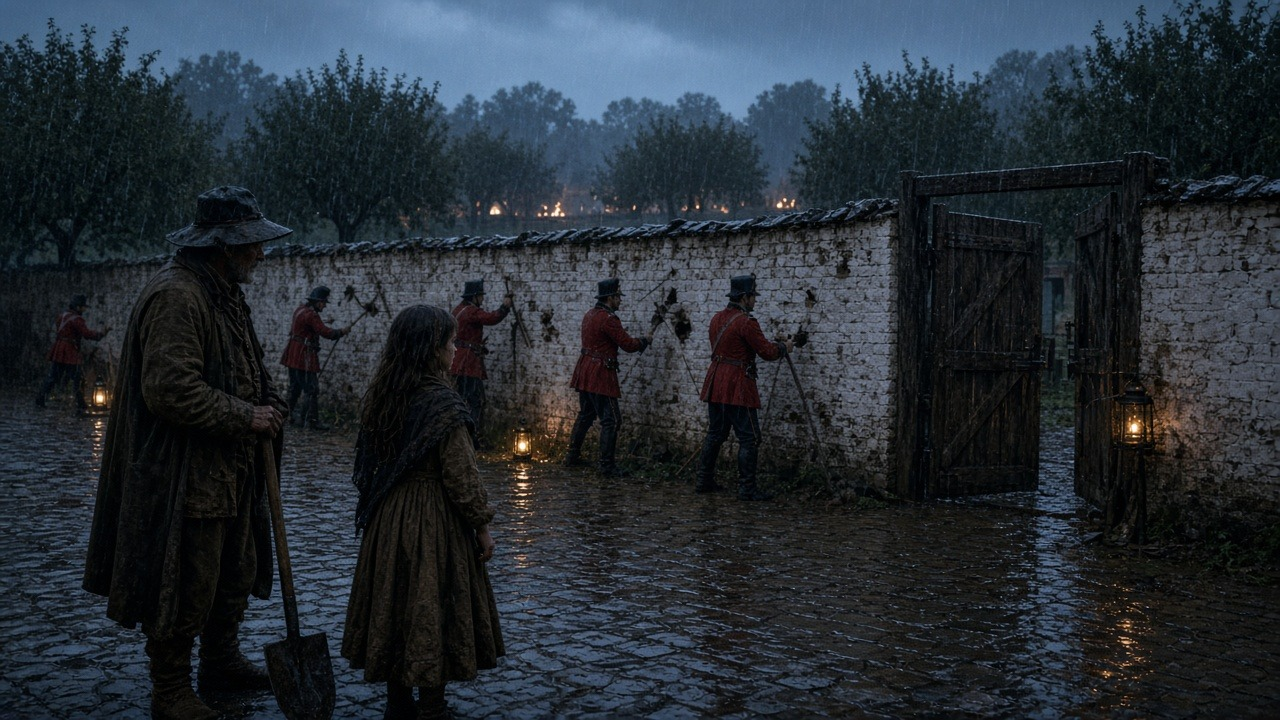
They came at dusk on Saturday, the seventeenth of June, in a hard summer rain. There were a few hundred of them, in red coats gone black with water. They marched in through the north gate, and right away they took out picks and started knocking holes in the garden wall.
"For their guns," Papa said. "So they can shoot through."
He stood in the rain with his spade and watched them. Although he said nothing, I knew what he was thinking. After all, he had built half of that wall himself.
I was twelve that summer. My name is Lise, but nobody called me that. Papa called me Nettle, because I was small and green-eyed and I stung when I was crossed.
Papa was the gardener at Hougoumont. We lived in the gardener's house on the south side of the farm, next to the big gate. Beyond the walls lay the orchard, and beyond that the wood. That night, beyond the wood, there were a great many campfires.
"Whose fires are those?" I asked.
"The French," Papa said. "And the ones behind us belong to the English and the Dutch and the Germans. Tomorrow they will all meet in the middle."
"In the middle of what?"
He looked down at his bean rows, flat in the mud.
"Us," he said.
Why We Stayed
By then, the farmer had already left with his wife and his cows. Most of our neighbors were already gone.
We would have gone too, if not for the Steward.
The Steward worked for the master, who owned Hougoumont but lived far away in town. He was a thin man with a thin voice, and he came riding up in the rain just before the soldiers did. I was out in the bean rows, so he did not see me. Still, I heard every word.
"Somebody must stay and watch the house," he told Papa. "If it is robbed, or burned, the master will want to know who let it happen."
"There will be a battle here, sir," Papa said.
"Then there will be a battle," said the Steward. "You have your house and your wage. Stay, or find another place to dig."
Then he turned his horse and rode back toward town as fast as it could go.
Afterward, Papa found me in the beans. He tried to put me on the last cart with the miller's family, because the miller said there was room for one small girl.
I said no.
So he picked me up, and I bit his hand. Not hard. Just enough. When he put me down, I ran and hid in the hayloft until the cart was gone.
He was angry for an hour. After that, he held me so tight I could hardly breathe.
"Stubborn as a nettle," he said into my hair. "Your mother was the same."
The Battle of Waterloo Begins
In the morning the rain stopped, and the whole world was mud.
In fact, the soldiers had worked all night. They had piled carts against the gates and cut holes in every wall. Now they sat in the yard, cleaning their guns and eating hard biscuits. They looked very tired.
One of them was a young corporal with red hair and so many freckles that his face looked rusty. So I called him Freckles. He showed me a little wooden horse he was carving. "For my brother," he said, and he pointed at a boy my size, then at the horse. That was how I learned my first English word: brother.
In return, I taught him to say merci. It took him the whole morning, though. He kept saying "mercy," like a man begging not to be hanged.
"No," I said. "Merci. Soft, like a cat. Mair-see."
"Mair-see," he said, and the other soldiers laughed at him.

I loved teaching. Before she died, my mother had taught the village children their letters, and I used to sit at the back and watch her. Someday, I thought, I would teach too.
Then, a little before noon, the first big gun went off to the south.
It sounded like a door slamming in the sky. Soon a hundred doors were slamming at once, and the ground shook under my feet. The Battle of Waterloo had started, even though nobody called it that yet.
Papa grabbed my hand and pulled me across the yard.
"The chapel," he said. "The walls are thick, and it is God's house. Stay there until I come for you. Whatever you hear, stay there."
The Little Chapel
The chapel at Hougoumont was small. It stood against the side of the master's house, with one door to the yard and one narrow door into the house.
Inside, it was cool and dim and smelled of old wax. There were two wooden benches and a little stone bowl of holy water by the door. Above the door hung a great wooden Christ on his cross, taller than a man. He had hung there for more than a hundred years, and his painted feet were right above my head as I came in.
I sat on the floor behind the benches with Prune, our gray cat. She had followed me in, and I was glad of her.
Soon the noise outside grew so big that it stopped being a noise. Instead, it became a kind of weather. Guns cracked behind the walls. Men shouted in English and in German. Once, something hit the roof, and dust came down like flour.
I said every prayer I knew. When I ran out, I started again from the beginning.
Then, after what felt like a long time, the shouting changed.
It came from the north side, from the big gate. First I heard a heavy chopping sound, like a man splitting logs. Somebody was hitting the gate with an axe.
Next came a crash, and a roar. Suddenly, there were French voices in our yard.
The Gate
French was my own tongue. Because of that, I understood every word they shouted, and it frightened me more than the guns.
"In! In! We are in!"
I put my hands over my ears and pushed my face into Prune's fur. She did not like it, but she let me.
Even with my ears covered, I could hear the English shouting too. Then came the sound I have heard in my dreams all my life. It was the slow, heavy groan of the great north gate swinging shut, and the thud of the bar falling across it.
After that, for a few minutes, the yard was full of terrible noise. I will not tell about that. I did not see it, and I am glad.
At last it went quiet, or as quiet as that day ever got.
Meanwhile, I stayed behind the bench with my heart thumping against my ribs.
That was when the chapel door creaked open, just a little, and a boy crawled in on his hands and knees.
The Boy With No Drum
He was smaller than me, maybe eleven years old. Dark hair was stuck to his forehead, and his face was as white as candle wax.
He had no coat, only a dirty shirt torn at the shoulder. Also, his trousers were so muddy that I could not tell what color they had been. Two drumsticks were tucked into his belt.
But he had no drum.
When he saw me, he froze like a hare in a field.
"It's all right," I whispered. "It's only me."
Still, he did not answer. He just stared.
I thought I understood. Freckles had told me that the English army had drummer boys, some as young as ten. So this boy must be one of them. He had lost his coat and his drum in the fighting, and now he was hiding, the same as me.
Of course, he would not speak French. So I spoke slowly and kindly, the way you speak to a frightened dog.
"Come here," I said, and patted the floor. "Behind the bench. It's safer."
After a long moment, he crawled over and sat beside me. He was shaking so hard that his teeth clicked.
Luckily, I had a piece of bread in my apron. I broke it in half and gave him the bigger piece.
Before he ate, he crossed himself. He did it quickly and the right way, forehead and chest and shoulder and shoulder, just as we did it in our church.
That surprised me a little. However, Freckles had said that many of the English soldiers were really Irish. So I decided the boy must be Irish.
I named him Sticks, for the drumsticks. He did not seem to mind.
Lessons in the Dark
That afternoon was the longest of my life, though.
Sometimes the guns stopped for a while. Then they started again, worse than before, and each time Sticks flinched and gripped his drumsticks.
To keep him calm, I gave him lessons. It was the only thing I knew how to do.
First I pointed at the bread. "Pain," I said.
"Pain," he said softly.
Then I pointed at Prune. "Chat."
"Chat," he said.
Finally, I pointed at the stone bowl by the door. "Eau. Water."
"Eau," he said.

He said every word exactly right, the very first time. Freckles had needed a whole morning for merci, while this boy needed a single breath. I was proud of him, and a little proud of myself.
"You are a quick one," I told him. "When the war is over, you must come back, and I will teach you everything."
He looked at me with his dark eyes. For a moment, I thought he might laugh, or cry. Instead, he just nodded.
By then, we were both thirsty. The bowl by the door held holy water, and I did not think God would like us to drink it.
So I made up my mind. I took Papa's tin jug from the corner, where he kept it for the altar flowers, and I went out into the yard to the well.
Water
The yard was so full of smoke that nobody noticed me. Soldiers stood at every hole in the walls, firing and loading and firing again.
I kept my eyes on the well and nothing else. Papa always said that a garden is small if you only look at the next row.
Freckles was there, hauling up a bucket for the men. His face was black with powder, and when he saw me, his mouth fell open.
"Mair-see!" he said. "What are you doing out here, you mad girl?"
I held out the jug. He filled it fast, even though his hands were shaking.
"Back inside," he said. "Stay in the chapel. Promise me."
I promised.
On the way back, I saw Papa across the yard. He was helping two soldiers carry a wounded man into the big barn. Fortunately, he did not see me, because he would have been furious.
In the chapel, Sticks drank half the jug in one go. Then he wiped his mouth and handed the rest back to me.
After that, he did something strange. He took my hand and squeezed it once, hard, the way you thank somebody who has pulled you out of a river.
Fire
Later that afternoon, the French began to throw a new kind of shell over the walls.
These shells did not just explode. They burned. Soon I smelled real smoke, the smoke of old wood and straw. Then men were shouting "Fire!" in English, and Papa was shouting too, in French, to get the horses out.
The master's house was burning. Next to it, the great barn was burning too, with all the hay inside.
Before long, smoke began to curl under the narrow door from the house. Then the door itself started to glow at the edges. Sticks jumped up and ran for the yard.
"No!" I grabbed his shirt. I had just been out there, and out there was worse.
So we stayed. I pulled off my shawl and soaked it in the holy water, and I decided God would understand. Whenever sparks blew in and landed on the old straw on the floor, we beat them out. Sticks stamped on them with his boots, while I slapped them with the wet shawl.
Then the narrow door caught fire. The flames came through the doorway and licked along the wall, climbing toward the great wooden Christ above the other door.
I watched them reach his feet. His painted feet turned black.
And then, for no reason that I could see, the fire stopped.
It simply stopped, right there at his ankles, as if somebody had told it to. Above that, he was not burned at all.
Hold the Place
A few minutes later, Papa came in. He was black from head to foot, and his eyebrows were gone.
He dropped to his knees and grabbed me. Then he saw Sticks, and he stared.
"An English drummer," I told him quickly. "He lost his drum. I'm looking after him."
Papa studied the boy for a long time, and Sticks looked back. Finally, Papa just nodded and pushed the boy's wet hair off his forehead, the way he did with me.
Outside, an English officer was shouting orders. Since Papa knew a little English from selling vegetables to travelers, he listened, and then he told me what it meant.
"A note from the Duke," he said. "Keep the men where the fire cannot reach. Hold the place."
"What about the master's house?"
Papa laughed, a short, cracked laugh.
"The master's house is gone, Nettle," he said. "The barn is gone. My beans are gone. And tomorrow the Steward will ride up and ask why I did not put out the fire with my hands."
Then he went back out to help with the wounded.
I sat down again behind the bench, and Sticks sat beside me. Above us, the great wooden Christ looked down on us with his burned feet.
I did not know if it was a miracle. I only knew that the fire had stopped, and that we were still alive.
The Quiet
Eventually, the evening came. Then, sometime after the light began to go, the guns moved away.
At first, I did not believe it. The noise rolled off toward the south, like a storm going over a hill. Far away on the ridge, thousands of men were cheering in English.
At last it was quiet. Truly quiet. I could even hear Prune purring.
Sticks lifted his head and listened for a long moment. Then he spoke, for the very first time.
"C'est fini?" he whispered. "Is it over?"
He said it in French. It was not my French, the slow French of our farms and villages. Instead, it was the quick, sharp French of the city, the French of the soldiers who had come through the gate.
My skin went cold.
"You are French," I said.
He nodded, and his eyes filled with tears.
"I came in through the big gate," he said, "with the others. With the officer and the axe. I am a drummer of the First Light Infantry, and I am from Paris."
"And the others?"
"All gone," he said. "Only me. A big English soldier knocked me down and took my drum. Then he pointed at this door and said something. I didn't understand it, but I think he said, go and hide."
He wiped his face with his torn sleeve.
"Then I heard you speaking French," he said, "and I was afraid you would call the soldiers. So I said nothing."
I stared at him.
"But the lessons," I said. "Pain. Chat. Eau."
For the first time all day, Sticks smiled.
"You are a very good teacher," he said. "But I already knew those words."
The Lantern
Not long after, a lantern came to the chapel door.
It was a big English sergeant, with Freckles behind him. They were going through the buildings, counting who was still alive.
The sergeant raised the lantern. He looked at me, then at Sticks, and then at the drumsticks in Sticks's belt.
My heart was pounding in my ears.
Even so, I stood up and put myself in front of Sticks, just as Papa had stood between me and the Steward's horse. Then I said the only English word I had learned that day.
"Brother," I said. "My brother."
For a long time, the sergeant said nothing. Behind him, Freckles looked at the muddy trousers and the drumsticks. Then he looked at me.
"That's right, Sarge," Freckles said. "That's the gardener's boy. Seen him all day."
The sergeant let out a long breath and lowered the lantern.
"Then the gardener's boy had better get some supper," he said, and he walked away.
Freckles stayed a moment longer, and he winked at me.
"Mair-see," he said. And this time, he said it perfectly.
The Feet of the Cross
Sticks stayed with us for three weeks. He dug potatoes with Papa and ate at our table, and the soldiers who came through called him the gardener's boy. Then, in July, when the roads were clear, he walked home to Paris with a loaf of bread under his arm.
After that, he never wrote, and I never learned his real name.
For years afterward, travelers came to see where the Battle of Waterloo was fought, and many of them came to our little chapel. They stood under the great wooden Christ and pointed at his burned feet. The fire stopped right there, they told each other. A miracle.
Maybe it was. I am an old woman now, and I still do not know.
But I know what I found under the cross the morning Sticks left. He had nothing in the world to give me, so he left me the only thing he had.


Leave a Reply