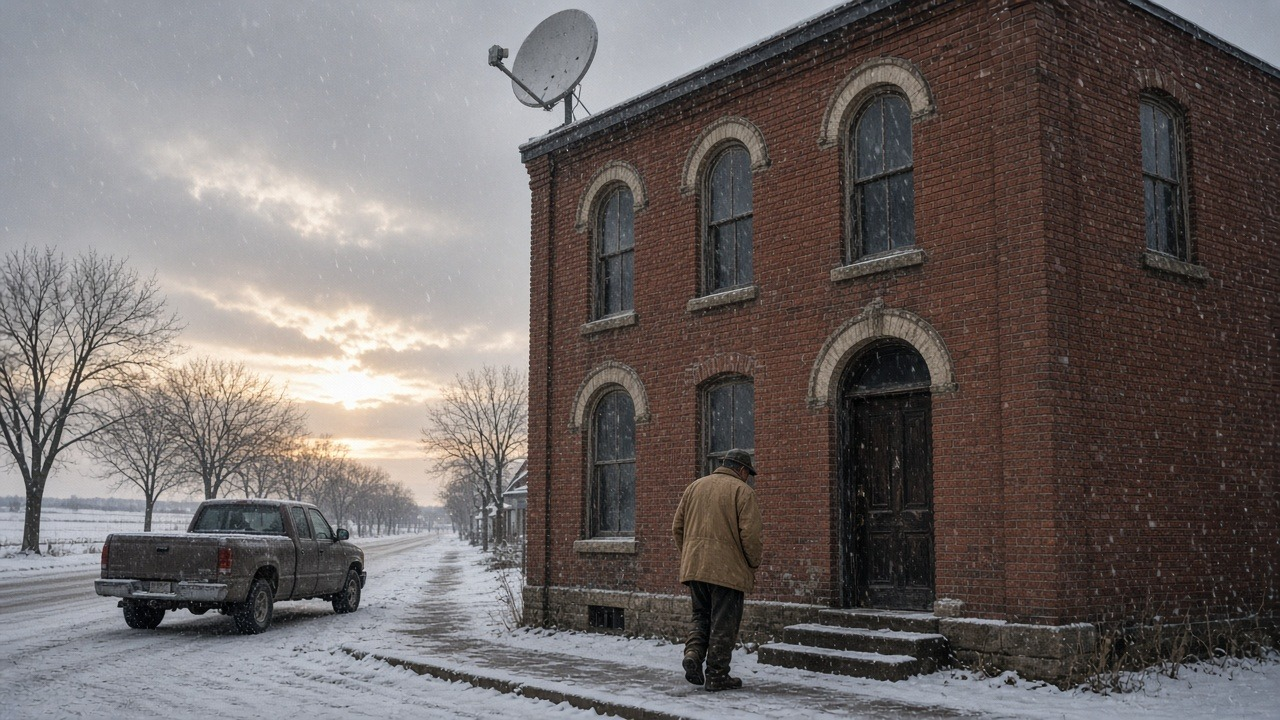
A science fiction short story set in Oslo, Minnesota, a little river town that turns into an island every time the Red River floods. Mittens, Swede, Birdie and the Milkman are all made up. However, the old weather satellite in this story is based on a real one. NASA's Terra satellite stops collecting science data on December 1, 2026, after 27 years in orbit. It was built to last six. (For another story from farm country, read The Slow One.)
The Man Who Came for the Picture
Every morning, a farmer called Swede came in for his picture, and every morning Birdie pretended he wasn't there.
The picture came down a little after nine. Our old dish on the roof of the bank caught it as the satellite went over, and then the printer in the corner groaned and pushed out one long sheet. Each one showed the whole Red River Valley from four hundred miles up. You could see the river, black and crooked as a shoelace, and every white field from Grand Forks to the Canadian line.
First, I pinned it to the corkboard by the door. Next, I made the coffee. Then Swede came in.
He was a big man in a seed cap and a canvas coat, with hands like split firewood. As always, he took his copy, folded it twice, and put it in his chest pocket. After that, he looked at the steel door at the back of the room.
"Twenty-two days," he said to the door.
The door didn't answer, though. It never did.
My name is Ana, but nobody in Oslo called me that. I was twenty-three, I was from Fargo, and I had worked at Valley Weather for exactly six weeks. In my first week, the bank was so cold that I typed in mittens. So Hank named me Mittens, and that was that.

Birdie and the Old Weather Satellite
Valley Weather was three people in an old bank on Main Street.
Hank owned it, and he wore red suspenders and read the forecast on the AM station every morning at ten to seven. He also sold frost calls to the sugar beet growers and told the school when to close. Meanwhile, I answered the phone, made the coffee, and learned.
Birdie was the third person, sort of, although she didn't count herself. She didn't work for Hank. Instead, she rented the bank's old vault, because the agency in Maryland wouldn't let her fly a satellite from anywhere with a window.
Yes, a satellite. And yes, from a vault, in a town of two hundred people.
It was a big old Earth-watching weather satellite, about the size of a school bus. It had gone up in December 1999 with a long name full of letters. Around here, though, people called it the Milkman, because for twenty years it came over every morning at half past ten, right on time. Every farm in the valley used its free pictures, since they showed snow and frost, smoke and ice, and the river coming up in spring.
At first, there had been a whole room of engineers for it. Now there was just Birdie, part-time, with a gray locked laptop and a phone line the agency paid for.
Birdie was about fifty, with a gray braid and reading glasses on a chain. She drank black coffee from a chipped white mug that said BAKKEN FARM – EST. 1911. At the time, I figured some farm had given them out at the county fair.
On December first, Birdie would turn the Milkman's cameras off forever.
Leave One Camera On
When I first heard Swede ask, I was refilling the coffee.
Slowly, he walked to the back of the room and stood at the vault door, cap in his hands. The door was open a crack, and inside, Birdie's lamp was on.
"Leave one camera on," he said. "Just the one that sees the valley. You don't need the others."
"No," Birdie said, without even turning around.
"You haven't heard me out."
"I've heard you out for a month, Swede." She didn't look up from her laptop. "If I leave a camera on, I can't burn. And if I can't burn, it just hangs up there and gets in somebody's way."
"So let it hang, then."
"It doesn't work like that, Swede."
Then she explained it again, slowly, like a teacher. The Milkman had a little fuel left. On December first, she would use it to drop the satellite lower, down and out of the way of the newer birds. After that, it would sink a little more every year, until one day it burned up. Finally, in January, she would switch everything off for good.
"The power isn't there for both," she said. "It's one or the other. And when you're done, you get out of the lane. That's the rule."
For a while, Swede turned his cap around in his big hands.
"Twenty-seven years," he said. "Every morning."
"I know how long it's been," she said, too fast.
"Then leave me one."
"Go home, Swede," said Birdie, and she pushed the vault door shut.
He stood there for a long time. Eventually, he put on his cap and went out into the wind.
The Money
As it turned out, Swede wasn't the only one who was going to lose something.
On the second Monday of November, Hank opened a letter from the sugar beet co-op and sat down hard in his chair. He read it twice, and then he took off his glasses and rubbed his eyes.
"They're dropping us," he said. "January first."
"Who's taking over?"
"Skyfield."
Of course, I knew the name. Skyfield was a company in California with three hundred little satellites. A computer read their pictures and sent a frost call straight to every farmer's phone, so nobody needed a man in red suspenders anymore. It cost nine dollars an acre, every year.
"Swede's got eight hundred acres," Hank said. "You do the math. That old weather satellite was free, and that's the only reason a place like this ever worked."
That same week, I heard Birdie's boss on her speakerphone. His name was Mr. Pike, and he had a voice like a man reading a menu.
"The burn is on the first, Ellen," he said. "Not the second. The whole sky has that date on its calendar, and there's no money for a do-over."
"I know the date," Birdie said.
"Also, your contract ends on the thirty-first. There's nothing after that. I'm sorry, but that's the truth."
"I know that too," she said, and then she hung up first.
Later on, Hank told me what everybody in town said. When the Milkman was done, Birdie was going to her sister's place in Arizona.
So I asked her about it once, while she was locking up.
"When it's done," Birdie said, "I'm going south."
After that, she didn't say anything else.
The River in 1997
The next morning, Swede stood in front of the corkboard longer than usual. After he left, I asked Hank why the pictures mattered so much to him.
Hank poured himself more coffee before he answered.
"You know about '97?" he finally asked.
I did, a little. I had been a baby in Fargo back then, but everybody in the valley talked about the spring of 1997 the way old men talk about a war.
"First, the snow that winter was crazy," Hank said. "Then it all melted at once. The river forecast said forty-nine feet at Grand Forks, so the whole city built its sandbags to forty-nine."
"And it came up to fifty-four."
"Fifty-four. It went right over the top. Then downtown Grand Forks caught fire while it stood in the water, and the fire trucks couldn't even get to it." He shook his head. "Up here, meanwhile, Oslo turned into an island inside its dike, like it always does. But the farms outside had no dike. Swede had water in his kitchen up to the windowsills."
"Is that why he watches the pictures?"
"Partly." Then Hank looked at the vault door. "Birdie was a kid in the river office in Grand Forks that spring. She helped work up the numbers."
"The forty-nine?"
"Everybody's numbers were wrong. Nobody had ever seen that river do that." He sipped his coffee. "Still, you can't tell her that. A year later, she went east to help build the Milkman. She said nobody in this valley would ever get caught guessing again. Then, five winters ago, when the job went part-time, she came back and moved into the room upstairs."
"Why here?"
Hank picked up the phone, although it wasn't ringing.
"That's hers to tell, Mittens," he said.
Swede's Kitchen
On the Friday before Thanksgiving, Swede didn't come in.
By noon, Hank was worried, so he sent me out with the picture. Swede's place was four miles south of town on the river road. It was flat, white and empty, except for a line of bare cottonwoods along the water.
The farmhouse was tall, and it badly needed paint. On the side of the barn, you could still see a faint brown line about waist high, where the water had stopped in 1997.
Eventually, Swede opened the door in his socks. He had a cold, and he was embarrassed about it.
"You didn't have to drive out," he said. Still, he made me coffee.
Unlike the barn, his kitchen was spotless. Everything in it came in twos: two chairs, two hooks by the door, two of every cup in the cupboard. Yet only one of anything had ever been moved.
That was when I saw the shelves.
They ran along the whole back wall, floor to ceiling, and they were full of blue binders. Each one had a year on the spine. 2000. 2001. 2002. All the way to 2026.
"Is that every one?" I asked.
"Every one since the first picture," he said, as if that were normal. "February 2000."
Charge and Drain
Swede took down 2009 and opened it on the table.
"That October, something hit her," he said. "A speck of junk, they think. It broke a battery cell and killed half her heaters. Everybody figured she'd freeze."
"How do you know all that?"
"I read." He turned the pages gently. "They kept her warm by running the battery up and down. Charge and drain, all night long. Like rubbing your hands together."
Afterward, I looked at the binders again. Twenty-seven years of the same valley, the same river, the same white fields.
"Swede," I said, "what do you actually use them for?"
He looked at me for a long time before he closed the binder.
"Every morning, I look at the picture," he said. "That's how I know what kind of day it is."

Forty Names
So I helped him.
Even now, I don't know why, exactly. Maybe it was the binders. Or maybe it was the two chairs.
Together, we wrote a letter to the agency. I typed, and Swede told me what to say. Afterward, he drove from farm to farm for three days and got forty names. Hank even read the letter on the radio, right after the hog prices.
On the Friday after Thanksgiving, an email came back. It was long and polite, too. It thanked the farmers of Oslo for their "decades of partnership." In addition, it said the old pictures would stay free forever, and it suggested Skyfield.
Swede read it standing up, because he couldn't sit still.
"I don't want the old pictures," he said. "I've got the old pictures."
Then he went to the vault door again.
"Ellen," he said, before she could shut it. "Please. Leave me one."
But Birdie didn't answer. Through the crack, I could see her bent over the laptop with her braid over her shoulder. Her hands lay flat on the desk, and they weren't moving.
That night, I got angry. As soon as Hank went home, I knocked on the vault door.
"He's got forty names," I said. "He's got twenty-seven years of binders. So why can't you just give him one camera?"
For once, Birdie took off her glasses.
"Sit down, Mittens," she said.
Six Years
Inside, the vault was warmer than the rest of the bank, and it smelled like old paper and coffee. On the wall hung a photo of the Milkman before launch, wrapped in gold foil, with tiny people in white suits standing around it.
"Do you know how long it was built to last?" Birdie asked, once I sat.
"No."
"Six years." She laughed, but it wasn't a happy laugh. "Six years. I told somebody six years."
Then she showed me things on the laptop, while the furnace ticked. The Milkman had turned all the way around twice to look at the Moon, in 2003 and in 2017, so the team could check its eyes. In 2009, it took the hit Swede talked about, and they nursed its battery through the cold. Now, however, it was drifting. It used to come over at half past ten. These days it came before nine, and it got a little earlier every week.
"It's tired," she said. "It has done everything we asked, plus a lot we didn't. But if I leave it up there half alive, it's just hanging around. Some things you have to finish, so you can stop."
"Still, he thinks you're being cruel."
"I know what he thinks."
"Then tell him."
Birdie put her glasses back on.
"In April of 1997," she said, "I typed a number, and the river didn't care what I typed. After that, I made a promise. I'm going to keep it, Mittens. All the way to the end."
The Last Night of November
On the last night of November, it snowed.
That evening, I stayed late to help Hank with the school calls. Then, around nine, a truck pulled up outside. Swede got out and stood in the snow under the streetlight. He didn't come in. Instead, he just stood there looking at the bank, while the snow piled up on his cap.
Finally, Birdie came out of the vault and opened the front door.
For a while, they stood there with the door between them and the snow blowing in.
"Tomorrow, then," Swede said.
"Tomorrow."
"Ellen, I never asked you for anything. Not once in twenty-seven years."
"I know you didn't," she said.
"So I'm asking now. Leave me one."
Birdie held the door for a long moment. Then she said, very quietly, "Go home, Swede."
Afterward, she shut the door and locked it. For another minute, he stood outside. Then his truck went away down the white street.
I wanted to throw the stapler at her. Instead, I put on my coat and walked home in the snow.
December First
The last picture came down at 8:52 in the morning.
At least it was perfectly clear. The whole valley lay white, from the Canadian line to the bottom of the sheet, and the river ran through it like a black thread. Oslo was only a tiny gray dot. South of it, I could even make out the dark line of cottonwoods.
My hands shook while I pinned it to the corkboard.
In the vault, Mr. Pike was on the speaker.
"Cameras," he said.
"Cameras off," said Birdie. Her voice was flat and steady. "Confirmed."
"Burn."
There was a long quiet. I could hear the old furnace ticking, and Hank breathing behind me.
"Burn's good," Birdie said at last. "It's going down."
"Thank you, Ellen," said Mr. Pike. "That's twenty-seven years. Nice work." Then he hung up.
At nine sharp, the front door opened. Swede came in, stamping the snow off his boots. He walked to the corkboard and took down the last picture. This time, he didn't fold it. He only held it in both hands.
Then the vault door swung all the way open.
A moment later, Birdie came out in her winter coat. She had a suitcase in one hand and the white mug in the other.
Arizona, I thought. So that's it. She isn't even going to say goodbye to him.
Going South
Birdie set the suitcase down by the door.
"It's done," she said.
When Swede looked at the suitcase, his face did something terrible.
"So you're going," he said.
"I'm going south. Four miles south." She held out the mug to him. "I told you I'd come home when it was done. Six years, I said. But it just kept working."
Even so, Swede didn't move.
"That was twenty-seven years ago," he said. "I figured you forgot."
"I said when it was done. It wasn't done until this morning." She shook her head. "You never could listen to the end of a sentence, Ole Bakken. Not in thirty years."
Bakken. I looked at the mug in her hand. BAKKEN FARM – EST. 1911.
Slowly, Swede took it. His big hands were shaking.
"Every morning," he said. "Every morning, I came to that door."
"I know," said Birdie. "I heard you count down every day. Through a steel door."
Behind me, Hank blew his nose.
"Thirty years today," he said softly, when nobody else spoke. "They got married in the church across the street. First of December, 1996. I was an usher."
"They're married?" I said. "They're still married?"
"Nobody ever got around to fixing that," said Hank. "He wouldn't leave the land, and she wouldn't leave the bird."
Everybody in Oslo knew. I was the only one who didn't.
Finally, Swede picked up the suitcase. Then the two of them walked out into the snow together, and he opened the truck door for her, as if it were the first time.
The Last Picture
In January, Birdie switched the Milkman off for good. She did it from a kitchen table four miles south of town, with two cups of coffee on it.
As for the co-op, it went to Skyfield. Even so, Hank kept me on. When the river comes up in April, he says, somebody has to answer the phone.
Since then, I have never put another picture on the corkboard. But the last one is still in Swede's kitchen, in a new blue binder, all by itself, with the year written on the spine in two different hands.


Leave a Reply