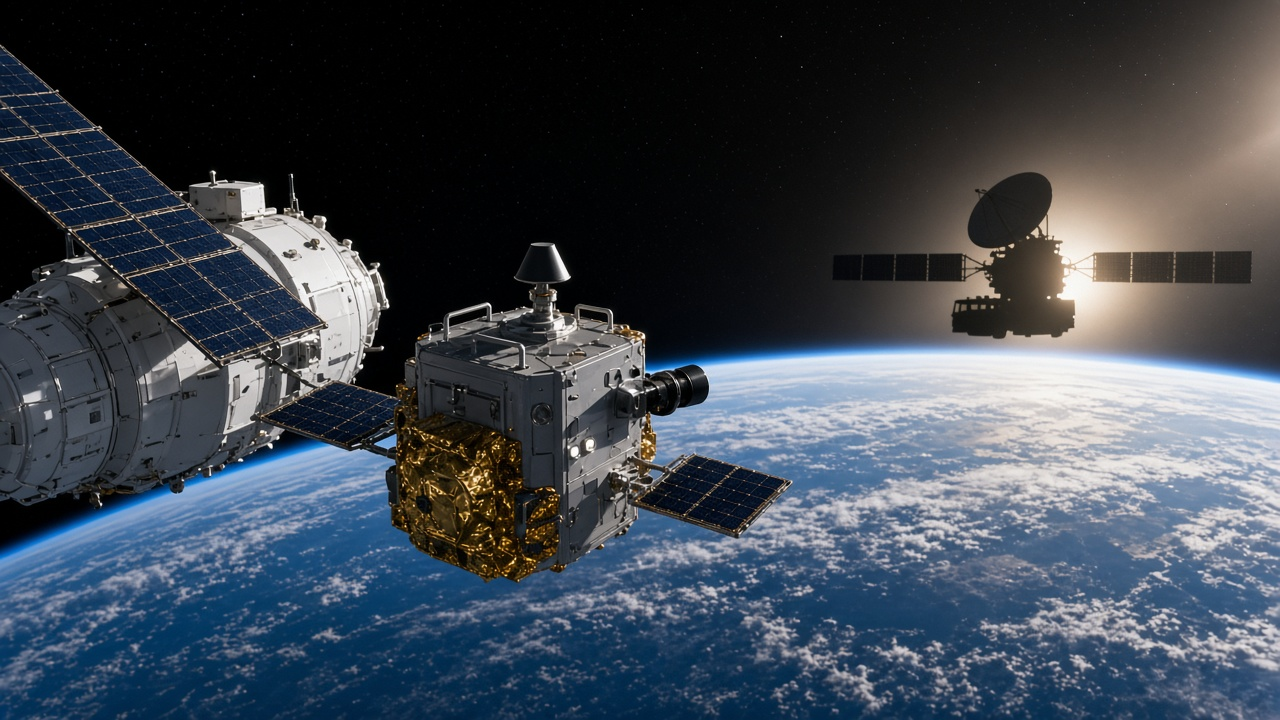
A space war story set in the 2030s, told as a short story. The company, the satellites, the country and the people are all made up. However, the idea is real. In October 2026, a space clean-up company proposed fleets of "bodyguard" spacecraft to protect important satellites, and Britain signed a contract to study how to counter close approaches in orbit. That same month, a military satellite spent days a few hundred meters from a commercial radar satellite. So this space war story asks a simple question. What is it like to fly the bodyguard?
Three Hundred Meters
At 2:14 in the morning, a stranger parked three hundred meters from the satellite I was guarding, and my boss told me to make a cup of tea.
"Log it as routine," the Gaffer said. His voice was thick with sleep. "Then put the kettle on."
"It's very close," I said.
"It's always very close. But it never comes closer. Good night, Wren."
Of course, I wasn't in bed. I was on the night shift, in a low brick building outside Oxford, between a sheep field and a car park. Meanwhile, the Gaffer was at home in bed, and I could hear his wife's radio playing somewhere behind him.
He hung up, so I looked at the big screen on the wall. There were three dots on it. The first was ours, and the second was the thing we guarded. Then there was the third one, the Wolf.
Shep and the Lamb
My real name is Jess, but nobody at Fieldfare used it. In my first week, I worked in the clean room with an old technician called Nan. Because I was small and talked all day, she said I was like a wren. After that, I was Wren to everyone.
Two years later, I was a pilot. That sounds grand, but I flew a spacecraft from a desk, with two screens, a keyboard and a cold cup of tea.
The spacecraft was called Fieldfare One. However, Taff called it Shep, after a sheepdog he had as a boy in Wales, and the name stuck. Shep was about the size of a fridge. It had a camera with a long lens, two bright lights, a small radar, and fuel. That was all.
Shep's job was to stay near the Lamb. The Lamb was a weather satellite, big and white and slow, eight hundred kilometers up. It went around the Earth from pole to pole every hundred minutes, and it took pictures of the clouds for half of Europe. Farmers used them, and so did fishing boats, airports, and the man on the evening news.
"A bodyguard doesn't fight," Taff told me on my first night. "Instead, a bodyguard stands in the way and looks big."
"Shep isn't big," I said.
"Then Shep stands in the way and looks busy."
Taff and the Fruit Gums
Taff was the senior night pilot. He was fifty-eight, with a gray cardigan, reading glasses on his head, and a bag of fruit gums he never offered to anyone. Before Fieldfare, he spent twenty years in the air force, watching radar screens in a hut on a hill.
Since that night, he had taught me almost everything. For example, he taught me that you never chase anything in orbit. If you speed up, you climb into a higher orbit, and a higher orbit is slower, so you fall behind. If you want to catch something, you slow down first.
"Space is backwards," he said. "Like teenagers."
He also taught me the loop. Shep didn't sit still next to the Lamb, because sitting still costs fuel. Instead, it flew a slow, lazy circle around it, once every orbit, almost for free. The Earth's pull did the work, so Shep only needed a tiny push now and then.
"Fuel is life," Taff said. "Spend it like it's your own money."
I knew about spending my own money, because I never had much of it. I had a student loan, a room in a shared house in Didcot, and a mum in Swindon who still asked whether I had a proper job yet. So I told her I did, and that I worked for a company that kept satellites safe. Mostly, that was true.
The Bird on the Hood
Nan also had a habit. Before each spacecraft left the clean room, she painted a tiny white bird on the hood of its star camera. The star camera is the little eye that looks at the stars, so the spacecraft always knows which way it is pointing.
"So they're not lonely up there," Nan said.
She painted a neat little bird on Shep. Then she let me paint one on the second unit, the test unit. Halfway through, the fire alarm went off and I jumped, so my wren came out with one crooked wing.
"He'll fly fine," Nan said.
But he didn't fly at all. A month later, Unit Two went off to a test lab in Germany, to be shaken and frozen and cooked until something broke. That's what test units are for. Later on, the Gaffer told us it had been cut up for parts. I felt a bit sad, and then I forgot about him.
Soon after that, Nan retired to the seaside. Meanwhile, I learned to fly. And then, last winter, the Wolf came.
Not a Space War Story
The Wolf belonged to a country I am not allowed to name. Honestly, it doesn't matter which one. The catalog gave it a number, but Taff gave it a name, because that's what Taff does.
Ever since last winter, it had come every eight days. First it slid up into our orbit from somewhere lower. Then it parked on the line ahead of the Lamb and sat there for three days. After that, it dropped away again, as quietly as it came.
It was ugly. On radar, it looked like a box with a big dish on the front and two long wings. At night, our camera saw only a gray smear, because the Wolf had no lights. In daylight, it always sat with the sun behind it, so we saw a black shape and nothing more.
It never came closer than two hundred meters. Not once, even though it had been coming for a whole year.
"Polite, for a wolf," Taff said.
"So what does it want?"
"It wants to look and listen. Also, it wants us to know that it can." He chewed a fruit gum. "This isn't a space war story, Wren. Nobody fires anything up there. It's a staring contest, that's all."

A Quiet Month
The real trouble was money.
Fieldfare had one big customer, and that was the government. Our contract came up for renewal on the thirtieth of November, so everything depended on that day. If they signed it, we had five more years. If they didn't, then Shep would be switched off, and so would all of us.
So the Gaffer called a meeting on Monday. He wore a nice blue suit and a tired face.
"We need a quiet month," he said. "That means no incidents, no near misses, and no pictures in the newspaper. And nobody calls the ministry at night, unless the Lamb is actually on fire."
"And the Wolf?" Taff asked.
"The Wolf is routine. It's been routine for a year."
I wanted to say that a year of something scary doesn't make it safe, but I was the youngest person in the room by twenty years. So instead, I wrote "routine" in my notebook, underlined it twice, and kept my mouth shut.
The Visitor
On Tuesday, a woman from the ministry came to see us. She was small and gray-haired, in a gray coat, and she carried her own coffee in a steel cup. The Gaffer called her Mrs Moss, but behind her back Taff called her the Auditor, because she wrote down everything.
At first, she walked slowly around the control room. Then she stopped at my desk, which made my stomach drop.
"You're the new pilot," she said. "So tell me, in your own words. What does the Wolf do?"
Before I could open my mouth, the Gaffer answered for me. "It parks, and it watches. Then it goes home. It's completely routine, Mrs Moss."
She didn't look at him. Instead, she kept looking at me, so I nodded, because I didn't know what else to do.
"We are paying for eyes," she said at last. "Make sure they stay open."
On her way out, she put a small white card on my keyboard. It had a phone number on it and nothing else.
"In case you ever see something I should see," she said.
The Stairwell
On Wednesday, I went to fetch my coat from the hooks on the back stairs. The Gaffer was on the landing above me, talking on his phone. He didn't see me, since I was in the shadow under the stairs.
"No, it won't go inside two hundred," he said. "It can't. It's in the software."
He went quiet for a moment, listening.
"Yes, I know. The second payment cleared on Friday. Just keep it boring until the thirtieth. Please."
Then I went back to my desk without my coat. All night, I turned it over in my head. In the end, I decided he was talking about Shep. After all, Shep had a rule in its software too, a line it could never cross. Maybe the ministry was nervous that a young pilot would do something stupid. Maybe he was promising them that I couldn't.
It made sense, and I wanted it to make sense. So I let it.
The Warning
On Thursday, the Wolf came back right on time. Then on Friday, at half past one in the morning, the warning came.
It was a conjunction message, which is a long way of saying "something might hit you." A piece of an old rocket, about the size of a suitcase, was going to pass very close to the Lamb at 4:51 on Sunday morning. The chance of a hit was one in two thousand.
That sounds small, but it isn't. In fact, the rule is simple: if the chance is worse than one in ten thousand, you move.
So the weather people decided to move the Lamb. It would be a tiny push, just a few centimeters a second, at ten past three on Saturday morning. That meant Shep had to move too, or be left behind.
After that, Taff and I planned our burn all night. Every gram of fuel mattered, because Shep had enough for about two years of careful flying, and a lot less than that of careless flying. Shep also had a mode called Heel. When the radar saw the Lamb move, Heel made Shep copy it at once, like a dog at its owner's side.
"Use Heel," Taff said. "Keep it small and smooth. Above all, keep it boring."
"What about the Wolf?"
"The Wolf will do whatever the Wolf does."
The Burn
At ten past three on Saturday morning, the Lamb fired its little engine. Two seconds later, Shep fired too. While I watched the numbers roll on my screen, my hands went cold on the keyboard.
Then the third dot moved.
The Wolf had fired as well. It wasn't late, and it wasn't clumsy. Instead, it moved at almost the same moment, with almost the same push, as if it knew the steps.
"How did it know?" I asked.
"Radar, maybe. Or somebody very awake." Taff frowned at the screen. "That was quick, though. That was Heel quick."
When the burns were done, the three of us settled into the new orbit. Still, the new orbit was not quite the same as the old one. Now the Wolf was closer, only two hundred and ten meters from Shep. And for the first time all year, the sun was behind us instead of behind it.

Two Hundred and Ten
The Gaffer came in at four, wearing a long coat over his pajamas.
"Report?" he said.
"Two hundred and ten meters," I said. "It's holding."
"It won't come closer." He didn't even look at the screen when he said it.
"How do you know?"
He waited before he answered. "Because it never has."
Over the next ten minutes, the Wolf drifted to two hundred and five. Then it stopped at exactly two hundred, as if it had reached the end of a lead.
"Very polite wolf," Taff said again. This time, though, he didn't smile.
"Our sunny side starts in six minutes," I said. "I can get a real picture of it with the long lens. It would be our first good one."
"No," said the Gaffer. "A picture is an incident, and incidents get reports. Reports get read at the ministry. Not this month."
"It's our job to look," Taff said quietly.
"This month, it's our job to be boring."
Then his phone buzzed. When he looked at it, something in his face shut tight, like a window in the rain. Without a word, he walked out to the stairwell.
The Picture
I had six minutes. I had a camera on a fridge, two hundred meters from a wolf, with the sun at my back for once.
Shep had a short list of jobs a pilot could do without asking anyone. "Take a picture of a nearby object" was on the list. I checked it twice, because Taff always says to check things twice. Then I looked at the small white card beside my keyboard, and I put the picture in the plan.
As soon as it was ready, the command went up at the end of our pass over the ground station in the far north of Norway. While Shep was out of contact over the dark ocean, it turned a little and took the picture. After that, there was nothing to do but wait for the next pass, when the picture could come down.
At 4:51, the old rocket piece went past the Lamb. It missed by more than a kilometer. Taff let out a long breath and ate three fruit gums at once.
Then, at 5:02, the picture started to come down, line by line, from the top.
Line by Line
First came the black of space. Then came the big dish, very clear now, with gold foil and a dent on the rim. Next came the two long wings, which were newer than the rest.
Finally, the box in the middle appeared.
It was the size of a fridge, with the same corners as Shep. It had the same gray handrails down the sides, and it had the same little hood over the star camera.
Taff stopped chewing.
Behind me, I heard the Gaffer come back from the stairwell. He didn't say anything, and instead he just stood there in his long coat and his pajamas, while the last lines came down.
Cut up for parts, he had told us. The second payment cleared on Friday.
There, on the hood of the star camera, in white paint, was a little bird with one crooked wing.


Leave a Reply