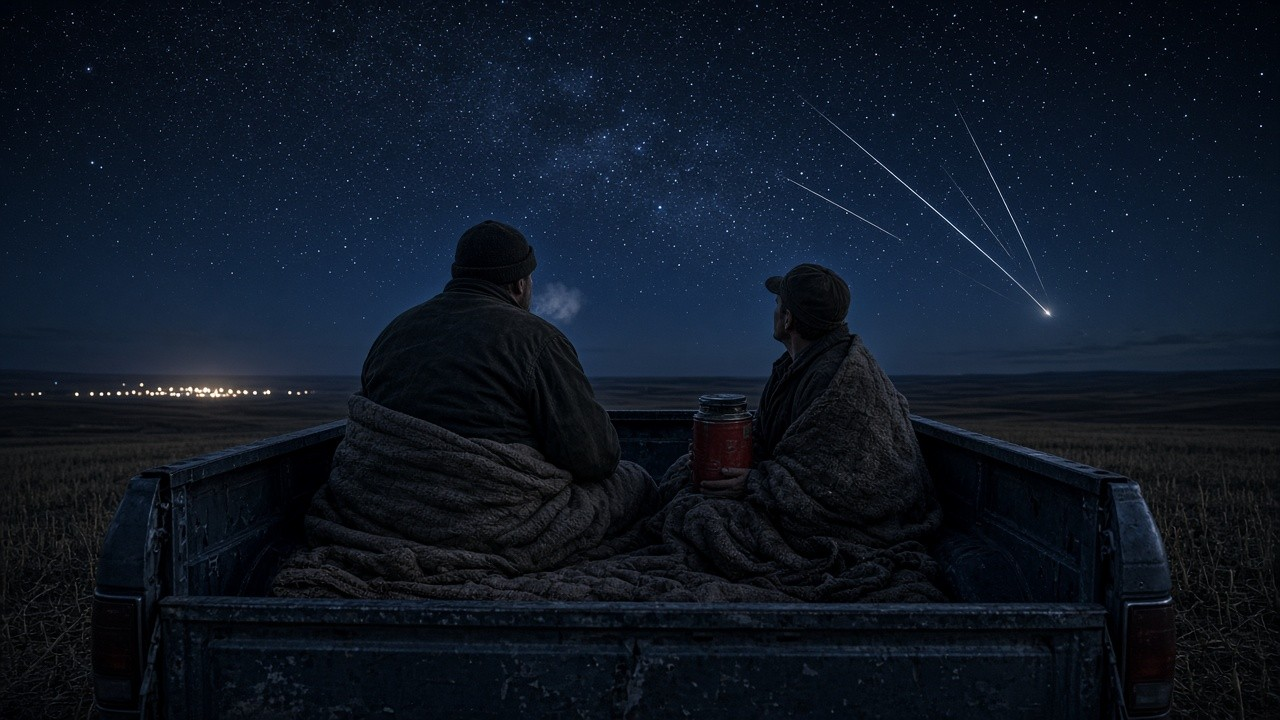
A Leonid meteor shower story, told as a short story. Runt, Hoss and their farm are made up. However, the shower is real. Every November, Earth drives through the dust of comet Tempel-Tuttle, and NASA says this year's Leonids are best before dawn on November 17 and 18. So this Leonid meteor shower story jumps ahead to 2034, a year the experts have already circled. (For another night spent looking up, read The Wrong Side of the Sky.)
The Last Night on the Farm
We were selling the farm at nine o'clock Saturday morning. So on Friday night, my brother wanted to lie in the back of Dad's truck and watch rocks fall out of the sky.
I drove in from Denver on Thursday. It is two hours east on I-70, and then twelve miles south on gravel. Before that week, I had not been home in nine years.
Nothing had changed, except that everything looked smaller. The house needed paint, and the wheat ground was brown stubble. Meanwhile, the wind still came across the plains like it had somewhere better to be.
My brother Wade was in the shop, welding a gate nobody needed. Everybody calls him Hoss, because he was big at twelve and never stopped. Since I was the small one, I was Runt. I am thirty-nine years old, and I am still Runt.
He flipped up his mask. "You made it."
"I said I would."
"You say a lot of things."
So that was our hello.
Dad died in August. He went down in this same shop, next to the welder, and Hoss found him. At the time, I was in a truck outside Kansas City when the phone rang. I made the funeral. Then I left the same night, because the funeral was the easy part.
Now the farm was sold. A solar company from Denver wanted the whole section, all six hundred and forty acres. They planned to cover the wheat ground with panels, and they were paying more than wheat ever had.
Both of us had to sign, though. That was the only reason I came.
The Coffee Can
Dad, meanwhile, was on the shelf over the kitchen table, in a red coffee can.
"He didn't want a box," Hoss said. "Said a box was for shoes."
Someone had taped the lid shut with black electrical tape, around and around. When I picked the can up, it was lighter than I expected. Still, I had never held my dead father before, so what did I know?
"Put him down," Hoss said.
"I was going to scatter him. Up on the High Forty, before they bolt it all down."
"No."
"He loved that field."
"He's not going in the dirt, Runt." Hoss took the can out of my hands and put it back on the shelf. "He spent seventy-one years in the dirt. That's enough."
The High Forty is the top of our place. It is a long, bald rise south of the house, and it is the highest ground for miles. From up there, you can see the lights of Limon to the north and nothing at all to the south.
When we were kids, Dad drove us up there for everything. We went for thunderstorms and for the Fourth of July, when the fireworks in Limon looked the size of a postage stamp.
And once, we went for the stars.
Clean Boots and the Bank
The solar man came out on Thursday evening. His name was Brandt, but Hoss called him Clean Boots, since Brandt's boots had never touched a field in their lives.
Then he sat at our table under Dad's coffee can and smiled a lot.
"Both signatures by nine on Saturday," he said. "The title lady in Limon is opening up just for us. After that, my people move on to the next section. There are a lot of farms out here, boys."
He meant a lot of broke farms. Sadly, he was right.
After that, the bank called. Hoss put Mr. Teague on speaker, because his hands were greasy. The loan on the land was due December first. Dad had borrowed against the farm three bad years running.
"There's one more thing, Wade," Mr. Teague said. "The forty thousand that the solar people paid up front, the earnest money. It came in at the end of August. Then it went out again the same week."
For a moment, Hoss just looked at the table.
"Where did it go?" Mr. Teague asked.
"It's handled," Hoss said, and he hung up.
I stared at him. "You spent the deposit?"
"You'll get your half on Saturday. Every dime."
"That's not what I asked."
Then he went out to the shop and slammed the door. Meanwhile, I stood in the kitchen with Dad on the shelf and my own trouble in my pocket.
In January, my company was taking the last drivers out of the trucks. The trucks drive themselves now. They only kept a man in the seat because the insurance company wanted one. After the first of the year, the insurance company would not need me either.
So yes, I needed my half. In fact, I needed every dime of it.

What I Heard Through the Wall
That night, I could not sleep. My old room still had my bed in it, and the bed was still too short.
Around midnight, I heard Hoss on the phone in the shop. The shop is twenty feet from my window, and the wall is just tin.
"No," he said. "It has to be Friday night. It has to be that night."
Then he listened for a while.
"I know what it costs. I already sent it. All of it."
After a pause, he said, "Over the High Forty. That's right. Two-forty in the morning."
There was another pause.
"And if there's cloud, you hold off. I don't want it if there's cloud. He wouldn't want it either."
So I lay there in the dark and did the math. Forty thousand dollars were gone. Now there was a phone call at midnight, and something over the High Forty at two-forty in the morning.
I figured he had made some side deal with Clean Boots. Maybe it was a survey crew, or a drone flight to map the field. Or maybe it was something worse. After all, Hoss had always been the one who stayed and the one who decided. I was only the one who left.
In the morning, though, he made eggs like nothing had happened.
"Meteor shower tonight," he said. "The Leonids. Big year. We're going up."
"Since when do you care about meteor showers?"
He put a plate in front of me. "Since Dad," he said.
The Message I Never Played
That afternoon, I sat in my car by the mailbox with the engine running. Then, finally, I did the thing I had not done since July.
I played Dad's last message.
"Runt. It's your dad." His voice was slow, the way it got near the end. "Listen. That comet's back around. The experts say this November might be a big one. It's thirty-three years since the last good one, same as the comet. Anyhow, your brother says he'll drive."
Then there was a long gap, so long I thought it was over. Wind blew across the phone.
"I'd sure like you up there, son. That's all. Call me."
I never called. Instead, I meant to call every week that summer, and then it was August.
I sat in the car until the battery light came on. After that, I went back inside and helped Hoss find the old blankets.
The Leonid Meteor Shower of 2001
The last time we watched the Leonids together, I was six.
It was November of 2001, and Mom was still alive. Dad woke us at two in the morning and carried me out to the truck in a sleeping bag. Hoss was twelve, so he walked out on his own, trying to look bored.
When we got up to the High Forty, Dad dropped the tailgate. Then the four of us lay in the truck bed under every blanket in the house.
And then the sky came apart.

They fell everywhere. Some were quick little scratches. However, others were long and green, and they left smoke behind them that glowed for a whole minute. Sometimes three fell at once. At first I counted, but I gave up at two hundred and just yelled.
Out of the Lion
Dad knew all about them, because he read about everything during the long winters.
"They all come out of the lion," he said. Then he showed us Leo, a backward question mark rising in the east. "See? Every one starts from there and runs away."
He told us they were dust from a comet called Tempel-Tuttle. The comet came around every thirty-three years and left dust behind it, like a dirty truck on a gravel road. So every November, Earth drove through that trail. The dust hit our air at forty-four miles a second and burned up sixty miles over our heads.
"In 1833, folks back east thought the world was ending," Dad said. "And in 1966, out in Arizona, they saw forty a second."
Mom laughed at him for knowing all that. Even so, he liked that.
Just then, a big one went over, slow and bright, and lit up the whole field.
"Now that's how I want to go," Dad said. "Fast and bright, and everybody looking up."
Mom slapped his arm. "Lyle Pruitt, don't you dare."
Up on the High Forty
Hoss drove Dad's truck. It still smelled like him, like diesel and coffee and snuff.
Meanwhile, I brought the coffee can. I did not ask. Instead, I just took it off the shelf and held it on my lap. Hoss looked at it, then at the road, and he did not say a word.
We got to the top of the rise at ten. By then the wind had laid down. Above us, the sky was clear from edge to edge, and it was cold, about twenty degrees. Hoss dropped the tailgate the way Dad used to, with one hand. After that, he threw in the blankets.
A half moon hung low in the west. "Leo comes up around eleven," Hoss said. "The moon goes down about the same time."
"How do you know that?"
"I looked it up."
According to the radio, the big burst would come over Europe and Africa, before dawn their time. Out here, it came at suppertime, while Leo was still under the ground. In other words, we had already missed the best of it. After midnight, we would only get the leftovers.
"Maybe forty an hour," Hoss said. "If we're lucky."
"Dad would have been mad," I said.
"Dad would have been out here anyway."
That was true, too.
Things That Move
Of course, the sky was not like 2001. Back then, a satellite was something you pointed out. "Look, boys, there goes one." Now they were everywhere. They slid across the stars in long, quiet lines, like ants on a kitchen counter. Some flared and faded, while others marched past in trains of twenty.
"Never used to be like this," I said.
"Nope."
Then Hoss picked one out and followed it with his finger, all the way across the sky, until it slid into the Earth's shadow and winked out. After that, he picked another one.
For a while, we did not talk. Finally, around eleven, the moon went down, and the dark came up around us like water.
The first Leonid was a scratch, low in the east. Soon another one came. Then there was nothing for ten minutes. After that, two fell at once, and both ran away from the lion.
"There's your forty an hour," I said.
Hoss checked his watch. He had checked it maybe a dozen times already.
"You got somewhere to be?"
"Right here," he said.
The Fight in the Truck Bed
Around one, I said it. I had been holding it all night, just like the can.
"Where'd the forty thousand go, Hoss?"
For a long time, he did not answer.
"I heard you on the phone. Two-forty, over the High Forty. You sold something, didn't you? Some deal on the side with Clean Boots."
"You heard wrong."
"Then tell me."
"You left," he said. It came out flat, like a board dropped on concrete. "You left at eighteen, and you left after the funeral, and you'll leave on Saturday. So don't come up here and ask me where things went."
"I had a job."
"I had Dad. Every day. I had Dad when he couldn't remember the combine. Also, I had Dad when he cried at the kitchen table about the bank. And I found him, Runt. On the shop floor. I found him."
Since I had nothing to say to that, I said nothing.
A Leonid went over, green, and broke into two pieces. Neither of us said "look."
After a long time, Hoss asked, "Which way's west from here? Exactly."
"You've lived here forty-five years."
"Humor me."
So I pointed past the cab, toward the far glow of Colorado Springs. "Pikes Peak is that way. West is a little to the right."
He nodded. Then he looked at his watch again.
The Slow One
By two-thirty, the Leonids were picking up. Now they came one every minute or so, all from the east, all fast and thin, like somebody striking matches on the sky.
At two-forty, Hoss sat up.
Just then, a light came over the edge of the world in the west.
Unlike the others, it did not scratch and vanish. Instead, it was gold, and it was slow. It rose out of the west and crawled across the sky toward us, and it kept coming. Little pieces broke off and trailed behind it, a whole string of sparks, like a burning rope pulled across the stars.
Even so, it made no sound at all.
"That's not a Leonid," I said. My voice came out strange. "It's going the wrong way."
Everything else that night ran away from the lion, out of the east. This was coming out of the west, against the grain. Besides, it was far too slow. A Leonid hits at forty-four miles a second, but this thing crept along at maybe five. It moved like something that had been going around and around the Earth, and had finally decided to come home.
Ten seconds went by. Then fifteen, and then twenty.
It passed right over the High Forty, right over us. As it did, the sparks lit up Hoss's face from above, gold and then orange and then red.
"Hoss," I said. "What is that?"
He did not look away from it. "Open the can," he said.
Open the Can
I peeled the black tape off with my thumbnail. My hands were shaking, either from the cold or from something else.
At first, I did not understand what I saw. The can was empty.
There was no gray dust inside and no little plastic bag. There was no Dad. Instead, there was only a folded piece of paper.
I held it up in the light of the falling thing. At the top, it said LAST RIDE MEMORIAL FLIGHTS. Under that, it said, Passenger: Lyle Pruitt. Full return. Then it gave a date and a time: November 18, 2:40 a.m. Mountain. Over Lincoln County, Colorado.
"Forty thousand dollars," Hoss said quietly. "That's where it went."
By now the light was over the east, still breaking apart and still burning. All around it, the Leonids kept falling out of the lion, quick and white, as if they were making room.
"He went up in September," Hoss said. "A little company in Texas put him on a rocket with a bunch of satellites. Since then, he's been going around over our heads. Every hour and a half, for two months."
Suddenly I thought of Hoss with his finger in the air, following those quiet dots across the sky.
"You could have told me," I said.
"You wouldn't have come." He wiped his face with the back of his glove. "You'd have sent your half and stayed in Denver. And I wasn't going to watch it alone, Runt. Not this."
I wanted to say he was wrong. However, he was not wrong.
Fast and Bright
Finally, the gold light went down in the east, over Kansas, in one last little flare. Then it was gone.
Still, the Leonids kept coming. One fell, and then another. Later, a green one went over, long and slow, and left a smoke trail glowing behind it, just like in 2001.
I slid over on the cold metal until my shoulder was against my big brother's shoulder, the way it used to be when I was six.
"Thirty-three years," I said. "Same night."
"Same truck," Hoss said.
We stayed there until the sky went gray in the east. At nine o'clock we would sign the papers, and the High Forty would grow glass instead of wheat. But Dad would not be under it. Not one bit of him.
After all, he had gone out the way he wanted to. Fast and bright.
And everybody looking up.



Leave a Reply