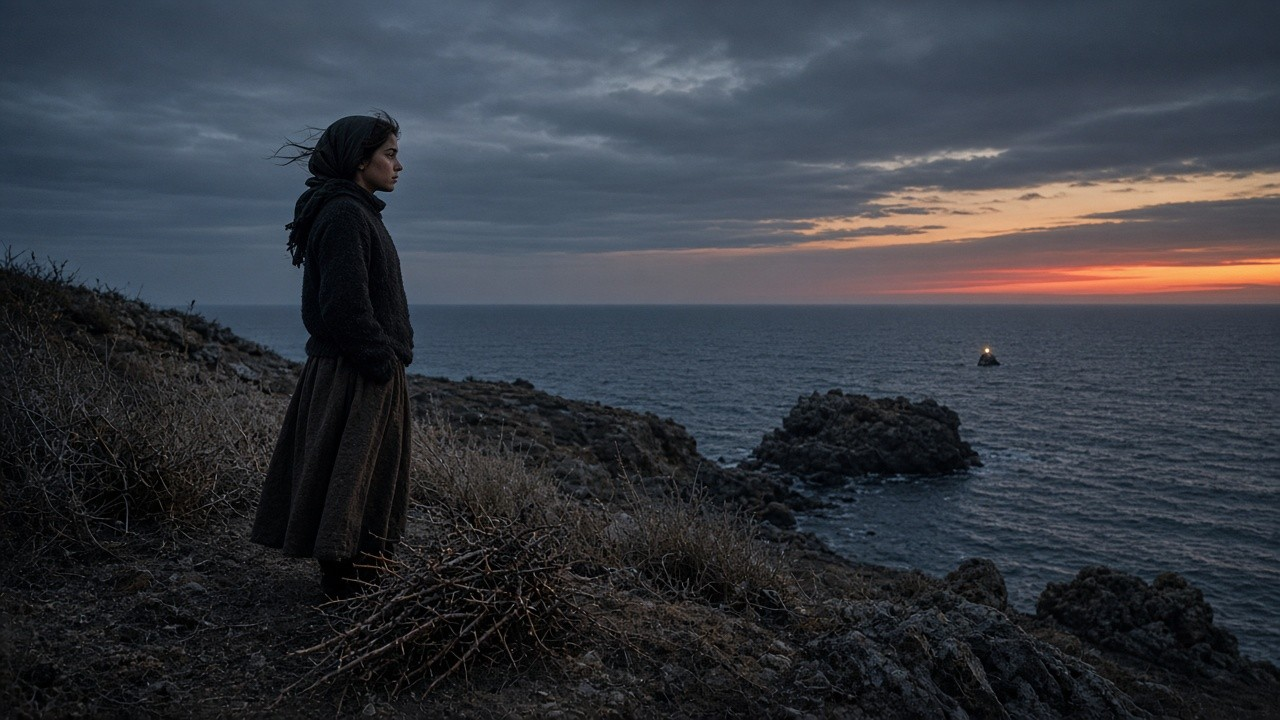
A ww2 Greece story, told as a short story. Lena, her family, the soldiers and the plane are all made up. However, the island is real. Antikythera is a speck of rock between Kythera and Crete, and in November 2026, the first service was held over the wreck of an Australian plane lost off its coast in December 1943. Three of its airmen still rest there. So this ww2 Greece story imagines one girl on that island, that same winter. (For another story from December 1943, read our ww2 Christmas story.)
The Light on the Water
The plane came down at dusk, and I was the only one who saw it.
I was on the west cliffs, pulling dry thorn bushes for the fire. The north wind had blown for three days. Now, finally, it had dropped, and the sea lay flat and gray like a sheet of tin.
First I heard it. A low hum came from the south, from the direction of Crete, and one engine coughed like an old man on the church steps. Then I saw it, dark against the red sky. It had two engines, and it was flying much too low.
It passed over the Goat Rocks. Then it touched the water, bounced once, and went in.
There was a white burst of spray. After that, there was nothing at all. The sea closed over it like a hand closing over a coin.
My thorn bundle slipped out of my arms. Even so, I did not bend to pick it up.
Then, out past the rocks, a tiny light came on. It blinked three times and went dark. A moment later, it blinked three times again.
I looked back over my shoulder. Up on the hill, by the old windmill, two soldiers stood at their post with a field glass. However, they were looking north, toward Kythera, where the German boats came from.
Nobody else was on the cliffs. Only me.
Our Island in WW2 Greece
My name is Eleni, but on the island everybody called me Lena. Only my brother Petros ever called me Wick. He said my hair stood straight up like a lamp wick. Besides, trimming Mama's lamps was my job.
Antikythera is a small island. You can walk across it in a morning. We had goats, thorn, stone walls, one church, a dark lighthouse at the north end, and the sea all around. Long ago, divers had pulled bronze statues out of that sea, and a green lump full of tiny wheels. Baba said the sea gives things back when it wants to, not when you want it to.
The Italians came in 1941. Then, in the autumn of 1943, Italy quit the war, and the Germans came instead. There were fewer of them, but they were colder.
Baba was a fisherman. That winter, though, his chest was bad, and he coughed in bed all day.
Petros drowned in March of 1942. He went out alone in the little boat one night, and only the boat came back. When I was small, I used to watch his lamp from my bed while he fished, until I fell asleep.
We held a service for him at the church. The whole island came, and the women wept. Mama did not cry. Everybody said grief had frozen her.
After the service, Mama put a small oil lamp in our south window, the one that faces Africa, where nobody we knew lived. Since then, she had lit it every single night.
The Germans had ordered every window dark. However, Mama's lamp was so small, and it sat so close to the icon of the Virgin, that the soldiers called it a church thing and let it be.
The Sea Lay Down

I ran home so fast that I tasted blood.
Baba was asleep, his breath rattling. Meanwhile, Mama was next door with Big Mitsos's wife, who had a new baby. So I took the oars off the wall and went down to the cove.
Our boat was small and blue and older than me. I had rowed it since I was six. Still, I had never rowed it in December, at night, alone.
The sea was quiet, and that helped. The cold, however, bit right through my sweater, and soon my hands went numb on the oars. Behind me, the island turned into one black hump against the stars. In front of me, there was only black water, and somewhere in it, a man.
I rowed toward the Goat Rocks. Twice I stopped and waited, and twice the light came back. Three blinks. Dark. Three blinks.
Soon I heard water slapping against something. Then I saw it. It was a little round yellow boat, like half of a giant orange, and a man lay across it.
He wore a heavy leather jacket with a fur collar. His face was swollen and gray with cold. When I touched his arm, he jerked and lifted a small metal torch.
"English?" I whispered. It was the only foreign word I knew.
For a long moment he did not answer. Then he nodded.
"Thank you," he said in English. His voice was a croak.
I tied his yellow boat to ours, and then I rowed until my arms burned. All the way back, Mama's lamp sat in our south window, small and steady, and I steered by it.
The Goat Hut
Above our cove stood an old stone hut where Baba kept the goats in bad weather. It had one low door and no window.
I helped the man up the path. He leaned on me, and he was heavy, and he shook so hard his teeth clicked. At the door, I opened my mouth to tell him to bend.
But he was already bending. He ducked under the low stone in the pitch dark, as if he had done it all his life. At the time, I thought nothing of it.
Inside, it smelled of goat and old hay. I found Baba's spare blanket and the sacks we kept for the baby goats in winter. Then I pulled off his wet jacket and wrapped him up.
"I'll bring a lamp," I said.
"No." He caught my wrist. "No light. Please."
So we sat in the dark. I gave him the two barley rusks from my pocket, and he ate them slowly, the way hungry people eat.
After a while, he spoke again. "Four," he said, and held up fingers I could barely see. "Four men."
"Only you," I said. "I only found you."
He made a small sound, as if something hurt inside him. Then he turned his face to the wall.
I stayed until his shaking stopped. After that, I went down, dragged the blue boat high up the stones, and turned it over so the wet inside would not show.
When I came home, Mama was back. She looked at my hair and my wet sleeves.
"Wind," I said.
She studied me for a long time. Then, without a word, she went back to her lamp.
Teapot
The soldiers came in the morning, three of them, up from the harbor at Potamos.
Their sergeant was short and round, and he whistled through his teeth when he climbed. That was why the boys called him Teapot. He had been on Crete for two years, so he spoke Greek, but badly, like a man with stones in his mouth.
He waited in the square by the church until the whole village came out. Then he held up a hand.
"Last night, an English airplane falls in the sea," he said. "At dawn, we find one English. On the rocks by Potamos. Alive. Very cold. Very angry."
At that, some of the old women crossed themselves. Meanwhile, I kept my hands in my apron.
"In the airplane are four men," Teapot went on. "So we look for three more."
Next he named the reward. A sack of flour. A tin of olive oil.
Everybody went quiet at that. We all remembered the first winter of the war, when people starved in the streets of Athens, and on our island the children's bellies swelled.
Then came the other part.
"Who hides an English," he said, "we burn his boat. And the men of his house go to Crete."
He let that sit. Then his eyes moved slowly over the crowd and stopped on me.
"You," he said. "Girl. Yesterday my soldier on the hill sees a girl on the cliffs. With the thorn."
What I Told Them

At once, everybody turned to look at me.
My mouth was so dry I could not swallow. Behind me, I felt Mama step closer.
"Tell," Teapot said. He did not sound angry. Instead, he sounded tired, like a man who wanted his lunch.
I could tell him everything. Then the flour would go to somebody hungry, and Baba's boat would stay ours, and nobody would go to Crete.
Or I could tell him nothing. But his soldier had seen me. So if I said nothing, he would know I was lying.
In the end, I told him the truth. I just did not tell him all of it.
"It fell by the Goat Rocks," I said. "I saw it go in."
"And then?"
"Then I saw one light on the water." I swallowed. "And then it went out."
Teapot wrote something in a little black book. Afterward, he looked out at the sea for a moment, as if he could see the place.
"One light," he said. "Then nothing." He closed the book. "The sea is cold, little one. In December, the sea keeps them."
He touched his cap to the priest. Then the three of them walked back down toward Potamos.
Mama's hand landed on my shoulder. It stayed there, heavy and warm, but she said nothing.
A Sack of Flour
That afternoon I carried water past Big Mitsos's door. It stood open a crack, and I heard his wife.
"A whole sack, Mitsos," she said. "Do you know how long a sack lasts? Until Easter. And if I don't eat, the baby gets no milk."
"I know," Mitsos said.
"Also, Yannis's blue boat was upside down this morning. Who turns a boat over in December, when the weather is good? Somebody with something to hide."
For a long time, Mitsos said nothing.
Finally he said, "Let me think, woman."
I walked on with the water, and I did not spill a drop. However, my knees had turned to soup.
After all, Big Mitsos was not a bad man. He had carried Petros on his shoulders when Petros was small. Still, I had seen his baby, all eyes and no cheeks. And I knew what a sack of flour was worth on our island, because I had been hungry too.
At supper, I could not eat. Mama put my bread aside for the morning without a word, because in our house nobody wasted bread, not even then.
That night, I sat on my bed with my shoes on and waited for the knock on the door. Every time a dog barked, I stood up. Every time the wind moved the shutter, I stopped breathing.
It never came.
The Englishman
At dusk, I went up to the hut with bread, a few olives and a cup of Baba's wine. Before I went in, I knocked once.
"It's me," I said. Then I remembered he could not understand me. Still, he said "Thank you" again, and somehow I heard him smile.
We sat in the dark while he ate. He spoke a few English words, and I spoke a lot of Greek, so we got by with our hands.
He pointed at himself, and then at the sky.
"Boat," he said. "Saint night. Point." He pointed north. "Light."
Slowly, I worked it out. A boat would come for him on the night before Saint Nicholas, at the north point. He would signal with his torch.
Saint Nicholas is the saint of sailors. On our island, nobody fished on his day, and even the Germans let the boats rest.
"Your father?" he asked. "Fisherman?"
"Sick," I said, and coughed to show him. "My brother was a fisherman. But he drowned."
He was quiet for so long that I thought he had fallen asleep.
"Sorry," he said at last, very softly.
Before I left, he pressed something into my hand. It was two little coins.
"Church," he said. "Two candles." He held up two fingers in the dark. "Two friends."
I closed my hand around the coins until they were warm. I did not ask about the fourth man, since I already knew. The fourth was the angry one on the rocks.
The Search
The next day, the soldiers searched.
They came with a dog and poked into every shed and cistern on the island. Meanwhile, Teapot went down to the cove to look at the boats.
From the wall above, I watched him stop beside our blue boat. It was right side up now. He bent and put his hand inside it.
Big Mitsos was mending a net nearby. So Teapot called him over and pointed.
For a moment, I forgot how to breathe.
"This boat," Teapot said. "Two nights ago, it goes out?"
Mitsos spat on the stones. "That one? That's Yannis's boat. Yannis is sick in bed two weeks. I pulled it up myself, Sergeant. Dry as a bone."
He did not look up at me, not even once.
Then the dog started up the path toward the goat hut. Quickly, I grabbed a stick and ran at our goats in the next field, shouting. They scattered across the path, bleating, and the dog went wild.
The soldier holding the leash swore and hauled it back. Teapot laughed.
"Island girl," he told the soldier. "Island goats." After that, they went back to the village.
Then I sat down in the thorns and shook until my teeth hurt.
That evening, Mitsos's wife brought Mama a little bowl of chickpeas. She did not speak to me. Yet when she left, she touched my hair quickly, the way you touch an icon.
Saint Nicholas Eve
On the night before Saint Nicholas, Mama scrubbed the floor and polished the icon. Even Baba sat up in bed and drank a little soup.
"Tomorrow, not even the Germans will fish," he said, and he laughed until he coughed.
As always, Mama lit her lamp in the south window. This time, though, she stood beside it for a long while, looking out at the dark sea toward Africa.
"Go to bed, Lena," she said without turning round.
So I went to bed. Then I waited until the moon went down, and I climbed out the back window.
The Englishman was waiting outside the goat hut. He stood straighter now, but he still kept his face down and away. I led him by the hand along the goat paths to the north point, below the dark lighthouse. It took two hours. Twice we lay flat in the thorn while a patrol passed along the ridge.
At the point, he climbed down onto the last rock above the water. Then he lifted his torch toward the black sea.
Three short. Dark. Three short.
I stared at the light in his hand, and something cold turned over in my stomach. Before I could think, though, a light answered from the sea.
Three Short
A long low shape slid out of the dark with no engine noise at all. It was a fishing caique like ours, only bigger, and the men in it rowed with wrapped oars.
Soon a small boat came in to the rocks. Two men in dark sweaters jumped out and held it steady.
The Englishman turned to me. For a moment, he just stood there, as if he were deciding something. Then he bent close, and for the first time, he spoke in Greek.
"Goodnight, Wick," he said.
I could not breathe.
Nobody in the world had called me that for almost two years. Only one person ever had.
"Petros?" It came out of me as a whisper.
"Shh." He put his cold hand on my cheek. "You never saw me. You saw an Englishman. If they ever learn that a son of this house flies with the English from Africa, they burn the house. Understand?"
I nodded. Tears ran down into my collar.
"Tell Mama the lamp works," he said. "Every clear night we fly over. And every clear night, I look for it."
Then the men in sweaters pulled him into the boat, the oars dipped, and the dark took him.
Out on the water, just before the caique vanished, a light blinked. Three short.
Every night of my childhood, that was how Petros had said goodnight from his boat. And I had watched it from my bed until I fell asleep.
The Lamp in the South Window
I ran all the way home, and this time I did not care about patrols.
Mama was sitting at the south window in the dark kitchen. She had not gone to bed at all. When I came in, she did not ask where I had been.
"He says the lamp works," I said. After that, I could not say anything else.
Mama closed her eyes. Then her shoulders shook, just once.
"I know," she whispered. "Who do you think it was for?"
That was when I understood why she had not cried at the church. After all, you do not cry at the funeral of a son you put on a boat to Egypt yourself.
In the morning, on Saint Nicholas Day, I lit two candles in the church for two men I had never met. Teapot stood at the back with his cap in his hands. He looked at me once, and then he looked away.
Two nights later, the sky was clear. Mama lit the lamp, and I trimmed the wick, and we sat beside it in the dark.
Late, very late, we heard it. A plane came over low from the south, from Africa. Just above our roof, a small light winked under its belly.
Three short.



Leave a Reply