A WW2 Christmas story set in Surrey, England, in December 1943, told as a short story. Sprout, Stretch, Aunt Nell and everyone at Larch Hall are made up. However, the Canadians were real. Thousands of young Canadian soldiers spent the war in Surrey, and Canadian sappers built Dunsfold airfield there in 1942. This story imagines one of their Christmases. (For another box that waited years to be opened, read The Secret Box in Our Garage.)
My WW2 Christmas Story
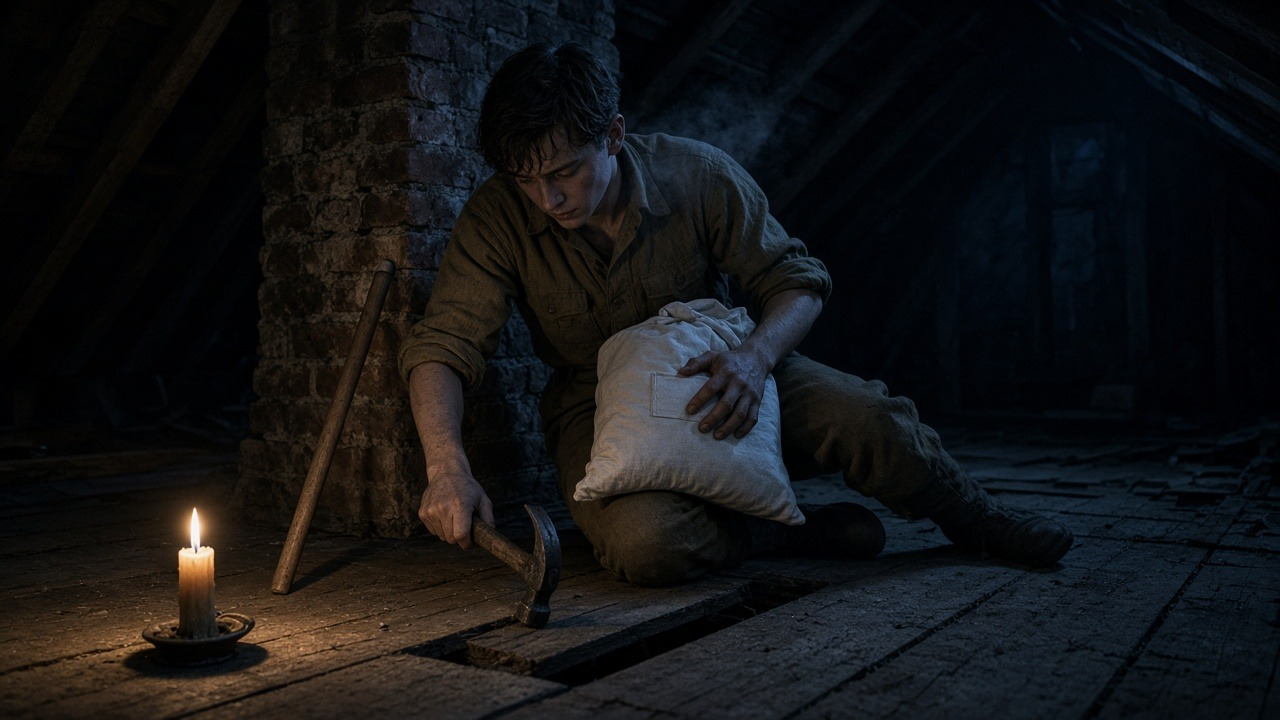
I hid Aunt Nell's parcel on the ninth of December, 1943. I did it with a stolen claw hammer, a candle stub, and a knee that would not bend.
Up there, the attic of Larch Hall was cold enough to see your breath. Still, I was sweating by the time the second board came up. Then I laid the white linen bag in the dark space between the joists. I kept my thumb over the name on the label the whole time. After that, I put the board back and tapped the old nails into their old holes, one soft tap at a time, so nobody downstairs would hear.
Finally, I rubbed dust into the cracks with my thumb until the floor looked like nobody had touched it since Queen Victoria.
I had one reason. It was not the cake, although Aunt Nell made the best fruitcake in Saskatchewan. It was not the gum, either.
My granddaughter calls this my WW2 Christmas story. She has heard it a hundred times. Even so, I will tell it straight, the way it happened, and I will get to the reason at the end.
Sprout and Stretch
My name is Tad Miller. In 1943, though, nobody called me that. Everybody called me Sprout, because I was the youngest man in the company and looked it.
I was seventeen. You had to be nineteen to go overseas with the Canadian Army, so I lied. Actually, Stretch lied for me. We walked into the recruiting office in Moose Jaw together in the fall of 1941, and Stretch put his big hand on my shoulder.
"This is my cousin," he told the sergeant. "He's nineteen. He just eats light."
The sergeant looked at me for a long time. Then he looked at Stretch, who was six foot four and had to duck under the door. Finally he sighed and signed the paper.
By the way, Stretch was Danny Kerr. He was two years older than me, and he lived on the next farm down the road. We were not cousins. Even so, he was the closest thing to a brother I ever had.
Together we joined the Royal Canadian Engineers. That made us sappers, which is the army word for a man who builds things and then gets told to build them faster. Once we got to England, we dug drains, poured concrete, and put up huts. We also cut roads through the prettiest farmland you ever saw, and we did it so fast the English farmers called us locusts.
Then, on the twenty-seventh of November, I rolled a jeep.
The Ice
Because of the blackout, nobody had real headlights. Instead, every truck crept along behind two little slits of light, like a cat with its eyes half shut. The lane near Dunsfold had a skin of ice on it that you could not see until you were on it.
I was driving. Meanwhile, Stretch was beside me, singing something rude about the colonel.
Suddenly a lorry came around the bend. I turned the wheel. Then the wheel turned me.
Sometimes, even now, I still feel it jump in my hands at night.
Next thing I knew, I woke up in a hospital in Guildford with cracked ribs and a knee the size of a cabbage. Later, a court of inquiry came and asked me questions. Afterward, they wrote down that it was the ice, the dark, and nobody's fault. In the end, they were very kind about it.
Stretch went to Brookwood on the train on the second of December. I could not even stand up to see him off.
Larch Hall

When the doctors were done with me, they sent me to Larch Hall to mend.
Larch Hall was a big gray stone house on a hill outside Guildford, with too many chimneys and not enough coal. The family who owned it had moved to a cottage for the war. Battalion headquarters had the ground floor, so the hall smelled of ink, wet wool and pipe smoke. Upstairs, under the roof, there were twelve iron cots for men like me. We were the walking wounded, and we walked as little as possible.
Worse still, every meal was mutton. There was mutton stew, mutton and cabbage, mutton with something gray poured on it. One fellow from Winnipeg swore that if he lived through the war, he would never look a sheep in the face again.
Still, two people made the place bearable.
The first, of course, was Mrs. Budd, the cook. She was a round little woman from the village with flour on her elbows and a husband on a destroyer somewhere in the cold. Better still, her girl Peg came with her every day. Peg was nine. She had two missing teeth, and she knew exactly one phrase of Canadian.
"Got any gum, chum?"
The second was Sergeant Hollis in the orderly room. We called him Pencil, because there was always one behind his ear, and because he was thin as one. Besides the paperwork, Pencil ran the mail. He was forty, and he had a dry way of talking that made the Adj, our captain, go red in the face.
Aunt Nell
Now I should tell you about Aunt Nell, because this is her story too.
To be honest, she was not my aunt. In fact, she was not really anybody's aunt except Stretch's. His mother died when he was small, and Nell, her sister, raised him on the farm next to ours. My own mother died when I was six. My father was a hard man with a hard hand, so before long I was eating more Sunday dinners at Nell's table than at ours.
Even so, everybody on our road called her Aunt Nell. She was that kind of woman.
Every fall, as soon as the harvest was in, she made the fruitcake. It was dark and heavy, wrapped in waxed paper, and full of raisins she had been saving since summer. Each Christmas she also knitted socks, two pairs, one for each of us boys. Stretch and I fought over socks the way other brothers fought over the last pork chop. So Nell knitted the toes of my pair in red.
"There," she said, the first year she did it. "Now you can both stop bleating."
From then on, it was red toes every year. Even in England, we still had them.
The Wrong Pile
The parcel came on the ninth of December.
That morning I was limping down to the kitchen to beg tea from Mrs. Budd. On the way, I passed the open door of the orderly room. As usual, the mail went to Pencil first. He sorted it into piles on two tables, and he did it the same way every morning.
On one hand, the big table by the door was for the living. That pile went upstairs.
On the other hand, the little table by the window was for everything else.
And there it sat on the little table, a white linen bag the size of a loaf of bread, sewn shut with heavy thread. The address was inked right onto the cloth in a big round hand I would have known anywhere. Also, a customs label was stitched to one corner. CAKE. SOCKS. GUM. BEANS. TOMATO JUICE. BOUILLON CUBES. TEA.
My heart did something it had not done since the ice.
"Sarge," I said. "That's from Aunt Nell."
At last Pencil looked up from his ledger. Then he looked at the bag, and then at me. He did not say anything for a while.
"Can't, kid," he said finally. "Rules."
"Just for tonight. I'll bring it back."
"Rules, Sprout." He went back to his ledger. Yet his pencil did not move.
That night, after lights out, the orderly room was dark and the door was not locked. I am not proud of it. Nevertheless, I would do it again tomorrow.
The Grate
The attic had an old iron grate in the floor, left over from some Victorian way of heating the house. It sat right above the Adj's office. If you lay down beside it, you could hear every word.
That is how, on the morning of the tenth, I heard the Adj find out.
"A parcel walks off my returns table," he said, "in my headquarters, two weeks before Christmas. Do you know what that is, Sergeant?"
"Yes, sir."
"It is theft from His Majesty's mails. The postal inspectors are here on the twentieth. On top of that, the colonel wants a clean house for Christmas, and Brigade has already cut our coal. I will not stand in front of an inspector and tell him I lost a parcel in my own building."
"No, sir."
"Find it. And search that kitchen. That cook's girl is in and out of here all day with her hand out."
"Sir, she's nine."
"Then she's old enough to know better. If it isn't back by the twentieth, somebody goes on a charge. And it won't be me."
All that time, I lay on the cold boards with my cheek on the grate. Meanwhile, a few feet away, under a board I had nailed down myself, Aunt Nell's parcel sat in the dark.
Peg

They searched the kitchen that afternoon.
First, two corporals went through Mrs. Budd's flour bin and her coat pockets while she stood by the stove with her lips pressed white. They even looked inside the oven. Then they made Peg turn out her little cloth bag. In it there was a hair ribbon, a lump of coal shaped like a dog, and half a ration card.
Of course, they found nothing. Still, the Adj told Mrs. Budd that if the parcel did not turn up, he would find a new cook by Boxing Day. The army paid her wages, and the army could stop.
After that, Peg stopped asking for gum.
For me, that was worse than anything. Now she would come up the back stairs with the tea tray and set it down and go, without a word. Before, she used to stand at the end of my cot and ask me about Canada. Did we have bears? Was the snow really up to the windows? Did we really eat oranges whenever we wanted?
One Egg a Week
One afternoon I found Mrs. Budd crying into the pudding basin.
"It's not the job, love," she said, when she saw me. "Well, it is the job. But it's Christmas too. One egg a week, eight ounces of sugar, and I've a girl who thinks Christmas cake is something in a picture book." She wiped her face with her wrist. "Her dad used to bring her an orange. One orange. She'd make it last a week."
Afterward, I went back upstairs. Then I lay on my cot and looked at the ceiling. Above it was the attic, and in the attic was a fruitcake with enough raisins to make a nine-year-old girl forget her father was at sea.
I could have gone up that night and fixed everything. Instead, I did nothing. That was the worst week of my war.
Pencil
On the twentieth, the morning the inspectors were due, I went down to the orderly room before breakfast. Pencil was alone, with the stamp pad open on his desk and his ledger in front of him.
"It was me," I said. "Not Peg. Not her mother. Me."
Strangely, he did not look surprised. He just took the pencil from behind his ear and turned it over in his fingers.
"I figured," he said.
"You figured? Since when?"
"Since you asked." He nodded at the little table. "Nobody asks for the ones on that table, Sprout."
For a while we were both quiet. Outside, a lorry ground its gears on the hill.
"Where is it?" he asked.
"Safe."
"You know what happens if I find it."
"It goes home," I said.
"It goes home." He looked at the stamp pad. "Every morning I check the names on the list against the names on the parcels. Then I get out the stamp. Forty-one times this year, Sprout. I hate that stamp."
Then, without a word, he opened the ledger and wrote one line. I could read it upside down. Parcel, 1, not received at this HQ. Error at depot.
"Sarge, they'll have your stripes."
"Maybe." He blew on the ink. "Go and tell Mrs. Budd she's still the cook. Then go back to bed before the inspectors see you limping around looking guilty."
Christmas Eve
By Christmas Eve, the house was full of holly and the smell of boiled mutton. Somehow, somebody had found a gramophone. Downstairs, the officers were singing, badly, while the Adj played the piano worse.
So I took my candle stub and my claw hammer, and I went up to the attic for the second time.
This time the boards came up easier. I lifted out the bag and set it on my knees. Then I cut Aunt Nell's thread with my jackknife, very carefully, the way you would open a letter you wanted to keep.
Sure enough, it was all there. Two tins of beans. A tin of tomato juice. A little packet of bouillon cubes and a packet of tea. There was gum, five sticks. Socks, two pairs, rolled tight. One pair had red toes.
And at the bottom, wrapped in waxed paper, was the cake.
On top of everything lay a card in that big round hand.
Two pair socks, one for each of you. The red toes are Tad's, so don't you dare fight. Share the cake. Look after each other. All my love, Aunt Nell.
For a long time I sat in the cold with that card. Then I turned the bag over in the candlelight and read the label one more time, the part I had kept my thumb over since the ninth.
SPR. D. KERR.
The Reason
Stretch was the one the parcel was for. Stretch was the one on the little table by the window.
He went to Brookwood on the train, all right. Brookwood is the big military cemetery in Surrey, where they buried the Canadian boys who died in England. He is still there now, in the Canadian plot, under a stone with a maple leaf on it.
And I was the one driving.
Here is the one reason, the thing I could not say to Pencil or the Adj or anybody. If they found that parcel, they would stamp it and send it home. It would go back across the ocean in the hold of a ship. Then, sometime in February, it would land on Aunt Nell's porch, with her own handwriting on it and a big purple word stamped across her nephew's name.
After all, she already had the telegram. She did not need the parcel too.
So instead, it would stay here. It would stay in England with Stretch.
Red Toes
On Christmas morning, before anyone else was up, I limped down the back stairs to the kitchen with the cake under my arm.
Already Mrs. Budd was lighting the stove. Pencil was at the table with a mug of tea, as if he had been waiting. Probably he had.
Then I cut the cake into four.
Soon Peg came in rubbing her eyes. Then she saw it, dark and shining on the plate, and she stood very still.
"Is that real?" she said.
"Real as Saskatchewan," I said. Then I gave her the gum. All five sticks.
She ate her cake in tiny bites to make it last, the way she used to do with her dad's orange. Mrs. Budd watched her and cried again, but differently this time.
Meanwhile, Pencil just raised his mug. "To Aunt Nell," he said.
"To Aunt Nell," I said. Then, more quietly, "And to Stretch."
Afterward, I went back up to the attic one last time. I put on the red-toed socks. They fit, the way they always did. I put the other pair back in the bag, along with the beans and the juice and the tea and the bouillon cubes. Next, I tucked Nell's card on top, sewed the bag shut with thread I begged from Mrs. Budd, and laid it back between the joists. Finally, I nailed the board down for good.
Still There
That afternoon I wrote to Aunt Nell. First, I wrote that I was healing fine. I wrote that the English were kind and the mutton was terrible. Then I wrote the only lines that mattered.
Your parcel came, Aunt Nell. It came in time for Christmas. We shared the cake.
My granddaughter says that is a sad way to end a WW2 Christmas story. However, I don't think so. Stretch got his Christmas. Peg got her cake. And Aunt Nell got a letter that said her parcel came in time.
I never went back for it. As far as I know, it is still there.


Leave a Reply