An asteroid mining sci fi story, told as a short story. Flea, Ike, Lefty, the Top and Bluestone Mining are all made up. However, the physics is real. In November 2026, ESA's Hera spacecraft sent home new pictures of the asteroid Didymos, a 780-meter rock that spins so fast it is close to coming apart. In fact, scientists think its little moon may be made of rock that slid off it. This story imagines living on a rock like that. (For another rock that was not what it seemed, read our Maui asteroid story.)
Falling Up
The first time I fell up, my uncle caught me by the ankle.
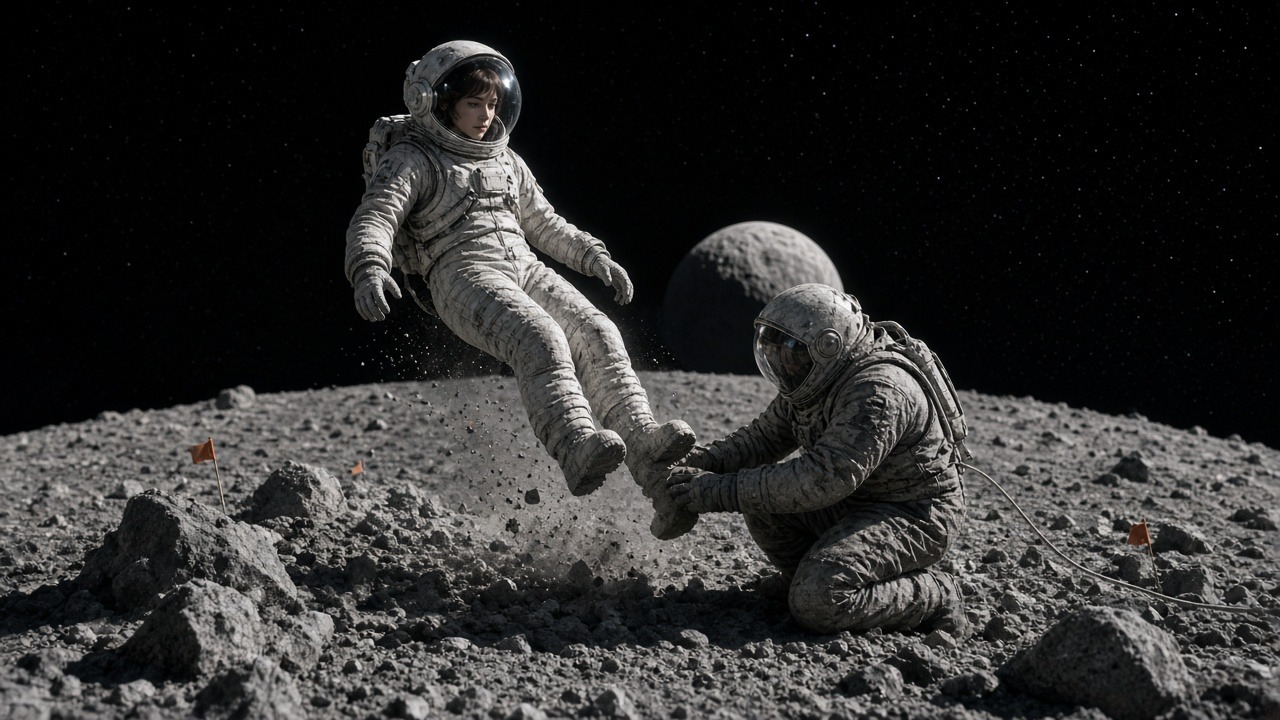
I was nineteen, and I had been on the Top for six days. Until then, I had only worked near the pole, where the ground holds you like a tired hand. That morning, though, I followed a magnet rake too far south. Soon the rock got flatter under my boots. Then the gravel around my feet began to lift. It did not jump. Instead, it rose slowly, like dust in a sunbeam.
So did I.
There was no pull and no warning. One second I was standing on a gray boulder. A moment later, it was two feet below my boots, and the black sky was very large.
Then a gloved hand closed on my ankle. Uncle Ike pulled me down slowly, the way you reel in a kite.
"Clip in," he said. "Always clip in when you go south of the flags."
"I didn't jump," I said, and my voice was shaking. "I swear I didn't."
"You don't have to jump here." He pointed his helmet at the horizon, which was close enough to throw a rock at. "Spin a thing fast enough and it lets go of its children, Flea. That's how a rock gets a moon."
As he said it, Button came up over the edge of the world. Button was our little moon, a lumpy gray potato as wide as a city block. It rose fast, because everything rises fast on the Top.
Ike watched it for a long time. Back then, I thought he was just tired.
The Top

On the company charts, the Top had a long number for a name. Of course, we never used it.
It was a rubble pile about eight hundred meters across, shaped like a child's spinning top. Basically, it was a bag of gravel and boulders held together by almost nothing. Worse, it spun once every two hours and fifteen minutes. That was its whole day.
Because of that spin, the rules changed depending on where you stood. At the poles, a girl my size in a work suit weighed about as much as a penny. At the equator, however, the spin almost cancelled the rock's weak gravity. There, I weighed less than a paper clip. If you dropped a wrench at the equator, it would not fall. Instead, it would just hang there, thinking about it.
Our camp sat near the north pole. We had a hab the size of a school bus, a solar wing, and a little oven called the Kettle. Every day, the Kettle baked our dirt and pulled out the good stuff.
The good stuff was glitter. In fact, the Top was full of tiny flakes of nickel and iron, mixed into the gray dust like sparkles in cheap nail polish. First our magnet rakes combed them out. Then the Kettle melted them into bars, and a cargo drone carried the bars home.
There were three of us. Lefty ran the Kettle. He was thirty-four, left-handed, and from Tulsa, and he sang old country songs on the open channel. Uncle Ike was the boss. And I was Flea, because I was small and, as Lefty said, I kept hopping.
The Debt
My real name is Nora Hale. Still, nobody out there used it.
I was on the Top because of my dad. He had mined rocks like this one for twenty years, for Bluestone Mining. Then, two years before, he died in his sleep on a supply ship. It was his heart. The doctor said it was quick, and I have decided to believe her.
After the funeral, a man from Bluestone came to our kitchen in Denver. He was very polite. He drank Mom's coffee and explained that Dad owed the company for his suit, his training, and three years of air. Altogether, it came to a little over a million dollars.
"The debt rides with the name," the man said. He said it kindly, as if it were a weather report.
So I signed a five-year contract on my eighteenth birthday. Mom cried in the car, while I told her it was just like college, except that I would be paid.
Uncle Ike was Dad's big brother. He had retired to a trailer by a lake in Utah. But when he heard what I had signed, he called Bluestone the same day. Three weeks later, he was my boss on the Top.
He never said why. Instead, he gave me grief about my knots.
He also carried a paper notebook with a pencil on a string. Every night, he filled pages with numbers about the Top's spin. Most of them meant nothing to me. Still, one number on the inside cover was circled twice, and next to it he had drawn a tiny, lopsided moon.
Real Asteroid Mining Is Not Sci Fi
Lefty liked to say that our lives sounded like a cheap asteroid mining sci fi show.
"Brave young miner! Danger at every turn!" he would announce. Then he would look at me, scraping dust off a rake with a butter knife, and laugh until he coughed.
He was right, of course. Real asteroid mining is mostly cleaning. The dust is fine and sharp, so it sticks to everything, even teeth. As a result, each night we spent an hour brushing each other off in the airlock like monkeys.
The rest of the job was waiting. First we waited for the Kettle to cool. Then we waited for the drone. Mostly, though, we waited for Vance.
Vance was our boss at Bluestone, in an office somewhere on Earth. The Top was so far away that a radio call took a minute and a half to reach him, and a minute and a half to come back. So every talk with Vance was a speech, a long silence, and then another speech.
During the long silence, Ike usually wrote in his notebook.
Around then, Ike started a strange new habit. Every night after dinner, he slid a pad across the table and told me to sign my full name.
"Nora Jean Hale," he said. "The whole thing. Neat."
"Why?"
"Because your signature looks like a spider fell in the ink. Besides, forms are coming. Insurance forms."
So I practiced. Twenty times a night, I wrote Nora Jean Hale until it looked like a grown-up's name. Naturally, Lefty called it my homework.
Vance
The bad news came on a Monday.
"Good morning, Top," said Vance. His voice was smooth and friendly, like a man selling a nice car. "Here's the thing. Nickel prices dropped thirty percent this month, because the big metal rock in the Belt came online. So I need you to do two things."
Then came the silence.
"First," Vance went on, "from today, you're paid for six hours a day, not ten. Anything after six is your own time. Second, I need you on the ridge. The ridge dirt is twice as rich and ten times easier to scoop. Otherwise, I bring you home at the end of the month, and the contract is done. Your call, Ike."
Ike pressed the talk button. "No."
After that, we waited a minute and a half for Vance to hear it, and then another minute and a half for his answer.
"Think it over," Vance said at last. "We'll talk tomorrow."
That night, I asked Ike what the ridge was. He didn't answer. Instead, he took me out to the edge of the flags and pointed south.
The Ridge
At the Top's fat middle, the rock had a sharp seam, as if someone had pinched it all the way around. That was the ridge, a wave of gray gravel frozen just before it broke.
"The spin pushes loose dirt toward the middle," Ike said. "It goes grain by grain, for a million years. So all the fine stuff ends up there, and the glitter ends up there too. That's why Vance wants it."
"So why won't you dig it?"
"Because it's barely hanging on." He tapped his helmet against mine, so he didn't need the radio. "Up there, the ground already moves as fast as an orbit. It doesn't fall off. It just hasn't noticed yet that it could."
Later, Lefty told me the rest. Ten years before, a crew on another rock had dug a ridge like this. A slab slid out from under one man, and he drifted off into the dark. Eventually, they caught him with a drone and a net, three hours later. By then, he had eleven minutes of air left.
"That's why the insurance won't cover ridge work," Lefty said. "Not one cent. Read your contract, Flea. Page forty."
Of course I hadn't. Hardly anyone does.
Two nights later, I heard something I was not supposed to hear. Ike was in the airlock with the inner door almost shut, on the private channel. Vance's voice came through the gap, small and tinny.
"Ike, let's be adults. If somebody gets hurt out there, it did not happen on the ridge. Understand? It happened at the pole. That way, the insurance people never have to know."
However, that was not the worst thing I heard that week.
The Paper
The worst thing came on Thursday.
I had gone to the airlock for my spare gloves. Once again, Ike was on the private channel, with the door open a crack. So I stopped and listened. I am not proud of that.
"There's one more thing," Vance was saying. "The girl still has three years on her father's debt. If you want this contract to go on, I want her signed for five more, starting today. Send me the paper with her name on it, and we're square."
Then came the minute and a half. Meanwhile, I stood in the dark hallway and counted my heartbeats. I counted to a hundred and four.
Finally, Ike pressed the button.
"Send the paper," he said. "I'll sign for the girl."
I don't remember going back to my bunk. All I remember is lying there with my face in the pillow, so Lefty wouldn't hear. Eight years! I would be twenty-seven before I saw Mom again. All of it was for a debt I had never made, on a rock that was trying to throw me off.
And the one man I trusted had just sold me for a better price on dirt.
The next morning, I didn't speak to him. I just ate my oatmeal and stared at the wall. Ike didn't seem to notice. He just wrote in his notebook, and once, he smiled at a number.
That afternoon, he pressed the talk button and said one word to Vance.
"Yes."
Yes

After that, everything moved fast.
Ike planned the ridge job the way other men plan a wedding. For two days he walked the seam with a handful of orange flags. He planted them in a long, curving line, then moved half of them. Every hour, he checked his notebook against the clock.
"We cut at two in the morning," he told us. "Saturday."
"But that's after hours," said Lefty. "Vance won't pay for that."
"No," Ike said. "He won't. It's our own time."
Even so, I saw him and Lefty look at each other for one second too long.
In the evenings, Ike shut himself in the airlock. He was building something on the workbench and painting it. Whenever I came in, he threw a tarp over it. Once, though, I saw a corner. It was a stubby orange beacon, the kind that blinks and talks to satellites. It had something painted on the side that I couldn't read.
On Friday night, he slid a stack of forms across the table.
"Ridge insurance," he said. "Sign every page. Use your best signature."
I looked at him for a long time. Then I signed every page, Nora Jean Hale, neat as a schoolteacher. I didn't read them, because I didn't care anymore what they said.
Afterward, Ike signed under me on every page, on a smaller line, in his ugly little capitals.
"Good," he said quietly. "That's my girl."
That night, I went to bed without saying goodnight.
The Cut
At two in the morning, the Top was in its short night, and the stars were thick enough to touch.
First we clipped in at the flags. Then Lefty ran the cutter, a long arm on a tracked cart that bit into the gravel along Ike's line, while I ran the cable. Ike stood on the high side, holding his notebook like a Bible.
Halfway through, he handed me the orange beacon.
"Survey marker," he said. "Walk it out past the line, ten meters. Screw it in deep and switch it on."
"Past the line? But that's the part that's going to move."
"That's the point. We want to see where it goes."
So I walked it out on my safety line, crossed the cut, and drove the beacon into the gravel. As soon as I switched it on, it started blinking orange, slow and steady, like a heartbeat.
Just as I was walking back, the whole ridge began to sigh.
There was no sound, of course, since there is no air. But I felt it through my boots. It was a long, soft shudder, like a sleeping animal turning over. All around us, gray dust lifted in a slow fog.
"Clip check!" Ike called.
I reached for my clip. Suddenly I saw that my line had snagged on the far side of the cut, on the piece that was leaving.
Let Go
At first it was gentle. My boots left the ground, and I rose with the dust. Then the line pulled tight and tugged me toward the slab. That slab was as big as a barn, and it was peeling away from the Top as slowly as a page turning.
Strangely, I wasn't scared yet. That came later. Mostly, I remember how quiet it was.
Then a hand closed on my ankle.
Ike didn't pull hard. He never did. He just held me with one hand and unhooked my snagged line with the other, like a man untangling a fishing reel. Soon the line came free and floated away. After that, he reeled me down, and I knelt on the gravel beside him, shaking.
"Twice," I said. "That's twice."
"Last time, I hope," he said roughly.
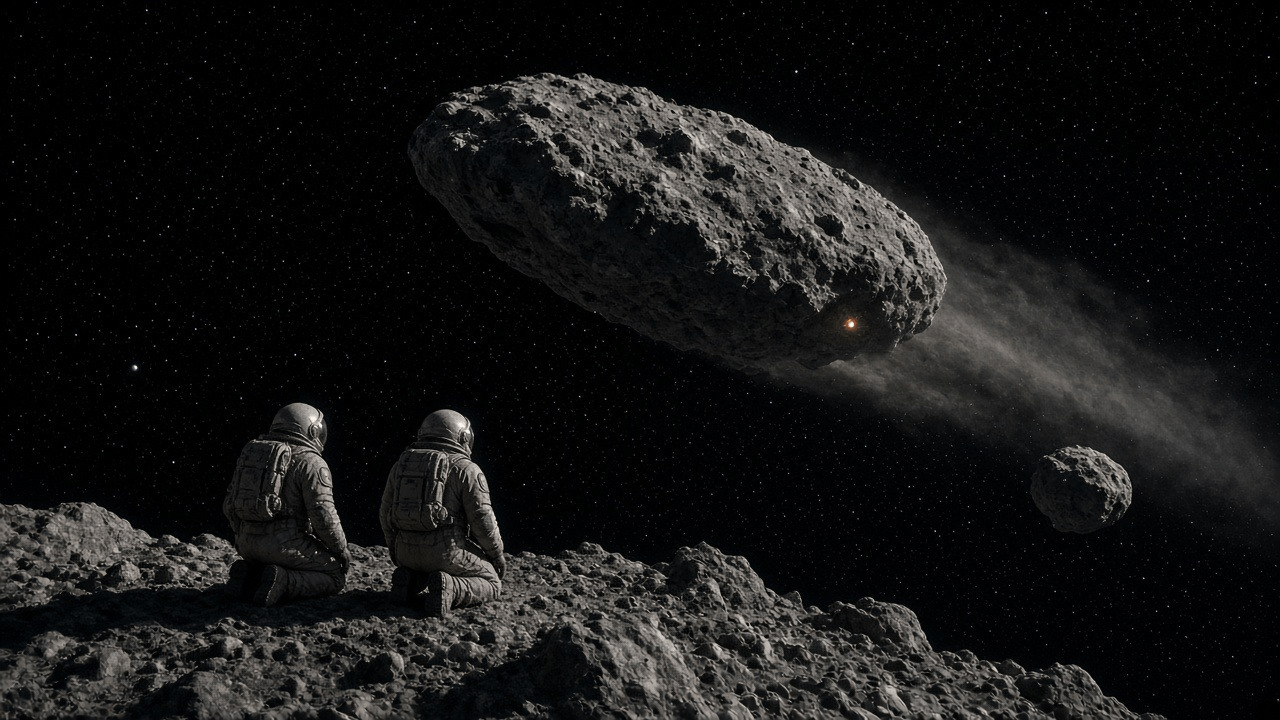
Together we watched the slab go. It drifted up off the ridge with a long gray tail of dust behind it. It didn't fall back, and it didn't fly away. Rather, it kept rising, a little higher each minute, turning slowly. On its side, my orange beacon blinked.
Over the open channel, Lefty was laughing and crying at the same time. "Look at that," he kept saying. "Would you look at that."
Out in the dark, Button had just come over the edge. Now there were two moons in the sky.
Then Ike opened his notebook and showed me the circled number on the inside cover. It was today's date, and the time, two in the morning. Next to it sat the tiny, lopsided moon.
Who Owns a Moon
Vance called at seven.
"Ike." He was not smooth now. "The sensors show a big piece of the ridge in orbit, full of glitter. That's seven thousand tons of company ore. Bring it in."
Once more we waited the minute and a half. Ike was already smiling.
"It's not company ore," he said. "Check the registry. Then check her contract, section nine."
Three minutes later, Vance came back, and his voice was very quiet.
"Section nine says anything a worker finds on her own time is hers," he said slowly. "We wrote that so we'd never pay finder's bonuses." Then he stopped. "And the registry has a new body around the Top. The first beacon on it belongs to Nora Jean Hale. Witness, Isaac Hale."
I looked at Ike. Ike looked at his boots.
"Those weren't insurance forms," I said.
"No."
"But you said you'd sign for the girl."
"And I did," he said. "On the witness line." He tapped the notebook. "Six months of numbers, Flea. I had to know exactly when that ridge would let go, and how deep to cut. Also, I had to know your beacon would ride the piece that stayed up. And Vance had to cut our hours first, so the cut would happen on our own time. He did that part for free."
"So what about the paper Vance wanted, with my name on it?"
"I sent it to him," Ike said. "It just wasn't the paper he expected."
Every Rock Lets Go
Bluestone bought the moon from me three weeks later. After all, they wanted that ridge dirt badly, and the posted price was the posted price, even after a thirty-percent drop.
It paid Dad's debt three times over, and I flew home in the spring.
Ike stayed on another month to close the camp. On his last night, he called me in Denver. Since it took ninety seconds each way, mostly we just listened to each other breathe.
"Did you name it?" I asked.
"The registry wants a name." Then came the long silence, and then his voice again. "So I told them it already has one. It's painted on the beacon."
Somehow, I knew before he said it. Maybe I had known since the airlock.
"Spin a thing fast enough," he said, "and it lets go of its children. That's how a rock gets a moon. I just gave it a little push, Flea."
The beacon still blinks out there in the dark. And on its side, in Ike's ugly little capitals, it says FLEA.


Leave a Reply