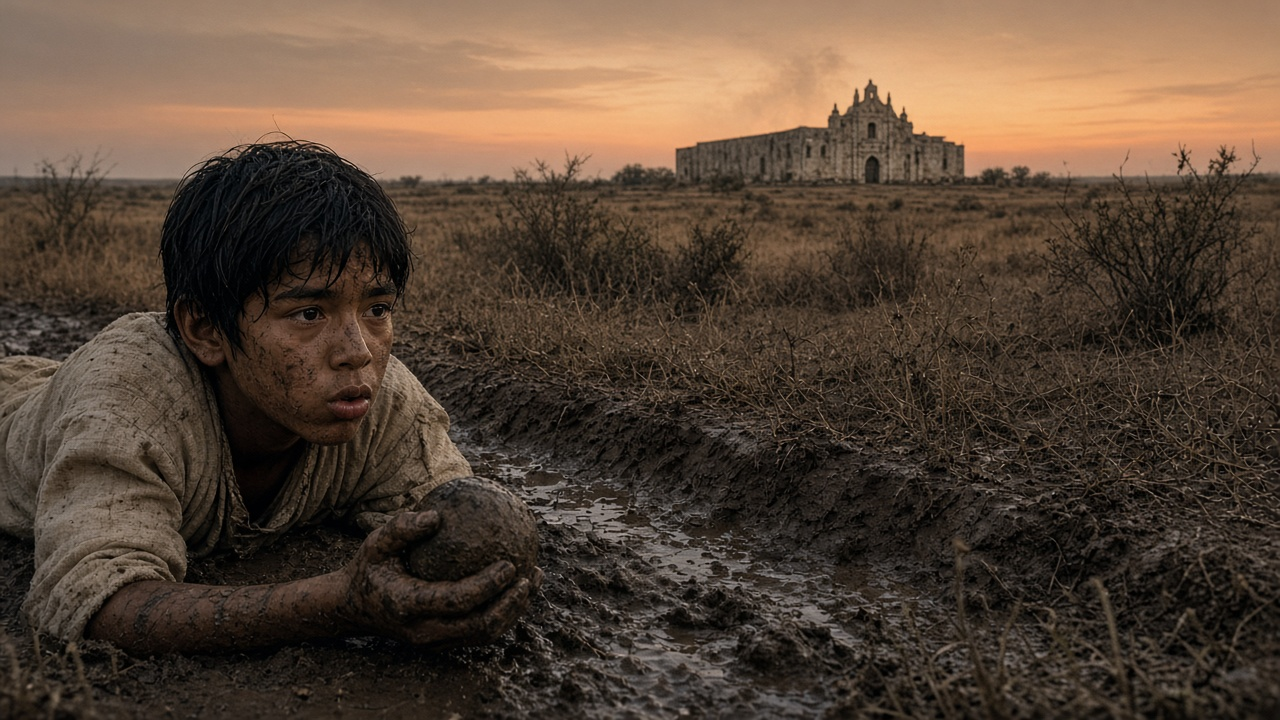
A short Alamo story from the siege of 1836, told as a short story. Beto, his family and everyone around him are made up. However, the cannonballs were real. During the siege, the men inside the walls picked up the balls fired at them and fired them back. In October 2026, archaeologists announced four battle-era cannonballs found beside the old church. So this story imagines a boy who picked them up on the other side.
A Moon on the Ball
I scratched the moon with Papa's knife, the way Nico taught me. First, one long curve. Then a thinner curve inside it, like a fingernail.
Like the others, the ball was bronze and cold, about the size of my fist. It had landed in Old Garza's onion field that afternoon, so it was still caked with mud.
When the moon was done, I lay flat in the ditch and waited for dark.
Across the field, the old church sat gray against the sunset. Above it, smoke hung over the walls. Somewhere a dog was barking too, and meanwhile the army band was tuning up for the night.
Then I whistled. It was our family tune, the one Papa used to whistle to call us home from the river. It went three notes up, then a little drop.
At first, nothing happened. After a while, from the roof of the church, somebody whistled the last three notes back.
Nico.
He never called my name, though. Not once, in all those nights. Of course, talking carries across a field, and a whistle doesn't. So I told myself that was smart.
Why I Tell This Alamo Story
My name is Roberto, but only the priest ever used it. Everyone else called me Beto. That winter, when all this happened, I was thirteen.
People in Bexar tell the Alamo story about the men inside the walls. That's fair, since they paid the most. However, there were also people outside the walls, and we were the ones who lived there.
We had a little kitchen on the plaza. Every day, Mama made tortillas and beans for the soldiers, whichever soldiers were in town that year. Papa had been a soldier too, before the fever took him. After that, his brother, Uncle Chuy, came by every Sunday to check our roof and eat our beans.
Nico was nineteen. Unlike me, he was tall and slow to talk, and he carved little moons on everything. One sat on the door frame. Another was on Mama's big spoon. Papa's knife had one on the handle, too.
"Why always moons?" I asked him once.
"Because the moon always comes back," he said. "Even on the nights you can't see it, it's still up there."
That fall, there was fighting in the streets of Bexar. When it ended, Nico joined the Tejano volunteers with the Texians. Mama cried about it for a week. Meanwhile, Uncle Chuy rode south with the army, because that was his job.
So in our family we had one man on each side, and Mama prayed for both.
The Night the Army Came
By February, everyone in town knew the army was coming back. Still, the men in the old mission didn't believe it.
On the twentieth, people started packing carts. The next day, our neighbor ran in with news. Fifteen of the Tejano men had walked out of the Alamo to move their families south, out of the army's road.
Mama put down her spoon. "Not Nico," she said. "Nico gave his word."
Then she went back to her beans, and nobody said it again.
Two days later, the army came. First, we heard the bugles. Then the church bell rang, and the Texians ran for the old mission with cattle and corn and anything they could carry. Before dark, the gate was shut.
That night, a red flag went up on the tower of our church in town, across the river from the Alamo. I was too young to know exactly what it meant. However, I saw Mama's face, so I knew enough.
Don Paco's Debt
Don Paco owned the store on the corner. He was short and loud, and he strutted when he walked, so we called him the Rooster behind his back.
In January, the men at the mission had taken our corn for their stores. They paid with a paper promise. Of course, Mama couldn't buy flour with paper, so she bought it from the Rooster on credit.
By February, the credit had a number. Worse, it was a big one.
"Sunday," the Rooster told her, the week the siege began. "Pay me on Sunday, Senora, or I take the kitchen."
So I went to work.
As it happened, the Rooster bought metal. He took iron, nails, old hinges, anything, as long as it was metal. Above all, he wanted cannonballs.
"Bronze, half a real each," he told me. "Iron, less. And don't get shot, boy. Dead boys don't bring me anything."
Gathering Balls Between the Lines
There were plenty of cannonballs that first week. The army's guns fired at the walls all day. Many shots went long, so they skipped over and rolled into the fields and ditches on the far side.
Soon I learned the work. You go at dusk, when the light is bad. Then you stay low in the ditches. Above all, you never stand up straight.
Once, a rifle shot kicked dust a few feet from my hand. After that, I lay in the mud for an hour, shaking. Another time, a young soldier with a cough found me in a ditch. He was maybe sixteen, with his feet wrapped in rags.
"Go home, chamaco," he said. Then he gave me half his biscuit, and he walked away.
On the twenty-sixth, a cold wind came down from the north. Soon the ground went hard, and my fingers went numb. That same day, the guns inside the walls almost stopped.
"They're saving powder," Uncle Chuy told me. He had come into town with the presidial company, the soldiers who used to guard Bexar. "And shot, too. They pick up every ball we send them, Beto. Then they send it back."
After that, I thought about it all night.

The Boy with the Cough
A few nights later, I found the boy with the cough again. He was sitting alone behind a low wall of dirt, near one of the army's guns, wrapped in a thin blanket.
This time I didn't run. Instead, I sat down next to him, because it was too cold to be proud.
"You again," he said. "The ball boy."
His name was Pepe, and he came from a village far to the south. He had walked the whole way, he said, even through snow in the mountains. Some of his friends had not finished the walk.
"Do you have a brother in there?" he asked, nodding at the walls.
I didn't answer. Even so, he understood.
"I have one at home," he said. "He's your size. He wanted to come with me." He coughed for a long time. "I told him no. Somebody has to bring in the corn."
After that, he dug into his coat and handed me an iron ball. It was smaller than the bronze ones, though, and rough, like a lump of coal.
"One of theirs," he said. "It came over this morning. Sell it to your Rooster, ball boy. Then buy your mama some flour."
So that night I carried home a ball from inside the walls, given to me by a boy outside them. I sold it, too. Mama bought flour.
Mama's Question
Every evening, I came home with mud to my elbows and a few coins in my fist. Then Mama counted them on the table. Then she put them in the coffee can on the shelf, under the moon on the door frame.
She never asked where the coins came from. Instead, she asked one thing.
"Did he whistle?"
"He whistled," I said.
Each time, when I said it, she closed her eyes and let out her breath. Then she went back to the stove.
After a while, I started to whistle the tune while I worked in the ditches, very softly. Somehow it made the dark feel less big. Besides, it felt like Nico was beside me, the way he used to be at the river.
On the third of March, a big gun inside the walls fired three times in the morning. Then, later, it fired again. Uncle Chuy said they would fire it three times a day now.
"Why?" I asked.
"So the town knows they're still there," he said.

What I Heard Behind the Store
That same week, I carried a sack around to the back of the Rooster's store. As usual, the door was open a crack. Inside, he was talking to a sergeant with a gray mustache.
"Bronze is bronze," the Rooster said. "I don't ask whose boy finds it."
"Just bring more," the Sergeant said. "The big guns are still a week behind. Monday, they say."
"The General won't wait for Monday."
"No," the Sergeant said. Then again, he sounded tired. "He won't."
Then the Rooster laughed. "Tell the widow Sunday," he said. "No later."
For a long time I stood very still with my sack. Because now I understood. Every ball I sold went back to the army's guns. Then the army fired it at the walls. And behind the walls was Nico.
That night, I took out Papa's knife.
From then on, I scratched a moon on every bronze ball I sold. It was a prayer, I suppose. Fly high, little moon. Fly over his head. Come home.
And every dusk, I whistled from the ditch, and somebody whistled back.
Uncle Chuy's Orders
On the fourth of March, Uncle Chuy came to our kitchen and ate without talking. Afterward, he walked me out to the street.
"We have orders," he said quietly. "The men from Bexar stay back. When it comes, we don't go in."
"Why?"
"So that no cousin has to shoot a cousin." He looked across the river toward the old mission. "Somebody up there has a heart, at least."
"When it comes," I said. "When is that?"
He didn't answer, so I knew it was soon.
The next day, the fifth, was warm, almost like spring. By then, too, the north wall was crumbling. Still, people said the big guns were coming on Monday. And all day the army's cannon fired, so nobody in town could sleep.
Then, at ten that night, the guns stopped.
The Quietest Night
I have never heard a quiet like that. No cannon. No band. Finally, even the dogs had gone still.
Earlier, at dark, Uncle Chuy had come back. He stood in our door with his hat in his hands. "Tomorrow, before light," he told Mama. "Keep the boy inside. Bar the door."
Then he looked at me, and I looked at the floor.
Mama fell asleep in her chair with her rosary in her lap. Meanwhile, I lay on my blanket with my eyes open. In my pocket was the last moon ball. I had found it that afternoon by the river, and I hadn't sold it yet.
Tomorrow, after all, was Sunday. The Rooster would want his money. However, I wanted something else much more.
So I got up, and I opened the door very slowly.
The Window in the Church
I went by the ditches, the way I knew. The grass was wet. Still, the stars were very bright. Twice I passed soldiers asleep in their blankets, and twice I held my breath.
At last I reached the old church. Up close, though, it was huge. Everywhere, the stone was scarred where the balls had hit. Near the northeast corner, a little way up the wall, there was a small window.
I stood under it, and I whistled.
At first, nothing. Then, from the dark window, the last three notes came back. Soft, but very close.
"Nico," I whispered. "Nico, come out. Uncle Chuy says tomorrow, before light. Come with me through the ditch. Please."
Something moved. Slowly, a face came to the window, pale in the starlight.
It was not Nico.
The Face at the Window
He was a young man, maybe nineteen, just like Nico, with red hair and a sunburned nose. Even in the dark, I could see his freckles.
"Your brother isn't here, little brother," he said. His Spanish was slow and bad, but kind.
For a moment, I couldn't speak.
"He left on the twenty-first," the redhead said. "With the others. He went south for your grandmother, on the Medina. He was going to tell your mama first. Then the army came between."
So all those nights, Nico had been out there on the roads. Not in here. Not behind the walls at all.
"Before he left, he asked me to look out for you," the redhead went on. "He said you'd come whistling. So I answered, to let you know somebody was listening. Also so you'd stay away from the walls." He almost laughed. "That part didn't work."
Next, he reached into his shirt. "We had to fire your moons back," he said. "All but this one. This one I kept."
He held out a bronze ball. On its side was a little scratched moon. One long curve, and a thin one inside it.
I took it. Surprisingly, it was warm from his shirt.
"Come with me," I said. "Through the ditch. Nobody will see."
But he shook his head. "I gave my word," he said. "Same as your brother would have."
"What's your name?"
"Red," he said. "Now go home. Bar the door."
The Moon by the Wall
I didn't go right away. Instead, I stood there with two moon balls, his and mine, one in each hand. Together they were too heavy to run with.
So I knelt and set his down in the dirt, right at the corner of the church, close against the stone. The moon always comes back, Nico said. Maybe, I thought, it would bring Red luck.
Then I ran. All the way home I ran, through the ditches and the wet grass. Once inside, I barred the door. Afterward, I sat down beside Mama and held her hand until the sky went gray.
I never sold the other ball. On Sunday, the Rooster could wait.
But some nights, even now, I still see the first one. A little bronze ball in the dark dirt at the corner of the old church, with a scratched moon on its side, under all those quiet stars.


Leave a Reply