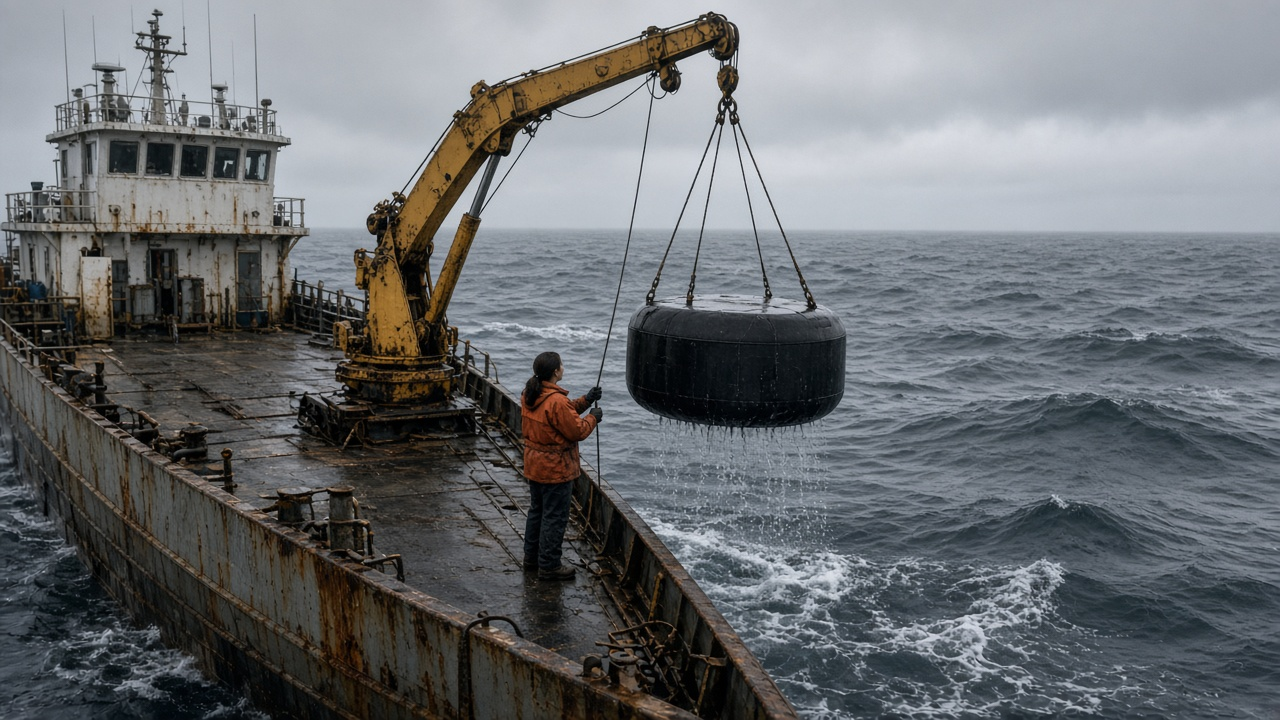
A lost at sea story set in 2031, told as a short story. The company, the boat and the people are all made up. However, the test behind it is real. In October 2026, a small SpaceX capsule called Starfall carried Air Force cargo pods to orbit and back down to a splashdown in the Pacific. The pods held medical kits, food, a tracker and a water maker, and engineers also checked whether a life raft would fit inside. So this story asks what it might be like, a few years from now, to be the one who fishes those capsules out of the sea.
The Puck
The capsule fell out of space on a Thursday, and my job was to pull it out of the ocean before anybody took a picture.
"Clean and quick," Cap said, reading it off the paper taped by the wheel. "No phones on deck, and no pictures. Also, nobody talks about it in bars." Then he looked at me over his glasses. "That means you, Kid."
"I don't go to bars," I said. "I'm nineteen."
"Then you're halfway there already."
My real name is Rosie, but nobody on the Dolly Mae used it. On my first day, Big Lou asked how old I was, and Cap said, "She's the kid." After that, I was Kid, even on the paycheck envelopes.
The Dolly Mae was an old supply boat out of San Diego, long and slow and patched with paint. Cap owned her, together with the bank, but mostly the bank.
Seven Hundred Miles Out
For two years, we had worked for a rocket company called Highline. Highline sent small capsules up into orbit. After a day or two up there, the capsules came back down under parachutes and landed in the Pacific, about seven hundred miles west of San Diego. Then we went out and picked them up.
Each capsule looked like a giant hockey puck, about ten feet across and black on the bottom. So of course everyone called it the Puck.
The pay was good, too, because nobody else wanted to sit seven hundred miles out for a week. Since Dad left, Mom had cleaned offices at night in National City. So every check I got went half to her, and the other half went into a coffee can for a car I still did not own.
Twenty People in a Box
However, this Puck was special. It carried cargo pods, the way the real test ones had a few years before. Inside, there were medical kits, food packs, batteries and a satellite tracker. There was also a water maker, a little machine that turns sea water into water you can drink.
And for the first time, there was a life raft. It was a big orange one, for twenty people, folded tight into its own pod. When it touched the water, it would blow up by itself.
"Think about it," Cap said, when Doc showed us the list. "One day, somebody's ship goes down a thousand miles from anywhere. Then forty minutes later, one of these falls out of the sky right next to them."
"That's the dream," Doc said. "That's exactly the dream."
Doc was Highline's engineer on board. He was about thirty, with a thin beard and a laptop he carried like a baby. He worried all the time, too. First he worried about the weather, and then about his sensors and the coffee. Mostly, though, he worried about his boss.
His boss was Mr. Hale, who ran the whole program from an office with a view of the bay, and he called Cap's sat phone more than Cap's wife did.
The Dummy
Two weeks before the trip, we practiced in Highline's yard by the harbor. The yard was hot and dusty, with a fence around it and seagulls on every post.
They kept a second Puck there, a trainer for crews like us. It looked exactly like the real one, right down to the black bottom, but it had no rocket parts and no computers inside. Everybody called it the Dummy.
"The Dummy will never see the sky," Doc said, and patted it like a horse. "Poor thing. It just gets opened and closed by people like you."
We practiced all morning. First we opened the hatch, and then we lifted out the pods. After that came the raft.

Doc let me pull the handle on the practice raft, right there on the concrete. It went off with a bang like a car crash, and it grew and grew until it was the size of a small house. Big Lou laughed so hard that he had to sit down.
Then folding it back up took us two hours. Meanwhile, the sun cooked us, and my hair kept falling in my face.
A Small Toll
I had a yellow hair tie with a little plastic daisy on it. It belonged to my sister Mia, who was eight. Our dog had chewed one petal off, so it only had four. On the morning I first left for sea, Mia had pushed it into my hand.
"So you come home," she said.
But somewhere in that yard, I lost it. When we finished, I looked under every pod and in every corner of the Dummy, but it was gone.
"The sea takes a toll, Kid," Cap said. "Better a hair tie than a finger."
Clean and Quick
The morning we left San Diego, Mr. Hale called while we were still in the harbor. Cap put him on the speaker, because his hands were busy with the wheel.
"Walt," Hale said. "Big week. The board meets Friday, and the government people will be in the room."
"We'll get it," Cap said.
"I know you'll get it. But I need it clean. If the pods look good, they sign for six more flights, and the recovery contract is yours for another year."
"And if they don't look good?"
There was a little pause. "Then I can't protect you, Walt. The big boats want this work. They have cranes the size of churches."
"There's a clean bonus for the crew, too," Hale added. "Tell them that."
When I heard that, I did the math in my head. A clean bonus was two months of Mom's rent.
Then Cap hung up. For a while, he didn't say anything. Instead, he looked down at the deck, at the rust coming through the gray paint, at the old crane with its slow leak.
"The bank likes clean too," he said at last.
Later, Big Lou told me the Dolly Mae had two more payments before it was Cap's for real. "He's been paying on her for eleven years," he said. "So if we lose Highline, we lose the boat."
That night, I called Mom from the deck while we still had a signal.
"Don't become a lost at sea story," she said. That was her joke every time I left. But this time, she didn't laugh when she said it.
The Boat With No Name
After that, it took almost three days to get out there. The sea was long and gray, and the swells came from the north in slow hills. Because the old engine rattled, I slept with a pillow over my head.
Meanwhile, Big Lou did crosswords in the galley and never finished one. Doc checked his laptop every hour, while Cap sat in the wheelhouse with cold coffee and an old country song playing low on the radio.
On the last night before the splashdown, I had the midnight watch. At about two in the morning, a dot showed up on the radar, eight miles to the north. It was moving east, fast, back toward the coast.
Usually, every boat out there shows a name on the screen. This one showed nothing, no name and no number. It was just a dot, hurrying home in the dark.
So I woke Cap, and he came up in his socks and looked at it for a long time.
"Fishing boat," he said finally. "Some of them switch off their name so nobody steals their spot."
"Out here? Seven hundred miles out?"
"Tuna go where they want, Kid." He yawned. "Then the boats go where the tuna go."
Then he went back to bed. Still, I watched the dot until it slid off the edge of the screen.
What Doc Said
After my watch, I couldn't sleep. So I went out on the back deck for some air.
Doc was out there already, on the sat phone, with his back to me. The wind was blowing toward me, and I heard every word.
"It'll be there," he said. "Yes. I know what the numbers say. I've been looking at the numbers for two days."
He listened for a while. Then he rubbed his face with his free hand.
"No, they don't know. Cap doesn't need to know. He just needs to pick it up."
Again, he listened.
"I understand, Mr. Hale. If the board sees a zero on Friday, there's no seventh flight. And there's no me either. I get it."
I backed away quietly and went inside. In my bunk, I stared at the ceiling.
At the time, I thought I understood. I thought Doc's sensors were showing a problem, maybe heat or a bad seal. I thought he was scared the cargo would come back cooked. So in my head, I said a little prayer for the Puck, the same way Mom prays before a ball game.
Back then, I thought he was just afraid of bad news. It was worse than that, but I didn't know it yet.
Splash Day
At breakfast, Doc didn't eat. Instead, he slid his mug across the table to me. It was the good coffee, the kind he brought from home in a bag with a gold lid, and he never shared it.
"You're a good kid, Kid," he said. Then he went back to his laptop before I could ask him why.
The Puck was due at 10:40 in the morning. By ten, all four of us were in the wheelhouse, and Doc had his laptop open on the chart table.
Unfortunately, the sky was low and gray, and the clouds sat on the sea like a lid. We were supposed to see a bright streak and then a parachute. Instead, we saw only clouds.
At 10:41, there was nothing. Even at 10:45, there was still nothing.
Meanwhile, Doc kept refreshing the screen. His knee was bouncing so hard the table shook.
Then, at 10:52, his laptop beeped. "Beacon's on," he said, and he let out a breath like he'd been holding it for three days. "Four miles. Bearing two-seven-zero."
"That's close," Cap said. "That's very close. Usually, they land twenty miles off."
"Good targeting," Doc said. "Highline's getting better."
So we turned west and pushed the old engine hard. Within an hour, Big Lou spotted it from the bow. It was a black disk riding high in the gray water, rocking gently, as if it had always been there.
Big Lou and I took the small boat over to put a line on it. As we got closer, I looked all around for the parachute. Normally, the chute floats nearby like a huge orange jellyfish, and it's half our work to haul it in.
This time, there wasn't one.

Soot on My Glove
"Where's the chute?" I called back to the Dolly.
On the radio, Doc's voice came back fast. "It cuts loose on impact. New design. It probably sank."
"They don't sink," Big Lou said quietly, only to me. "They float for days."
I reached out and touched the top edge of the Puck with my glove. The black came off on my fingers, like soot from a barbecue grill. Even so, the paint underneath was smooth and clean.
I couldn't see any scratches or chips. In fact, it looked almost new, as if it had come out of a box that morning. Then again, this was only my second season, and I had only ever seen five of them up close.
We hooked it up, and Cap swung it on board with the crane. The old crane groaned and leaked oil the whole way, while Cap swore at it like a brother.
When the Puck was down on the deck, it sat there dripping in the cold air, black and quiet, with the soot running down its sides in little gray streams.
Everyone stood around it, but for a moment nobody said anything.
"Well," Cap said. "Clean and quick."
After that, Doc took pictures of it on his Highline camera from every side, even though his hands were shaking.
Every Boat Has a Lost at Sea Story
The plan was to leave the pods sealed for the lab. But when we opened the outside hatch, we saw a problem right away.
Sea water was dripping out of a crack in the seal of the raft pod.
"If that raft blows up in there, it'll smash every other pod," Cap said. "Open it, Doc."
At first, Doc just looked at the pod. Then he looked at me. "You do it, Kid," he said. "You did it in the yard. My hands are no good today."
So I knelt down and opened the raft pod.
The raft was there, orange and folded, but it wasn't folded right. The folds were loose and lumpy, with corners sticking out, like somebody tired had stuffed it back in a hurry. Worse, the gas bottle that blows it up was already empty. I could tell by the little red flag on the valve.
"It's been used," I said.
Nobody answered me. Instead, Doc went very white. Big Lou looked at Cap, and Cap looked at the sea.
"Every boat out here has a lost at sea story, Kid," Cap said quietly. "I always swore this boat would never be one."
Up in the wheelhouse, the sat phone began to ring.
I didn't get up. Instead, I put my hand on those lumpy orange folds. I knew those folds. I had made them, on a hot day, with my hair in my face.
Caught deep in the orange, small and yellow and still a little wet, was a hair tie with a plastic daisy on it. One petal was chewed off.

Leave a Reply