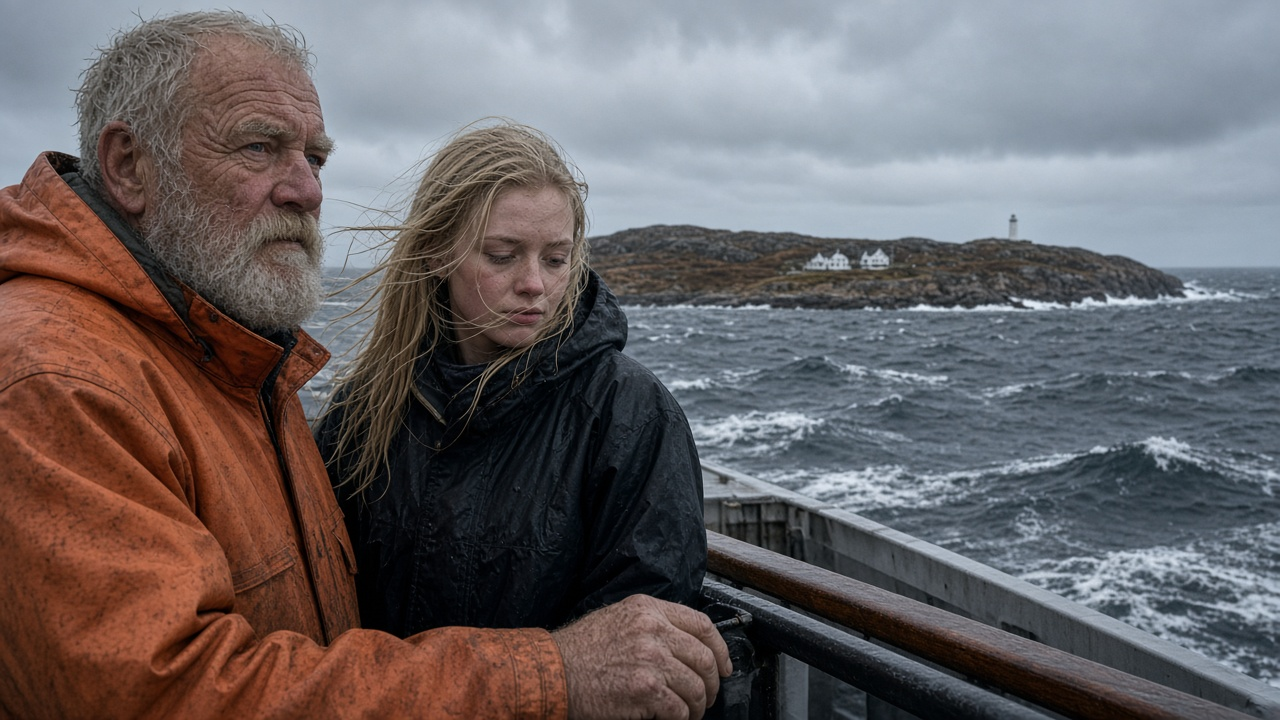
A mercury submarine story, told as a short story: on the island of Fedje, Norway, a seasick young press officer is sent to sell a quiet plan for a sunken U-boat, and the loudest old fisherman in the hall has a secret. This is fiction, so the people are made up. However, the wreck is real. On February 9, 1945, the British submarine HMS Venturer sank U-864 west of Fedje, and all 73 men aboard died. In fact, on September 1, 2026, Norway's Coastal Administration sent the ministry a new report that recommends covering the wreck. The ministry has not decided yet, and this story does not say what it will decide.
Not Over That Rail
I was sick three times on the ferry to Fedje. The third time, an old man held my hair.
"Not over that side," he said. "Into the wind is for tourists."
So I moved to the other rail. He kept holding my hair the way you hold a rope for a stranger, with no fuss at all. The sea was gray and lumpy, and the sky sat on it like a wet lid. Behind us, the mainland got small. Ahead, a low, bare island rose out of the water, all rock and brown heather and white houses.
"First time out here?" he asked.
"First time on a ferry since I was ten," I said. Then I was sick again.
When I stood up, he was watching me with pale, wet eyes. He was eighty at least, but built like a bollard on a pier, in an orange work jacket that had seen everything. His hands were huge, too. However, on his left hand, the first finger stopped short at the first joint.
"You cry like a gull," he said. "Gull. That is your name now."
"But my name is Ida."
"Not out here."
Meanwhile, at his feet sat two plastic crates of live crab, claws tied, clicking softly. Because I wanted to say something normal, I said, "You must eat crab every day."
He laughed, a big dry laugh like a door in the wind. "I sell them. I don't eat them."
So I pointed at his short finger. "A crab did that?"
"No," he said. "A bad winch in '79." After that, he turned away and watched the island come.
The Mercury Submarine
My job is words. I am twenty-four, and I am a new information officer at the Norwegian Coastal Administration. I have been there five months, so I am still on probation. In other words, one bad week can end it.
Still, this was supposed to be an easy week. The Director had said so himself. "Explain the plan, smile, pour coffee."
So here is what I was sent to explain, in plain words.
In February 1945, a German submarine called U-864 set out from Bergen on a long, secret trip to Japan. Then, off Fedje, a British submarine called HMS Venturer found her. Both boats were under water at the same time. Venturer fired four torpedoes, and the fourth one hit. It is the only time in history that one submarine has sunk another while both were submerged. All 73 men on U-864 died.
In her keel, she carried mercury for Japan's war factories. Even though nobody has the papers to prove it, people believe it was about 67 tonnes, packed in steel flasks. The navy found the wreck in 2003, about 150 meters down and broken in two, around four kilometers west of the island. Since 2006, fishing and boat traffic near it have been banned.
Then, this June, our hired robots opened part of the keel and lifted 22 flasks. Some were whole. However, many had leaked, and loose mercury lay in the mud like spilled beads. So our new report said: cover it. Put a thick cap of clean sand and stone over the wreck and the bad seabed, and leave it.
After that, the ministry in Oslo would decide. Not us, and not the island.
"Our job is to explain," the Director told me before I left Bergen. "Fedje's job is to nod."
Covering Is Cheaper
That first evening, I set up chairs in the community hall. The Director had come out on the late ferry to look at the room. Meanwhile, he took a call in the little kitchen and left the door open a crack.
"Covering is cheaper and safer," he said. "I know. I know that. But I need Fedje to nod, not to be on the evening news."
There was a pause.
"No, she's new. She's fine. She looks harmless. That's the whole point."
So I put the next chair down very, very quietly.
When he came out, he was smiling. He was about fifty-five, with a neat gray beard and a rain jacket that had never met rain. "Ida! Good." Then he patted the coffee machine. "Calm is a skill, you know. Calm, clear, short. On Friday, we want one story in the paper: the island listened."
"And if they don't nod?"
"Then we were not calm enough," he said. He laughed as if it were a joke. Even so, his eyes did not laugh at all.
After that, he caught the last ferry back, and I was alone with ninety chairs.
Lift It
On Tuesday, we held the drop-in day. I pinned up maps and a drawing of the wreck in two pieces. Also, I set out the waffles, because on the coast nobody trusts a meeting without waffles.
As soon as the doors opened, the old man from the ferry came in. He did not take a waffle. Instead, he went straight to the map and put his short finger on the red box that marked the ban zone.
"Lift it!" he shouted. "Get it out of our sea!"
A woman pouring coffee rolled her eyes at me. "Don't mind Hook," she said. "He has shouted that for twenty years."
So that was his name. Hook. It fit him the way a hook fits a hand.
"Our report says covering is safer," I told him. Still, my voice came out small. "When you dig into the wreck, mercury spreads while you work. In June, about three kilos got out of the work area, even with all the care in the world."
"So be more careful," Hook said.
"It also leaks now. About four kilos a year, the studies say. In fact, a cap stops that."
"A cap hides that," he said. "You put a blanket over poison, girl, and it is still poison. It just sleeps under a blanket."
After that, he came back the next day and shouted it again. Then he came back the day after that, too. "In thirty years," he told two young fishermen by the door, "kids will still hear the word Fedje and think mercury submarine."
A Man with a Clean Promise
On Wednesday, Mr. Lund arrived in his own fast gray boat. He ran a salvage company out of Bergen, and he looked like a man who owned good boots and used them. He was forty, tanned, with very white teeth.
"Call me Lund," he said to everyone. Soon, everyone did.
Then he handed out shiny leaflets with a picture of a crane on a big ship. Across the top, it said in friendly letters that his team could do it. "Lift it," he told the hall, "and the island gets jobs and a museum. Real work, right here, for years."
Of course, the crab fishers liked that. So did the man who ran the shop.
Afterward, Lund found me by the coffee. "You know Parliament asked for a new study," he said. "About lifting the whole boat, or taking out the torpedoes. That door is not closed."
"That's true," I said, because it was. In fact, the ministry says it will order that study next. It was right there in the papers I had read on the bus from Bergen.
"Then say it Thursday. Say the door is open." He smiled. "By the way, when this starts, I will need a local face. Somebody who knows how to talk to the press. Somebody calm."
"I already have a job," I said.
"For now," Lund said kindly, and he went to shake more hands.
The Twins and the Yellow Line
Before dawn on Thursday, two young crab fishers took me out on their boat. Everybody called them the Twins, though they were a year apart. They were maybe twenty-five, both in the same green overalls, both chewing gum.
When we left the harbor, the sea was the color of an old knife. Out to the west stood Hellisoy lighthouse, a tall iron tower from 1855, blinking over the open North Sea. On the boat's screen, a yellow line showed the edge of the ban zone.
"The best grounds are in there," said the older Twin. He pointed past the line. "Our grandfathers fished there. We can't. Every time we sell crab in Bergen, someone jokes about the mercury submarine. And every year the bank still wants its money."
"Our fish and crab are tested every year," said the younger one. "Since 2004. So make the box smaller. That's all we ask."
I wrote it down. In fact, I wrote everything down. That was my one rule.
When we turned for home, the younger Twin looked back at the light. "Hook taught us everything," he said. "Knots, weather, how to read the birds. But he never set a single pot out west. Not once in his life. He says the west is bad luck."
His brother laughed. Still, neither of them looked at the yellow line again.

Seventy-Three
That afternoon, the Director sent me a letter to print and set out on the table. The letter came from a German group that cares for war graves, and it was polite and short.
Above all, it asked, with respect, that the 73 men be allowed to rest in peace. Also, it thanked the people of Fedje for watching over them for so long. Otherwise, it did not ask for anything.
I read it three times. Then I printed it and put it beside the waffles.
Seventy-three is a lot of men. Most of them were young, some barely older than the Twins. Also, the men on Venturer had been young, doing a cold, frightening job in cold, frightening water. Nobody on this island hated any of them anymore. It was just a very old war in very deep water.
Hook found the letter before anyone else. He read it slowly, with his lips moving. Then he folded it very carefully, along its own lines, and put it back.
"They were boys," he said. "Boys don't choose the cargo. I was born that same spring, a few weeks after they went down."
For once, he didn't shout. For a moment, though, he looked a hundred years old.
Thursday Night
By seven o'clock, the hall was full. There were maybe a hundred and twenty people, wet coats on every chair back, the smell of coffee and wool.
My hands shook, so I held the clicker with both of them. First of all, I showed the map, the wreck, the flasks from June, and the cap. Then I said the true thing: our report says cover it, and the ministry decides.
After that, the hall had its turn.
Lund stood up and talked about jobs, cranes, and a museum with big windows. People clapped. Next, the older Twin asked for a smaller ban zone, and people clapped for him too. Then a young teacher asked one quiet question: "What do I tell my class about the water?" Nobody clapped for that. Instead, the hall went still.
Finally, Hook stood up in the back row. He did not need a microphone.
"Lift it!" he said. "Get it out of our sea!"
People laughed a little, the way you laugh at weather you know.
"You cover a thing, it is still there," Hook said. "Ask any man with a secret."
The hall laughed again. However, I did not. For some reason, my neck went cold.
Meanwhile, at the back, the Director stood by the door, typing on his phone with his thumb.

Calm Is a Skill
Afterward, he walked me out into the wind. "Well," he said. "How did it feel?"
"They didn't nod," I said.
"Write that they listened. That is also true." He zipped his jacket. "The minutes go to Oslo with the report, Ida. Nice and short. Your review is in three weeks, by the way."
He did not say it like a threat. Instead, he said it like the weather. Somehow, that was worse.
So I sat in my little rented room above the shop and wrote the minutes. At first, I wrote them his way. Then I deleted them and wrote what happened.
Many in the hall want the mercury lifted. Many want the ban zone smaller. A teacher asked what to tell children about the water. Nobody nodded.
I saved it. Then I did not send it. Instead, I stared at it until the screen went dark.
The Boathouse
On Friday, my last night, someone knocked on my door at ten o'clock. It was Hook, in the rain, without a hat.
"Come," he said. "Bring your phone. And bring your rules."
We walked down a wet gravel road to the water, past dark houses, to his old boathouse. Inside, it smelled of tar and rope and the sea. Old nets hung from the beams like gray curtains. Then he switched on a work lamp and moved a stack of crab pots, one by one, breathing hard.
After that, he took a crowbar and pulled up three floorboards.
Underneath sat a blue plastic drum with a clamped lid. He opened the clamp with his good hand. Inside, something was wrapped in old brown oilcloth.
"I can't lift it anymore," he said. "In 1979, I could."
When he folded back the cloth, I saw a steel bottle, rusted orange and black, about as long as my forearm. It sat in the drum like it had grown there.
"It weighs like a child," Hook said. "Like my girl did, when she was ten."
West of the Light, 1979
"I was thirty-four," he said. "I had a new boat and a big loan. One night that winter, I was trawling west of the light, where nobody had any business being."
He sat down on an upturned crate.
"The net caught on something big. Down deep. The winch screamed, and the wire jumped, and it took my finger with it." He held up the short finger and looked at it, almost kindly. "I wrapped it in a rag. Then I hauled the net up anyway, because nets cost money."
"And this was in it," I said.
"Torn right into the mesh. When I tipped it, one drop ran out on the deck. Silver. It rolled around like a living thing." He shook his head. "My grandfather had a thermometer with that inside. So I knew what it was."
"Why didn't you tell anyone?"
"Because it was 1979," Hook said. "Buyers in Bergen would stop buying Fedje fish if one man said poison out loud. Also, the bank wanted the boat. Above all, I was a coward, Gull. So I hid it here. After that, I never fished west again. And I never ate my own crab."
I sell them. I don't eat them. Now it did not sound like a joke at all.
"For forty-seven years," he said, "I watched my island eat its own fish, and I said nothing. Then in 2003 the navy found the boat, and it came out about the mercury, and I thought, now someone will come for me. Nobody came. Instead, they came for the wreck."
The Rules Are Simple
I knelt by the drum, but I did not touch it.
"In 2014, they found six rusted flasks in the mud outside the wreck," I said slowly. "Empty ones. So yours is not crazy. And the food people lifted their old warning about fish near the wreck in 2015. The tests are real, Hook."
"That is now," he said. "But I didn't know that then."
Then he looked straight at me. "That is why I shout. Lift it. Get it out. All of it, so no other fool ever pulls one up. Even mine."
Because my hands were shaking again, I did the rules in order. First of all, I closed the lid. Then I opened the boathouse door wide for air and told Hook to stay out by the water. Found mercury is acute pollution, and acute pollution goes to 110 first. So I called 110. The fire service took my name and passed it on to the Coastal Administration's duty officer.
Soon, the duty officer called me back. His voice was calm and far away. Is it leaking? Is there any silver on the floor? Has anyone touched it without gloves? Don't sweep. Don't vacuum. No heater. Keep everyone out.
"The response team will be on the first ferry," he said. "They'll seal it, log it, and take it. You did this right."
After that, I called the Director. It was almost midnight. I told him everything, and then there was a long silence on the line.
"Is the old man all right?" he finally asked.
"He's sitting by the water."
"Good. Then write it all down, Ida. The real minutes, too." He let out a breath. "We will talk about your review later. It will be fine."
What the Sea Gives Back
When I went back in, Hook was standing over the drum again. The duty officer had asked for one clear photo for the log, so Hook pulled the work lamp down close.
The light fell hard and white into the blue drum. Beside it, the oilcloth lay folded back. On the rusted shoulder of the flask, a stamp was pressed into the steel, worn almost smooth.
I knew that word. In fact, I had read it in our June report, on flasks the robot lifted from the keel. Almaden. The old mercury mine in Spain.
Then Hook rested both hands on the rim of the drum, very gently, as if it might wake.
"A bad winch," he said softly. "In '79."



Leave a Reply