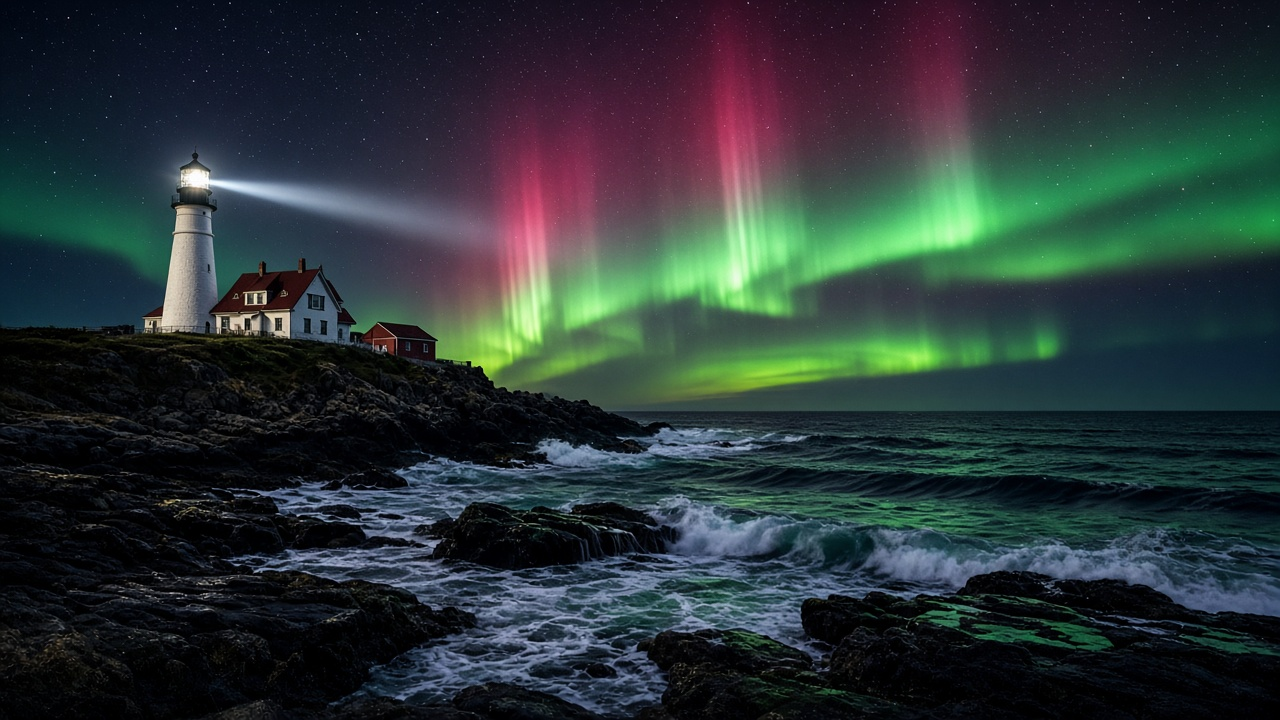
A northern lights short story: on a solar storm night in Maine, a night reporter fights her editor over a scary front page while she waits on the phone with a space weather forecaster she has talked to for two years but never met. This is fiction. The people, the newspaper, and the sky watch are made up, and no story can promise an aurora. For real forecasts, check NOAA's Space Weather Prediction Center.
The Night Desk on Storm Night
My name is Dorothy, but nobody has called me that since second grade. At the Harbor Ledger, I am just Dot. I am thirty, and I am the night reporter, so I cover whatever happens after the day staff goes home. Usually, though, it is a car crash, a town meeting that runs late, or a moose on the turnpike.
On Thursday, the eighth of October, it was the sun.
Our newsroom sits in an old brick mill out by the turnpike, far from the water. We have twelve desks but only six people. There is also a police scanner that never stops talking, as well as a coffee pot nobody has washed since spring.
The storm had a name in our building by Tuesday. At lunchtime that day, the Space Weather Prediction Center in Boulder, Colorado, put out a watch. The sun had thrown a huge cloud of charged gas at us after a medium-sized flare. If the forecast held, the cloud would reach Earth late Thursday night. Then a G1 or G2 storm was likely. On the five-step G scale, that is a one or a two.
In other words, it was a maybe. It was a good maybe, but still a maybe.
Even so, the town of Cape Elizabeth had given an astronomy club a one-night permit to keep the park at Portland Head Light open until three. Normally, though, the gates close at sunset. Because of that, Big Ed had already sent our photographer, Sal, out there with two cameras and a thermos.
Fear Is Traffic
Big Ed came in at six with a box of doughnuts and a tired look on his face. As our editor, he runs the whole show. He is six foot four and sixty-one years old, and he wears the same green sweater every Thursday. He is not a bad man, though. However, he has signed eleven layoff letters in three years, and you can still see every one of them in his eyes.
At seven, the owner called. Big Ed shut the glass door of his office, but the glass is thin, and the door never closes all the way.
"Fear is traffic," the owner said on the speaker. "And traffic is payroll. You want to keep your night desk, Ed? Then give me a front page nobody can scroll past."
"It's a G2 watch," Big Ed said. "That's pretty lights in Maine. Maybe."
"So make it sound like more than maybe."
After that, there was a long quiet. Finally, Big Ed opened the door and walked to my desk. He set a doughnut next to my keyboard, which is never a good sign.
"Dot," he said, "I want the front to read CARRINGTON 2.0."
At first I looked at the doughnut. Then I looked at him.
"Ed, the Carrington Event was the biggest solar storm on record. Back in 1859, telegraph wires threw sparks. But this is a two. In fact, it's not even a three."
"It's a headline, not a lab report," he said. "Put a question mark on it if that makes you feel better."
Then he went back to his office. The doughnut stayed, though.
The Forecaster on the Phone
At eight o'clock, my desk phone rang, just as it always does on storm nights.
"Portland, this is Boulder," said Wes. "How is your sky?"
"Foggy," I said. "How is your sun?"
"Still grumpy. The cloud is on its way."
Two years ago, on the night of October tenth, 2024, a big storm hit. It was a G4, and people saw red skies as far south as Florida. Late that night, I called the Space Weather Prediction Center for a quote. Soon a forecaster named Wes picked up. He explained the whole storm to me in plain words, and he even laughed at my bad jokes. Before he hung up, he asked me one question.
"Can you see it from where you are?"
I could not, because I was stuck at my desk until two in the morning. So I told him that someday I would watch the northern lights from the rocks at Portland Head Light, like a real Mainer.
On the next storm night, he called back to ask if I had made it. Of course, I had not. Since then, he has called on every storm night. Still, we have never met, and we have never even done a video call. He says that is because he has a face for radio. Meanwhile, I look like a raccoon after midnight.
My friends think it is strange. Then again, my friends have never heard Wes explain the solar wind.

Watches, Warnings, and Alerts
"Tell me what I'm allowed to say," I said. "Big Ed wants Carrington 2.0."
Wes made a sound like a man stepping on a rake.
"Okay," he said. "First of all, it's a watch. A watch means we saw the cloud leave the sun, and we think it's coming. A warning comes later, when it's close. Finally, an alert means it's happening right now."
"So when does it get close?"
"There's a spacecraft parked about a million miles out, between us and the sun. When the cloud passes it, we get maybe thirty to sixty minutes of notice. At that point, we finally learn how fast it is and which way its magnetic field points."
"And why does that matter?"
"Because the field is the key. If it points north, then the cloud mostly slides past us. But if it points south, it opens the door, and the energy pours in. That's when you get a show."
"What about the timing?"
"Our model says late tonight, your time. Still, give or take several hours, because the sun doesn't wear a watch."
"And Carrington 2.0?"
He laughed. "Dot, a real Carrington storm would be off the top of our scale, while this is a two out of five. For example, power companies get a heads-up, and some grids up north may see a few alarms. Also, some radio and GPS signals get a little fuzzy. Meanwhile, people in Maine might see a glow low in the north, as long as the clouds let them. Even so, most storm nights here, folks get clouds or a faint gray glow. That's the honest truth."
I typed every word of it, because the truth makes a better story than people think.
Is That a Foghorn?
Soon after nine, the fog on the coast got thick. I could see it on the traffic cameras, a gray wall over Casco Bay. My heart sank a little, since nobody sees the sky through a cloud.
"Is it bad there?" Wes asked.
"Fog on the water. The weather service says it clears after midnight, once the wind turns."
"Then we hope for the wind."
For a while, we talked about other things. He told me about his old beagle, who is staying with a neighbor this week and likes her better anyway. In return, I told him about my landlord, who thinks the sun is a hoax. Then, in the middle of a sentence, a low sound came down the line. It was long and deep, like a giant blowing across the top of a bottle.
Suddenly Wes stopped. "Is that a foghorn?" he asked. "On your end?"
I laughed so hard I spilled my coffee. "Wes, I'm in a brick mill by the turnpike with the windows shut. The only horn here is Big Ed."
"Huh," he said. "Must be the line."
"Must be the line," I said. After that, I forgot all about it.
Mrs. Hale Reads the Wire
At nine-thirty, the main line rang. Even before I picked it up, I knew who it was.
"Is this the night desk?" asked Mrs. Hale. "Is the sky doing anything yet, dear?"
Mrs. Hale is eighty. She worked for the phone company for forty years, and she knows more about old telegraphs than anyone in Maine. On every storm night, she calls the paper and reads the same old story out loud. Nobody asks her to. Over the years, though, I have come to love it.
First she told me about the Carrington Event of 1859. During two nights in early September, the whole sky lit up. Out in the Rocky Mountains, gold miners woke up and made breakfast, because they thought it was morning. Here in the Northeast, people read the newspaper by the light of the aurora.
"And the wires went wild," she said. "So on the line between Boston and Portland, the operators tried something new."
Then she read it to me, as she always does, in two voices.
"Boston says, please cut off your battery entirely for fifteen minutes."
"Portland says, will do so. It is now disconnected."
"Boston says, mine is disconnected, and we are working with the auroral current. How do you receive my writing?"
"And Portland says," she whispered, "better than with our batteries on."
Then she let out a happy sigh. "They worked about two hours like that, dear. No batteries at all. Just the sky."
"Shall I go ahead with business?" I asked, because that is Portland's line near the end.
"Yes," said Mrs. Hale, in her Boston voice. "Go ahead."

Talking on the Wire
When I told Wes about the call, he made me read it all again. He has heard it maybe twenty times, and yet he still wants it every storm.
"We're like those two," I joked. "Talking on the wire for two years. Never meeting."
For a second, he was quiet. "Still, Portland always gets the best line," he said.
Then, out of nowhere, he asked when the paper hit the street.
"The press is in South Portland," I said. "After we close the front page at eleven-thirty, the trucks roll around one. The earliest copies land at the all-night gas station on Shore Road, so the fishermen can buy them."
"Fishermen read your stuff?"
"Mostly the tide tables," I said. "Still, they buy it."
At 10:41, his voice changed.
"Here it comes," he said. "The speed just jumped at the spacecraft. That's the front edge of the cloud, so we're putting out a warning now. It should hit Earth in about forty minutes."
I wrote 10:41 on a sticky note, then stuck it on my screen. My hands were shaking a little, even though I did not know why.
The Headline Fight
At 11:05, Big Ed came and stood behind me, reading my story over my shoulder. My headline said LOOK UP. Under it, in smaller type, it said: Solar storm may light Maine sky. Experts say lights, not blackouts.
"Too soft," he said. "Nobody clicks on soft."
"Ed, it's true. If we scream Carrington tonight and it's just pretty, who believes us next time? When a real one comes, they'll scroll right past."
"Next time, I may not have a night desk to argue with."
Just then his cell phone buzzed. He looked at it, and his face changed. "It's my mother," he said.
When he answered, I could hear her from my chair, because she is ninety and talks loud. Earlier, she had seen a video online. In it, a man in a dark room said the grid would fail tonight and the water would stop. So now she wanted to know if she should fill the bathtub.
Big Ed sat down on the edge of my desk. For a full minute, he told his mother she was safe. Then he promised her the lights would stay on. He also told her that if she looked out her kitchen window later, she might see something beautiful.
After he hung up, he did not look at me for a while.
"Fear is traffic," he said at last, very quietly. "But it's also my mother filling a bathtub at ninety."
Meanwhile, at 11:22, the cloud hit Earth. "Alert is out," Wes said in my headset. "The field is pointing south. Not hard south yet, but south."
Big Ed tapped my screen. "Run it," he said. "LOOK UP. And make the subhead bigger."
At 11:28, two minutes before deadline, the front page went to the plant.
The Sky Starts to Clear
By 11:50, the storm had reached G1. I updated the web story and added a line from Wes's notes: "Lights, not doom. Clouds are the biggest risk."
"The owner is going to call me at seven," Big Ed said. "So let him."
Finally, around midnight, the wind turned. On the traffic cameras, the gray wall over Casco Bay began to tear apart. Soon I could see the lights of the islands, and then a few stars.
"Your sky is clearing," Wes said.
"How do you know that from Boulder?"
"I'm looking right at it," he said. "On the cloud map."
At 12:40, the storm reached G2. Right after that, Sal texted me a photo from the lighthouse. It showed a pale green band low over the water, as if someone had left a light on behind the sea.
Then I looked at Big Ed. He looked at the clock.
"Is the web story done?" he asked.
"Yes."
"And the morning update?"
"Written and saved."
"Then why are you still here?"
One Hour Off
At 1:12, I was in my car on the way to Cape Elizabeth when Wes called again.
"Dot, listen. The field just turned hard south. This is the part, so if you're going, go now."
"I'm going," I said. "What's the number?"
"Kp seven," he said. "That's G3. It might only last an hour. But right now, it's the real thing."
"Stay on the phone," I said. "Walk me to the rocks."
"My battery's almost dead," he said. "Go look up. I'll catch up with you."
Then he hung up. At the time, I was a little hurt, because after two years, he would not even stay on the line for the best part.
Soon I was driving down Shore Road past the dark houses. On the corner, the all-night gas station glowed, and a stack of fresh Ledgers sat by the door. As I turned into the park, I left my headlights off, just as the club had asked. Hundreds of people stood on the grass with their phones up. Some were in pajamas, and one family had even brought a couch, I swear.
Above them, the sky was moving.
The Northern Lights at Portland Head Light
I had seen photos, and I had written stories. Still, nothing had told me what the northern lights would really look like over my own coast.
Green curtains hung over the sea and swayed slowly, as if a wind I could not feel was moving them. Higher up, the green turned red, a deep red like the inside of a cherry. Meanwhile, pink rays shot straight up from the horizon. Every few seconds, the lighthouse beam swept across the water and through all of it.
It was bright enough to see the rocks. In fact, it was bright enough to see my own hands.
So I walked past the crowd, down toward the rocks below the lighthouse, until the noise of the people dropped away and the waves took over. That was where I saw him.
A man stood alone on the rocks, near the edge of the water. He wore a navy fleece with a small round patch on the chest, the kind they give you at NOAA. In both hands, he held up a newspaper, tilted toward the sky. He was reading it by the light of the aurora.
Even from there, though, I could read the big black letters across the top. LOOK UP.
The Portland Line
When he heard my shoes on the rocks, he turned around. He was taller than his voice, and he looked tired, and he was grinning like a kid.
"You said you were at your desk," I said.
"I said I was looking at the numbers," Wes said. Then he held up his phone, which was buzzing. "Gus is at the desk tonight, and he's been texting me all night. I took two days off and flew into Portland on Tuesday, right after we put out the watch."
"The foghorn," I said.
"That was the line," he said. He nodded at the lighthouse behind him. "This line."
Then he lifted the paper a little higher, so the green light fell across my front page.
"Portland," he said, "how do you receive my writing?"
Above us, the whole sky turned red.
"Better than with our batteries on," I said.

Leave a Reply