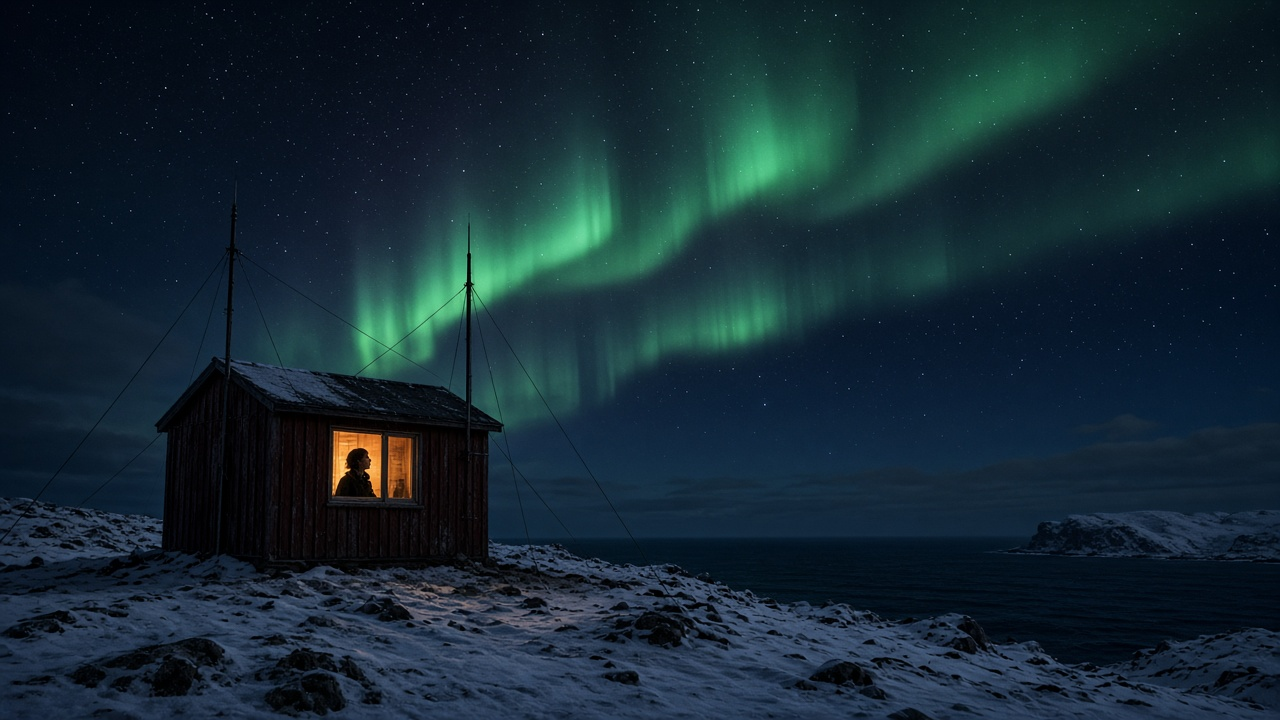
A ham radio story for a dark October night, told as a short story. The station, the people and the reply are made up. However, the echoes are real. In 1927, a Norwegian radio amateur heard a Dutch station come back about three seconds late, and on October 11, 1928, a test from Eindhoven brought back echoes of 3 to 15 seconds. Almost a hundred years later, nobody is sure what causes them. So this story imagines the night of the hundredth birthday.
Three Seconds Late
The beeps started at 9:40, and our transmitter was still cold.
I know, because I was the one who was supposed to switch it on. After all, that was my job. I had the checklist on my knee and the warm-up timer in my hand, and the big old set in the corner had not even started to hum.
But the speaker on the desk was talking anyway.
Beep-beep-beep. Then nothing for twenty seconds. Then beep-beep-beep again.
Three quick signals, every twenty seconds. I had known that pattern since I was eight years old, because everyone at Skarvik knew it. It hung on our wall in a frame.
"Sparks," said the Admiral behind me, very quietly. "Tell me that is us."
First I looked at the cold transmitter. Then I looked at her.
"It's not us," I said.
The Hut on the Hill
My name is Ida, but at Skarvik station nobody used it. Radio operators have been called Sparks for over a hundred years, and on my first day Bear decided I was one. I was twenty-four, a fisherman's daughter from Tromso, and I had held a ham radio license since I was twelve. When my dad was out on the boat, the radio was how he said good night. He told me my first ham radio story when I was six, about the night his engine died off Senja and a stranger in Finland heard his call.
Skarvik was a small university field station on a bare hill on an island north of Tromso. There were three huts, two tall antennas, a road that drifted shut every winter, and a view of the sea that made visitors stop talking. Especially in October, the northern lights came almost every night, green and moving, as if somebody were shaking out a sheet over the water.
Meanwhile, my contract ended in December. According to Bear, that didn't matter, since the station probably ended in December too.
The reason was a white envelope on the Admiral's desk.
Northline's Cheque
The Admiral was the head of Skarvik. Her real name was Kari, and she had been a radio officer in the navy for twenty years, so she walked like a ship and gave orders like weather. She was fifty-eight and drank her coffee black.
The envelope was from Northline, a satellite company. They wanted our hill for a new ground station, with forty white dishes in neat rows. In return, they would also pay the university twelve million kroner and keep the road ploughed.
The university said yes, unless we gave them a reason to say no.
That was when the Admiral had her idea. October 11, 2028, would be exactly one hundred years since the famous echo test. Back in 1928, a Dutch station in Eindhoven had sent three quick signals every twenty seconds, on 31.4 meters, while listeners near Oslo waited for them to come back. Then, some of them came back, three, eight, even fifteen seconds late.
Even now, nobody had fully explained it.
So we would do it again, on the same night, on the same wavelength, with a TV crew from Oslo in the hut.
"If the sky gives us an echo," the Admiral said, "we stay famous. And famous places don't get sold."
The Frame on the Wall
The frame hung above the coffee machine.
Inside was a copy of one page from the Dutch operator's log, October 11, 1928. Somebody had given it to the station long before I came. The paper was brown and the ink was faded, but every line was still clear: a number and a time. One, two, three, all the way down the page.
Then, at number forty-seven, there was a little note in the margin.
Missed number 47. Cat on the key.
When I was a kid, I loved that line. My dad brought me to Skarvik for an open day when I was eight, and while the grown-ups talked about the ionosphere, I stood on a chair and read about the cat. Somewhere in Holland, a hundred years ago, a cat had jumped on the desk in the middle of a science test, and some tired man had simply written it down.
"Most honest scientist who ever lived," Bear said, when I told him. "He didn't hide the cat."
Bear was the station engineer. His real name was Arne, but since he was six foot five with a beard like a hedge, nobody called him that. At sixty-three, he knitted during long tests, and he could fix anything with a fork and a piece of wire.
"Echoes are honest too," he said. "They only give back what you put in."

The Cheat in Every Ham Radio Story
Two days before the big night, I went behind the equipment rack to look for a cable.
Instead, I found a small gray box I had never seen. It was patched into our receiver, with a wire running to the Admiral's laptop. There was also a sticky note on it in her neat navy handwriting: 8.0 sec.
Nobody needed to explain it to me. If you recorded our own beeps and played them into the speaker eight seconds later, they would sound exactly like an echo. Every old ham radio story has a cheat in it somewhere, and people had faked echoes before. In fact, one radio magazine had warned that some hams faked them on purpose.
For a while, I stood there with the cable in my hand and felt sick.
That evening, while I was carrying firewood to the stove, I heard her on the phone in the office. Since the door was half open, every word came out.
"I know, Per. I know. Northline wants an answer by New Year." A long pause. "The cheque is on my desk right now. Twelve million, and the road. And what do we have? A hill and a hundred-year-old rumor." Another pause. "No, I don't need it real. I need it on TV."
Then she saw me in the doorway with the firewood.
Even then, she did not look away, and neither did I.
Insurance
The next morning, the Admiral found me in the radio hut before the coffee was ready. She put the gray box on the desk between us, so I knew that she knew.
"Insurance," she said. "If the sky is quiet on the night, it plays our own beeps back eight seconds late. Nobody gets hurt."
"The man in Holland wrote down the cat," I said.
She frowned. "What?"
"He missed a beep because a cat jumped on his key, and he wrote it down anyway, even though it made him look silly." My voice shook, but I kept going. "That's the whole reason anyone believed them."
For a while she didn't answer. Then she picked up her coffee and looked out at the antennas, black against the snow.
"Eleven years I've given to this hill, Sparks," she said. "If it goes, I go too."
"Then don't let it go like that," I said.
She took the box with her when she left. However, she didn't promise anything, and I didn't ask her to.
Red Coat Arrives
The TV crew came up the hill on Wednesday, October 11, in a van with snow chains.
There was a cameraman with a heavy cold, a sound man who never spoke, and the host. Because she wore a bright red coat, Bear called her Red Coat as soon as she was out of earshot. Still, she was kind, and she asked good questions.
"So what exactly are we hoping to hear?" she asked me, while the camera light made my face hot.
"Our own signal," I said. "Coming back late."
"From where?"
"That's the whole mystery," I said. "Radio goes around the world in about a seventh of a second. Some echoes take longer, because the signal gets trapped high up and bounces around for a while. But in 1928 they heard echoes of eight seconds, and fifteen. Nobody has explained those for sure."
"Some people say aliens," said Red Coat, smiling for the camera.
"Some people do," I said. Back in 1973, a writer had even drawn the old delays as dots and then claimed they made a star map from an alien probe. However, he took it back a few years later. "Most of us just say we don't know."
All the while, the Admiral was watching me from behind the camera. I thought about the gray box, and I did not smile.
Beeps Before the Button
At least our plan was simple. At ten o'clock, I would switch on, and we would send three quick beeps every twenty seconds on 9.55 megahertz, just like Eindhoven in 1928. After that, we would listen.
At 9:40, though, the speaker started first.
Beep-beep-beep. Twenty seconds. Beep-beep-beep.
Red Coat gasped, while the cameraman swung around so fast he banged the lens on a shelf. Meanwhile, Bear put down his knitting.
I turned on the Admiral before I could stop myself. "Turn it off," I said. "Whatever you think you're doing, turn your box off. They're filming."
Still, she did not argue. Instead, she reached into her coat pocket and held up a cable. The plug end hung loose in the air.
"I pulled it at supper," she said quietly. "I couldn't do it, Sparks. Not in front of you."
For a second, the only sound in the hut was the speaker.
Beep-beep-beep.
"Then who is that?" Red Coat whispered.
The Wrong Tone
Bear was already at the receiver. For a big man, he moved fast.
"Not local," he said. "Not some ham down the road playing games, either. This is coming down from the sky, high up." He turned the gain up and tilted his head. "Now listen to the tone."
So I listened. When we sent our beeps, they were clean and sharp, like a modern alarm clock. But these were rough. They had a hiss inside them, like bacon in a pan.
"That's an old valve transmitter," Bear said slowly. "Nobody has built one like that in eighty years."
"Could it be the satellites?" Red Coat asked. "Or the northern lights?"
"The northern lights make whistles and crackles," I said. "They don't count to twenty."
Then I looked up at the frame above the coffee machine, at the brown page and its long list of numbers. Then a strange cold feeling began at the back of my neck.
Without a word, I picked up a pencil and started to count.
Counting with the Cat
One, two, three.
Every twenty seconds, I made a mark. At first Bear only watched me. Then he understood, and the color left his face above the beard. He took the frame off the wall and laid it on the desk beside my notepad.
Ten, eleven, twelve.
The Admiral stood behind my chair, and for once she gave no orders. Red Coat held the microphone in both hands like a candle, while the cameraman forgot to sniff.
Thirty, thirty-one.
Because I could not stop counting, I explained in a whisper. "In 1928, a radio signal on that wavelength mostly bounced off the sky. But at night, when the sky is thin, some of it goes straight through. Then it just keeps going, out into space, at the speed of light, forever."
"Forever," Red Coat repeated.
"Unless something sends it back," Bear said.
Forty-four, forty-five, forty-six.
By then my pencil shook. I counted the next twenty seconds under my breath, and they felt as long as a winter.
But there was no beep. There was only the hiss of the open sky.
Then, twenty seconds later, the beeps came again, as steady as a ship's clock.
Forty-eight.

No. 47 Missed
For a long time, nobody spoke. Finally, the Admiral did, and her voice was very small for a navy voice.
"Cat on the key," she said.
I nodded, because I couldn't talk.
This was not our signal, and it had never been our signal. Instead, it was the Dutch station's own, from the night of October 11, 1928. Same rough old tone, same twenty seconds, and even the same missed beep where a cat jumped on a desk in Holland a hundred years ago. It had gone out through a thin patch of sky, and now, after all those years, it had come home.
Bear did the sum on the back of the Northline envelope, since it was the nearest paper. A hundred years, out and back. So the signal had traveled fifty years out, and then something had sent it fifty years back.
"Fifty light-years," he said. He looked at the number as if it might bite him. "Something fifty light-years away heard a Dutchman's test with a cat in it. And it waited until tonight to give it back."
"It didn't wait," I said. "It sent it straight back. It's just far."
Red Coat lowered her microphone. "Is this real?" she asked. "Please, Sparks. Honestly. Is this real?"
I thought of the brown page and the tired man who wrote down the cat. Then I thought of the first listener near Oslo, a hundred years ago, writing his own careful letter about a sound he could not explain.
"I can only confirm that I really heard it," I said.
The Last of 1928
The beeps went on until number ninety, where the old page ended. Then they stopped, exactly like the log.
For a while, we sat in the silence. Outside, the northern lights were moving over the sea, green and slow, and Bear's knitting lay on the floor. Meanwhile, the Admiral picked up the white envelope with Bear's sums on the back. She looked at it for a while, and then she opened the stove door.
"I think we just found the university a reason," she said, and she dropped it in.
Then, at 10:00 exactly, my timer beeped. It was time for our own test, the one we had planned for a year.
My hand went to the Morse key, but I didn't press it.
Because the speaker had started again.
This time it was not the old bacon-hiss tone. Instead, it was clean and sharp, almost like ours. And it was not three quick beeps.
It was four.
Four, then twenty seconds of silence. Then four again.
Nobody on Earth had ever sent that.
"It added one," Bear whispered. "It's not giving it back anymore, Sparks. It's taking a turn."
The Admiral put her hand on my shoulder, heavy and warm, the way my dad used to at the radio when I was small.
"Well, Sparks," she said. "It's your station now. Somebody is waiting for us to answer."



Leave a Reply