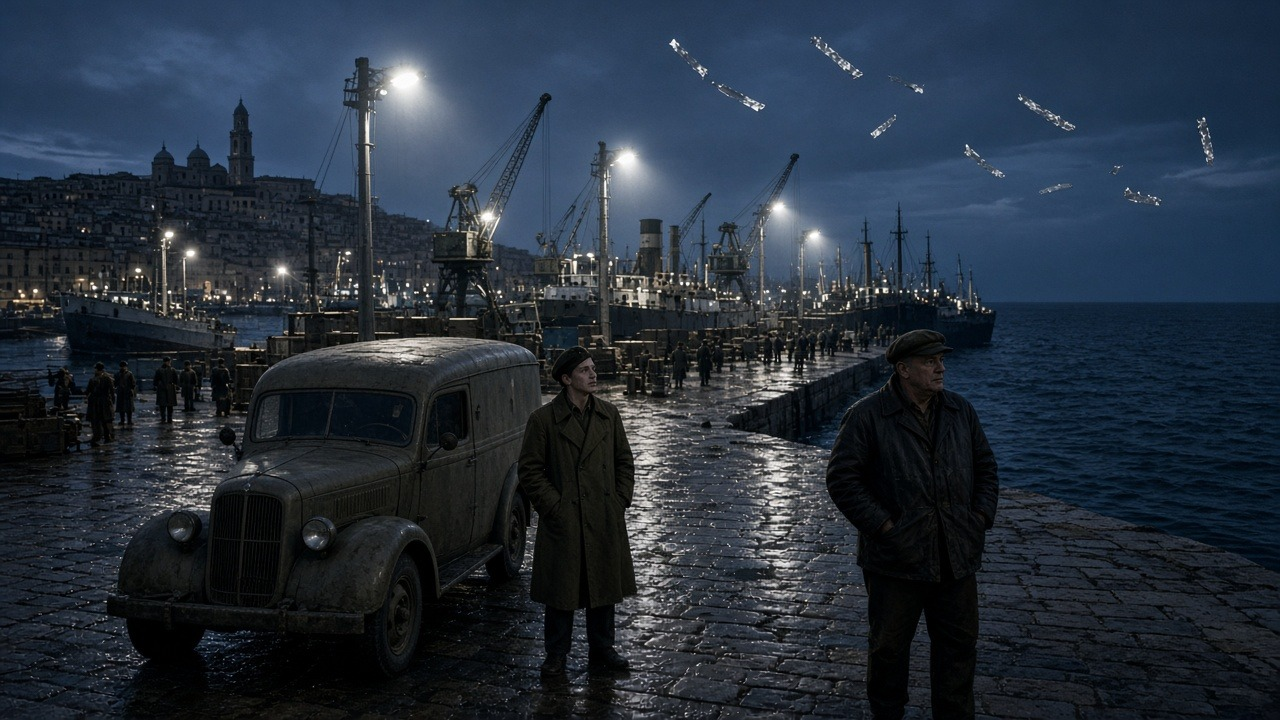
A WW2 short story set in the Italian port of Bari on December 2, 1943, the night people later called Little Pearl Harbor. Chalk, Biscuit, the Major and Starch are all made up. However, the night was real, and so are the ambulances still parked on the deck of a sunken ship off Bari. In October 2026, divers went down to film them again. (For more stories from those war winters, read The Light Off Antikythera and Sugar and Molasses.)
The Ship That Came In Late
The new ambulances were close enough to hit with a rock, and the Major said we couldn't have them.
There were six of them. They sat in a row on the back deck of a Liberty ship that had come in late that morning. They were green and clean, and from the stone quay at Bari, I could see their canvas covers flap in the wind.
Our ambulance was called the Mule. It had no heater, one good headlight, and a back door that only opened from the inside.
"Six," I said. "Six brand new ones. Biscuit, one of those is ours."
Biscuit was eating, as usual. He shrugged and dipped a hard British biscuit in his tin of tea.
"She's not even tied up yet, Chalk," he said. "Nothing comes off till she gets a berth. Look at this place."
He was right, though. The harbor was jammed with ships from America, Britain, Norway and Poland, nose to tail along the long stone arm of the mole. Cranes swung all day, and trucks lined up for a mile. Every crate went north to the front, where our boys were stuck in the mud below the mountains.
It was Thursday, the second of December, 1943. I was nineteen years old. And I wanted that ambulance more than I wanted to go home.

Why They Called Me Chalk
My name is Eddie, but nobody in Italy ever called me that.
I was pale as paper, and even under the Italian sun, I only went pink. So the British drivers named me Chalk on my first day, and it stuck.
I came from Toledo, Ohio. When I was eight, scarlet fever took the hearing in my left ear. After that, the ear was a dead radio. So in 1942, an Army doctor tapped my file and stamped me 4-F. Unfit.
My two brothers went to war. Meanwhile, I stayed home and sold shoes.
Then I heard about the volunteers. They were Americans who drove ambulances for the British Army, and plenty of them were 4-F like me. Nobody drafted them, and nobody saluted them. Still, they went wherever the wounded were. So I signed up, mostly so I could look my mother in the eye.
They paired me with Biscuit.
He was forty-six, from Georgia, and as wide as a door. His voice sounded like gravel in a bucket. He had driven an ambulance in France in the first war, and that was all he ever said about it. "France." Then he would change the subject.
He drove slowly, and he talked to the Mule like a horse. Besides that, he dunked biscuits in his tea the way the British did, which was how he got his name.
At first, I thought he was the most boring man in Italy.
Lunch on the Mole
At noon, an old Italian cook came along the quay with a basket. He sold bread, still warm, rubbed with oil and garlic. I bought two pieces for a handful of cigarettes and gave one to Biscuit.
He took it, sniffed it once, and stopped. Then he took out his pocketknife and scraped the garlic off, very carefully, onto the stones. Afterward he coughed, a dry cough deep in his chest.
"Can't abide it," he said. "Not since France."
"It's garlic, Biscuit. It won't bite you."
"Eat yours," he said. "I'll eat mine plain."
So I ate mine, and I laughed at him. However, he did not laugh back.
After lunch, we walked out along the mole to stretch our legs. Near the far end, another Liberty ship sat tied up, low in the water. Unlike every other ship in Bari, nobody was unloading her. Instead, two soldiers with rifles stood at the foot of her gangway, while a third walked up and down.
"What's she got?" I asked one of the guards. "Gold?"
"Move along, mate," he said.
So we moved along. But I looked back twice.
Nothing on That Ship
The Major ran the transport for our end of the port. He was a short man with a red face and a little brush of a mustache.
Late that afternoon, I went to his office, a tin shed by the gate, to ask about our new ambulance. Before I could knock, I heard him through the thin wall.
"There is nothing on that ship," he was saying. "Nothing. You never saw it. Is that clear?"
"Yes, sir."
Soon a sergeant came out past me fast, staring at his boots.
Of course, I thought I knew what that meant. Everybody in Bari knew the Major had a little business on the side. Cigarettes, sugar and petrol went out the back gate at night, and money came back in. So that guarded ship, I decided, was full of the Major's cigarettes.
Still, when I asked about the ambulances, he smiled at me.
"Your partner wants a new ambulance?" he said. "Then your partner can sign my petrol sheet like everybody else."
The petrol sheet said the Mule had burned forty gallons that week. In truth, we had burned twelve. The rest had gone out the back gate.
"He won't sign that, sir," I said.
"Then he can drive that old mule till its legs fall off."
I walked back to Biscuit so angry I could hardly see straight. I told him all of it, and then I told him to sign the stupid sheet.
He shook his head. "No."
"It's six ambulances, Biscuit!"
"It's a lie," he said. "And I don't sign lies. Not anymore."
The Night They Called Little Pearl Harbor
That evening, the harbor lights came on.
Every crane had a lamp, and every quay had floodlights. The whole port blazed like a county fair, because the Major and the men above him wanted the ships unloaded all night. After all, every hour a ship sat waiting cost money. Besides, the front was starving for shells.
That same afternoon, a big man from the air force had told the newspapers that the Germans were finished in the air. When somebody repeated it on the canteen radio, everybody cheered.
Biscuit did not cheer. Instead, he looked at the lights, and then at the dark sea to the east.
"Lit up like a Christmas tree," he said.
At twenty-five past seven, we were parked at the foot of the mole, waiting for a sailor with a broken arm. I was eating the last of the bread.
Then something glittered in the air above the harbor. At first it looked like snow, or tinsel. Thin silver strips came drifting down through the floodlights, thousands of them. When one landed on the Mule's hood, I picked it up. It was foil.
"Biscuit," I said. "What is this?"
He didn't answer. Instead, he grabbed my collar and pulled me down behind the front wheel.
High above us, flares bloomed, white and slow, under little parachutes. Even so, they were hardly needed, because we had already lit the target for them.
Years later, people called that night Little Pearl Harbor. On the night itself, nobody called it anything. We were too busy.
Fire on the Water
The first bombs walked across the water like giant footsteps.
I won't tell you all of it, because some of it I still can't. But I will tell you about the ammunition ship.
She was tied up two berths down the mole. When the bomb hit her, the whole world turned white. Then the air punched me in the chest, and the sound came after, bigger than sound. Windows broke all over Bari. Later, I heard that glass broke seven miles away.
When I could think again, my good ear was ringing like a church bell. So for the rest of that night, I could barely hear a word. Instead, Biscuit talked to me with his hands and his face, and by shoving me where he wanted me.
Meanwhile, a fuel pipe on the quay had burst. Now burning oil was spreading across the harbor in a long orange sheet. Ships were on fire, and men were in the water, black with oil, swimming for the stones.
Out past the mole, a searchlight on shore had caught the late Liberty ship, and it stayed on her for a long time, like a finger pointing. Soon she was burning too, with our six new ambulances on her back deck.
Still, I had no time to think about that.
Biscuit and I ran to the steps at the edge of the quay. We hauled men out of the water. They were slick with oil and heavy as sandbags, and the oil coated them from their hair to their boots. We laid them in the Mule, four on stretchers and two on the floor, and wrapped them in our blankets.
Then Biscuit stopped.
The Smell
He stood very still on the wet stones, with his head up, like a dog at a fence.
Then I smelled it too, because it came across the water with the smoke. It was sharp and sweet and strong, like garlic, or like horseradish.
I thought it came from the old town. I pictured the cook with his basket, and somebody's kitchen burning.
But Biscuit's face had gone a color I had never seen on a man. He looked at the black water. After that, he looked down the mole, toward the far end, where the guarded ship had been.
I could not see her anymore, since there was only fire there now.
Biscuit grabbed my arm. He put his mouth right against my good ear and shouted.
"Don't touch your eyes! You hear me? Don't wipe your face!"
I nodded, although I did not understand at all.
Then he drove up the hill road to the hospital faster than I had ever seen him drive. And the whole way, he kept the windows down, even though the men in the back were shivering, and even though it was December.
The Hose
The hospital was a big stone building up the hill, run by the British. By the time we got there, the yard was chaos. Trucks and ambulances were pulling in from everywhere, while doctors ran from stretcher to stretcher, looking for blood, burns and broken bones.
Our men had none of that. Instead, they were just cold, soaked and black with oil.
So the orderlies started to carry them straight inside, blankets and all.
Biscuit stepped in front of them. "Not yet," he said.
Next, he found a hose on the wall by the laundry and turned it on full. The water was ice cold. Then he knelt by the first sailor, a skinny kid shaking so hard his teeth rattled, and started cutting off his oily clothes with his pocketknife.
"What are you doing?" the kid cried.
"Giving you a bath, son. Close your eyes."
I just stood there. So Biscuit turned the hose on me.
"You first, Chalk. Arms up."
My face burned, because nurses were watching, and half the orderlies in Italy. Even so, he hosed me down like a muddy dog and made me peel off my oily jacket and throw it on a pile. Afterward, he tossed me a clean shirt off the laundry line.
"Now help me," he said.

So I helped him. We washed every man from the Mule, one by one, and threw their clothes on the pile. After that, we wrapped them in clean, dry blankets from the laundry room, which was not where blankets were supposed to come from.
Then a woman's voice cracked across the yard.
Starch
She was the ward sister, in charge of the big ward on the ground floor, tall and straight, with a white cap so stiff it could slice bread. The drivers called her Starch, though never to her face.
"What on earth do you think you're doing?" she said.
"Washing them, ma'am," said Biscuit.
"These men are freezing! They need warmth, tea and a doctor, not a cold bath in a yard!"
"They need the bath first, ma'am. Then all the rest."
"Says who?"
He opened his mouth. Then he shut it again, and I saw something in his face I didn't understand. Finally, he said, "Please, ma'am. Wash the rest of them too. Every man from the water. Get the oil off them. Please."
She looked at him the way you look at a drunk.
"I have two hundred men coming in," she said, "and no orders about baths. Stop this nonsense, or I will have you thrown off this hill."
Then she swept back inside. Her orderlies carried the next load of sailors in after her, oily clothes and all, and tucked them into warm beds with hot sweet tea.
Biscuit watched them go. After that, he turned back to the hose.
"Next load, Chalk," he said.
That night, we went back down the hill eleven times.
Write a W
Every trip went the same way. First, we pulled men from the steps or from the boats. Next, we drove them up the hill with the windows down. Then we washed them in the yard with the cold hose and wrapped them in laundry blankets.
On the third trip, Biscuit handed me a stub of pencil.
"Every man we wash," he said, "you write a W on his tag. Small, in the corner."
"Why?"
"So somebody knows."
So I wrote a W on thirty-one tags that night.
Around two in the morning, the Major came up the hill in his staff car. He wanted to know why the Mule was burning so much petrol. Then he saw the hose and the pile of clothes, and his red face went redder.
"Are you mad?" he said to Biscuit. "Water and blankets, wasted on baths? I'll have you sent home on the next boat."
By then Biscuit was soaked to the skin. His eyes were red and running, and he kept blinking hard. Still, he stood up straight.
"Send me," he said. Then he stepped close to the Major and lowered his gravel voice.
"What was on that ship, Major?"
For one second, the Major looked afraid.
"Nothing," he said. "There was nothing on that ship."
Then he got back in his car and drove away.
Not Yet Diagnosed
By noon the next day, the fires were mostly out. However, the trouble at the hospital was only starting.
I went inside to find our skinny kid sailor. On the way, I passed Starch's big ward, and I stopped in the doorway.
The men in there were sick, and it was not the kind of sick anybody had expected. Their skin had gone an angry red, like the worst sunburn you ever saw. Many of them could not open their eyes. They lay still and asked for water, while young doctors moved from bed to bed, frowning.
On the charts, the doctors had written one word and three letters. Dermatitis. N.Y.D. Not yet diagnosed.
Starch stood in the middle of it all, looking as if she had not slept since the war began.
Then, in a side room off the back hall, I found the men with the W on their tags. Some had sore eyes, and a few had red patches on their hands. But they were sitting up, eating porridge and complaining, and the skinny kid was cheating at cards.
Meanwhile, all afternoon, people kept climbing the hill from the old town. They were Italian mothers, old men and kids, and they held wet rags to their eyes. A cloud had drifted over their streets in the night, they said, and it stank of garlic.
So I went looking for Biscuit.
France, 1918
He was sitting on the running board of the Mule, out in the yard. A wet rag was folded over his eyes, and his big hands hung between his knees.
"Biscuit," I said. "What's wrong with them?"
Even then, he didn't take the rag off.
"Garlic," he said. "Horseradish. You smell it once, Chalk, and you never forget it."
Then, finally, he told me about France.
It was the summer of 1918, and he was twenty-one. One afternoon, he drove his ambulance into a little valley where the shells had come down full of mustard gas. It hung low in the grass, and it smelled like a kitchen. Biscuit loaded men all afternoon with his eyes streaming. By night, therefore, he could not see. It was three weeks before his eyes opened again.
"And afterward," he said, "the officers told me what to write on the tags. Burns. Just burns. So I wrote it."
Suddenly my mouth was dry.
"The ship," I said. "The one with the guards."
"Ours," he said. "Our own bombs, Chalk. Sent over in case the other side used gas first. Then tonight the bombs came, and it all went into the water with the oil. And oil soaks it up like bread soaks up gravy. Gets in your clothes. Sits on your skin all night long."
I thought of Starch's warm beds. I thought of the oily clothes, and the hot sweet tea.
"Nobody told the doctors," I said.
"Nothing on that ship," said Biscuit. "Remember?"
Still on the Stern Deck
He would not let me take him inside, though. Instead, he made me fetch the Mule's logbook from the glove box.
"Write it down," he said. "What we smelled. Who we washed. Write the real word, Chalk. Mustard. Somebody has to."
So I wrote it down, in pencil, in big square letters, while my hands shook.
Later, the records said that the men who died in Starch's ward died of burns due to enemy action. Our thirty-one men went back to sea. Biscuit's eyes opened again in nine days, just like he said they would. As for the Major, he got a medal for keeping the port running.
The Mule ran until spring.
But the six new ambulances never came off that ship. She sank before morning, a mile or two off the coast.
I am a hundred and two now. Still, last month, my granddaughter put a pair of goggles on my face and showed me a film the divers made. And there they were, a hundred and sixty-five feet down, parked in a row on her stern deck, with fish swimming through the cabs.
Even now, they are still waiting for somebody to drive them home.



Leave a Reply