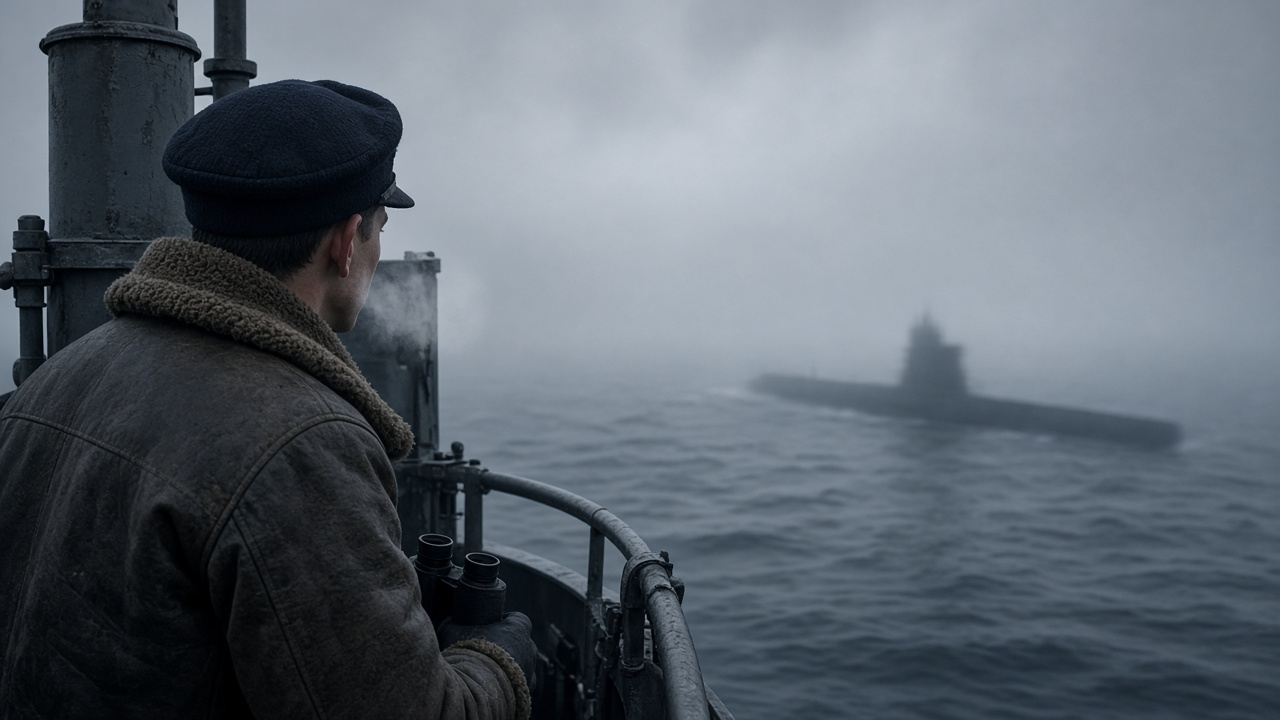
A WW2 submarine story, told as a short story: a young soundman on USS Barb hears two explosions in the fog off the Kuril Islands, and then he has to decide what goes into the war patrol report. This is fiction, so the sailors in it are made up. However, the boats, the dates and the loss are real. In June 2026, the Naval History and Heritage Command confirmed that a wreck more than 300 feet down off Matsuwa Island is USS Herring, lost with all 83 men on June 1, 1944.
Two Booms in the Fog
The first one came a little before dawn, and I almost missed it.
We had dived early, because the fog was lifting in patches and the Old Man didn't trust it. So Barb hung at periscope depth off the Kuril Islands, rolling a little, and I sat in the sound shack with the headphones on, listening to the whole cold North Pacific breathe.
Then, far off to the north and east, something went boom.
It wasn't loud. In fact, it was more like a fist hitting a mattress two rooms away. I turned the wheel on the sound gear toward it and held my breath.
After a long wait, there was a second boom. Then came something I didn't have a name for, a long, low groan with a tearing edge on it. It went on and on, and then, finally, it stopped.
"Conn, sound," I said into the phone. "Two explosions. Very distant. Bearing about zero three zero."
The officer of the deck was a young lieutenant everybody called Junior. He came back and leaned in the doorway in his sheepskin coat.
"Depth charges," he said. "Somebody up there is catching it." He turned to the quartermaster. "Log it. Distant depth charges."
The quartermaster wrote it down. Four words, in pencil, in a green book.
I was nineteen, and I had been wrong before. So I didn't say a word. Still, I sat there with the headphones pressed to my ears, and I counted on my fingers anyway.
Two.
A Kid Called Ears
My name is Walt, but on Barb nobody ever used it. I was Ears from my second day aboard.
I grew up in Toledo, over a shoe shop, in a flat that always smelled of leather. My mother taught piano in the front room. Every afternoon, while I did my homework at the kitchen table, I heard kids play wrong notes through the wall. By ten, I could tell you which note was wrong, and by how much.
Also, I grew up on Lake Erie. Every March, the ice broke up. You'd stand on the shore in the dark, and the whole lake would let out a long tearing groan as the sheets split and slid. My father called it the lake clearing its throat. Once you heard it, you never forgot it.
So when the Navy gave me a hearing test, I didn't miss a single tone. A week later, I was on a train to the submarine school in New London.
That was where I met Pop. He was a soundman first class, about thirty, with a bald head and a voice like gravel in a bucket. Pop said every sound in the sea had a shape, and a good soundman learned the shapes the way a farmer knows his cows.
"A depth charge is a door slamming," he told us once. "A loud one. Bang, and then it's over. Remember that. The sea forgets a depth charge fast."
Red and the Knock Code
At New London, I bunked under a skinny kid from Pittsburgh named Red. He had hair like a new penny, freckles everywhere, and a harmonica he played very badly.
Red couldn't hear half as well as me. However, he could talk to anybody, and he never let me be shy. Whenever I went quiet at a dance, he dragged me out of the corner by my sleeve.
During training, they shut us inside an old steel tank for drills, with the lights off. Somebody outside would bang on the wall with a wrench, and we had to say where it came from. Red got bored fast. So he made up a code.
"One knock means you okay?" he said in the dark. "Two knocks means I'm okay. That's all you need, Ears. Everything else is just talk."
After that, we knocked on everything. We knocked on bunk rails and mess tables. Once, we even knocked on a church pew, and a chaplain gave us a look I still remember.
Then the Navy split us up, the way it always does. Red went to Herring, a fleet boat that had fought in the Atlantic, the same as Barb. Meanwhile, I went to Barb. We shook hands on the pier at Pearl Harbor, and Red knocked twice on my shoulder.
"See you in the Kurils," he said. He was joking. As it turned out, he wasn't wrong.
The Megaphone Conference
Both boats topped off at Midway and headed north. Later, I found out Red's boat had left Midway the same day as ours.
On the morning of May 31, Barb and Herring met on the surface off the Kurils. The sea was gray and slow, and the cold bit through my gloves. Because I was on lookout that watch, I stood up in the shears above the bridge with a pair of binoculars, watching the empty water for planes.
I watched Herring instead, mostly.
The two boats drifted close enough to shout. Then the two captains leaned out on their bridges with big tin megaphones and talked it over like farmers at a fence. Our Old Man would take the area south and west of the shipping lane. Herring would take north and east, up toward Matsuwa.
Matsuwa was a little island with a volcano on it. The Japanese had guns there and a harbor where ships waited out the fog. I didn't know that yet. All I knew was that it sounded far away.
Then I saw a skinny shape in Herring's shears, with a red head under a wool cap.
Red didn't wave. Instead, he made a fist and knocked on the steel rail in front of him. Once, and then again.
Two knocks. I'm okay.
So I knocked back twice on our rail, so hard it stung. Red grinned, and I could see the gap in his teeth from fifty yards away.
A little before noon, the conference ended. Herring turned north and slid into the gray. I watched her until the fog took the top of her shears, and then she was gone.

The Line in the Log
That afternoon, Barb found two freighters and sank them both. It was fast and loud, and I was too busy on the gear to be scared. That evening, we pulled one cold, shaking man out of the water. He told our officers that the other American boat had sunk his escort ship the night before.
The whole crew cheered for Herring. Even the cook banged a pot.
So when I heard the two booms before dawn on June 1, everybody already had a story ready. Herring was up north. Herring had been busy. Now Herring was paying for it.
By breakfast, the whole boat knew. In the crew's mess, the men talked in low voices over powdered eggs.
"They'll be fine," said Sparks, our radioman, who was always sure. "Herring's an old hand. She'll go deep and wait them out."
"Sure," said the cook. "Sure she will."
Nobody looked at me, since they all knew Red was my buddy. Meanwhile, I sat with my coffee getting cold and played the sound again in my head. First a boom, then a long wait. After that, a second boom, and then that long, tearing groan.
It bothered me, because it didn't sound like a door slamming. Rather, it sounded like the lake in March.
But I was the youngest soundman on the boat, and Junior was an officer. Besides, the line was already in the book.
Real Depth Charges
The next day, I learned what a depth charge really sounds like.
On June 2, we went after a lone ship. However, she was a fighter. She turned on us, shot at our periscope, and then came racing over the top of us, dropping charges.
The first one went off close. Barb jumped like a kicked can. Then the lights flickered, and flakes of cork paint rained down off the overhead into my coffee. My headphones screamed, so I tore them off.
Then the second one hit, and the third. Each was a hard, flat bang that went right through your chest. And then, just like Pop said, it was over. The sea forgot it fast.
There was no tail at all. Not one of them groaned.
Afterward, the Old Man took us north to hide in the ice fields. We crept in among the floating sheets for hours. All the while, I listened to the ice grind and split against our hull, groaning and tearing, just like the lake at home.
I sat very still in the sound shack. My hands had started to shake, but not from the charges.
Because now I knew that sound. I had heard it on Lake Erie when I was eight, and again in the fog on the morning of June 1.
It was the sound of something big breaking up. And there had been only one big thing up there by Matsuwa that I knew about.
Herring.

No Receipt
On June 3, a message came in from headquarters for both boats. It told us to keep clear of an area where our own surface ships would be working. Also, the message asked for a receipt, which meant each boat had to answer.
Barb answered. Herring didn't.
Sparks told me about it that night, while we stood in line for the head. He said it like it was nothing.
"Doesn't mean a thing, Ears," he said. "Boats keep quiet up here. Her antenna could be iced up, or she's deep. Or else her radioman's asleep."
"Sure," I said. I didn't tell him what I knew.
After that, Sparks tried to raise her a few more times. Each time, he got nothing but static and the hiss of the empty sea.
Meanwhile, Barb kept fighting. The Old Man took us into the Sea of Okhotsk, and we sank three more ships there before the torpedoes ran out. The crew was proud and tired and starting to smell. Every night, though, I lay in my bunk and played those two booms in my head, over and over, like a record with a scratch.
Two booms, and then a tail like the lake. Not a door slamming. A boat breaking up.
I was sure now. Red was gone, and I had heard it happen.
The War Patrol Report
On the long run home, Inky started typing the war patrol report.
Inky was our yeoman. He typed with two fingers and a cigarette, at a tiny table jammed in the corner of the officers' area, and he swore at the carbon paper in four languages. Every patrol, the Old Man wrote a report of everything that happened, day by day, from the logs. Then it went up the chain to the admirals at Pearl, and they read every word. After that, it went into a file in Washington forever.
On the third night, the Exec called me in. He was a tired, careful man with a pencil behind his ear. He had the sound log open, and he wanted every sound entry checked against it.
"June first," he said. "Before dawn. Distant depth charges. That right, Ears?"
I didn't answer. Instead, I looked at the four words in Junior's pencil.
"Sir," I said finally. "I don't think they were depth charges. Depth charges don't groan like that. I think it was Herring, sir. I think I heard her break up."
The Exec put down his pencil.
"You think," he said.
"Yes, sir."
He rubbed his eyes. "Listen, son. You change that line, and here's what Pearl reads. Herring broke up and sank before dawn on June first, and Barb heard it. That goes in a file. Then somebody stops looking for her. Somebody tells a mother in Pittsburgh to stop hoping, weeks early. And if you're wrong…" He didn't finish.
"Let me talk to him," said a voice behind me.
What the Old Man Asked
The Old Man had been standing in the passage in his socks, drinking coffee. He was quiet like that. Then he sat down across from me and looked at me for a long time.
"Ears," he said, "can you swear to it?"
I thought about Lake Erie. I thought about the ice grinding on our hull up north. Then I thought about Red's gap-toothed grin in the shears, and his fist on the rail.
"No, sir," I said. "I can swear to what I heard. Two explosions, far off, and a long tail. But I can't swear to what they were."
He nodded slowly.
"Then we write what the watch logged at the time," he said. "A report isn't a guess, son. It's a record of what we knew, when we knew it. If there's more to know, somebody will find it someday. The truth is patient."
Then he patted the table twice with his flat hand and stood up.
So Inky typed it. Distant depth charges. The carbon went under the paper, and the line went to Pearl. I let it stand, and I hated myself a little for being glad. At least somebody in Pittsburgh still got to hope.
Waiting at Midway
We tied up at Midway in early July, in bright sun, with gooney birds dancing on the sand. After the cold up north, the heat felt like a warm bath.
Herring was due by the third or fourth. It was now past that. Still, the base had been told to keep a sharp lookout, in case she came home with her radio broken.
I knew better than to hope. Even so, every evening after work, I walked to the end of the pier and sat there until dark. I watched the channel and the reef and the flat blue water. Sometimes, other men from Barb came and sat with me, and nobody said much.
Once, a boat came in at sunset, low and gray. I stood up so fast I nearly fell in the water. It was the wrong boat.
Finally, on July 13, word came down that Herring was presumed lost. I had known it for six weeks. Still, I went back to the pier anyway.
That night, I knocked on the wooden piling. Once. You okay?
The sea didn't knock back.
Every WW2 Submarine Has a Story
The war ended. I went home to Toledo and became a piano tuner, because I already knew every wrong note in the city.
Then, in 1949, the Navy put out a book about the lost submarines. Every boat had a page or two, and every WW2 submarine in it had a story that ended the same way. A buddy from Barb mailed me a copy. So one night I sat down at my mother's piano bench to read Herring's page, ready to read about the morning I heard her die.
It said the Japanese records were clear now. On the morning of June 1, 1944, at Matsuwa, two merchant ships had been sunk by American torpedoes while they lay at anchor. Then a shore battery fired back, and it hit the submarine's conning tower twice. Afterward, there were bubbles, and a long slick of oil on the sea.
And there was Barb, too, in the Navy's own words. Barb, hearing distant depth charges.
Two Knocks
I closed the book and sat there for a long time.
Then I read it again. Two ships, at anchor, that morning. I had heard two booms in the fog, and a groan like the lake in March.
It wasn't Herring breaking up. It never was. Those were the two ships, going down at Matsuwa. Red's boat hadn't been catching it at all. In fact, Red had been winning, right up to the last, in the fog under that volcano. And the guns that came afterward made no sound I ever heard.
For five years, I had grieved over the wrong noise. Meanwhile, the record still said somebody was dropping depth charges. But I finally knew what I had heard, sitting in the sound shack with my fingers counting in the dark.
Two knocks.
I'm okay.


Leave a Reply