A war short story about a WW2 Thanksgiving night over the Himalayas in November 1944. Chick, Uncle, Tiny, Sonny, Pocket, the colonel and Fat Annie are made up. However, the airlift is real: for three and a half years, cargo planes flew gasoline from Assam in India over the mountains to Kunming in China, through ice, wind and cloud, and more than a thousand airmen never came home. Read about the real Hump airlift. (For another WW2 holiday story, read Aunt Nell's Parcel.)
The Turkeys
On Thanksgiving Day, 1944, I threw the colonel's turkeys out of an airplane at eighteen thousand feet.
That is the part of the story everybody at Chabua tells. In fact, a man in Ohio told it to me at a reunion forty years later, and he got most of it wrong. He said I was drunk. I was not. I was nineteen, I was cold, and I was more scared than I had ever been in my life.
Every WW2 Thanksgiving story has a turkey in it. Mine has two. Still, the turkeys are not the important part.
My name is Walter, but nobody has called me that since Nebraska. On the base they called me Chick, because I was the youngest radio man in the squadron and I looked it. I worked the radio on a C-46 called Fat Annie. She was a big, bare-metal cargo plane with two huge engines and a belly like a barn. When she was empty, she flew like a dream. But when she was full, she flew like a barn.
We flew the Hump. That was what everybody called the mountains between India and China. First you took off from the tea fields of Assam, climbed over the jungle, and then climbed some more. After that came the high ridges, the snow and the clouds. Kunming was on the other side, and so was the war that needed our gasoline.
The Board
Every flight started at the board.
The board was a big black wall in the operations shack. It held every crew's name in white chalk, and next to each name, the tons they had carried to China that month. The new general in India liked charts, so our colonel loved the board. Every morning he stood in front of it with his coffee, as if he were in church.
Our crew, however, was at the bottom.
That was mostly because of Uncle. Uncle was our pilot. He was thirty-four, which was ancient for a pilot, with gray at his temples and a slow voice from Oregon. Before the war he had flown the mail over the Cascades. So he knew ice, he knew mountains, and he knew when to go home.
The other crews had another name for him. They called him Turnback.
"He has turned around four times this month," the colonel said one morning. I was getting coffee, and he did not see me behind the stove. "Four times, with a full load. Do you know what that does to my numbers?"
Then somebody said something quiet.
"I don't care what Turnback thinks the sky looks like," the colonel said. "Thanksgiving is a tonnage record or it is my neck. One more turnback, and he flies a desk in Karachi for the rest of the war."
I took my coffee outside and drank it standing in the rain. Even so, I never told Uncle what I heard.
The other person who was always around the shack was Pocket.
Pocket was a Chinese boy, about twelve, small enough to fit in a pocket, which is how he got the name. In the spring he had come over the Hump on a troop flight with his big brother, who went on to the Chinese training camp at Ramgarh. Pocket, however, got left behind at Chabua. Somehow, nobody ever sent him back.
So he shined our boots. Also, he swept the radio shack, and he learned more English in six months than I learned in high school. Most of all, he talked about his grandmother. She lived in Kunming, near the old west gate, and she made noodles with so much pepper that your eyes ran.
"Chick," he would say, "you fly to Kunming tonight?"
"Every night, Pocket."
"Take me."
"Can't. Colonel says no."
That was true, too. Pocket had asked the colonel himself, standing at attention in front of the board. The colonel had not even looked down. "No passengers," he said. "No exceptions. Every pound on my airplanes is tonnage."
The afternoon before Thanksgiving, I found Pocket in the cargo shed, standing on the big loading scale. He was watching the needle like it was a fortune teller.
"Eighty-one pounds," he said. "Chick, is that a lot?"
I laughed. "For a turkey, maybe."
He did not laugh, though. Instead, he hopped off the scale and ran out into the rain.
Loading Fat Annie
That night we were set to take off an hour after midnight. By ten o'clock, Fat Annie sat on the wet steel mats under the lights, and the loading crew was rolling drums of gasoline up into her belly.
Tiny watched every drum go in, as usual. Tiny was our crew chief. He was six foot five, from Georgia, and as quiet as a fence post. When he did talk, people listened, because it did not happen often.
Just then, the colonel's jeep pulled up. Two men lifted out a pair of long wooden crates, covered in frost.
"Turkeys," the colonel said. "For the general's Thanksgiving dinner in Kunming. Those birds go over if the airplane doesn't. Is that clear, Captain?"
"Clear," Uncle said.
After that, Tiny came back from the shed with a third crate. It was square and heavy and made of new boards. He and Sonny, our copilot, carried it in together and tied it down by the cabin heater.
"What's that?" I asked.
"Engine parts," Tiny said. "For Kunming."
I went to get my oxygen mask and my walk-around bottle from the rack. That was the little green tank you carried when you moved around the plane up high. There should have been five on the rack. However, there were only four.
"Supply's short again," Tiny said, and he took the last one.
Meanwhile, Uncle walked all the way around Fat Annie in the rain, the way he always did. At the door, he stopped and looked at Tiny.
"Everything tied down good back there?"
"Everything, Uncle."
"Then let's go see China."

A WW2 Thanksgiving Over the Hump
Fat Annie took a long time to get off the ground. She always did with a full load. I felt the wheels leave the mat, and then I felt her hang there, thinking about it, before she started to climb.
Before long, the tea gardens slid away below us in the dark. Soon the jungle came, black and endless. Then the clouds closed over the windows like a wet blanket.
Up there it was cold. Of course the C-46 had a heater, but the heater was a joke. By twelve thousand feet my breath came out white, and we put on our oxygen masks. Uncle's voice came over the earphones, slow and easy, the same as always.
"Happy Thanksgiving, boys."
"Happy Thanksgiving," Sonny said. "I want the drumstick."
"The colonel's got the drumsticks," Tiny said. "We're in the back with them."
Twice, Tiny got up and went back into the dark cargo hold with his walk-around bottle and his flashlight. Both times he was gone for a few minutes, too.
"Load shifting?" I asked when he came back.
"Checking the drums," he said.
Meanwhile, my job was to listen. I sat behind the cockpit at a little table with the radio, where I tapped out our position every half hour and listened for weather and for anybody in trouble. A lot of planes were over the Hump that night, and many were in trouble. Through the hiss, pilots asked for bearings. Somewhere north of us, a voice said, very calmly, that they were losing an engine.
Then that voice stopped. So I wrote down the time, because that was my job, too.
The Ice
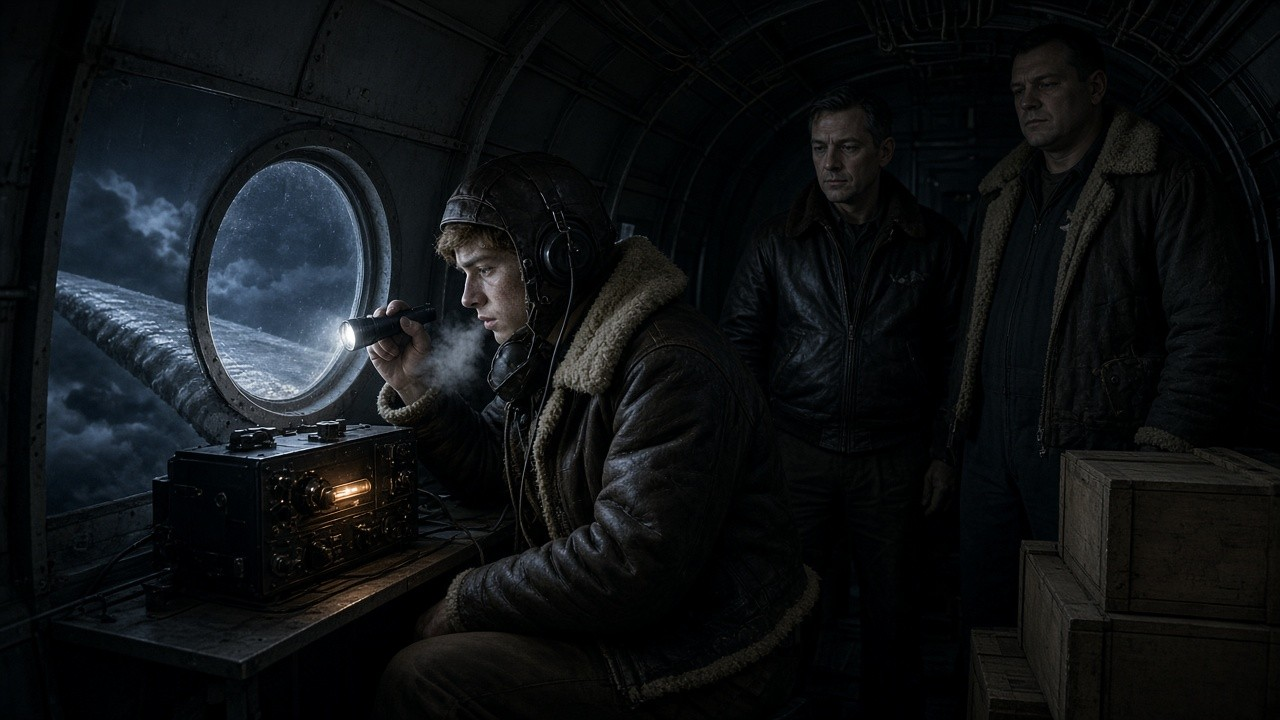
At eighteen thousand feet, I shined my flashlight out the little window at the wing.
The wing was white.
It was not snow, because snow slides off. This was ice, rough and gray, growing on the front edge of the wing like something alive. The rubber boots meant to crack it off were pumping, but the ice grew around them. As I watched, a little more built up. Then a little more.
Over Sonny's shoulder, I looked at the airspeed. It was falling. Then I looked at the altimeter. It was falling, too, very slowly.
Here is the truth. For three whole minutes, I sat there and said nothing.
Instead, I thought about the colonel at the board, and about Karachi and a desk. Mostly, I thought about Uncle's slow voice, and how much I wanted to keep it. If I told him about the ice, he would turn back. Of course he would, because that was what Uncle did. And then the colonel would take him away from us.
So I watched the ice. In fact, I watched it until my hands shook so hard the flashlight beam jumped all over the wing.
Finally, I pressed the button.
"Uncle. The left wing. It's white, and it's growing."
There was a short silence. After that, his voice came back, just as slow as before.
"Thank you, Chick. I know. I've been watching the right one."
"Are we going back?"
"Can't," he said. "We're past the high ground. Behind us is higher than what's ahead. We're going over, son. We just need to be a little lighter to do it."
Not That One
Lighter meant the cargo.
Tiny and I went back into the hold with our bottles and flashlights. Since the hold had no heat at all, the cold back there was like a knife. Together, we got the big cargo door open, and the wind came in screaming. It tried to pull my mask off my face.
Then we started with the drums.
Each one weighed more than I did, so it took both of us. We cut the straps and rolled them to the door, and the night took them. One. Two. Three. I lost count somewhere after ten. Still, Uncle's voice said, "More."
So I turned to the turkeys.
I will be honest. Secretly, I enjoyed that part. With my boot against the first frozen crate, I thought about the colonel in front of his board, and then I kicked. It went out into the dark like it had somewhere to be. Then the second one followed it.
"More," Uncle said.
After that, there was nothing left near the door except the square crate by the heater. Engine parts. I grabbed the rope and started to drag it.
Tiny's big hand came down on the lid, flat and hard.
"Not that one," he said.
"Tiny, we're going down!"
"Not that one, Chick."
Then Uncle's voice came over the earphones, calm as Sunday. "Leave it, Chick. Come up front. Sit down and hold on."
At first I could not believe it. We were going to hit a mountain for a box of engine parts. However, I did what I was told. I always did what Uncle told me.
The Ridge
I sat down at my radio and held on.
Fat Annie shook while the engines roared. Uncle put the nose down a little to get speed, and then he eased it up again, slow and gentle, like a man lifting a sleeping baby.
Suddenly, the clouds tore open.
There, in the moonlight, was the ridge. It was white and enormous, and it was close enough that I could see the wind blowing snow off the top like smoke. I could see the rocks. In fact, I could see the shadows of the rocks.
Then it was under us. A moment later, it was behind us.
After that, nobody said anything for a long time. Finally, Sonny laughed, the shaky kind of laugh.
"I still want the drumstick," he said.

Kunming
We came down over the lake at Kunming just as the sun came up on Thanksgiving morning. Fat Annie touched the runway like she was tired, because she was.
As soon as we stopped, a ground officer drove out in a jeep with a message from Chabua. The colonel had already heard we were short sixteen drums and two crates of turkeys. The message was long, and most of it cannot be printed. At the end, it said we had not turned back, so there was nothing he could do about that.
When Uncle read it, he laughed. Then he handed it to me.
"Keep it," he said. "You earned it."
The Crate
I was still angry, though. While Sonny and Uncle talked to the jeep, I went back into the hold. Tiny was kneeling by the square crate with a crowbar.
"Engine parts," I said. "We nearly died for engine parts."
Tiny did not answer. He just pried up the lid, very gently.
Inside, wrapped in Tiny's gray blanket, with an oxygen mask strapped over his nose and the missing green bottle hugged in his arms, sat Pocket. Twice in the night, Tiny had gone back to fill that bottle from the plane's own oxygen.
Slowly, Pocket pulled the mask down and blinked at the morning light.
"Chick," he said. "Is this Kunming?"
For once, I could not speak. So Tiny spoke for me.
"It's Kunming," he said. "Go on home. Your grandmother is waiting."
Behind me, I heard Uncle climb into the hold. He leaned on the doorframe and smiled at Pocket like he had known all night what was in that box. Of course, he had. Uncle always knew exactly what was on board. That, I finally understood, was the only reason he ever turned back. It was never about the weather. It was about what he was carrying.
Later that morning, Tiny filled out the cargo sheet for the colonel. Near the bottom, in his big careful printing, he wrote one more line.
One crate. Engine parts. Eighty-one pounds. Delivered.

Leave a Reply