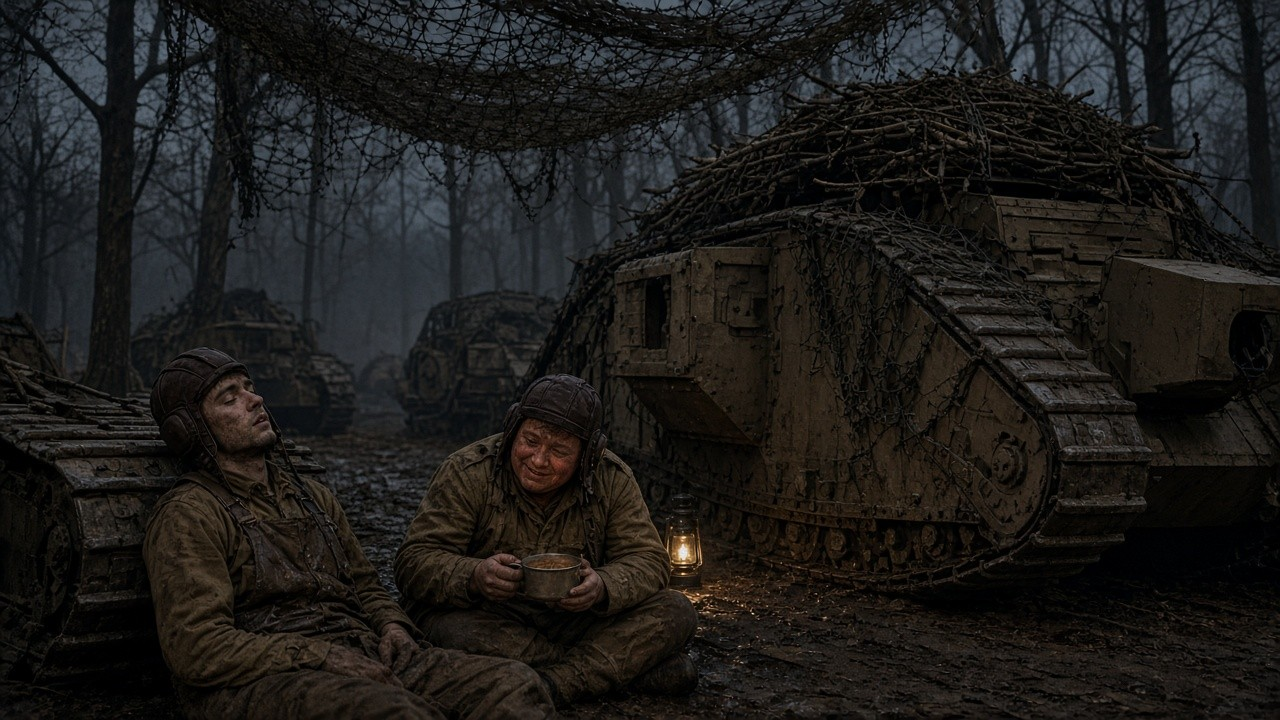
A war short story set during the Battle of Cambrai in November 1917, the first time hundreds of tanks went over the top together. Sparrow, the Kid, Spud, Daisy and the Bank are made up. However, the hidden tanks in Havrincourt Wood, the brushwood bundles, the great trenches of the Hindenburg Line and the church bells at home are real. Read about the real battle. (For another young soldier on the Western Front, read Count Your Bombs.)
The Wood
Spud says Havrincourt Wood looked like a fairground that night, if somebody had hidden a fairground under nets. I will take his word for it. I was busy listening to Daisy.
Daisy was our tank. She weighed twenty-eight tons, and she had a heart like a sick cow. When her engine was happy, she purred. When something was wrong, she coughed twice and then sulked. I had driven her for four months, so I knew every one of her noises. In fact, I knew them better than most men know their own wife’s voice.
“She all right, Sparrow?” the Kid asked.
“She’s all right, sir. Bit of a cough. It’s the cold.”
The Kid was our officer. He was twenty years old and had a voice like a choir boy, so of course the crew called him the Kid. Still, he did not mind. In fact, he said it was better than what they called the last one.
All around us in the dark, men whispered and swore. Engines ticked as they cooled. Somewhere a horse was eating hay. Meanwhile, four hundred tanks hid in that wood and in the villages around it, and every one of them was waiting for the same thing.
Tomorrow, at twenty past six in the morning, we would go over the top. There would be no big guns first to warn the Germans. There would be no week of shelling. Instead, there would just be us, crawling out of the mist.
Nobody had ever done it like this before. Later, the papers would call it the Battle of Cambrai. That night, though, it was just a cold wood full of nervous men. And I was the one who had to drive.
The Bank
That evening, the Major came to talk to us. His name was something long and posh, but behind his back we called him the Bank. That was because he talked about money more than any man I ever met.
“Do you know what one of these costs?” he asked. He slapped Daisy’s side, and the metal rang. “About five thousand pounds. You could build a whole street of houses for that. So you will bring her back. Do you understand me?”
“Yes, sir,” we said.
“There is a man here from a London newspaper,” the Bank went on. “Tomorrow, the whole country will read about you. Furthermore, the people at the Ministry will read about you too. If the tanks fail, there will be no Tank Corps by Christmas. They will melt you down for shell cases.”
He looked at each of us in turn. When he got to me, he stopped.
“And any crew that loses a tank through carelessness,” he said, “gets broken up. Every man goes back to the infantry, one by one, to a different battalion. Is that clear?”
Nobody said anything after that. Because that was the one thing we were all afraid of, and the Bank knew it.
Later, Spud and I sat against Daisy’s track with a tin of cold stew. Spud was our gearsman, and he was also my best mate. He was short and round and he could read better than anybody in the crew. When my mum’s letters came, he read them out to me, and he did the voices too.
“Five thousand pounds,” Spud said. “And what are we worth, then? Two bob?”
“Less,” I said. “They do not have to pay to melt us down.”
The Doctor
Before midnight, the doctor came round to look at the drivers. Drivers got sick from the fumes inside the tanks, so he checked our chests and our tongues.
“Breathe in,” he said. “And out. Good.”
Then he shone his torch in my face.
“Eyes a bit red, Private.”
“It’s the petrol, sir,” Spud said quickly, from behind him. “Gets in everybody’s eyes.”
The doctor grunted and moved on to the next tank. After he left, the Kid came and stood next to me for a long time. He did not say anything. Finally, he put his hand on my shoulder and squeezed once, the way he always did.
“Get some sleep, Sparrow,” he said. “Big day.”
I did not sleep. Instead, I lay under the net and listened to four hundred engines not running, and I thought about my mum.
The Battle of Cambrai Begins
At six o’clock, we climbed in.
Inside, a Mark IV tank is like being shut in a hot iron box with a lorry engine. The engine sits right in the middle of the floor, and eight men squeeze around it. It is loud enough to make your teeth hurt. Soon it is so hot that you sweat through your shirt. Also, the fumes make your head pound. We wore leather helmets and little masks of chain mail over our faces, because when a bullet hits the outside, bits of hot metal fly off the inside.
I sat at the front on the left, with the steering levers in my hands. The Kid sat on my right, next to the brakes. Behind us, Spud and Tubby worked the gears, and four gunners waited at the guns.
At twenty past six, the Kid tapped my shoulder.
“Go.”
I let in the clutch, and Daisy rolled forward out of the wood.
There is a trick to driving a tank. You cannot hear anybody in there, not even if they shout. So we used a system. If the Kid tapped my left shoulder, I turned left. If he tapped my right, I turned right. Two taps meant stop. A hand flat on my back meant faster. Then I would bang on the engine cover, and Spud and Tubby would change the gears behind me.
That morning, the Kid tapped my shoulders like a man playing the piano.
A little gray light came in through the slit in front of me, but mostly I drove by feel. I felt the ground go soft and then hard again. I felt the old shell holes tip us forward and then pull us back. Meanwhile, the Kid’s hand moved from shoulder to shoulder, and I followed it.

The Wire
Then we hit the wire.
The German wire was the worst thing on the Western Front. Men had died in thousands trying to cut it. It was miles deep, as thick as a hedge, and nailed down with iron posts.
Daisy just rolled over it.
I felt the wire scrape under her belly like a giant cat. Next, there was a long screech of metal, and the posts snapped one after another. Bullets started to rattle on the outside, like hail on a tin roof. Behind me, our gunners opened up, and the whole iron box shook.
The Kid leaned in close to my ear, so close that I could smell his breath.
“It’s working!” he yelled. “Sparrow, it’s working! They’re running!”
I did not answer. I was too busy counting.
The Big Ditch
The Hindenburg Line had trenches wider than any tank could cross. Spud said the big one was as wide as a barn. So the army had come up with a trick. On Daisy’s roof, we carried a huge bundle of brushwood, wrapped in chains. It was ten feet long and as fat as a haystack. The officers called it a fascine. Most of us just called it the bundle.
When we reached the big trench, the Kid would pull a lever and drop the bundle in. Then I would drive Daisy onto the bundle and over the other side.
We only had one go. If he dropped it in the wrong place, we would tip nose first into the ditch. And there we would stay, like a beetle on its back, until a German gun found us.
The Kid tapped twice. I stopped.
He pulled the lever. Above us, something heavy rolled and fell. I felt Daisy jump a little as the weight came off her roof.
Then the Kid put his hand flat on my back, and I knew what it meant.
I drove her forward. Her nose dipped. My stomach dropped with it, and for one long moment we hung there, tipped down into the trench, with all twenty-eight tons pulling us toward the bottom.
But then her tracks bit into the brushwood. She groaned, and she climbed, and suddenly we were up and over the other side.
Behind me, Spud was cheering so loud that I could hear him over the engine.
The Ridge
For the next three hours, everything went right. We crossed a second trench and then a third. Prisoners came out with their hands up. The Kid kept shouting things in my ear, like “Two miles!” and “We’ve never got this far!” and once, simply, “Bloody hell, Sparrow.”
Then we came to the ridge at Flesquieres.
I knew something was wrong before the Kid told me. The sound changed. The rattle of bullets stopped, and instead there was a deep crack, and then another. Clearly, those were big guns. They were close, and they were firing straight at us.
The Kid’s hand stopped moving on my shoulder.
“Sir?”
“Daisy’s sisters,” he said quietly. “Sparrow, they’re burning.”
To our left, a tank I knew by its engine went silent. Then another. The Kid tapped right, hard, and I swung Daisy away. But it was too late. There was a noise like the end of the world, and Daisy jumped sideways. After that, her left track went slack, and she would not move.
Inside, the air filled with smoke. Somebody was coughing. Lofty, our biggest gunner, was making a low noise and holding his leg.
The Bank’s voice came into my head. Five thousand pounds. You will bring her back.
The Kid did not even stop to think.
“Out!” he shouted. “Everybody out! Now!”
We tumbled out of the side door into the mud. The smoke was so thick that nobody could see a yard in front of them. Spud and I took Lofty between us, one arm each, and we started back toward our own lines.
“Left foot,” Spud kept saying. “Shell hole. Step. Wire, go round it. Step.”
So I did exactly what he said. We walked like that for nearly a mile, with the guns still cracking behind us.

Bells
Three days later, we were back behind the lines in a muddy farm. Lofty was in hospital with a broken leg, but he was alive. Daisy was still out on the ridge, with her track off and a hole in her side.
That morning, a dispatch rider brought the news. Back home, all over the country, they had rung the church bells for the Battle of Cambrai. It was the first time in the whole war that the bells had rung for a victory.
“My mum will have heard them,” Spud said. “Every church in town.”
“Mine too,” I said.
However, by afternoon, the Bank was there. Behind him came the newspaper man, with a notebook and a nice coat.
The Bank stood in front of the Kid and spoke very softly, which was worse than shouting.
“You left a five-thousand-pound tank on that ridge, Lieutenant.”
“Yes, sir.”
“With a broken track. Which your men might have fixed.”
“Under those guns, sir? No.”
“I told you what happens to crews who lose tanks.”
The Kid did not answer. Next to me, Spud went very still.
Then the newspaper man stepped forward, smiling. He did not seem to notice that anything was wrong.
“Which one of you is the driver?” he asked. “My readers will want to hear from the driver. You took her through the wire and over the great trench. So, tell me, young man. What did it look like? What did you see?”
What I Saw
Everybody went quiet. The Kid looked at me, and then at the Bank, and then he gave a tiny shrug, as if to say that it was over now anyway.
So I told the truth.
“Nothing, sir,” I said. “I haven’t seen a thing since August.”
The newspaper man laughed, because he thought it was a joke. Nobody else laughed.
Then the Kid told them all of it. First, Daisy had sunk in the mud at Ypres in August. Then the shells came over with mustard gas while we tried to dig her out. After that, my eyes swelled shut for two weeks, and when they opened again, the world was gray fog and bright blurs, and nothing more.
So the crew had decided not to tell anyone. After all, a blind driver goes home, and then the crew gets broken up, and a new driver comes. A new driver does not know Daisy’s cough. A new driver does not know which way she pulls when she is tired.
“So we made the system, sir,” the Kid said. “Taps on the shoulder. I was his eyes, and he was the best pair of hands in the battalion. Spud read him his letters. Spud stood behind the doctor and talked for him. We drove him through the wire, sir. Or he drove us. I am honestly not sure which.”
A Penny
The Bank stared at me for a long time. He was, I think, adding something up.
“Hold out your hand, Private,” he said.
I held it out. He put something small and cold into it. It felt like a coin.
“Do you know what that is?”
“No, sir.”
“It is a penny. That is how much the army spent on the system that took my tank further into the Hindenburg Line than any tank in the battalion.” He turned to the newspaper man. “You will not print this man’s name. You will write that the driver kept his eyes on the job. That is true enough.”
Then he turned back to the Kid.
“Private Sparrow goes to the eye hospital in Rouen tomorrow,” he said. “This crew stays together until he comes back. That is an order. And it is the cheapest one I have ever given.”
He walked away through the mud without another word.
Spud says the Bank was smiling. I will take his word for it.


Leave a Reply