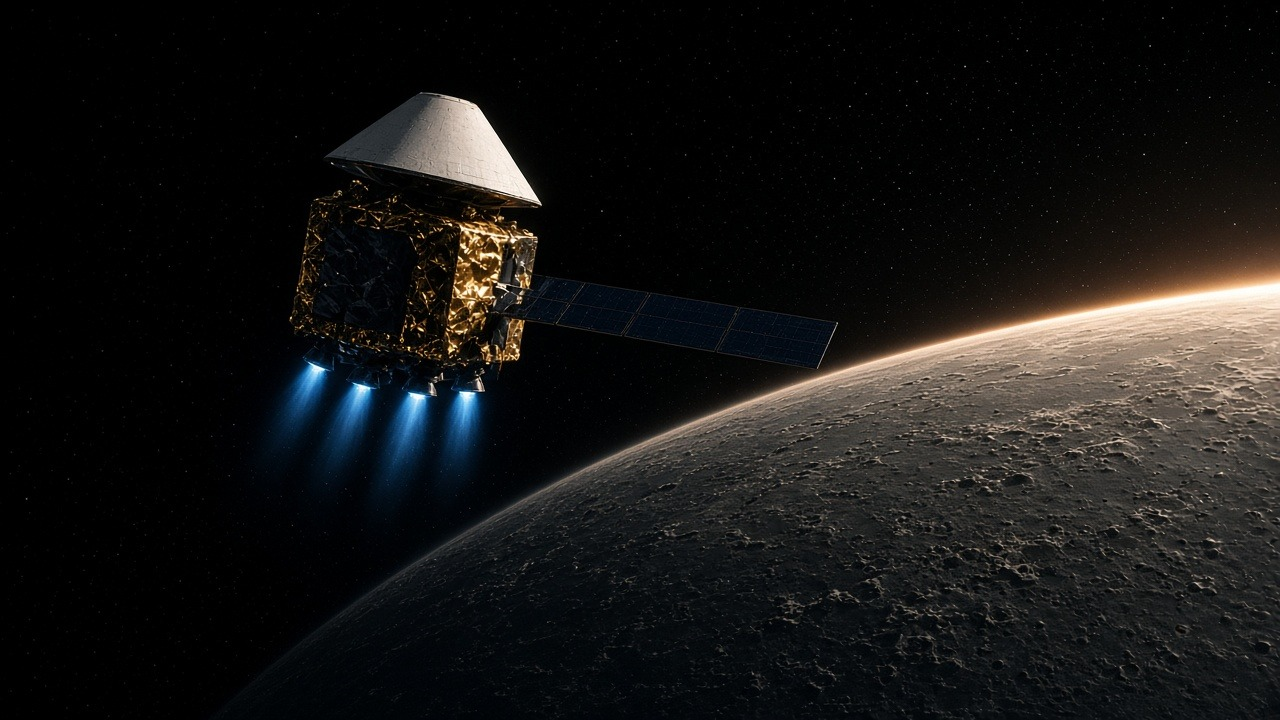
A sci-fi short story about the night shift that brings a Mercury probe home to its new orbit. Hen, the Chief, Moss, Kit and the two Sisters are made up. However, the long trip, the stacked twin orbiters, the sunshield and the arrival in late November 2026 are drawn from a real mission. See the real arrival timeline. (For another night in a small control room, read Read It to Me.)
The Ghost
Somebody had been sneaking into our spacecraft every night for six years. On arrival week, the Chief gave me the job of finding out who.
"Quietly," he said. "Before the insurance man finds out first."
It was Monday, five days before the big burn. We stood in the hallway outside the control room in Darmstadt, because the Chief never said anything important in front of the screens. He thought the screens listened. After thirty years in this building, maybe they did.
"Why me?" I asked.
"Because you work nights," he said. "And because you are the only one here who reads the logs for fun."
That was true, so I did not argue.
Then he handed me a single sheet of paper. On it was one line from the power log, printed again and again, down the whole page. The same line, the same time, every night.
03:10. Heater line seven. On. Nine minutes. Off.
"Forty watts," the Chief said. "Every night since 2020. Somebody on the ground is sending that command, and nobody will admit it."

Two Sisters and a Hat
Let me explain our spacecraft, because it is not one machine. Most people call it a Mercury probe, but really it is two.
First, the big one is ours. We call her Big Sister. She is the size of a small bus, wrapped in gold and black foil, with one long solar wing. She has the engines, so she does all the steering.
Meanwhile, the little one belongs to our partners in Japan. Everyone calls her Little Sister. She is round and flat, like a fat coin, and she has spent eight years riding on Big Sister's back under a white cone we call the hat. The hat keeps the sun off her. Mercury is so close to the sun that the sunny side of anything out there gets hot enough to melt lead.
Little Sister does not steer, and she does not talk. In fact, she has been asleep since launch. Her job starts in December, when Big Sister lets her go and she drifts off into her own orbit. Only then does she wake up.
At least, that was the plan on paper.
"Line seven goes to Little Sister's battery heater," I said.
"Yes," said the Chief.
"The one we stopped using in 2020."
"Yes." He rubbed his eyes. "So who keeps turning it on?"
The Insurance Man
The insurance man came on Tuesday. He wore a gray suit and gray shoes, so of course Moss named him the Suit before lunch.
Moss was our youngest controller, just two years out of school. He drank energy drinks out of a coffee mug so his mother would not worry. Also, he talked too much when he was nervous, and on arrival week he was always nervous.
"The Suit wants the Ghost," Moss told me in the kitchen. "That's what he calls it. The Ghost."
"Good name," I said.
"He says forty watts a night is power we stole from Big Sister. If she runs short on the burn, the insurance won't pay." Moss lowered his voice. "He says if we can't explain it by Saturday, they won't cover the split in December either."
In fact, that was the real fear. Without insurance, our partners would have to pay for any trouble out of their own pocket. They had already paid more than they could easily afford.
Then Moss looked at me sideways. "You work nights. You must have a guess."
"I have lots of guesses," I said. "That's the problem."
Suspects
My first guess was Moss himself.
After all, he was always in the building. He slept on the couch in the break room more nights than he slept at home. Moreover, he had once sent a test command to the wrong spacecraft during training, and he still turned red when anyone said the word "training."
But Moss had only joined us two years ago. The Ghost was six years old.
My second guess was Kit.
Kit was our partner engineer in Japan. I had never met her face to face. Still, I had heard her voice on the night loop almost every night for six years, because her morning was my night. She would come on at the same time, say "Good morning, Darmstadt," and read out Little Sister's temperatures in her soft, careful English.
Little Sister was Kit's whole life. She had built the battery with her own hands, back when she was younger than Moss. When we stopped the heater in 2020, she cried on the loop. I remember because I had never heard anyone cry on a voice loop before. Afterward, she apologized for an hour.
So Kit had a reason. However, Kit could not send commands to our spacecraft. Only a desk in Darmstadt could do that.
The Third Guess
My third guess was the Chief.
That sounds crazy, I know. After all, he was the one who asked me to find the Ghost. But the Chief had signed the 2020 report that switched off the heater, and I had seen his face when he signed it. He looked like a man putting down a dog.
Besides, he knew every old procedure in the building, because he had written half of them. If anyone knew about a forgotten checkout command, it was him.
So on Thursday I asked him straight out.
"Was it you?"
He laughed so hard he had to sit down. "Hen," he said, "I go to bed at nine. My wife makes me. Ask her."
Then he stopped laughing. "But I'll tell you something. Whoever it is, I hope they are careful. Because if the Suit catches them, they will never work in this building again."
The Hot Side
On Wednesday night, I read the old logs from 2020.
Of course, I knew some of the story already, since I had started on nights that same year. Back then, the stack had been flying the long way around the sun, with Big Sister always turning her back to the heat. One side of the stack faced the sun all the time. We called it the hot side.
Little Sister's battery, however, sat on the other side. It sat in the shadow, out of the heat, which sounds nice until you remember how cold space is in the shade.
That winter, the experts did their math. Big Sister needed every watt for her own long trip, they said. The heater on line seven used too much. Meanwhile, the battery inside Little Sister was getting old anyway. Someone wrote a short report. Someone else signed it. Then a small group in a meeting room agreed to switch the heater off and say nothing in public.
The report had one line I never forgot.
Little Sister is not expected to wake after separation. Mission success will be measured by Big Sister alone.
In other words, she was luggage. She was never meant to wake up at all.
I put the old report away, and I got up for my break. It was ten past three. My coffee went cold, like it always did.
The Night Before the Burn
On Friday, the whole team came in. The room filled with people I only saw at parties. The Chief wore his lucky blue sweater, which had a hole in the elbow that nobody was allowed to mention.
Meanwhile, in the corner, the Suit sat with a laptop and a list.
"Did you find the Ghost?" the Chief asked me quietly.
"I found where it comes from," I said.
"Where?"
"The old night desk. The one in the quiet room down the hall." I kept my eyes on my screen. "The command uses a checkout procedure from before launch. Nobody ever deleted it. It is allowed, so the computer never stopped it."
The Chief thought about that for a long time. "Can you lock it?"
"I can lock it."
"Then lock it after the burn," he said. "Tomorrow we fly. On Monday, we deal with ghosts."
The Burn
Big Sister came up on Mercury in the dark, on the planet's night side, heading for the south pole. Then four of her thrusters fired to slow her down.
That was the whole plan. If she slowed enough, Mercury would catch her. If not, she would sail past, and the sun would pull her away. Eight years of flying would be gone in a few minutes.
For a while, nobody in the room spoke. All the same, I could hear everyone breathing.
"Thrust is good," said Moss, in a voice that cracked in the middle.
On the big screen, the speed numbers crept down. Meanwhile, the power numbers crept down too, because thrusters need heaters and valves and pumps. Every watt counted. Out of the corner of my eye, I saw the Suit lean forward and look at the clock.
It was ten past three.
The Ghost never came. Heater line seven stayed off. The Suit made a little note and looked almost disappointed.
Finally, the thrusters stopped. The numbers held. Then someone in the back said, "We're in orbit," and the room went crazy.

Suddenly, people hugged who had never hugged before. Moss spilled his energy drink on a keyboard, and the Chief did not even yell. The orbit was long and stretched, nearly six hundred kilometers at the low end and more than eleven thousand at the high end, exactly as the plan said.
On the loop, Kit said, "Congratulations, Darmstadt." Her voice was flat and polite. She did not cry this time.
The Truth About the Mercury Probe
On Monday, the Suit wrote his report.
The Ghost had used about forty watts a night, he wrote, for six years. Even so, Big Sister had never once run short. The burn had used less power than planned, not more. Therefore, he would recommend full cover for December. He signed it with a gray pen.
On his way out, he stopped by my desk.
"You never found out who it was," he said.
"No," I said.
"Funny," he said. "The commands always came from the quiet room. At ten past three. Every night." He looked at my cold coffee. Then he put on his gray coat and left.
I locked heater line seven later that afternoon, like the Chief asked. It did not matter anymore. We were in orbit now, and Little Sister was on the hot side of the stack for the last few weeks of her ride. She did not need my help to stay warm.
Still, I kept checking her battery every night. It was an old habit.
Separation Day
On the ninth of December, Big Sister finally let her sister go.
On our screens, it was only a few numbers changing. Big Sister got a little lighter, and she wobbled a little, and then she settled. Somewhere out there, the second Mercury probe was drifting away on her own for the first time in eight years.
Then we waited for Little Sister's voice.
Of course, it was not our job. It was Kit's. Her team in Japan would listen for the first signal, and we would hear about it after. Even so, nobody in our room went home. The Chief brought in pizza at one in the morning. Moss brought in his mother's cookies. I sat at my desk and stared at a blank screen that would never show me anything, because Little Sister did not talk to us. She was never ours.
At last, at two in the morning, the loop clicked.
"Darmstadt, Japan," said Kit.
"Go ahead, Japan," said the Chief.
There was a long silence. Then Kit started to laugh, and the laugh turned into something else.
"She's awake," she said. "Little Sister is awake. Battery is at nineteen degrees. Nineteen degrees after eight years. She sounds like she was born yesterday."
The room went crazy again. Someone opened a bottle they were not supposed to have. The Chief hugged the Suit's empty chair, just to make people laugh.
Thank You, Hen
When things got quiet, Kit came back on the loop. By then, most people had gone home, and I was the only one left at the desks.
"Darmstadt night desk," she said. "Are you there?"
"I'm here," I said.
For six years, she had always said "Thank you, Darmstadt" at the end of her report. Every night, the same words, in the same soft voice, after the same nine minutes.
This time, she said something different.
"Thank you, Hen."
I said goodbye and I signed off. Then I picked up my cold coffee, and I walked down the hall to the quiet room, out of habit. It was ten past three. There was nothing left to send.
So I sat down in the old chair, at the old desk, and for the first time in six years I just drank my coffee while it was still a little warm.

Leave a Reply