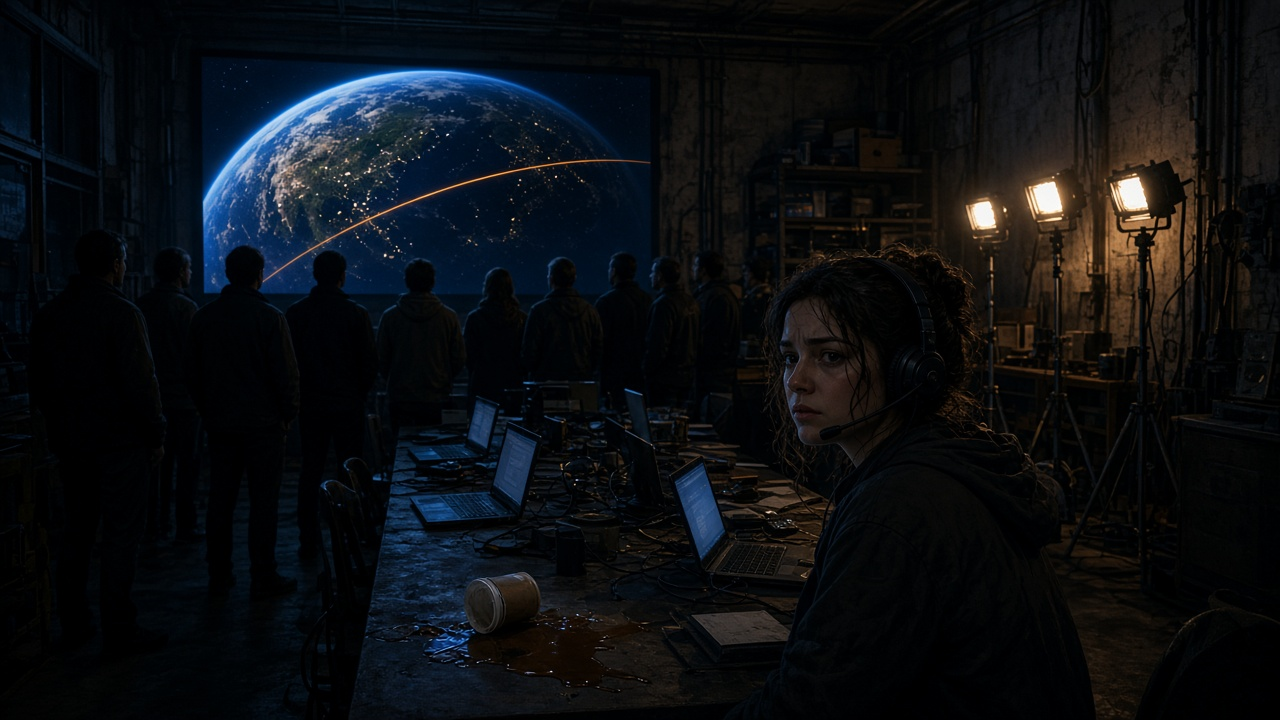
A space mission story set in a small control room in Oakland, California, told as a short story. Salt, Pepper, Two Birds Space and everyone in the room are made up. However, the flight path is real. This month NASA's twin ESCAPADE probes are skimming past Earth and firing their engines over southern Australia to throw themselves toward Mars, the first powered Earth flybys ever flown by a Mars-bound NASA spacecraft. This story imagines a tiny company trying the same trick a few years from now.
Four Minutes In
At four minutes and ten seconds into the most important engine burn of my life, every screen in the room froze.
The big wall went first, and then the six laptops on the long table. Even the little clock in the corner stuck at 2:55:10 a.m., as if time had stepped out for a smoke.
Meanwhile, nine hundred miles above southern Australia, a probe the size of a refrigerator was still firing its engine. We just could not see it anymore.
"Noodle," our boss said, and his voice cracked. "Noodle, what is happening?"
Nobody answered, because nobody knew. Twenty people stood in a room above a bike shop and stared at a picture that had stopped. Somebody's coffee tipped over, but nobody picked it up.
Then, from the end of the table, an old man said one calm word.
"Tick."
That was me. So I turned around.
Why I Tell This Space Mission Story
Most people want a space mission story with a rocket in it. Of course that is fun. There is fire and smoke and a crowd on a beach.
This one has no rocket. Instead, it has two small probes, one old man, one gray box with a knob, and nine minutes in the dark. It also has a lie, although no person told it. A gauge did.
My real name is Rosa. I was twenty-six that fall, the youngest controller at Two Birds Space. Before that, I fixed farm drones outside Fresno. In fact, I count everything: stairs, seconds, the beeps of a microwave. So on my first day, when I counted a test burn out loud without meaning to, the old man laughed.
"We'll call you Tick," he said. "Like a clock."
The name stuck, and so did I.
Salt and Pepper
Two Birds Space had thirty-one people, one ops room, and two probes. The probes were twins, so we called them Salt and Pepper. Salt wore a white blanket and Pepper wore a black one. Otherwise, you could not tell them apart.
They launched the November before, which sounds like a mistake, because Mars was on the far side of the Sun that winter. Instead of going straight there, the twins went out about a million miles to a quiet spot in space called L2. Then they looped around it all year, slow and patient, like two dogs waiting by a door.
When Mars and Earth finally lined up, the twins fell back home.
The plan was simple to say and hard to do. Each twin would skim past Earth, hundreds of miles higher than the space station, and fire its engine for nine minutes right at the bottom of the dive. Earth's pull would sling it while the burn pushed it. Together, they would throw each twin toward Mars, ten months away.
"A push at the bottom of the hill is worth more than a push at the top," Coach told me on my first day. "You burn where you're fastest. That's the whole trick, kid."
He was right, too. Physics people call it the Oberth effect, although Coach just called it kicking the swing.
Coach
Coach was our flight director, sixty-six, tall and stooped, with short white hair and big soft hands. Long ago he had flown missions for the big agencies. Later he coached Little League for twenty years, which is where the name came from.
He never looked at you when he talked. Instead, he looked about a foot to your left, as if you had a taller friend standing there. At first I thought he was shy, but after a while I decided it was just Coach.
He also had the Radio. It was a gray metal box the size of a lunch pail, with one black knob and a cable that ran down through the floor. Coach had built it himself, and it turned the twins' numbers into sound. A low hum meant the engine was pushing, while a high, thin whistle meant tank pressure.
He wore one earbud from it all shift, so Noodle called it Coach's elevator music.
"Screens lie," Coach said whenever anyone teased him. "Ears don't."
Then he would tip his chair back and say what he said fifty times a night. "Read it to me, Tick."
So I read him the numbers, all of them, out loud. His wife, June, dropped him at the curb every evening and picked him up every morning. "He doesn't like driving at night," she told me once, and then she smiled at me a little too long.

Saturday
Salt went first, on Saturday.
Our sponsor, a big phone company, paid for a livestream with three cameras and a host in a bright jacket. In return, our paychecks cleared, so Mr. Bright, our boss, loved them.
Mr. Bright was not a bad man. He was forty-four, with good shoes and a phone that never stopped buzzing. However, he had thirty-one people to pay, and our last big payment came only when both twins were on their way to Mars.
"Two for two," he kept saying. "Two for two, and we all eat."
Salt's burn was perfect. The hum came on at 2:51 a.m. and ran nine minutes clean, so Mr. Bright even hugged the camera man.
Meanwhile, Coach sat there with his earbud in, frowning a little.
"She dipped," he said quietly. "Minute four, when she went into Earth's shadow. The whistle dipped and came back."
I checked. On the screen, the pressure line had wiggled for about ten seconds. "That's tiny, Coach."
"Tiny is how big things say hello."
Later, Noodle cornered Mr. Bright by the coffee machine. He ran our network and ate ramen at every hour, which is how he got the name.
"The stream box is on the same switch as our screens," he said. "Monday it'll pull twice as much. If it chokes, every screen in here freezes."
"Then buy a second switch the day Pepper is on her way," Mr. Bright said. "Not one day before."
Still, that night I saw Noodle under the long table, alone, running a separate cable from the old command terminal into the floor. Nobody had asked him to.
The Hallway
When I went for my coat, Mr. Bright was on the phone at the end of the hall, and his voice carried.
"No, I hear you. A fresh medical on everyone in the room by Friday. Eyes, ears, heart, all of it. Fine." He paused. "Look, after Monday the old man retires. He's earned it. Besides, the sponsor wants younger faces on camera, and frankly, so do I."
Then he said the part that made my hands go cold.
"Tick can run the room. She's sharp, she's cheap, and she'll grow into it."
I stood there holding my coat. For one bad second, I felt happy. A real title meant real money, and I could already see my mom's face when I told her.
But then I thought about Coach looking a foot to my left, saying "Read it to me," and I felt sick about the happy part.
I did not tell anybody. Instead, I drove home and counted the stoplights. There were forty-one.
Sunday Night in the Dark
On Sunday night I could not sleep, so at eleven I drove back and climbed the stairs.
The ops room was dark. Every light was off, even the wall, and at first I thought it was empty. Then I heard the Radio, very soft, ticking out Pepper's quiet beeps.
Coach sat alone at the end of the table with his eyes shut.
"Lights bother me these days," he said, before I said a word. Apparently he knew my footsteps. "Sit down, kid."
So I sat. For a long time we just listened. Pepper was still a couple hundred thousand miles out, falling toward us, and she sounded calm, like a cat purring under a blanket.
"You heard Bright," Coach said.
It was not a question, and my face went hot in the dark. "Yes."
"He's not wrong about everything." Coach turned his head toward the black wall. "A room has to hand itself down. Otherwise, it dies with whoever is in it."
"I don't want it like this."
"Nobody gets it the way they want." He tapped the Radio twice. "So learn this box, Tick. Learn what normal sounds like. Then you'll know what wrong sounds like, even when the screens say everything's fine."
Monday, 2:40 A.M.
By 2:40 on Monday morning, the room was full.
The camera crew had three lights on stands. Meanwhile, Mr. Bright walked back and forth behind us like a man outside a delivery room. Before we even started, the stream counter read three hundred thousand.
Coach sat at the head of the table with his earbud in. As always, I sat on his right with my notebook open.
"Pepper's dropping fast," I said. "The dish in Australia has her."
"Good," Coach said. "Read it to me."
So I read speed, angle, tank pressure, battery and engine heat. Everything was green. The hum murmured in the room speaker, and above it the whistle was high and thin, the way it should be.
"Two minutes," I said. "One minute. Thirty seconds."
Mr. Bright stopped walking, and the host stopped talking. For once, the whole room was quiet.
"Ignition," I said, at 2:51 exactly.
Suddenly the hum swelled into a deep, round note, like a cello string. On the wall, the speed number began to climb. Somebody behind me let out a breath.
"She's pushing," Coach said. "Good girl. Keep reading, Tick."

Frozen
Four minutes and ten seconds later, the screens froze.
"It's the stream!" Noodle shouted, typing with both fists. "The stream box ate the switch! Everything on it is locked!"
"Then reboot it!" Mr. Bright said.
"Reboot takes six minutes, and the burn has five left!"
Mr. Bright went white. "What still works?"
Noodle pointed under the table. "Big Gray, the old command terminal, because I ran it its own line." Then he pointed down the table. "And Coach's box. It was never on the switch. It runs straight off the dish feed."
So everybody looked at the Radio.
Right then, the whistle changed. At first it was just a wobble, like a kettle before it settles. Then it started to fall, lower and lower, a long sad slide like air going out of a tire.
"That's tank pressure," I said. My mouth was dry. "Coach, that's tank pressure going down."
Mr. Bright grabbed my shoulder. "What does that mean?"
I knew exactly, because I had read the rules a hundred times. If Pepper's computer saw low tank pressure for thirty seconds, it would shut the engine down to protect her. Then she would be safe, but she would also be short. Half a burn at the bottom of the hill would miss Mars by a whole planet.
"It means she quits in thirty seconds," I said. "Actually, twenty-five now."
By Ear
Coach pulled out his earbud and turned the black knob until the hum and the whistle filled the room.
"Listen," he said. "Everybody, shut up and listen."
Even the host shut up.
The whistle was still falling. Underneath it, however, the hum had not changed at all. It was the same deep cello note, steady as a heartbeat.
"Hear that?" Coach said. "The engine is pushing exactly as hard as before. If the tank were really losing pressure, the hum would drop too. Since it isn't dropping, the tank is fine. The gauge is lying."
"How do you know?" Mr. Bright said.
"Because Salt did the same thing on Saturday at minute four, when she went into Earth's shadow. Her sensor got cold and sagged. Pepper's is doing it worse." Coach turned his face toward me. "Tick, inhibit the pressure rule. Now."
Of course, everybody looked at Mr. Bright.
"If he's wrong," Mr. Bright whispered, "and the tank really is going…"
"Then I'm wrong in front of nobody," Coach said, "because your stream is dead. Sixteen seconds, Tick."
Mr. Bright closed his eyes. Then he nodded once.
Big Gray
I dropped to the floor and crawled under the table to Big Gray. Its little green screen was still alive. However, my hands shook so badly that I typed the first word wrong.
"Slow is fast," Coach said above me, very calm. "Read it to me."
So I read it to him while I typed, letter by letter: the command, the rule number, the word INHIBIT, and then the code to send it.
"Good," Coach said. "Send."
Then I hit the key. "Sent. Nine seconds."
The signal went to the dish in Australia and then up to Pepper, nine hundred miles high and falling fast. After a few long seconds, Big Gray blinked one green line.
RULE 14 INHIBITED.
"Got it!" I shouted. "She took it!"
The whistle kept sliding down until it was almost a growl. Nevertheless, the hum never changed. In the dark room, twenty people stood still and listened to a probe they could not see push itself toward another world.
"Seven minutes," I counted from the floor. "Eight. Eight-thirty. Nine."
At nine minutes and two seconds, the hum stopped. It did not fade, either. Instead, it stopped clean, like a door closing softly.
"Shutdown," Coach said. "On time. That's a good burn."
The Bottom of the Hill
At 3:01, Noodle's reboot finished, and the wall came back to life.
At once the numbers rolled in. Pepper was doing 6.7 miles a second, right on the line for Mars. Then, as we watched, the pressure line crept back up to normal while her cold sensor warmed. As a result, the little red flag on the chart turned green by itself. The tank had been fine all along.
Then the room went loud.
Noodle threw his ramen fork at the ceiling. Meanwhile, Mr. Bright sat down on the floor next to me and laughed until he coughed.
"Two for two," he said. "Two for two, Tick."
I crawled out from under the table, grinning so hard my face hurt, and turned to thank Coach.
But he was not looking at the wall. He was not looking at me, either. Instead, he was smiling at the empty corner by the door, about a foot to my left, the way he always did.
"Coach!" Mr. Bright called, getting up. "Come look at the numbers on the wall!"
Coach did not turn his head. He just tipped his chair back and said it one more time.
"Read it to me, Tick."
A Foot to the Left
And then, all at once, I understood.
The dark room on Sunday. June at the curb, every evening and every morning. The way he looked past me, and the box that turned numbers into sound. For eight months he had said "Read it to me," and not because I was fast. It was because he could not see the screen.
"How long?" I said, so only he would hear.
"About two years." He kept his voice low. "Bad eyes. The middle went first, so I see the edges of things a little. Not numbers, though. Not faces." He smiled. "So I listen better than most."
"Friday," I said. "The medical."
"I know, kid. I was going to tell Bright myself, after. Let them have tonight first."
Behind us, Mr. Bright had gone very quiet. I did not know how much he had heard. When I looked up, though, he was standing still, watching Coach watch nothing.
"Tick," Mr. Bright said at last, and his voice was rough. "That medical on Friday. Write it down for me. What exactly does a flight director need to pass?"
I looked at the gray box with the one black knob.
"Ears," I said.
June
At 6:10 a.m., the sun came up over Oakland, and June's little car pulled up to the curb right on time.
Coach stood up slowly and felt under the table for his bag. I had seen him pick up that bag every morning for eight months. Still, I had never once watched what he took out of it on the way down the stairs.
This time I did.


Leave a Reply