A shipwreck story set in the Downs off Deal, Kent, in November 1703, told as a short story. The Falcon, Cap, Latch and everyone else aboard are made up. However, the Great Storm was real. So was the warship that sank that night on the Goodwin Sands. In October 2026, divers surveying that wreck reported an unopened sealed wooden chest still sitting on the seabed. This story imagines a boy who was told to guard one.
The Latch on the Door
Cap put my hand on the lid and held it there.
“You are the latch on my door now, boy,” he said. “While I am on deck, this chest does not move. It does not open. If a man asks for the key, you have no key. If a man offers you a coin, you have no ears. Do you understand me?”
“Yes, Cap,” I said.
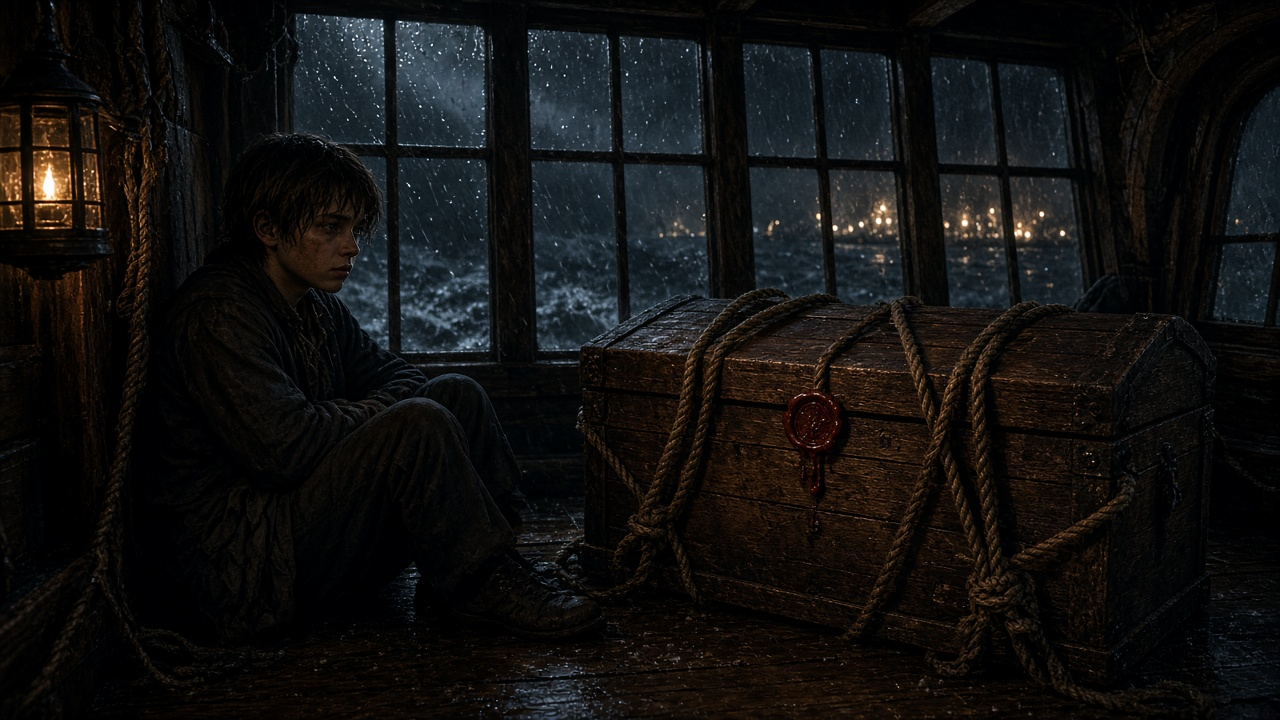
Then he took his hand away. Meanwhile the oak lid stayed cold under my palm. The red wax seal sat in the middle like a little sun that had gone hard.
I was fourteen. On the Falcon, that was old enough to die and young enough to be called boy for the rest of my life. Still, Cap looked at me as if I were a lock that might hold. Besides, somebody had to sit with the chest.
Why I Tell This Shipwreck Story
My name is Tom. Cap named me Latch on the second day, and after that nobody used Tom except in my own head.
I came from Deal. Mama took in washing on Middle Street, three doors past the baker. In May, a press gang caught me behind the fish stalls. By June I was scrubbing the Falcon’s decks. By November we were back in the Downs, anchored behind the Goodwin Sands with the rest of the sick fleet, waiting for London and for pay. Until then, Cap said, we would do our duty and keep our mouths shut.
People like a shipwreck story about captains and gold. Of course that is fair. Cap had a gray mustache and quiet boots, and he never shouted. However, this one is about a sealed chest and a boy who was told not to open it. Above all, it is about what a seal can hide when men are hungry for treasure.
Cap’s Order
The chest lived under the stern windows in the great cabin. It was the length of my arm and the width of my knees. The lock was iron. Likewise, the seal was Cap’s own, pressed deep, with a ribbon under the wax.
Around us, the cabin smelled of damp wool, old ink, and the lemon Cap kept in his desk for his cough. Outside the glass, the Downs looked flat and brown. Deal’s lights sat low on the shore. Further out, the Sands waited under a skin of water, the way a dog waits under a blanket. Yet Cap spoke of them as if they were only weather.
Cap checked the seal every morning. After that, he checked it every night. Once, when he thought I was asleep on my mat by the door, I watched him count small coins into a cloth. Then he slid the cloth under the lid before he warmed the wax again.
I told myself he was hiding prize money from the Navy Board. Boys hear talk. Afterward they invent the rest.
Ink Wants the Inventory
Ink was the purser. He was thin as a spar, and his fingers were always black. He hated sealed things. Sealed things, he said, could not be counted, and things that could not be counted could not be paid for.
On the twenty-fourth, while Cap was on the quarterdeck, Ink came to the cabin door with a paper and a smile.
“Board wants the chest listed before we sail for the river,” he told me. “Open it, Latch. I’ll make a note. Cap will thank us when the clerks in London are happy.”
“I have no key,” I said.
“Then break the seal. Wax is cheap.”
“Cap said no.”
Ink’s smile got smaller. “Cap has a career. Careers drown in missing paper. If that box is light when we reach the yard, somebody hangs, and it will not be a ship’s boy.”
Then he left. Later I heard him in the passage with Bones, the old gunner’s mate.
“Every day we sit here burns biscuit and wages,” Ink said. “The Board will ask why the Falcon hugged the Sands like a frightened mule. If Cap’s precious chest is empty, I will not take the blame.”
Bones only grunted. “Storm first. Hangings later.” Even so, Ink kept looking at the cabin door.
So I kept the door shut. Meanwhile Cap’s order sat in my ears like a second seal.
The Sick Fleet
We had come home thin. The Mediterranean had taken men with fever. On our decks, the hammocks still smelled of vinegar. Bones said three quarters of the fleet could barely haul a rope. Cap said we would wait in the Downs until the wind and the orders both turned kind.
Orders were slow. However, wind was not.
Deal boats came out with water and gossip. One boatman shouted that the White Squadron had already gone up toward London. Another said the Channel ships would hold us here like cattle. Cap paid for the water and did not argue. In fact, he never argued with men who brought barrels.
That evening he called me to the stern glass and pointed at the town.
“Middle Street,” he said. “Which door?”
I told him. Three past the baker. Green paint peeling. Then he wrote it in his little book, slow and neat, the way a man writes a debt he means to pay.
“Don’t spend what you haven’t been given yet,” he said.
I thought he meant my pay. Accordingly I nodded like I understood.
Heavy with Paper
On the twenty-fifth the sky went the color of wet ash. Cap came down from the deck with salt in his hair and put both palms on the chest, as if he were blessing it.
“Some chests are heavier with paper than with gold,” he said. “Remember that, Latch.”
Then he laughed once, soft, like a man who had made a joke only he could hear.
“If the ship is lost,” he added, “the seal is yours to break. Not for Ink. Not for a king. For you. And not a moment sooner.”
I stored the words the way boys store coins. Of course I did not spend them yet. Nevertheless I felt them in my pocket all night.

The Wind Turns
By dusk on the twenty-sixth, the Downs had stopped being a road and started being a trap.
At first the wind came from the southwest, hard enough to make the lanterns lean. Then it backed and rose until talking on deck was mostly mouths and no sound. The Falcon jerked at her cables. Spray came in through seams that had been dry all week.
Cap sent me below.
“Chest,” he said. “Door shut. If I knock twice, open. If anyone else knocks, you are deaf.”
So I sat with my back against the oak and counted the ship. One. Two. Three. Meanwhile the hull complained like an old door in a gale. Above me, feet ran. Somewhere a gun broke loose and people swore. Soon after, Cap’s lemon rolled off the desk and stopped against my heel.
After that I put it back. Then I checked the seal again, because checking felt like work I could still finish.
Night Without a Sky
There was no sky left to see. Instead the stern windows turned into black mirrors. Each time the ship lifted, my stomach lifted with it. Each time she fell, the chest slid an inch and the seal winked in the lantern light.
Twice Cap knocked. Twice I opened. Once he took a dry coat. Later he only looked at the wax, nodded, and went back into the noise.
“Still sealed?” he asked.
“Still sealed.”
“Good boy.”
After the second visit, the lantern smoked. So I trimmed the wick with Cap’s knife. My hands shook. Therefore I talked to the chest the way Mama talked to wet sheets on the line.
“You stay,” I told it. “I stay. We go to London. Mama gets her coins. Cap gets his thank-you from the Board.”
The chest said nothing. Of course chests never do.
Ink at the Door
Near what felt like midnight, somebody hammered who was not Cap.
“Latch! Board business! Open!”
Ink.
“Deaf,” I shouted, because Cap had said so.
“The cables are parting, you fool. If we strike the Sands, that chest is the only thing that pays for a funeral. Open it and give me the papers!”
I put my shoulders to the door. Meanwhile the bar held. Ink kicked once, then twice, then stopped. Maybe Bones pulled him away. Maybe the ship did. After that I heard him swearing about Cap’s career and Cap’s pride and Cap’s sealed nonsense, until the wind ate his voice.
Then I checked the wax. It was whole. A little white line had formed where the wood had flexed. Still, it held.
The Sands
I did not see the Goodwin Sands. Instead I felt them.
The Falcon hit something that was not water. The whole cabin tilted. My mat, Cap’s chair, and the lemon all went sideways. The chest strained against the rope Cap had used to lash it to the ringbolt. For a second the lantern swung so hard the flame lay flat.
Then Cap knocked twice, hard.
So I opened.
He was soaked to the skin. Blood ran from a cut on his forehead into his eye, but he was still Cap. He shut the door with his shoulder and put both hands on my face, quick, the way Mama did when she counted my fingers after a fall.
“Listen,” he said. “The best boat is gone. The cables are gone. Moreover, I cannot carry that chest and you both through what is coming.”
“Then I can carry it.”
“I know.” He almost smiled. “That is why you are the latch.”
Meanwhile water was already in the passage, cold around my ankles. Cap cut the lashing with his knife and shoved the chest into my arms. It was heavier than I expected. Or else I was weaker than I expected. Both can be true.
“On deck they will tear it open for gold,” he said. “Down here they may not find you in time. Break the seal. Now. Then you decide what to do with what is inside.”
“You said the ship had to be lost first.”
“The ship is lost, Latch.”
So I broke it.

What Was Inside
The wax cracked like thin ice. After that the ribbon came away in my fingers. Then I lifted the lid.
However, there was no gold.
Instead there was a cloth purse, soft with coins, tied with string. Under it lay two folded papers. The top one had Mama’s street on it in Cap’s neat hand.
Mrs. Hale, Middle Street, Deal, three doors past the baker. For her boy Tom, called Latch. His wages held back so the crew would not drink them. Plus what I owe for taking him from the stalls without a clean warrant. I am sorry. If I can, I will walk him to her door myself.
The second paper was shorter.
If you are reading this, I am not there to say it. Live if you can. If you cannot, put the purse back and seal the chest. The sea keeps better accounts than London.
I looked up. Cap was watching me the way a man watches a fuse.
“You let them think it was the Board’s chest,” I said.
“I let them fear the Board,” Cap said. “Fear keeps hands off a boy’s pay better than a lecture. Ink would have counted every coin into his book and called it virtue.”
Suddenly my throat hurt. “You wrote Middle Street.”
“I meant to take you there,” he said. “Christmas, if the wind allowed. A proper coat. Your mother’s door.”
Seal It Again
Then the Falcon struck again, harder. Cap braced me and the chest against the bulkhead. Meanwhile water climbed my calves.
“Seal it,” he said. His voice was almost calm. “Use my wax. From the drawer. If you go into the sea with an open box, men will fight you for empty hopes. If you go with a seal, they may leave you alone long enough to float.”
So I did what he said. My hands knew the work from watching him. Heat. Drop. Press. The new seal was uglier than the old one. Still, it was a seal.
Cap tied the chest to my belt with a length of rope. After that he tied a second rope from the chest to my wrist, gentle as a father tying a shoe.
“I am going back on deck,” he said. “Somebody has to shout while there is shouting left. You stay by the stern windows. If a Deal boat finds the wreck in the morning, you wave. If not…” He touched the new wax with one finger. “Then the sea has the account.”
He opened the door. Consequently the passage was loud and white with spray. Then he looked back once.
“Keep the latch shut, boy.”
After that Cap went into the dark, and the door slammed, and I did not see him again.
The Account
I do not know how long I sat there. Indeed, time goes strange when a ship is dying. First the water rose to my waist. Then the lantern died. Soon the stern glass cracked and let the Downs in by cups, then by buckets.
I held the chest the way Mama held a basket of dry sheets when the alley was muddy. Meanwhile I talked to it again, because talking is a kind of rope.
“Middle Street,” I said. “Three past the baker. Green paint.”
Outside, guns were firing for help that could not come. Cap had told me once that sound travels strangely over sand and storm. Maybe Deal heard us. Or maybe Deal only heard the wind.
The Falcon rolled, and kept rolling, and the cabin ceiling became a wall. So I climbed with the chest toward the cracked glass because Cap had pointed me there. Cold poured over my shoulders. The sealed lid bumped my chin.
I thought of Ink counting. After that I thought of Bones saying hangings later. Then I thought of Cap’s neat hand on Mama’s name. Above all, I thought of the ugly new seal under my fingers, still soft at the edges.
If a boat came, I would wave. If the sea took the account instead, then someday the chest would still be a chest, and the wax would still be wax, and nobody who opened it would find a king’s gold.
Instead they would find a washerwoman’s street, and a boy’s wages, and a captain who tried to walk a pressed child home.
The water covered my mouth. So I tipped my head back. Meanwhile the chest rose under my hands as if it wanted the air more than I did.
I did not let go.



Leave a Reply