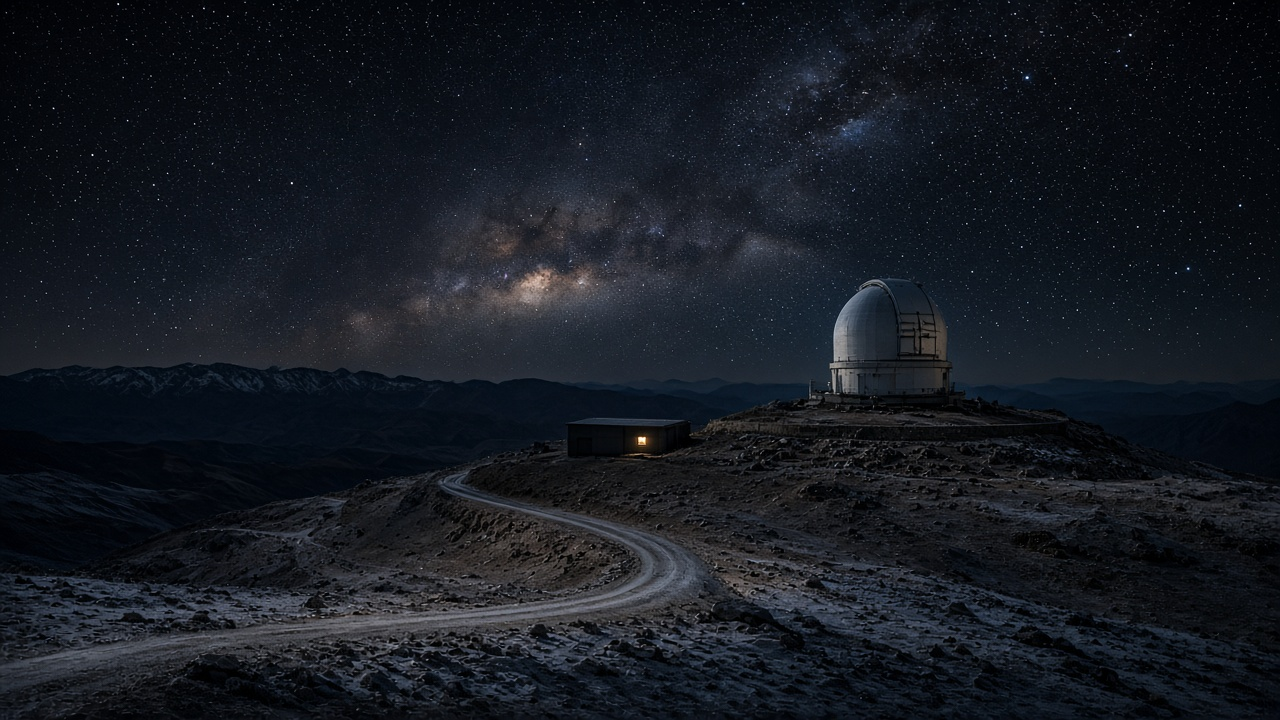
A dwarf planet story set on a Chile mountain ridge in 2026, told as a short story. Pix, Doc, Boss, and the Ridge crew are made up. However, the first dwarf planet candidate from the NSF-DOE Vera C. Rubin Observatory is real. On October 27, 2026, Rubin announced 2026 ED138, a bright world beyond Pluto found in survey data. This story imagines a night student who noticed that her candidate would not stop blinking.
The Blinking Dot
At 3:12 a.m., the Slow Walker blinked again.
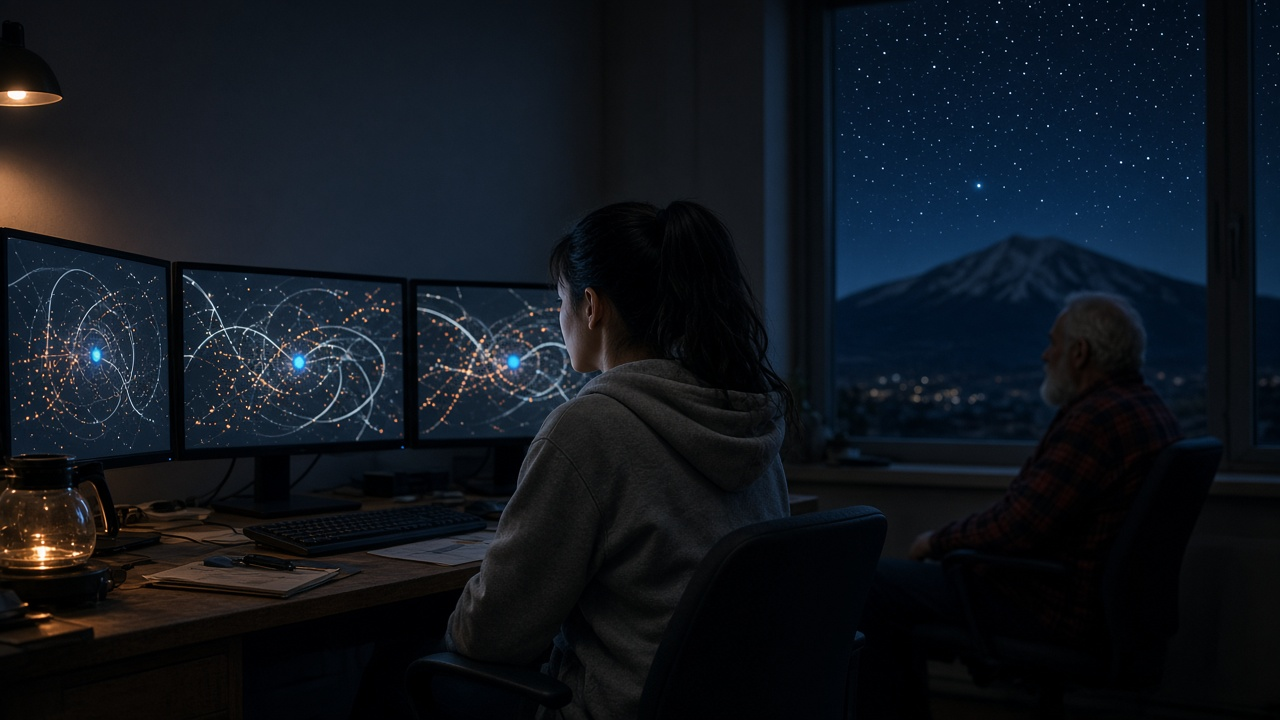
I almost missed it. Meanwhile the Ridge control room was cold, and my coffee had gone flat an hour before. On the wall screen, a crowded field of stars from the Milky Way plane filled every corner. Then one faint gray speck slid a little, the way a shy animal moves when it thinks nobody is looking. After that, it went dim. Then it came back.
So I wrote the time in my notebook. Then I wrote "blink #4" under it. Meanwhile my hands were shaking, and that was not from the coffee.
My name is Paola. On the Ridge, everybody calls me Pix. Doc named me that on my first night because I kept poking at pixels like they owed me rent. I was twenty-four, a night student from La Serena, and I was supposed to flag moving junk, not name a world.
Still, the Slow Walker kept blinking. And Boss wanted a name for a donor before anyone asked why.
Why I Tell This Dwarf Planet Story
People like a clean discovery. They want a new dwarf planet, a press line, and a dinner with good wine. Of course that is fair. Money keeps telescopes warm. However, this dwarf planet story is about a blink that would not behave, and about a dinner that almost buried the truth under a pretty name.
The Ridge sits high on Cerro Pachon, above the brown valleys and the thin white roads. In winter the wind finds every crack in the door. During summer the stars look close enough to scrape. We do not run the giant new survey camera. Instead we run a smaller partner telescope that feeds the same hungry sky pipeline. Doc says we are the night janitors of the solar system. First we sweep. Then we sort. After that we hand the bright finds uphill.
Until that week, my biggest find had been a rock the size of a city bus. It was already in three catalogs. Boss patted my shoulder and said good work. Then he went back to his grant slides.
This time was different. This time the object was slow, far, and bright enough to make Doc put his tea down.
Night School on the Ridge
Doc is sixty-one. He has a gray mustache, reading glasses on a cord, and a thermos that smells like burnt sugar. He has worked Chile nights longer than I have been alive. On my first night he stuck a yellow note on my monitor.
"Blink is a question," it said. "Pair is an answer."
I laughed then. I thought it was one of his old-man jokes. Later I stopped laughing.
"Rule one," Doc said that first night. "Never cheer at a first look. Rule two. Never name what you have not measured twice. Rule three. If Boss calls after midnight, put him on speaker so I can hear the lies too."
Boss is Mr. Vale. He is not a villain. Rather, he is a man with a roof to keep over a mountain and a donor dinner on Thursday. Still, midnight calls from Boss mean money is nervous. Consequently the whole Ridge learns to hear his ringtone.
Bean works days on the pipeline. He leaves sticky notes that say things like "filter wheel sticky again" and "do not trust frame 118." Once he left a note that said "lamp check before you cry." I kept that one in my pocket for luck.
On the night of the fourth blink, I almost blamed the lamp. However, luck is not the same as proof.
Boss and the Dinner
Tuesday morning, Boss came up the switchback in a clean jacket that did not belong on a mountain. He brought pastries and a smile that looked rented.
"Thursday at seven," he told Doc and me in the kitchen. "Valley lodge. Donor table. Quinn is flying in from Santiago."
Quinn funds half our winter power bill. His late wife loved star charts. Consequently Boss wanted something for the dinner program. Preferably a world. Preferably with a soft name.
"If Pix's walker holds," Boss said, "we float a provisional name. Lucille. Soft. Clear. People remember soft names."
Doc did not look up from his tea. "Provisional names are numbers first. Soft names come later. Soft names come after the orbit is boring."
Boss smiled harder. "Soft names bring hard money, Doc. The board meets Friday. If Quinn leaves happy, we keep the night crew through March. If he leaves bored, Pix goes back to campus and you drink tea alone."
Then he left pastry crumbs on the counter and drove down toward the clouds.
I thought about my sister's school fees in La Serena. Afterward I thought about Lucille written on a world that still blinked like a faulty bulb. Meanwhile Doc poured more tea and said nothing, which is how Doc shouts.

Bright Enough to Name
By Wednesday we had a rough track. The Slow Walker was far out, past Pluto's neighborhood, moving like something tired. Doc said the distance put it near forty-six times as far from the Sun as Earth is. Pluto averages about forty. Numbers like that make ordinary rocks look shy.
Brightness said big. Not city-bus big. Continent-chunk big, if the surface was as dark as we feared, or smaller if it was icy and bright. Doc scratched 600 to 1500 kilometers on the whiteboard and underlined "estimate." Infrared would settle it later. For now, the press line would say dwarf planet candidate, which is science for "big and roundish until proven otherwise."
The orbit was tilted about twenty-five degrees. Doc called that a hot classical path, which means the rock had been shoved around long ago. We found it near the crowded Milky Way plane, where a million background stars can hide a slow traveler for years. That is why earlier surveys missed it. Our smaller camera caught it because we kept looking at the same messy strip night after night.
Bean dug archival frames from an older wide-field camera down the next ridge. Some went back to 2016. Suddenly we had more than ten years of arc. The walker had been there the whole time, quiet as dust.
Still, it blinked. And blinking is a bad guest at a naming dinner. Besides, a dwarf planet story that skips the blinks is only half a map.
It Keeps Blinking
A spinning rock can blink if one side is brighter. Ice patches can do it. Dark dust can do it too. Likewise a long shadow of a hill can fool a tired eye. I learned that in class. So I told myself the Slow Walker was just showing off its dirty face.
However, the dips were neat. Too neat. About every third good night, the brightness fell hard for part of a frame stack, then climbed again. Once it dipped twice in one night. At first I wrote "lamp?" in the margin. Then I wrote "filter?" After that I wrote "me?"
At 2 a.m. I walked to the instrument hall and checked the calibration lamp with both hands. The lamp was cold. Likewise the filter wheel sat where Bean left it. No sticky. No stutter.
So I went back to the screen. The Slow Walker blinked on schedule, like a shy heart.
Doc watched over my shoulder. "Out past Pluto," he said softly, "lonely rocks sometimes walk with a shadow."
I looked at his yellow note again. Blink is a question. Pair is an answer.
Then Boss called, and the quiet part of the night ended.
The Call from the Valley
I put him on speaker, the way Doc asked.
"Pix," Boss said. His voice was bright with hotel air. "Quinn loves Lucille. He almost cried at lunch. We need the walker locked for Thursday's program. One page. Bright. Simple. No blinking talk. Blinking sounds like a bug."
"It does blink," I said.
"Then fix the pipeline before dinner. Bean can patch a bad flat. People do not fund bugs. People fund worlds."
Doc leaned in. "If it is a bug, we say so. If it is a rock, we measure it. Either way, Lucille waits."
There was a pause. In the background I heard plates and soft music.
"Doc," Boss said, quieter, "I am not asking you to lie about gravity. I am asking you not to scare a grieving man with half a sentence about blinks. Give me a clean candidate. After the board, you can chase ghosts for a month."
Then he hung up.
I sat with my notebook open to blink #7. Meanwhile the dinner invite on the cork board showed a gold border and the word Lucille in careful script. Until that call, I had wanted to be wrong about the blinks. Afterward I wanted to be right, even if right cost me March. Besides, a wrong soft name is harder to unsay than a hard number.
Archive Dig
Thursday began at noon for me, which is night for people who sleep like people. Still I skipped sleep. Instead I pulled every frame Bean could find. First the old ones. Then the new ones. After that the bad weather nights. Finally the good ones.
One 2018 stack showed the Slow Walker sitting clean. Another from 2021 made it look soft, as if somebody had smudged it with a thumb. During a March night from our own run, it was bright, then cut, then bright again. The cut was not random. Rather, the cut had a shape. A little bite out of the light.
So I lined the bites by time. Then I lined them by how deep they went. After a while the pattern stopped looking like a dirty face spinning. Instead it started looking like something passing in front of something else.
"Occultation," I whispered. School word. Fancy for one body covering another.
Doc came in with fresh tea and looked at my plot. For a long time he said nothing. Then he tapped the yellow note.
"Pair," he said. And for the first time that week, my hands stopped shaking.
The Donor Plate
Boss arrived at four with a printed program proof. Lucille sat in the middle in soft gray letters. Under it, in smaller type: a new dwarf planet candidate from the Ridge survey team.
"Quinn's driver is already on the switchback," Boss said. "We toast at seven. Pix, you say two sentences. Keep them warm. Doc, you nod like a wise uncle."
I held the page. The letters were pretty. Pretty is not the same as true.
"Boss," I said, "if we name it as one body tonight, and it is two, we bury the second one under a dinner speech."
Boss rubbed his eyes. He looked older than the clean jacket. "Pix. Please. I have a power bill and a board. I have a man who lost his wife and wants her name on something that will outlast both of us. Do not make this a philosophy class."
"It is not philosophy," Doc said. "It is counting."
Boss looked at the wall screen, where the Slow Walker was a dull pin in a storm of stars. "Then count fast. You have until six. If you do not have a clean story by six, Lucille goes in the program as written. After that, science can be complicated again."
Then he left the proof on the counter beside Doc's thermos. Meanwhile the clock above the sink moved like it was on Quinn's side.
Odd and Even
First I split the blinks into odd nights and even nights. Next I split them by filter. After that I split them by whether the calibration lamp had been on that afternoon. Bean's lamp theory died hard. The lamp logs were clean. Likewise the filter logs were clean. My own hands were the only messy thing in the room.
So I stacked the bitten frames another way. I asked the pipeline to treat the soft edges like two centers instead of one. At first the code refused. Then Bean, still on a day shift that had become night, patched a stubborn line and cursed in two languages.
At 5:41 p.m., the stack resolved.
Not one soft smudge. Instead, two points held the sky.
One brighter. One much fainter. Separated by a whisper of airless dark. The faint one sat where the bite had been eating light from the bright one. They were dancing slowly around a shared middle, far beyond Pluto, in a place earlier surveys had skipped because the Milky Way was too loud.
Therefore the Slow Walker was not a lonely rock showing a dirty face. It was a pair. And pairs do not fit on a one-name dinner card.

Six O'Clock
Boss came back at 5:58 with Quinn's schedule on his phone and panic in his shoulders.
I turned the screen. Doc turned the whiteboard. On it I had written, in big ugly marker:
WALKER A WALKER B (not Lucille yet)
Boss stared. Quinn's gold invite still hung on the cork board like a soft trap.
"Two," Boss said.
"Two," I said. "The blinks were the little one crossing the big one. So it was not my lamp. Likewise it was not Bean's wheel. And it was not a pipeline ghost. It was a companion. If we announce one soft name tonight, we teach the world to look for one body. Then the second one gets lost again in the crowded plane."
Boss sat down hard on the kitchen stool. For a moment he looked like a man who had carried a mountain too far. Then he laughed once, short and tired.
"Quinn wanted a world," he said. "We found him a marriage."
Doc poured tea into a third cup. "Tell him the truth. Soft names can wait for soft proofs. Infrared still has to confirm the big one is round enough to join the dwarf club. Until then, they are candidates. Candidates can come in pairs."
Boss nodded slowly. "Rewrite the program. Two sentences. No poetry. Pix says it."
So I rewrote the program with shaking hands and plain words. Meanwhile Bean found a clean shirt in his locker and tried to look like someone who belonged at a lodge table. Afterward Doc checked my two sentences twice, because rule two never sleeps.
What I Said at Dinner
I will not pretend I was brave. Instead my voice shook. Meanwhile the lodge windows showed the ridge lights like a thin bracelet. Quinn sat with both hands around a water glass, and his eyes were kind.
"We found a slow walker beyond Pluto," I said. "It blinks because it is not walking alone. There is a brighter body and a fainter companion. We almost named only one. Then we would have missed the reason it kept waving."
Quinn was quiet. Then he smiled in a way that had nothing to do with boards.
"My wife hated lonely stories," he said. "She said every good map has a second line. Call them what numbers you must. When the sky is ready for a soft name, ask me again. Tonight, toast the pair."
Boss exhaled like a man coming off a switchback. Doc raised his burnt-sugar tea. Bean, who had snuck into the back in that clean shirt, mouthed "not the lamp" at me and grinned.
Later, back on the Ridge, I took the Lucille proof off the cork board and folded it small. Then I taped Doc's yellow note beside the new stack instead. Above all, I wanted this dwarf planet story to stay honest when the soft names finally came.
Blink is a question. Pair is an answer.
On the screen, two faint points held their places in the noisy plane of the Milky Way. One bright. One dim. Both real. Both slow. Neither named for a dinner.
I wrote blink #12 in my notebook. Then I crossed out "lamp" forever.


Leave a Reply