A Phobos moon story, told as a short story: a young tour guide on Mars's little moon sells tourists the old legend that Phobos is hollow, until the ground under the lodge starts to sound wrong. This is fiction. However, the moon is real, and so is the trip. In October 2026, Japan launched its MMX probe to land on Phobos, scoop up some of its dust, and bring it home to Earth.
Listen. The Moon Rings.
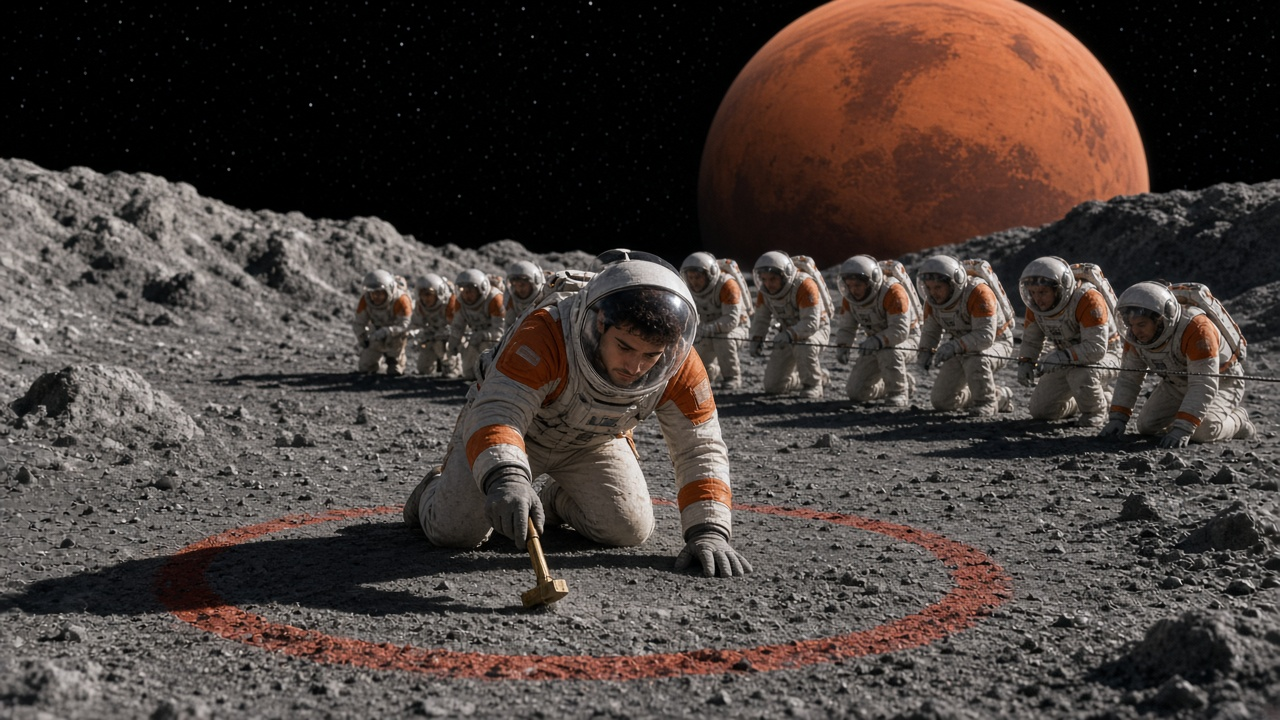
I always knelt at the same red ring of paint. Then I took out the little brass hammer, and I let the guests wait.
"In 1959," I said, "a smart man in Moscow did the math on this moon. And he said it was falling too fast. So he said it had to be light. Maybe hollow. Maybe built."
Right on cue, twelve helmets leaned in. Behind them, Mars filled half the black sky, huge and rusty and close enough to make your stomach turn.
Then I tapped the ground.
Tonnng.
Instantly it rang like a bell, deep and long, right up through your boots. Every single time, somebody gasped. Every single time, somebody laughed after, because they were a little scared.
I will be honest with you about that much. There was a steel drum buried under the red ring, about a meter down. The company put it there before I was hired. Without it, Phobos just goes tuk, like a shovel hitting gravel.
But nobody pays four years of savings to hear gravel. So the drum stayed, and the legend stayed, and the bookings came in.
My name is Luca. On the moon, everybody called me Lucky. I was twenty-six, and I was the best guide the Hollow Moon Lodge ever had, because I am good at telling people what they want to hear. That is the whole job.
A Moon Made of Gravel
First of all, Phobos is not round. In fact, it looks like a potato that lost a fight. It is about twenty-seven kilometers long, and its gravity is so weak that you could throw a ball hard enough to never see it again.
Because of that, we lived on lines. Every guest wore a tether, and every path had a steel cable staked into the dust. When you walked, you didn't really walk. Instead, you pulled yourself along, slow and floaty, like a man moving through a dream.
The lodge sat on the rim of Stickney, the big crater on one end. It was six white domes and a long glass window that faced Mars. Since Phobos always shows Mars the same face, Mars never rose or set for us. It just hung there. Meanwhile, the Sun went around us three times a day, and every few hours we slid into Mars's shadow and the window went black.
A Robot Asked First
There was a little museum by the airlock, too. It was mostly a photo wall, but it had one thing I loved: a plaque marking the spot where the first Japanese probe touched down in the late 2020s and scooped up a handful of this moon to carry home. Before anyone built a dome here, before any tourist paid a cent, a robot had come all this way just to ask Phobos what it was made of. Of course, that was a better story than mine. However, it didn't ring.

Big Sal ran everything that hissed, hummed, or leaked. He was fifty-eight, from Mumbai, as wide as an airlock door, with a gray mustache and very bad eyes. Unfortunately, he had cracked his reading glasses in March, and the next box from Earth wasn't due until December.
"Lucky," he would say, holding out his tablet. "What does the boss want now?"
Because of that, I read Mr. Grant's messages to him. Every one. Out loud, at breakfast, over bad coffee. Sometimes I did Mr. Grant's voice, which made Sal laugh so hard he had to hold the table.
Mr. Grant Needs a Full House
Mr. Grant ran the company from Dubai, and he had never once come up to see it. His messages took about eleven minutes to reach us that month, so you could never really argue with him. By the time you answered, he had gone to lunch.
That season, though, was bad. A news show on Earth had called our moon "a cracked egg." Afterward, bookings fell by half, and Mr. Grant started writing every day.
"Okay," I said at breakfast, reading. "Mr. Grant says, 'Fill every room through the thirtieth. Sell the legend. Smile more. The Hollow Moon is the product.'"
Sal grunted into his coffee. "The Hollow Moon is a drum in a hole."
"The Hollow Moon," I said, "pays for my sister's school."
That part was true, too. Nina was sixteen, back in Lisbon, and she was going to be an engineer. Besides, I had no other plan. I had been on Phobos for three years. Mars was too heavy for me now without months of training, and Earth felt like a story somebody told me once. This little gray potato was the only place I had ever been really happy.
Meanwhile, the real science was better than the legend, of course. Phobos is not hollow, but it is not solid either. Instead, it is a pile of rocks and dust held together by almost nothing, with lots of empty space inside, like a bag of gravel. Also, Mars is pulling it down, about two meters every hundred years. The long grooves on its face are stretch marks. Someday, millions of years from now, Mars will tear it apart.
I told guests that part only if they asked. Most of them never did, since a cracked egg doesn't sell rooms and a hollow moon does.
Peanut Hears Knocking
Then, on the first night of the last week, a little girl lay down on the lodge floor and put her ear to it.
She was nine years old, with two big puffs of hair and a green jumpsuit. Her grandpa called her Peanut, so everybody did. Her grandpa, whom everybody called Pops, was a quiet old man in a cardigan who had saved for twenty years to bring her.
"It's knocking," Peanut said.
"That's the pumps," I said.
"Pumps don't knock back," she said. "I knocked twice. It knocked twice."
Pops smiled at me over her head, like, kids. Naturally, I smiled back. Still, later that night, I lay on the floor of my own little room. For a long time, though, I heard nothing at all.
Then something deep below me went grrrk, low and slow, like a heavy door being pushed open somewhere in a basement.
I didn't sleep after that.
Then, the next morning, the shuttle brought one more guest. She was small and gray-haired, with a gray suit and a tablet she never put down. She didn't look at Mars, not even once. Sal named her the Clipboard before she was out of the airlock.
"I'm from the insurance company," she told me. "Mr. Grant asked us to come. I'd like to see your message log, please."
"Sorry," I said. "The log server has been down all week. Sal is working on it."
Sal looked up from the coffee machine, because he wasn't working on anything of the kind. However, he didn't say a word.
The Drum
On the third day, Sal and I went out to the red ring before the first tour, because the bell had sounded wrong the night before. It came out flat. Tunk. One guest had asked for a refund.
So we dug. In that gravity, the dust floated up around us in slow gray clouds and took forever to come down. Finally, Sal's glove hit metal, and he pulled.
At first I thought it was the wrong thing. But the drum came up flat. Not dented. Flat, like a soda can somebody had stepped on.
Sal turned it over in his big hands for a long time.
"Nothing up here weighs enough to do this," he said quietly. "So the ground did it, Lucky. It's squeezing. And that groove by the lodge is moving."
Even from where we knelt, I could see the groove. It ran right past the second dome, a long shallow ditch, the kind of stretch mark I pointed at four times a day. Now there was a fresh dark line in the bottom of it, thin as a pencil.
"The ground sensors send their numbers to Dubai every night by themselves," Sal said. "So Grant already knows. But you tell him anyway. Today. Tell him we need the shuttle."
"I'll send it right now," I said.
After that, I went inside alone. And the next morning, at breakfast, I read the answer to him.
"Mr. Grant says, 'Thanks, Sal. The insurer saw the numbers, and the cracks are old. Keep going through the thirtieth. Then we'll move the lodge.'"
Sal looked at me for a long moment with his bad eyes. Then he looked over at the Clipboard, who was typing at the far table.
"Old," he said.
"Old," I said.
The Last Tour
The last tour of the week was set for nine. However, I moved it up to seven, before the Clipboard came to breakfast. I told myself it was for the light.

So we went out early. Twelve guests, clipped on in a row. Peanut was right behind me, and Pops was behind her, holding her line like a kite string.
I didn't take them to the red ring. Instead, I stopped short, and I gave them the real science. First the bag of gravel, then the two meters a century, and finally the stretch marks. For once, I told it well, and people actually listened.
The Moon Chews
Then the whole moon went grrrk.
It didn't sound like a bell. It sounded like a giant chewing. Through my boots, the ground shifted sideways, about the width of a hand. After that, the groove beside the second dome opened up like a zipper, and gray dust rose out of it in a slow, silent curtain.
"Lines!" I shouted. "Hands on the cable! Back to the lodge, slow, nobody jumps!"
Everybody grabbed the cable. Everybody except Peanut, whose tether stake had been in the bad ground. The stake popped out, and she went up.
She didn't fall. Here, you don't fall. She just drifted, turning slowly, three meters up, then four, her little arms waving, her stake swinging below her on its line.
So I unclipped from the cable and jumped.
That is the one thing you never do on Phobos. But I had done the math on that moon for three years, and I knew exactly how hard to push. I came up under her, caught her ankle, and grabbed her line. Meanwhile Sal, who had come out the airlock without even closing his helmet visor properly, caught my boot.
For a second, we hung there, the three of us, in a silent cloud of gray dust, with Mars burning huge above our heads.
Then Sal pulled us down.
What Mr. Grant Said
Later, the shuttle came in forty minutes, which meant it had already been on its way. Nobody asked me about that. Not yet.
Sal sat with his ankle wrapped, because he had twisted it badly coming down. Peanut sat in Pops's lap, staring out the window, talking a mile a minute. On the other hand, the Clipboard sat across from me, and finally she put her tablet in my hands.
"The log server was fine," she said. "We got a copy from the company's side in Dubai."
And there they were, Mr. Grant's messages, the real ones.
Day two: "Lucky, the ground numbers are bad. Close the lodge. Send everyone home today. I'll eat the cost. Tell Sal, safety first, no arguing. Mrs. Park from the insurer is on this morning's shuttle to check."
Day four: "Mrs. Park says the cracks are new and you still have guests. Why? The big shuttle leaves Mars Station tonight. Answer me."
And my reply, under it, sent at 3:12 in the morning:
"All fine here, sir. Sal says the cracks are old. Guests are happy."
A Different Letter
Sal took the tablet out of my hands. He held it close to his face, squinting, for a long time.
Finally he looked at me, and I had never seen him look at anybody that way.
"You read me a different letter," he said.
Nothing came out of me, because there was nothing true left that would help.
Remember what I said at the start? I am good at telling people what they want to hear.
So I told you, too.
Out the shuttle window, Phobos was falling away behind us, small and gray and very old. Meanwhile, the domes sat empty on the rim of Stickney. And down by the second dome, half swallowed by the new crack, I could still see the red ring of paint, where the moon used to ring for me.




Leave a Reply