A green star story, told as a short story: in a cold basement full of old glass star plates in Pasadena, a temp with four days left on her grant finds a 100-year-old note that says "green?" This is fiction, so the people and the plate are made up. However, the star is real. On October 14, 2026, astronomers at the University of Warwick reported that a dead star called WD J1330+6435, about 300 light-years away, would look green to the human eye. Nobody has seen it green through a telescope. Instead, the color comes from its light, split into a rainbow and read like a fingerprint.
Light Is Old News
I had four days left on my grant when I found it. But first, I had to learn the basement.
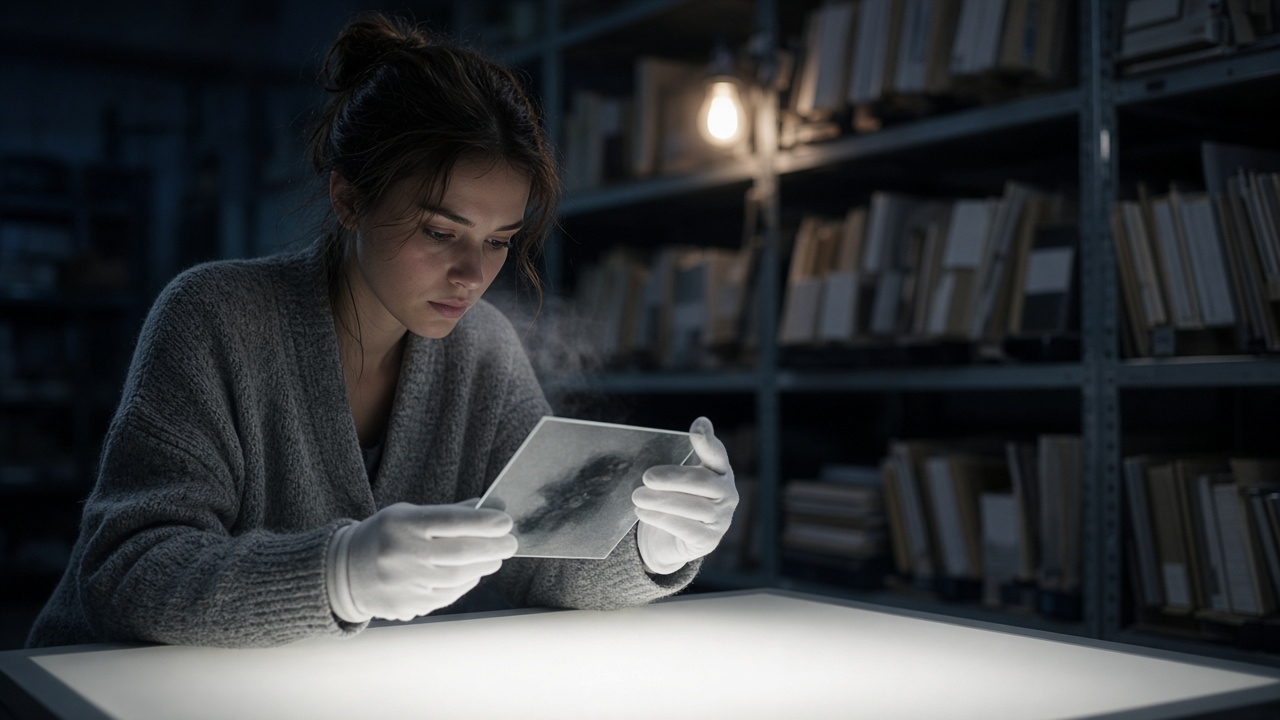
The basement was cold enough to see my breath. That was the first thing I learned. After that came the gloves.
"White cotton, both hands, every time," Frank said. "Skin oil eats the glass. And the glass is the sky."
Frank was sixty-seven and the last full-time plate keeper in the building. He had a gray ponytail, reading glasses on a cord, and a cardigan with leather patches at the elbows. Around us, steel shelves ran into the dark like train cars. On every shelf sat paper sleeves, while in every sleeve sat a sheet of old glass.
"How many?" I asked.
"About a quarter of a million," he said. "From Mount Wilson, Palomar, and Chile. So, a hundred years of nights."
Then he handed me a plate. It was the size of a paperback and heavier than it looked. When I held it up to the bulb, I saw thousands of tiny black specks. Each speck was a star, but black on clear glass, like a photo turned inside out.
"So these are pictures of stars," I said.
"No," said Frank. "Every plate is a photo of something that might not be there anymore." Then he took it back gently. "Light is old news, kid."
By lunch he had stopped calling me kid. Instead, he called me Mole, because I worked underground and blinked at the stairs like I had never seen the sun. Soon, everyone in the building called me Mole. Even the Deputy did, too.
The Famous List
My name is Rosie. I was twenty-four, and I had a temp grant to scan glass plates until Friday. After Friday, there was no more money, so I would go back to living on my sister's couch in Fresno.
That is, unless I finished the list.
The list came from the Deputy. Her real name was Doctor Shaw, and since she was the deputy director, everyone shortened it. At first I thought she was mean. In fact, she brought donuts on Mondays. Still, she walked like a woman who was always late for a meeting about money.
"The famous plates first," she told me on day one. "Hubble's plates, Adams's plates, the ones in the books. After all, the donors want to see them online by the gala."
So I scanned the famous ones. Meanwhile, Frank told me their stories while the scanner hummed.
Of all of them, the best one was a plate from 1917. A man named Walter Adams took the light of a small white star and spread it into a rainbow on glass. Then he wrote a short note on the sleeve and put it away. Nearly a hundred years later, in 2016, an astronomer looked again. This time, he found dark lines from calcium, the stuff in rocks. In other words, the dead star was eating the crumbs of its own planets.
"The earliest sign of planets around another star," Frank said. "It was sitting right there in a box. Still, nobody saw it for ninety-nine years."
"Why not?"
"Because nobody looked." Then he shrugged. "Looking is expensive."
Where Plates Go to Die
On Wednesday, I went up to the stairwell to get a phone signal. Then I heard the Deputy one floor above me, on her own phone.
"No, I hear you," she said. "But the lab build starts Monday. The basement has to be clear."
There was a pause while her heels tapped on the concrete.
"Scan the famous plates first. The donors want Hubble's and Adams's. The boring ones go to off-site storage Monday." Another pause. Then, more quietly: "I know. Of course I know what off-site storage is. Off-site storage is where plates go to die."
I stood very still. After a moment, her door closed.
Back downstairs, I did not tell Frank. However, he knew anyway. He was standing by the far shelves, where the pink tape began. Pink tape meant off-site, and it ran down six whole rows.
"Climate-controlled warehouse," he said, without turning around. "It's out past the freeway. Very safe, but with no scanner, no light table, and no people." Then he patted a shelf as if it were a horse. "They'll be fine. They'll just be alone, that's all."
"Can't we scan them first?"
"All of them?" He laughed, but not really. "At your speed? You'd be done around 2040."
So I finished the famous list on Thursday morning. As a result, my extension was safe, because that was the deal. Still, I could not stop looking at the pink tape.
The Boring Boxes
On Thursday afternoon, I asked Frank if I could use my last day on the pink rows.
"Nobody will see those scans," he said. "Nobody pays for those."
"I know."
For a while, he studied me over his glasses. Then he handed me a fresh pair of gloves.
The boring boxes were boring. That was the truth. Most held plates of the same patch of sky taken again and again, months apart, to catch stars that drift. Others had a crack across the corner. Some showed nothing but a smudge of cloud.
Each sleeve had a few lines in pencil, such as the date, the telescope, and the minutes the glass was open to the sky. Sometimes there was a little joke. One said, "Cold. Coffee frozen." Another said, "Dog howled all night."
Around six, I pulled a thin sleeve from a box marked 1926. Inside were three plates of the same field, all taken on the same night. One was shot through a blue filter, one through yellow, one through red. That was an old trick. Because if you compare how bright a star looks in each color, you can guess what color it is.
However, the note on this sleeve was different. Most notes were neat, but this one was small and shaky, as if the hand was nervous.
It said: "Faint star near center. Strong in yellow. Weak in blue AND red. Green?"
Under it, in a different pen, someone had drawn one hard line through the last word. Next to that, they had written: "Stars are not green. – R."
The Green Star
At first, I just read the note three times. Then I took off one glove, which I am not allowed to do, and pulled out my phone.
That whole week, the news had been full of it. A team in England said a dead star had turned green. It was a white dwarf, about the size of Earth, that had swallowed rocky stuff from its own old planets. As a result, the rock put sodium, calcium, and lithium into its sky. Then the sodium drank up the orange and red light, so what was left over looked green.
The first green star, the headlines said. Also, it was up north in the sky, above the handle of the Big Dipper.
My hands were shaking, so I put the glove back on.
"Frank," I said. "Where was this field?"
So he came over, read the sleeve, and frowned. Then he read the coordinates aloud. It was north of the Big Dipper's handle, in the same part of the sky.
"Lots of stars up there, Mole," he said gently.
"I know."
Still, he pulled the loupe out of his pocket. It was a little magnifying glass, like a jeweler's. Carefully, he set the yellow plate on the light table and bent over it for a long time. Nobody said anything, while the light table buzzed.
"There's a faint one near the center," he said at last. "Right where E.H. said."
"Who was E.H.?"
"No idea." He did not look up. "Probably some night assistant. Back in 1926 they had a lot of those. Mostly young. Mostly not allowed to sign their whole name."

A Hundred Years of Drift
But here is the hard part. After all, a dot on old glass is not a star with a name. To be sure, you need a modern spectrum, from a big telescope, tonight. Of course, nobody gives a temp telescope time. So I did the next best thing.
You see, stars move. Not much, but nearby ones drift across the sky a tiny bit every year. A space telescope called Gaia measured that drift for more than a billion stars. Better still, you can look it up for free.
So I looked up the green star. Then I wound its drift back a hundred years, like rewinding a clock. After that, I laid my math over the 1926 plate.
It landed on the dot. Not near it. On it.
Frank made a sound like he had been hit softly in the chest.
"Do it again," he said.
So I did it again. Once more, it landed on the dot.
By then it was nine at night. Upstairs, the building was empty and dark. Down in the basement, the scanner hummed, and the pink tape glowed under the bulbs.
"Someone saw it," I said. "Back in 1926, with nothing but three plates and a pencil. They saw it was green."
"They guessed it was green," Frank said. "And somebody told them stars are not green."
"Well, R. was wrong."
"R. was a lot of people." Then he sat down hard on a stool. "R. was most people, for most of history."
What Green Means
Then I did something stupid. I felt happy.
For one bright minute, I wanted to run upstairs. Also, I wanted to call the Deputy and my sister and the woman at the Fresno donut shop. After all, a temp on her last day had found a green star on a boring plate. Surely somebody would have to give me a job now.
But Frank was not smiling. He was looking at the plate with his hand over his mouth.
"Mole," he said. "Do you know why it's green?"
"Sure. It ate rocks. Sodium, calcium…"
"Where do the rocks come from?"
I opened my mouth, and then I closed it.
You see, white dwarfs do not make rock. Instead, the rock falls in. It falls in from asteroids, and moons, and planets that got too close, were torn apart, and then rained down onto a dead star, bit by bit, for a very long time.
"The green," I said slowly. "The green is a planet."
"Was a planet," said Frank.
Again I looked at the dot. It was smaller than a grain of salt. However, it was not a star anymore, not really. It was a grave. In fact, it was a grave that was still being dug.
"And this plate," I said. "This plate shows it was already eating that world a hundred years ago."
"Longer," said Frank. "The light was three hundred years old when it hit this glass. Light is old news, remember?" Then he rubbed his eyes. "We've been filing a funeral in a cardboard box. Pink tape and all."

The Deputy Comes Down
At ten, I called the Deputy. Since it was so late, I expected voicemail. Instead, she picked up on the first ring, as if she never slept.
"Mole? Is the building on fire?"
"No," I said. "But don't move the pink boxes on Monday."
She was quiet while I explained. She was quiet when I sent the scans. Then she was quiet for so long that I thought the call had dropped.
"You did this on the boring plates," she said finally.
"Yes."
"On your last day. With no money."
"Yes."
Twenty minutes later, she came down the basement stairs in a raincoat over pajamas. First she looked at the plate. Then she looked through the loupe. After that, she looked at the six rows of pink tape for a long time.
"How many more?" she asked quietly. "How many more like this, in those boxes?"
Frank said, "Nobody knows. That's the point."
Finally, the Deputy took out her phone. However, she did not call the donors. Instead, she called the moving company and left a message. Monday was off, so nothing in the basement was going anywhere.
Then she turned to me. "You'll need an extension," she said. "A long one. I'll find the money if I have to sell the donuts."
Stars Are Not Green
After she left, Frank and I stayed with the plate.
He wanted to find out who E.H. was. The old logbooks were upstairs, in a closet nobody opened, so he would start in the morning.
"And R.?" I asked.
"R. can stay a letter." For once, he almost smiled. "R. had a hundred years."
Later, I sat at the light table alone. Above us, the city slept, and above the city, far past the smog and the airplanes, a dead star was still eating what was left of a world.
Nobody can see it with their eyes, and nobody ever will. But I could see the note.
So I took a soft pencil, the kind we use for sleeves, and I added one line under the crossed-out word. I wrote it small, in case E.H. was shy.
Then I put the plate back under the loupe for the photo.
Under the Loupe
The light table glowed white. On it lay the yellow plate from 1926, its edges chipped, its glass full of tiny black stars.
In the center, under the round brass loupe, sat one faint black dot, no different from the thousands around it. The glass only knows black and clear. The green was never on the plate. It was in the note.
Next to the plate lay the old paper sleeve. The pencil said "Green?" Through it ran one hard line, and beside that, the old pen said, "Stars are not green."
And under that, in new pencil, it said, "Yes, they are. And this one is eating a planet."


Leave a Reply