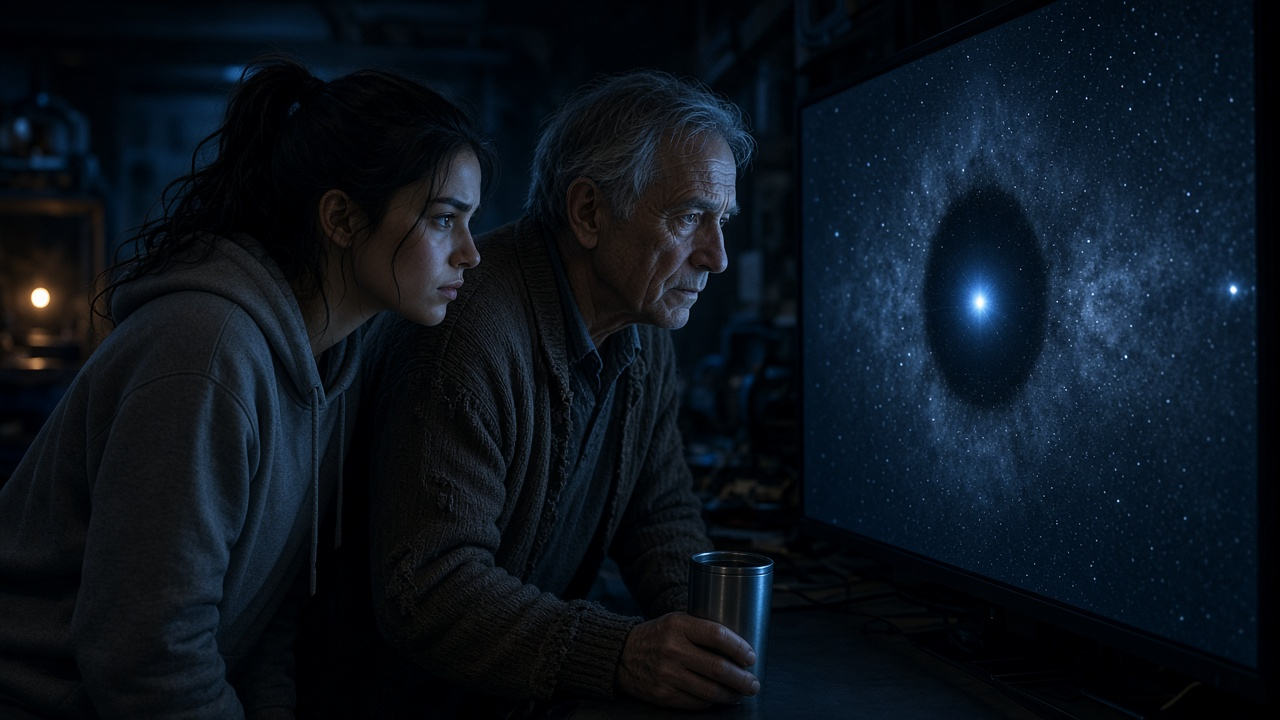
A new planet discovered story, told as a short story: in Greenbelt, Maryland, a young night analyst on NASA’s Roman telescope must scrub one stubborn speck from the first dark-hole picture before a Monday budget briefing. This is fiction, so the people, the night team, and the target star are made up. However, the telescope work is real. In fact, on October 14, 2026, NASA’s Roman team finished checking out the main instrument and sharpened the telescope’s focus, and the coronagraph is next.
Night Shift in Greenbelt
My name is Pippa, but everybody calls me Pip. Also, I am twenty-five, and I work nights at Goddard in Greenbelt, Maryland.
Most people in town think NASA is quiet after dark. However, our room stays lit. We sit in a long basement control room with soft blue screens, cold coffee, and a wall clock that always feels too loud. Outside, the trees along the Greenbelt roads go black. Inside, we talk to a telescope that is already in space.
The telescope is called Roman. It launched at the end of August. Since then, the day teams have been tuning it, a little at a time. In fact, they moved a mirror by about one-sixteenth of the width of a human hair. After that, the big camera looked even sharper than the plan asked for. Now it is our turn.
Our piece is the coronagraph. In plain words, it is a set of masks and tiny moving mirrors that dig a dark hole around a bright star. If the hole is dark enough, you can look for faint worlds in the leftover light. For the first year and a half, it is a technology demo. So our job is to prove it works.
I am the newest analyst on the night ground team. For now, my contract ends in March. Until then, I watch pictures come down, check the dark hole, and help write the next set of mirror commands that go back up.
Hutch and the Sticky Note
Hutch sits two chairs to my left. His real name is longer, but nobody uses it. Also, he is sixty-four, thin, and retiring at Christmas. Every night he brings a scratched steel thermos of black coffee and a sweater that smells like old paper.
At thirty-one, he was a junior on the Hubble fix team in 1993. Generally, he likes to say he carried tools more than ideas. Still, he remembers every detail.
On my first night, he pulled a tiny sticky note from his wallet. The paper was yellow and soft at the edges. In fact, someone had written 1990 on it in faded ink.
“Keep that story close,” he told me. “In 1990 we trusted the ruler, and the mirror paid for it. Before you blame the mirror, check the ruler.”
Then he folded the note away again. After that, he never made a speech about it. He just worked.
Digging a Dark Hole
The star we were pointed at had a long catalog name. Among us, though, it was just the Lamp. In fact, it was bright, steady, and far enough from the Sun for a clean test.
Here is how the loop works. First, the telescope takes a picture and sends it down. Then we look at the speckles inside the dark hole. Speckles are leftover bits of starlight that bounce around because nothing in optics is perfect. Next, the ground software works out how the two deformable mirrors should flex. Those mirrors have thousands of tiny pistons. When they move, they cancel flaws. After that, we send the new shapes up on the next antenna pass, wait, and dig again.
Each loop costs time. It also costs an antenna pass. So you do not get endless tries before Monday.
On Thursday night, the hole looked almost clean. Almost. Right near the edge, one faint speck would not go away.
Mo Needs Monday
Mo is our program manager. Her full name is Maureen, but she answers to Mo. Likewise, she is fifty-two, kind, and always a little late for lunch because someone stops her in the hallway.
On Thursday evening, she came down from the day offices with her badge still clipped to her sweater. For a minute she watched the Lamp on our screen. Soon her phone rang, and she stepped into the hall.
The door did not quite close. As a result, I heard her voice, low and tired.
“Congress remembers 1990,” she said. “If our first picture has a smudge, the headline writes itself. Get me a clean hole by Monday.”
After that, she came back in and smiled like nothing had happened. “You are doing fine,” she told us. “I need a picture I can take upstairs without apologizing.”
I nodded. Still, my stomach went tight. Because of that call, Monday was no longer just another meeting. It was a test of the whole demo. Also, my contract renewal sat on her desk in a thin folder. She had never used that against me. Even so, I felt it every time she looked at the screen.
The Speck Survives
So we ran three more loops before dawn.
First, we pushed the mirrors harder on the left side of the hole. The speck stayed. Next, we tried a softer pattern. The speck stayed. Then we waited for a better antenna pass and tried again. Still, the speck stayed.
Hutch rubbed his eyes. “It is not random noise,” he said. “Noise jumps. This one sits.”
“So is it a fixed optics flaw?” I asked.
“Maybe,” he said. “It could be dust on a mask. It could be a bad pixel cluster pretending to be polite. Or it could be something else. Before you decide, measure it again.”
So I measured it again. The speck sat at the same sky angle, night after night, while other faint dots drifted or faded. Therefore, it felt personal. It felt like the one flaw that had chosen us.

Mask It for the Briefing
Friday afternoon, before my shift, a day engineer named Cal stopped by our room. Certainly, Cal is smart and fast, and he likes clean slides.
“For Monday,” he said, “we can crop the frame. Or we can paint over that corner in the press still. Nobody needs the raw hole for a budget chart.”
Hutch did not look up from his thermos. “We do,” he said.
Cal held up both hands. “I am not saying lie. I am saying the briefing is not a science paper.”
Then Mo walked in. She had heard enough. “No paint,” she said. “I will take an honest picture, even if it is ugly. Still, I need you to dig that speck out if you can. The room upstairs wants clean.”
After Cal left, she stayed a minute longer. “Pip,” she said quietly, “your folder is still on my desk. I have not opened it yet. Do good work. That is all I ask.”
So I nodded, and she left. Meanwhile, Hutch poured more coffee and said nothing about the folder. He did not need to.
Before Anyone Says New Planet Discovered
On Friday night we dug again. Meanwhile, the hole grew darker. Even so, the speck held its place like a tiny nail.
“Soon people will ask if it is a world,” I said.
Hutch shook his head. “Not yet. Before anyone says new planet discovered, you prove what the speck is. Optics first. Sky second. Hope last.”
That line stuck with me. A new planet discovered claim is easy to print and hard to walk back. Because of that, we kept our mouths shut and kept looping.
Around two in the morning, the software offered one more mirror shape. At first, it looked clever on paper. In practice, it washed the left side of the hole and left our speck alone, as if it were laughing.
“Again,” I said.
“Again,” Hutch agreed.
By then my eyes hurt. Still, I kept notes in plain words, the way he taught me. Time. Pass. Shape. Speck still there.
Hutch Remembers Nineteen Ninety
Near four, Hutch finally told the old story without looking at me.
“In nineteen ninety, Hubble went up with a mirror ground to the wrong shape,” he said. “The test tool was off by about a millimeter and a third. The outer edge of the mirror was too flat. Everybody trusted the tool. Later, astronauts put in eyeglasses and a new camera. The pictures got sharp. But the first years hurt.”
“Who got blamed?” I asked.
“Lots of people tried to point,” he said. “I was not there yet. When I joined the fix work, the lesson was already clear. Basically, we all trusted that ruler. Everybody did. So you do not hunt for a villain. Instead, you hunt for the next check.”
Then he tapped the screen where our speck sat. “This may be a flaw. Or it may not. Either way, Monday does not get to invent the answer.”
I thought about Mo in the hallway. Similarly, she was not a villain either. She was a person carrying a room full of money and memory upstairs.
One More Night
Saturday passed in naps and bad pizza. Finally, Sunday night was our last real chance before the briefing stack locked.
Mo came down at the start of the shift with two folders. One was the Monday slide pack. Additionally, the other, thinner one, had my name on the tab. She set both on the side table and did not open either.
“Tell me what you need,” she said.
“One roll,” I said. The words came out before I could dress them up. “Not another mirror fix. A roll test.”
Cal, on speaker from home, groaned. “A roll burns a pass and rearranges the schedule.”
“I know,” I said. “But look. If the speck is an optics ghost, it should turn with the telescope when we roll. If it is on the sky, it should stay put while the speckles move.”
Hutch smiled for the first time all week. “She checked the ruler,” he said.
Mo looked at the Lamp on the wall screen. For a long moment she said nothing. Then she nodded once. “Do the roll. If we miss a prettier hole, I will explain it upstairs myself.”

Roll the Telescope
The commands went up on a late pass. After that, we waited while Roman slowly rolled around the line of sight to the Lamp. On the ground, waiting feels longer than the clock says. Nevertheless, we stayed quiet.
When the first rolled frame came down, the dark hole looked almost the same. Almost. Specifically, the faint speckles that had clung to the left edge had slid. They had turned with the telescope, just as a true optics pattern should.
Our speck had not.
It sat in the same place on the sky. Meanwhile, the hole had rotated under it. Then the ghosts had moved. Still, the speck stayed.
For a second, nobody spoke. Then Hutch set his thermos down so carefully it made no sound. Consequently, the room felt smaller.
“Again,” he said. “One more frame. No cheers yet.”
So we waited for the next packet. The second rolled frame said the same thing. Speckles turned. Speck stayed. A third frame arrived near dawn, and the answer did not change.
What Stays Put
First, I ran the numbers twice with shaking hands. Then Hutch ran them once more, slower.
“It is not on the optics,” he said. “It is on the sky. Faint. Real. Sitting in starlight we dug a hole to see.”
My mouth went dry. “So we did not fail to clean a flaw after all.”
“No,” he said. “You found a world by refusing to erase one.”
Of course, we still had to be careful. One night of rolls is not a full orbit. Still, the first test that matters had passed. Therefore, the speck that would not go away was not dirt on a mirror. Instead, it was a companion to the Lamp, never named, never claimed, waiting in the dark we had made on purpose.
I whispered it once, because the room felt too big for a shout. “A new planet discovered. By the smudge.”
Hutch only nodded. Then he took the old sticky note from his wallet and taped it to the bezel of the screen, right beside the faint dot.
Mo Takes the Honest Picture
At 6:10, Mo came back down with wet hair and no makeup. Evidently, she had slept in her office chair.
We showed her the rolled frames side by side. First the speckles turning. Then the speck holding still. After that, the simple plot Hutch had drawn on scrap paper with a thick pencil.
She sat down hard. “Congress remembers 1990,” she said softly. “Good. Let them remember this too.”
“What do you take upstairs?” I asked.
“The truth,” she said. “Raw hole. Roll test. No paint. If they want a pretty slide, they can wait for the paper.”
Then she picked up the thin folder with my name on it, opened it, and signed the renewal line without a speech. “March is too soon,” she said. “Stay.”
I laughed once, too loud for the room. Meanwhile, Hutch poured the last of his coffee into my empty cup, which is how he says congratulations.
Beside the Dark Hole
Later that morning, the day team took over. Afterwards, we stayed long enough to write the notes clean. Then Mo left for HQ with a drive in her bag and no apology on her tongue.
Before I clocked out, I looked one more time at the screen. The Lamp burned at the center behind its masks. Around it, the dark hole we had dug looked almost black. And in that black, one faint speck held its place, quiet as a held breath. Above all, nobody had painted it out.
Hutch’s old note was still taped beside it. The year 1990 sat in faded ink, no longer a warning alone. Next to it, the speck shone like an answer.
I turned off my console. Outside, Greenbelt was waking up under a pale October sky. Meanwhile, somewhere far above us, Roman kept its watch. Down here, we had finally checked the ruler.



Leave a Reply