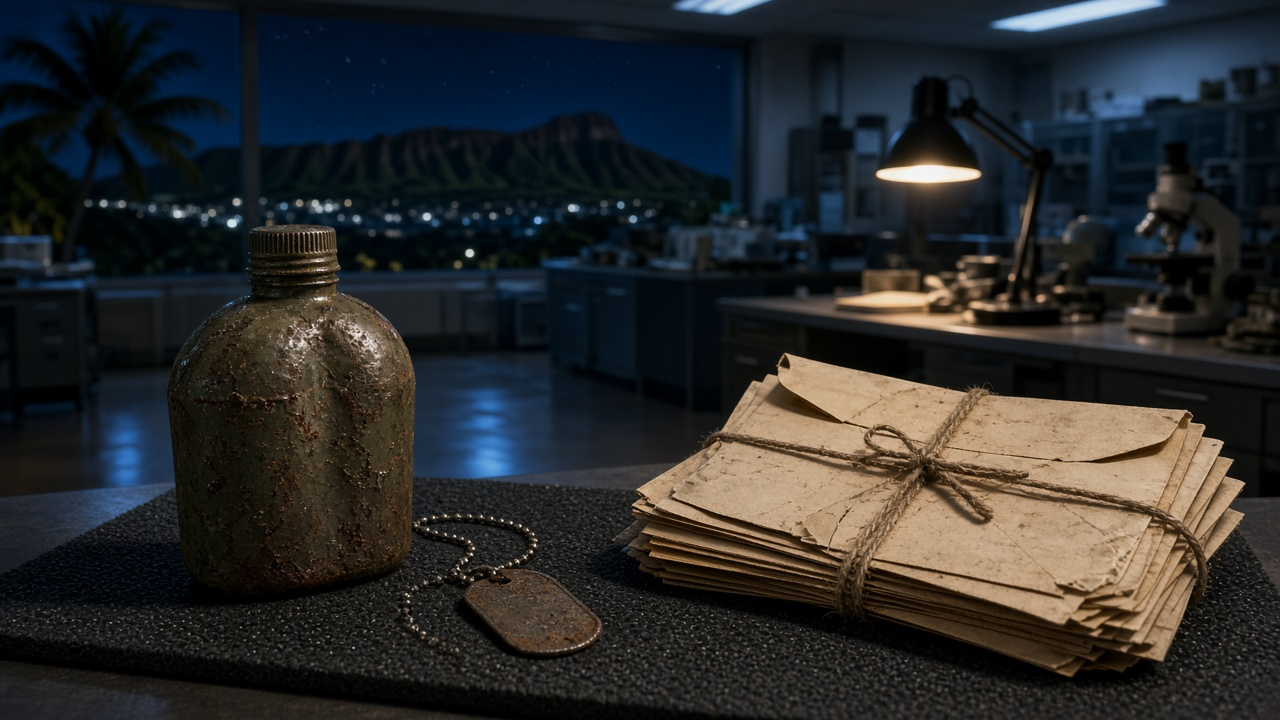
A Korean War soldier short story: in a military lab in Honolulu, a young scientist races her boss's record deadline to name a 20-year-old lost at the frozen Chosin Reservoir in 1950, while a stranger's old letters wait in his file. This is fiction. The people and the case are made up, but the science is real, and so is the record. In fact, the Pentagon's ID agency just announced a record 250 identifications in one year.
The Lab Where We Talk to Them
My real name is Hannah. At the lab, though, everyone calls me Doc. I am twenty-nine, and I am a forensic anthropologist. In other words, I study bones.
The lab sits on the base at Pearl Harbor, in Honolulu. It belongs to the Defense POW/MIA Accounting Agency, and we have one job. We give names back to Americans who never came home from old wars.
Most days, the room is so quiet that you can hear the clock. The air is cold and dry, and it smells like clean paper. Our tables are long, and they are also padded with black foam. On each one, we lay out a person, bone by bone, in the shape of a body.
I talk to them while I work. Some people think that is strange. Still, nobody complains, because I am good at the job.
I hum to them, too. It is always the same old tune, "Peg o' My Heart." My Nana Peg hummed it every night at her kitchen sink in Erie, Pennsylvania. She told me it was a harmonica song, the biggest hit of 1947. As a kid, I just liked that it had her name in it.
Nana died six years ago, when I was still in grad school. Even so, the song never left me.
A Korean War Soldier on Table Nine
In September, table nine held a man with no name, only a number. However, his file already had a best guess. That guess was Corporal Frank Dunn, age twenty, of Erie.
I had asked for his case myself, because he came from my hometown. Soon I was calling him Frankie. It just fit.
Frankie was in the Army, too, like most boys on his street. In the summer of 1950, he shipped out to Japan. That fall, his division landed in Korea. By late November, he was east of the Chosin Reservoir, high in the mountains of North Korea.
Then the Chinese army came over the hills. Soon about 30,000 UN troops were trapped by about 120,000 Chinese soldiers, in cold far below zero. For seventeen days, they fought their way out toward the sea. On the east side of the reservoir, an Army task force of about 3,000 men was nearly wiped out. More than a thousand of them were killed or died as prisoners. Frankie went missing on December 2, 1950.
After the war, in 1954, both sides traded their dead. Many of ours could not be named, so in 1956 they were buried as "Korea Unknowns" at the Punchbowl. It is the big green crater cemetery above Honolulu. Frankie lay there for more than sixty years.
Then in 2019, our agency began to dig up 652 of those graves, one group at a time. Finally, Frankie came up with one of the later groups.
Both sides still bring their dead home, by the way. This spring, South Korea handed back the remains of twelve Chinese soldiers from the same war. After all, every army has mothers.

A Record and a Deadline
Every September, the lab gets a little louder. That is because the fiscal year ends on the thirtieth, and Washington counts.
One evening, I walked past the Chief's office with my coffee. His door was open a crack. He was on the phone, and he sounded tired, so I slowed down.
"We're at 238, sir," he said. "Nine days left. We can beat last year."
After that, he listened for a long time.
"Yes, sir. I need cases signed by the thirtieth. I know. But I won't sign a weak one to make a number."
Of course, I liked him for that last part. The next morning, however, he stood at the foot of table nine with his reading glasses on his head.
"Doc," he said. "Is Dunn ready?"
"Almost," I said.
"Almost doesn't go on the chart."
The Chief is not a bad boss. He has run this lab for eleven years, and he still keeps a wall of thank-you cards from families. Still, a record is a record. Somebody above him wanted one, and that somebody did not have to look at the bones.
Why the DNA Was Not Enough
Here is how it works. First of all, our DNA lab is in Dover, Delaware. The scientists there pull DNA from a small piece of bone. Then they compare it to samples that families give.
For old cases, they often use mitochondrial DNA, or mtDNA. It passes from a mother to all of her children. So a soldier's sister carries the same mtDNA as he does.
Frankie's sister, Rosie, gave a cheek swab in 2003. She died in 2011, long before we found him. Her sample was still on file, though, and the bone matched it.
Because of that match, the Chief wanted to sign right there. But I had read the whole report. Frankie's type was a common one. In fact, three other men lost east of the reservoir shared it too. Also, back in the 1950s, the Army soaked the Korea Unknowns in formaldehyde before burial. That leaves the old DNA weak and broken.
"So it could be any of four men," I said.
"Or it's Dunn," the Chief said. "Like the file says."
"Then let's prove it. He has both collarbones. Let's do the chest X-rays."
The Old X-Rays
Back in 1950, the Army X-rayed new soldiers to check for TB. Many of those films still exist. That matters, because a collarbone is a lot like a fingerprint. The curves and the little bumps are different in every person. So we X-ray the bones the same way, and then an expert compares them side by side with the old film.
The Chief rubbed his eyes. "How long?"
"If I beg the X-ray team, maybe a week."
"Then beg," he said. "And Doc? The thirtieth."
My own DNA is on file in Dover, too. Everyone who handles the bones gives a sample, so the scientists can tell our stray skin cells from the dead. Somewhere in Dover, there is a file marked "Novak, H." I used to joke that it was the only way I would ever be famous, since nobody reads bone reports.
Something Small and Quick
On Friday, I heard Greg for the first time.
Greg is Rosie's grandson, which makes him Frankie's great-nephew. Frankie never married, and his parents and sister were gone. As a result, the Army listed Greg as his next of kin.
Every family gets an Army casualty officer. Frankie's was a calm woman named Dee. That day, she called Greg to update his file, just in case. Meanwhile, the Chief joined to answer science questions. I sat in the corner with my notebook while they talked.
"I appreciate all this, I really do," Greg said. Behind him, a drill was running. "But I own a heating business. October is furnace season. Everybody's heat breaks the same week."
"We understand," Dee said.
"Look, I never met the guy. Grandma Rosie talked about him sometimes. That's it." He paused. "So if it's him, can we keep it small and quick? A weekday. A short service. No speeches."
"That will be your choice," Dee said kindly.
When the call ended, the Chief looked at me.
"Don't," he said.
"I didn't say anything."
"You were going to say it's sad," he said. "It is sad. But it's also normal. Most of our families are like Greg now. The people who knew them are gone."
Then he handed me a thick brown folder. It was Frankie's old Army burial file, the one with his chest X-ray.
"Somebody in there wrote a lot of letters," he said.
The Letters From Miss June
At first, the file held only old forms, burial records, and dental charts. In the back, however, sat a stack of letters held together by a rusty clip.
All of them came from the same woman in Erie. She signed them only "June." So, before long, the whole lab called her Miss June. The first letter was from 1969, and the last was from 2019. There were twenty-two in all.
On each one, a clerk had also written the same note in the corner. "No relation. No reply."
That night, when the lab was empty, I read them in order.
Fifty Years of Letters
"I am not family," she wrote in 1969. "I am only a friend from Erie. My son turned eighteen this spring and signed up for the draft, the way boys do. Since then, I cannot sleep. So I am asking, after all these years. Is there any news of Corporal Frank Dunn?"
Over the years, she kept asking. Sometimes she wrote three lines. Other times, she wrote two pages. Instead of saying who she was, she told little stories.
"Frankie had a harmonica," she wrote in 1972. "He played our song at Union Station the day he left, in August of 1950. He played it badly, and he knew it, and he did not care. Then he gave it to his girl on the platform and told her to keep it warm."
I smiled when I read that. Miss June was the girl, I decided. She was an old sweetheart who never stopped writing.
Her cursive was neat and slanted, the kind the nuns taught in Catholic school. Then again, every nana in Erie wrote like that. Over the years, it got shakier.
"I hope you find him before I go," she wrote in 1998. "I hope somebody tells me."
Nobody did. After all, the rules said she was no relation.
The X-Ray Answer
On Monday, the X-ray team gave me a slot at six in the morning. Of course, I brought them doughnuts from the shop near the gate. In Hawaii, that buys a lot.
We placed Frankie's collarbones on the table the way a body lies for a chest X-ray, and we took the films. After that, I sent them to our X-ray analyst. I also sent her the old 1950 films for all four men.
The next day felt a week long. Meanwhile, I cleaned, measured, and wrote. I hummed Nana's song so often that Lu, at the next table, started humming it too.
On Tuesday the twenty-ninth, the analyst came to my table with a tablet.
"Three of them don't fit at all," she said. "But this one does. See the little hook on the left end? It's the same bone."
The old film had the name Frank Dunn on it. The next morning, a panel of experts checked her work, and they all agreed with her too.
On September 30, at 4:40 p.m., the Chief signed off. Then he walked to the chart on his wall and added one more mark in red.
"Good work, Doc," he said quietly. "Real work."

The Last Letter
That night, I stayed late to finish the letters. Only one was left, the one from 2019.
However, it was not like the others. The writing was large and shaky, as if her eyes were going. She had also written it in pencil.
"To whoever reads this," it began. "I read in the Erie paper that you will open the Korea graves in Hawaii. I am eighty-seven, so this is my last letter. This time, I will tell the truth.
"Frankie and I were going to marry when he came home. In October of 1950, I wrote to tell him I was going to have a baby. I never knew if my letter reached him.
"In January, I married Walt, a good man who knew everything. Our son was born in April of 1951, and Walt loved him as his own. We never told our boy. Walt is gone now, and I have been a coward long enough.
"If you find Frankie, please do not only tell his sister's family. Tell my son, too. He carried the mail in Erie for forty years.
"He has a girl of his own. She is in college, and she wants to study old bones, of all things. She hums our song at my sink and does not know why.
"My name is Margaret. Everybody calls me Peg. Only Frankie ever called me June, because we met on the first day of June, on the beach at Presque Isle. And our song was 'Peg o' My Heart.'
"Margaret Lane Novak"
Novak
I read the last line four times.
My last name is Novak. Walt Novak was my grandpa. Also, my father, Pop, carried the mail in Erie for forty years. And I had never once asked Nana what her name was before she married. Who asks that?
Then I thought about the harmonica. Frankie played our song badly at Union Station, and Nana hummed it at her sink for the rest of her life.
Then I did the math. Pop was born in April of 1951. So this Korean War soldier was not a stranger from my hometown. He was my grandfather.
My DNA had been in Dover for four years, on a list of people to rule out. The lab had checked it against Frankie, the same as everyone's, and it did not match. Of course it didn't. That test reads only the mother's line, and mine came from my mom's side.
After that, I sat on the cold lab floor for a long time. Finally, I called the Chief, even though it was two in the morning.
The Right Thing at Two in the Morning
"Doc?" he said. His voice was thick with sleep. "Is somebody dead?"
"Yes," I said. "About seventy-six years ago."
Then I told him everything.
He was quiet for a long moment. "You know what this means," he said at last.
"I'm off the case."
"You're off the case," he agreed. "Not because you did anything wrong, since you didn't know. But a scientist can't judge her own family. So Lu will check every line of your work, start to finish, before anyone says a word."
"And the record?"
"If your work is good, it stands. If not, we take him off the chart." He sighed. "I would rather lose the number than get it wrong."
So Lu checked everything for three days. Every line held. On October 6, Washington announced the record. It was 250 people named in one year, and 51 of them were from Korea. Frankie was one of them, even though his story was not done yet.
Next, Dee mailed Pop a swab kit. He did it at his kitchen table in Erie while I talked him through it on speakerphone. Poor Pop was very confused. Then, in Dover, the lab ran its newest test on Frankie's bone. It reads thousands of tiny spots in the DNA, not just the mother's line, so it can show how close two people are. Best of all, it works on old, broken bones.
Two weeks later, the answer came back. Parent and child.
Under Army rules, a man's children come before his sister's family. So now Pop was Frankie's next of kin. Soon after, Dee flew to Erie and sat at Pop's kitchen table with a thick binder. It held every page of the case, from the frozen hills to my X-rays.
Greg Closes the Shop
I called Greg myself. At first, I expected him to be angry. Instead, he was quiet for a while.
"I wanted it small and quick," he finally said, "because I thought nobody was left who cared."
Then he closed his shop for a whole day.
Home to Erie
We buried Frankie in Erie on a cold gray morning, near the lake. The wind came off the water, the way it does in the fall.
It was not small, and it was not quick. Greg came with his whole family, and so did Lu. Half of Pop's old mail route came too, in winter coats. Soldiers fired three volleys, and a bugler played Taps. After that, two soldiers folded the flag from the casket into a tight triangle. Then an Army officer knelt in front of Pop and placed it in his hands.
Pop is seventy-five. Until this fall, he had never known his father's name. He held the flag the way you hold a baby.
When the soldiers stepped back, Pop reached into his coat. He pulled out something small and silver. He had found it in Nana's sewing box soon after she died. For six years, he never knew why she kept it.
It was an old harmonica.
He played "Peg o' My Heart." He played it badly, and he knew it, and he did not care.

Leave a Reply