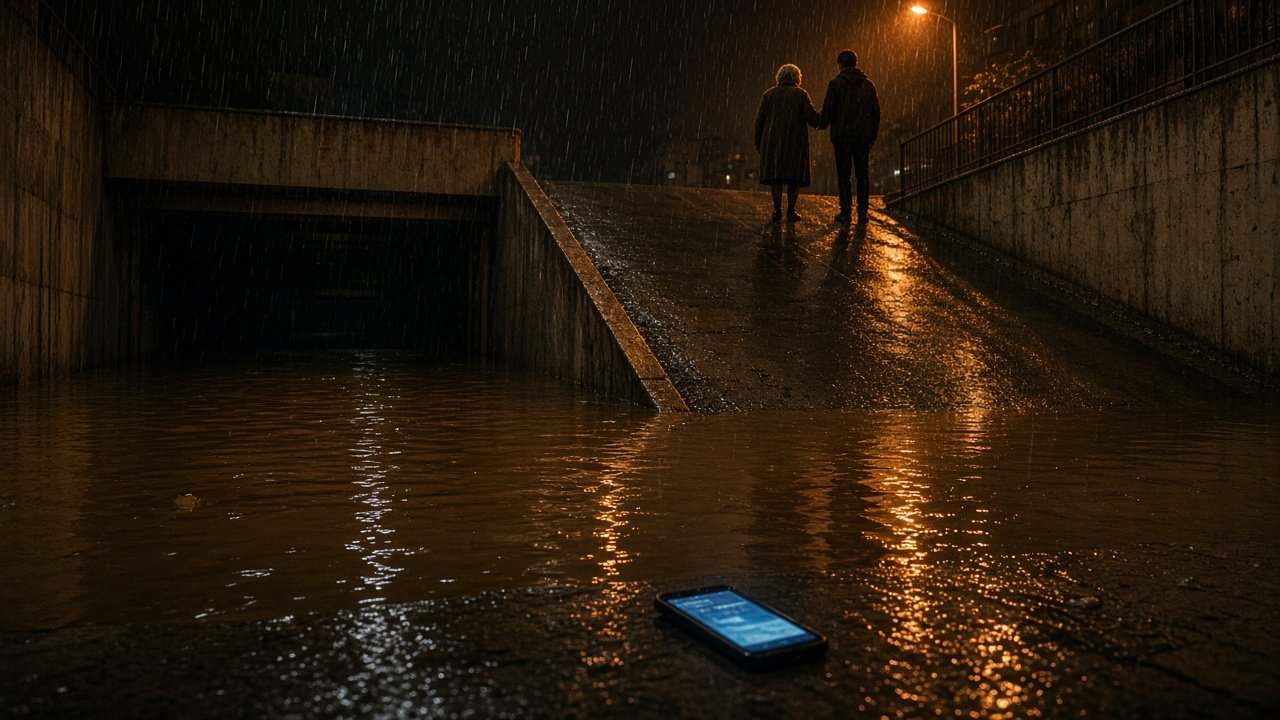
A Barcelona flood short story: on the wet night of 3 October 2026, a 15-year-old in Terrassa is stuck between his dad, whose boss wants the new riverside garage kept open for buyers, and his grandmother, who survived the deadly 1962 flood and will not go below the street. At dawn, the water peels the plaster off a wall and shows what the building was built on.
Bike, Ramp, and an Old Street Name
My name is Marc, but everyone calls me Bug. I am fifteen, and I live with Dad and Nana Rosa in a brand-new block called Riera Park, right by the dry stream that cuts through Terrassa, just outside Barcelona.
On the night of the third of October, I rode my bike home through rain that already felt wrong. The drops were fat and warm, while the streetlights made orange rings on the wet road. When I turned into our gate, the phone in my pocket buzzed so hard it almost jumped out.
ES-ALERT. Stay inside. Avoid basements and underground garages. Flash flood risk.
So I parked the bike at the top of the garage ramp, where the concrete started to tip down into the dark. Nana Rosa was waiting under the awning in her blue house coat. She is seventy-two, small, and she still walks like someone who expects the ground to move.
"Come up," she said. "Don't go under."
"I was only parking, Nana."
But she would not step onto the ramp. She never does. Instead, she held my sleeve and pulled me toward the lobby stairs.
"I don't go under the street," she said, as if that were a rule for the whole world. Then she pointed at the brass plaque by the door. "Twenty-four Carrer del Torrent. That is what this place is."
However, the plaque did not say that. It said Riera Park, number 12, and a new street name I had learned for school. Still, Nana said the old name every time, and Dad always sighed and corrected her. That night, I almost asked what Carrer del Torrent meant. After that, the phone buzzed again, and I forgot.
Dad and the Boss on Speaker
Dad's name is Jordi, but I call him Dad, and so does everyone else in the building, because he manages it. He was in the small office off the lobby with his laptop open and his hair still wet from a run to the parking cameras.
"The Boss is calling," he whispered, and put the phone on speaker.
Mr. Puig's voice filled the room, calm and friendly, the way people sound when they want something fast.
"Jordi, Sunday is the open house. We still have eight units left. So keep the garage open tonight. Buyers walk the cars in. They like to see dry concrete."
"There's an alert," Dad said. "The phone says stay out of basements."
"An alert is not a flood," said the Boss. "If we call this a flood zone, insurance triples overnight. Then the bank asks questions, and the sale dies. Keep it open. Put cones if you must. Just don't scare anyone."
Dad rubbed his face. "And if the water comes?"
"Then you pump it. Quietly. How you do it is up to you. But the garage stays open, and nobody uses the word flood in an email. Clear?"
"Clear," Dad said, though his voice was not.
After the call, he looked at me. "Don't tell Nana about the Boss. She's already wound up."
"She won't go near the ramp," I said.
"She never does." He tried to smile. "Old habits. Go help her with dinner."
Meanwhile, rain ticked harder on the lobby glass, and I felt the alert still warm in my pocket.
The Barcelona Flood Story Nobody Wants
Dinner was rice and beans, and Nana talked the whole time. Outside, the rain grew louder on the balcony glass.
"In sixty-two, the stream was dry," she said. "People built houses and workshops right next to it. Then a cold drop storm hit. Rain like a wall. In less than three hours, the dry bed became a river."
Dad stared at his plate. "Nana, not tonight."
"Why not tonight?" She tapped the table. "Because the phones are buzzing? Because your Boss wants pretty photos of a dry garage?"
I almost dropped my fork. So she had heard more than we thought.
"Six hundred and seventeen dead," she went on, softer now. "Some say more. On the Rambla alone, seventy-two. I was eight. The water came at night, and it took cars, beds, and people who thought a dry stream could never wake up."
"That was sixty-four years ago," Dad said. "This building is new. The engineers signed off. The drains are bigger."
"Drains are not a promise," Nana said. "A stream remembers its path."
Meanwhile, my phone kept lighting up with local videos of this Barcelona flood story unfolding live. Cars in Granollers sat on their roofs in brown water. Likewise, the Besos river was rising past its danger marks. In fact, Barcelona had already taken a huge dump of rain, and the news said it was the wettest day in twenty years in parts of the city.
"Dad," I said, "maybe close the garage. Just for tonight."
He shook his head. "Eight units. Sunday. If I close it, the Boss will say I scared the buyers. Then what? We lose this flat next?"
Finally Nana stood up and carried her plate to the sink. "Then you choose the Boss," she said. "I choose the street."
Cones on the Ramp
After dinner, Dad and I went down with orange cones and a roll of tape. The garage smelled of new paint and wet rubber. Already, water was pooling at the bottom of the ramp in a thin brown sheet, as if the ground were sweating.
"Just a little runoff," Dad said. "We'll push it to the drain."
But the drain was slow. When I shone my phone light into it, I saw leaves and a plastic bag stuck in the grate. So we pulled them out, and more water came, thicker now, with a smell like old mud.
Up at street level, Nana stood under the awning again, holding an umbrella she never opened. She would not come down. Instead, she only watched us, and every time a car engine echoed from the road, she flinched.
"Bug," she called, "come back up. Please."
"Five minutes," I shouted.
Then a neighbor from the third floor drove in, slow, headlights on. Dad waved him toward the open bays.
"Is it safe?" the man asked.
"Open house Sunday," Dad said, which was not an answer. "Park and go up the stairs. Don't use the lift if the power flickers."
Of course the man parked anyway. People trust a man with keys and a jacket that says MANAGER.
Meanwhile, my alert app flashed red again. Avoid underground spaces. Move to higher floors.
I showed Dad the screen. He looked at it, then at the cones, then at the dark mouth of the ramp.
"Help me put one more row of cones," he said. "Then we go up. We'll check every hour."
So we did. Still, I kept hearing Nana's voice in my head: I don't go under the street.

Water Like an Animal
By eleven, the power flickered twice. Soon the lift stopped between floors and then jerked free. Rain hammered the lobby glass so hard it sounded like gravel.
Dad and I went down again. This time the brown sheet was a lake. It covered the first six parking lines and licked at the seventh. A floating traffic cone spun in slow circles under an orange light.
"Close it," I said. "Dad. Close it."
He pulled out his phone to call the Boss. Before he could dial, the phone rang first.
"Jordi." Mr. Puig again, still calm. "I see the news. Don't panic the group chat. No photos of water. Buyers screen everything."
"The water is inside," Dad said. "It's past the cones."
"Then raise the cones. Put a sign that says temporary maintenance. Not flood. Never flood. Do you understand what that word costs us?"
Dad closed his eyes. "I understand."
"Good man. Call me at dawn."
After he hung up, Dad stared at the rising edge of the water as if it might listen to him.
"We close it," I said. "Nana was right."
"If I close it, I lose the job." His voice cracked on the last word. "And if I leave it open, and someone drives in…"
So I did the thing he could not. First I dragged the metal gate across the ramp mouth until it locked with a hard clang. Then I wrote on a piece of cardboard with a black marker: CLOSED. USE STREET PARKING. I did not write the word the Boss hated. I did not need to. After all, the water was writing it for us.
Nana's Night Watch
Upstairs, Nana had pulled three chairs to the window that faced the stream. She had a thermos of coffee and a candle, even though the lights were still on.
"Sit," she said.
We sat. Below us, the dry bed was not dry anymore. Instead, it was a black river with street junk racing through it: a chair, a football, a sheet of plastic. Across the way, someone on a balcony filmed with a phone light, and the beam shook.
"In sixty-two, we heard it before we saw it," Nana said. "A roar, like a train in a tunnel. Then the doors blew in."
"Where did you live?" I asked.
She smiled without humor. "On Carrer del Torrent. Number twenty-four. Right where your pretty lobby is now."
Dad went stiff. "Nana. Don't."
"Don't what? Tell the boy the truth? They knocked the old houses down years later. Then they built workshops. Then they built this." She waved at the new white walls. "Riera Park. A park by a stream. As if a nice name could tame water."
Consequently, I thought of the brass plaque and the name she always used. Suddenly it did not sound like a mix-up. In other words, it sounded like an address she had never stopped living at.
The Painted Line She Remembered
"Did your family get out?" I asked.
"Most of us. Not all." She poured coffee with a steady hand. "I was eight. I held my mother's skirt on the stairs while the dark came up the steps. Later, when the water fell, people painted lines on the walls so no one would forget how high it went."
Dad put his head in his hands. "I didn't know it was the same plot."
"You knew enough," she said gently. "At least you knew I would never go under. Yet you still hoped the past would stay polite."
Outside, sirens began, first far, then closer. The stream kept rising. Once, a car alarm went off somewhere below us and then died, as if the water had swallowed the sound.
Choosing the Stairs
At two in the morning, the building group chat exploded. A woman on the first floor said water was coming in under her door. Another man asked if the garage was still open. Someone else posted a video from Montornes, where a garage had filled and people were shouting.
So I typed before Dad could stop me: Garage is CLOSED. Use the stairs. Do not go down.
Dad's phone lit up with the Boss's name. He let it ring out. Then it rang again. On the third try, Dad answered on speaker, and his voice was flat.
"I closed the gate," he said. "People were going to drive in."
"You closed my garage," said Mr. Puig. "On open-house week."
"I closed a hole that was filling with a river," Dad said. "You can fire me on Monday. Tonight I keep people upstairs."
There was a long pause. Finally the Boss said, "No photos. No statements. We'll talk when it's light." The line went dead.
Nana reached over and squeezed Dad's wrist. "Good," she whispered. "Late. But good."
After that, we became a night watch. Dad walked the halls and knocked on doors. Likewise, I carried bottles of water and a bag of bread from our kitchen. Nana sat by the window and named the old streets out loud whenever a siren passed, as if saying them kept the map honest.
Sometime near four, the rain eased. Soon the roar from the stream dropped a note, then another. Still, nobody slept much. I kept seeing the cardboard sign and the brown lake under the orange lights. Above all, I kept hearing Nana say she did not go under the street.

Dawn and the Firefighter's Light
At first light, the world looked rinsed and wrong. The stream was still high, but it had stopped climbing. Mud painted the lower walls of every building on our side. Before long, a fire truck rolled up to our gate, and two firefighters in yellow stepped down into the sludge.
"Anyone in the garage?" one asked Dad.
"No," Dad said. "We locked it."
"Good. We'll check anyway."
They cut the lock because the key would not turn in the swollen metal. Then they walked down the ramp with big lamps. Dad and I followed as far as the wet line. Nana came to the top of the ramp and stopped there, one hand on the rail, the other on my shoulder. Even then, she would not step onto the slope.
Inside, the water had dropped to mid-shin. Cars sat like sad animals in a brown bath. Meanwhile, the new white plaster on the far wall was blistered and peeling in long strips, as if the building were shedding a skin.
What the Plaster Hid
One firefighter raised his lamp and swept it slowly across that wall.
As a result, the beam caught a dark painted line, high above our heads, almost two meters up. Under the ruined plaster, old brick showed through. On the brick, in faded black paint, someone had written a careful hand:
1962 – L'AIGUA FINS AQUI – ROSA, 8 ANYS
The water came up to here. Rosa, age 8.
For a second, nobody spoke. Then the firefighter lowered the lamp a little, then raised it again, as if he needed to be sure.
Dad made a sound that was not quite a word. I looked up at Nana. Her eyes were wet, but her mouth was steady.
"I told you," she said softly. "Carrer del Torrent, number twenty-four."
In fact, she had painted the line herself, a small girl with a brush, so the wall would remember. Years later, new owners covered it. Afterward, Riera Park rose on top of her family's house, and the garage wall kept her mark under fresh plaster until the storm of 2026 washed the lie away.
Finally the firefighter's light held on the words. High above the mud, the old line waited, quiet and exact. That was the end of our Barcelona flood story, written sixty-four years early.

Leave a Reply