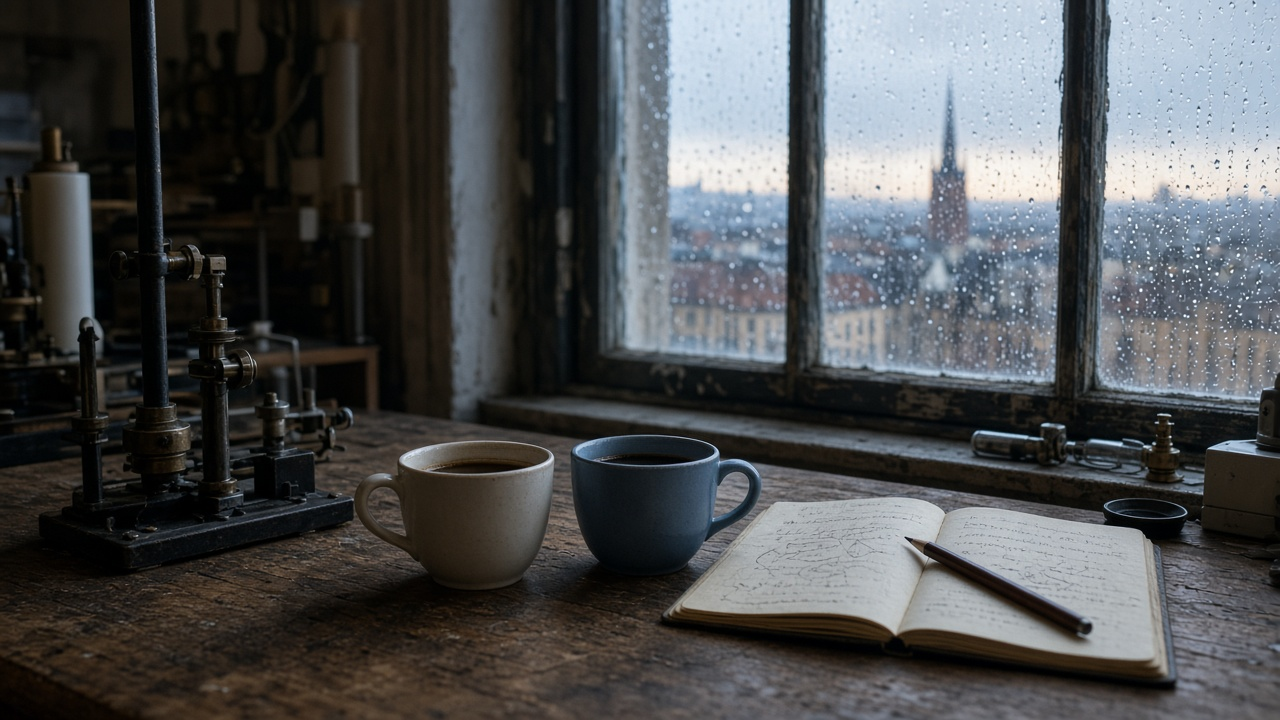
A Nobel Prize short story: on announcement morning in Stockholm, a young physicist waits with her lab for the call that could make her boss famous for her work. She is falling for the man she thinks is helping him take it. At 11:45, the live stream tells her who he really is.
The Morning of the Call
On Nobel morning, the whole lab pretended to work.
It was Tuesday, the sixth of October, at a quarter to nine. Outside, Stockholm was gray and wet, while the first dry leaves stuck to the windows. Inside, nobody touched the lasers. Instead, we drank coffee and watched the Prof’s office door.
This year, the physics prize would be read out at 11:45. Before that, if you were the winner, the Academy called you first. So we waited for a phone to ring.
My name is Emma, but at the lab everyone calls me Em. I am thirty-one, and I am a postdoc, which is a polite word for a scientist with no fixed job. For six years I had worked in the basement of this building at KTH, the old technical university by the park. My bench was the one under the broken clock, which had said 4:10 since before I came.
“Do you think he’ll get it?” asked Kat, the press lady. Earlier, she had come down from the university office with a box of paper cups and a bottle of champagne.
“Nobody knows,” I said. That was true, at least on paper. The names on the list stay secret for fifty years. The prize itself is public the same day. Only the file behind it stays sealed.
Still, everyone had a guess. And for three years, the guess had been our Prof, because his name kept showing up on the lists that reporters make up every autumn.
Kat put the champagne in the little fridge, next to the milk. Then she checked her watch. “I’ve booked the photographer for 11:46,” she said. “Just in case.”
“And if the phone doesn’t ring?”
“Then I’ll cancel him at 11:47.” She smiled, but her eyes stayed on the door.
The Nobel Prize Story Nobody Tells
Above my bench hung an old postcard of a gray stone house in the snow. It came from Kungälv, a small town north of Gothenburg. I had bought it at a flea market for two kronor, because of the woman who once spent a Christmas there.
At Christmas in 1938, a physicist named Lise Meitner stayed in Kungälv with a friend. Earlier, she had fled from Berlin that summer with two small bags and ten marks in her purse. During that holiday, a letter came from her old partner in Berlin, the chemist Otto Hahn. When he hit uranium with tiny particles called neutrons, he found barium, a much lighter metal. He could not explain it.
So Meitner went for a walk in the snow with her nephew, Otto Frisch. Soon they sat down on a tree trunk and did the math on scraps of paper. By the end of the walk, they finally knew what Hahn had seen. The heart of the atom had split in two, like a wobbly drop of water.
Later, they gave it a name: fission.
In November 1945, the Nobel Prize in Chemistry for 1944 went to Hahn alone. Meitner was nominated forty-nine times in her life, but she never won. Afterward, she came to work at KTH, right here, from 1947 until 1960. She even helped build Sweden’s first reactor, deep in the rock under our campus.
So the postcard was a joke, mostly. However, it was also a warning I gave myself every morning.
Write it down. Date it. Keep a copy.
The Man With the Library Card
Leo came into the lab at nine, shaking rain off his coat.
He was thirty-three, tall, with a crooked smile and a Scottish voice that made every sentence sound like a kind joke. He had come from Edinburgh in January as a visiting researcher, and he planned to stay until spring. Then spring came, and he stayed. Since then, he had asked more questions than anyone I had ever met.
“Morning, Em,” he said. “Has the phone rung?”
“Not yet.”
First, he hung his coat on the hook by my bench. As he did, a blue lanyard slipped out of the pocket. The card on it said Royal Swedish Academy of Sciences in gold letters, above the word Visitor.
I picked it up. “Since when do you visit the Academy?”
“Oh, that.” He took it back, quick but gentle. “Library card. They have a lovely old reading room.” Then he pushed it deep into his pocket.
Just then his phone buzzed. As usual, he did not answer it at the bench. He never did. Instead, he walked out into the stairwell and closed the heavy door behind him. Through the glass, I watched him listen, nod, and say almost nothing.
When he came back, he sat on the stool beside me.
“Em,” he said, “that night in March. The night you first saw the signal. What was the exact date?”
“You asked me that last week.”
“I know. Humor me.”
So I opened my old black notebook. “March 14, 2019. Ten past two in the morning.” I tapped the page. “There. My writing. My coffee stain.”
For a long time, he just looked at it. Then he closed the notebook for me, slowly, as though he were tucking in a child. “Good,” he said. “Keep that safe.”

One Face for the Donors
At 9:40, the Prof arrived.
He was sixty-four, silver-haired, in a new blue suit that still had a shop crease on the sleeve. As always, he said good morning to everyone and good luck to no one. Then he went into his office.
But he did not close the door all the way. As a result, when his phone rang, the whole lab heard him.
“Yes, Dean. Yes, I know.” He laughed a little. “If the call comes, it’s one face. Of course it is. The donors want a name on the new building, not a list.”
There was a pause. Then he dropped his voice, though not enough.
“The postdocs? Postdocs are replaceable. I have one permanent post to give, and I’ll give it on Friday. Whoever keeps quiet today keeps their job.”
My face went hot. Across the room, Kat suddenly stared very hard at her phone.
I looked at Leo. Oddly, he was looking at the floor.
That was the other thing nobody said out loud. The lab had two postdocs left but only one real job. It meant a fixed salary, a desk with my name on it, and no more one-year contracts. Above all, it meant I could stay in Stockholm. Both Leo and I wanted it, so for nine months we had been friends, rivals, and something in between.
Our big paper had come out in 2020, after I had checked the data for a year. The Prof’s name was first. Mine was sixth, after two men who had never stood at my bench at two in the morning.
Leo had asked me about that list, too. He had asked too many times.
Cold Coffee
By ten, my coffee was cold, and so was I.
“You’re angry,” Leo said quietly.
“I’m doing math,” I said. “Hahn got the prize and Meitner got a postcard. I’m trying to work out which one I am.”
“You’re not a postcard,” he said. “And that’s the saddest Nobel Prize story there is. It doesn’t have to be yours.”
“Then why do you keep asking about my dates? Are you writing his speech for him?”
Only one other person had ever asked me that. In 2021, an old professor in Copenhagen wrote me a letter by hand. He had refereed our 2020 paper and, unusually, signed his report. He wanted the date of the first signal. So I sent him a copy of the page. He wrote back two kind lines, and I never heard from him again.
For a while, Leo did not answer. Instead, he took my cold cup, poured it into the sink, and made me a new one. He added the milk the way I like it, which annoyed me, because it meant he had noticed.
“I can’t tell you what I’m doing,” he said at last. “Not today.”
“That’s not an answer.”
“I know.” He looked at me, and his smile was gone. “Em, whatever happens at 11:45, please believe one thing. The work is yours. I know it is.”
Meanwhile, Kat was setting out paper cups in neat rows on the clean bench. There were twenty cups, all upside down, like small white tents. Every few minutes, she glanced at the Prof’s door.
It did not ring.
At 10:20, Leo’s own phone buzzed again. Once more, he walked into the stairwell. This time, though, he took his coat.
“Where are you going?” I asked.
“Just out,” he said. “Back soon.”

Under the Rock
I found him ten minutes later, in the one place I always go when I need to think.
Below the campus, behind a steel door, a tunnel slopes down into the rock. At the bottom is a huge hall, cut out of stone. It once held R1, Sweden’s first nuclear reactor. The reactor was shut down long ago, so now only the space is left. Today the hall is empty and cool, and every small sound comes back to you three times.
When I came in, Leo was standing in the middle of the floor in his coat.
“You followed me,” he said.
“You took your coat to go to the stairwell.”
He laughed, and the echo laughed with him. Then he grew serious. “I have to go somewhere at eleven. I can’t say where.”
“Is it the Academy reading room?”
“Em.”
“Because if you’re helping him take my work,” I said, “just tell me now. I’ll survive it. She did.”
He stepped closer. “I’m not helping him. I swear it to you, in this room, of all rooms.”
For a moment neither of us spoke. Then he kissed me, once, carefully, as if he were asking a question. Without a word, I said yes.
After that, he rested his forehead against mine. “When you know,” he said, “try not to be too angry with me.”
Then he walked up the tunnel toward the gray light, and he was gone.

Eleven O’Clock
By 11:00, the lab was full.
Students stood in the doorway. Two old professors from upstairs had also come down, pretending to borrow a tool. Kat stood by the fridge, holding the champagne like a baby. Meanwhile, the Prof sat at his desk with his hands folded, staring at his phone.
It stayed quiet.
At 11:15, he picked it up to check that it worked. Then he put it down again, very gently, as though it might break.
At 11:30, Kat whispered, “Sometimes they call late.”
“Sometimes they don’t call,” said one of the old professors.
Meanwhile, I sat on my stool with my notebook in my lap. Suddenly I knew what I had to do. Whatever happened at 11:45, I would knock on the Prof’s door at noon. Then I would show him March 14, 2019. After that, I would ask, out loud and in front of everyone, for my name to go first on the next paper. Maybe I would lose the job, too. Even so, I would not lose the story. Not like her.
Soon Kat opened her laptop on the clean bench and found the live stream from the Academy. A grand hall with tall windows filled the screen. In front of it, rows of chairs faced a long table. Reporters waited with cameras, while somewhere a man coughed.
“Leo’s missing this,” Kat said.
“He said he’d be back,” I said. I looked at the door, but it stayed shut.
The Call
At 11:31, the Prof’s desk phone rang.
The whole lab jumped. Somebody cheered before he even picked it up. Kat squealed, pulled the champagne from the fridge, and popped the cork. It hit the ceiling and bounced off the broken clock.
“Yes,” said the Prof into the phone. “Yes, speaking.” He stood up very straight, the way people do when a band plays. For a moment, his whole face shone.
Then he listened some more. Slowly, the shine went out of it.
“Shared,” he said quietly. “I see. Shared with…”
He did not finish. Instead, he turned his head and looked out through the gap in his door, straight at me.
Kat froze with the bottle in her hand, while foam ran over her fingers and onto the floor.
A minute later, something buzzed against my back. It was my own phone, in the pocket of the coat on my chair. I almost didn’t answer, because I never pick up numbers I don’t know.
“Hello?”
“Good morning,” said a calm voice. “Am I speaking with Emma? This is the Royal Swedish Academy of Sciences, calling from Stockholm.”
I sat down on the floor. I don’t remember deciding to.
Very kindly, the voice told me that I had been awarded the Nobel Prize in Physics, together with the Prof. It asked me to keep the news to myself until 11:45. Then it asked if I was all right.
“I don’t know,” I said. That was the truth.
11:45
At exactly 11:45, the Academy’s Permanent Secretary stood up on the screen and began to speak.
First in Swedish, then in English, came the decision. The Prof’s name came first. Then came mine.
For a second, the lab was silent. Then it exploded. Students hugged me while I was still sitting on the floor. One of the old professors took off his glasses and wiped them twice. Meanwhile, Kat poured champagne into the paper cups so fast that half of it missed.
The Prof came out of his office last. For a long moment, he just stood there and looked at me. Then he held out a paper cup.
“It was your signal,” he said. “I should have said so in 2020.”
I took the cup. My hand was shaking, and so was his.
On the screen, the camera turned to the long table. There, members of the Nobel Committee for Physics sat in a row, ready to explain the prize. Behind them, along the wall, sat a few more people in dark suits.
One of them had a crooked smile.
At first, he was looking down and turning a pen in his fingers. Still, I would have known him anywhere. Even his hair was still wet from the rain.
“Isn’t that…?” Kat began.
“Yes,” I said.
Fifty Years
Suddenly, it all made sense.
Nobody can nominate themselves for a Nobel Prize. Instead, only certain people may send in names, such as tenured physics professors in the Nordic countries. So I thought of an old man in Copenhagen who had once asked for my dates. Had he written my name next to the Prof’s? I would never know, since the names of nominees and nominators stay secret for fifty years.
Leo could not have named me, because he was not one of the people allowed to nominate. His job came later. Every spring, the committee sends its short list to a few experts it picks in secret. Each one writes a private report on the work, and on who really did it. Those reports are sealed for fifty years, too.
That was why he never took calls in the lab, why he kept slipping out to the stairwell, and why he had a library card. Above all, that was why he asked about March 14, 2019, again and again, until he was sure.
Later, Kat found me. “Leo emailed the department at eleven,” she said softly. “His visit ends today. He flies home tonight.”
Of course. He had judged my work in secret. Now he could not stand next to me, not today, and maybe not for a long time.
Behind me, the party grew loud. My phone lit up again and again. Maybe it was reporters, or my mother. I let it ring.
Slowly, I opened my notebook to March 14, 2019. A small folded note slid out from between the pages. He must have tucked it there at nine, when he closed the book so gently.
In fifty years they’ll open the file. It says what I could never say: it was always you. – L

Leave a Reply