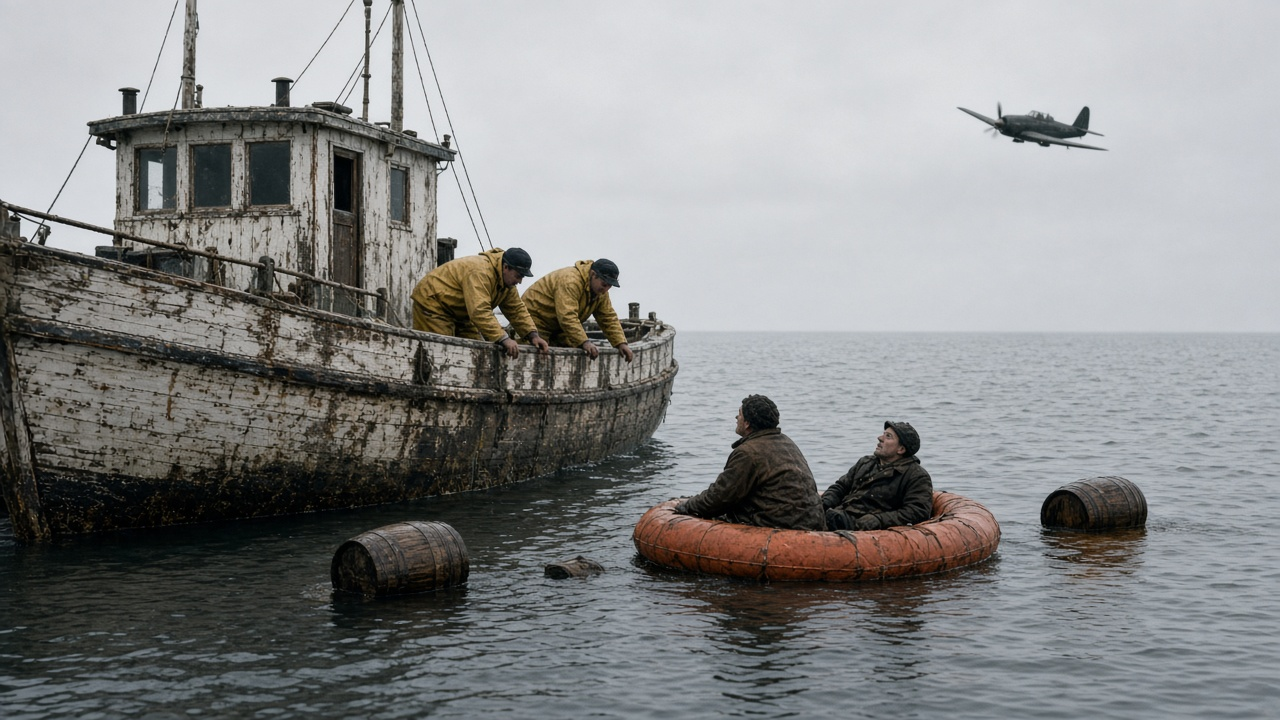
A WW2 short story from the coast of Maine, told as a short story. The boat, the crew and the captain are made up. However, the ship was real. On December 3, 1944, a German U-boat sank the Canadian freighter SS Cornwallis near Mount Desert Rock, with sugar and molasses in her holds. Sadly, only five of the 48 people on board lived. In July 2026, divers finally found her wreck in nearly 400 feet of water. So this WW2 short story imagines the small boat that pulled the five out of the sea.
The Sea Smelled Sweet
The sea smelled like my mother's kitchen at Christmas.
We were far out in the Gulf of Maine, in December, and the water smelled like molasses. At first I thought I was dreaming it, because I hadn't slept since Wednesday.
Then I saw the barrels. There were dozens of them, rolling on the smooth gray swell. Some were broken open, so a brown sheen spread out from them across the water like spilled tea.
"Don't look at the barrels, Pup," Cap said. "Look for men."
So I looked for men.
The Lucy Dean
My name is Danny, but nobody on the Lucy Dean used it. On my first trip I was sick over the rail for two days, and Cap said I looked like a wet pup. After that, I was Pup.
That fall, I was sixteen. I had quit school in October, because my father's lungs were bad and somebody had to pay the rent on our flat on Munjoy Hill. At first, Mom cried about school for a whole evening. Then she packed my bag anyway, and she put two of her molasses cookies in the bottom, wrapped in wax paper.
The Lucy Dean was an old wooden dragger out of the Portland Fish Pier. She was eighty feet long and smelled of diesel, wet rope and fried onions. There were five of us. Cap ran the boat. Pops ran the engine, and he was older than the engine. Meanwhile, Beans did the cooking, and Lefty and I did everything else.
We didn't own her, though. Instead, a man named Cobb did. He had an office on Commercial Street and a stiff white collar that looked like it hurt, so naturally everybody called him the Collar.
The Collar paid by the pound, so a full hold meant rent and coal. On the other hand, a half hold meant Mom counting coins on the kitchen table after supper, very quietly, so Dad wouldn't hear.
The Broomstick
Beans told me about the broomstick on my second trip.
"Summer of '43," he said, while he stirred his coffee. There was no sugar on board, because sugar was rationed, so he put a spoon of molasses in it instead. "Cap sees a periscope off Cape Elizabeth. So he calls the Navy, like a good citizen."
"Was it a periscope?" I asked.
"It was a broomstick, Pup. Somebody's old broom, standing up in a lobster buoy." Beans shook his head. "Still, the Navy held us in Portland three days. Questions, papers, then more questions. Meanwhile, the fish didn't wait for anybody."
Afterward, the Collar docked everybody's pay. Then the insurance man came down to the pier and talked to the Collar for an hour with his hat on.
"One more lost trip," Beans said, "and the insurance drops us. Then the Collar sells the boat, and we all go home and look at the wall."
I looked up at Cap in the wheelhouse. He was a big, quiet man with gray in his mustache and hands like split wood. He never yelled, not even at Lefty, even though Lefty deserved it most days.
"So what does Cap do now?" I asked.
Beans drank his sweet coffee. "Now Cap sees whales, Pup. Only whales."
Snow in Frenchman Bay
We left Portland on the last Monday in November, just after Thanksgiving. For two days we dragged for redfish on the grounds east of Mount Desert Rock, and the hold filled slowly.
On Wednesday, however, the wind came round to the northeast and brought snow. Consequently, Cap ran us in behind the islands and dropped the anchor in Frenchman Bay, under the dark shore near Hancock Point.
It was a strange night. All night long, the snow came in thin bands, and between the bands the moon was almost full. As a result, the whole bay kept changing, silver and then gray and then silver again.
I went to my bunk early, because I was so tired my arms hummed. Once, very late, I woke up and heard Cap's boots on the deck above me. Then they stopped near the rail and stayed there a long time. Soon I fell asleep again.
In the morning, Cap was at the little chart table with the log book open. His eyes were red, as if he hadn't slept at all. For a long time he wrote slowly, pressing hard. Then he tore the page out and folded it.
"Spoiled it," he said. "Spilled my coffee."
He put the folded page in his coat pocket and went up to start the engine.
The Kind of WW2 Short Story Men Tell on a Fuel Dock
On Friday we went into Southwest Harbor for ice and fuel. While Pops argued with the fuel man about the price, I carried ice and listened.
Meanwhile, there were three lobstermen on the dock, smoking. Of course they were talking about Hancock.
"Two fellows," one of them said. "Walked right out of the woods at midnight on Wednesday, in the snow. City coats, no hats, and carrying suitcases."
"Salesmen," said another one.
"Salesmen don't come out of the woods at Hancock Point. Besides, a boy saw them, and so did a lady coming home from cards. And then they got a taxi. Asked for a taxi to Bangor, if you please."
Everybody laughed, and even Lefty laughed too. To me, it sounded like the kind of story you tell on a dock to pass the time, like a fish that got away.
"Who walks around Hancock Point at midnight with no hat?" Pops said. "Only a fool or a fellow from Boston."
Cap didn't say anything, though. Instead, he went up to the store to use the telephone.
The Collar on the Telephone
The store had only one telephone, on the wall by the flour sacks. I went in to buy Mom a postcard, so I heard Cap's side of the call. Honestly, I heard the Collar's side too, because the Collar talked loud.
"I don't care about the snow, Joe," the Collar said. "I need a full hold by Monday."
"We'll have it," Cap said.
"And Joe. No more Navy business. You hear me? Besides, the insurance man was in again this week. One more lost trip and they drop the boat. If they drop her, I sell her. Maybe I sell her to the Navy, since you like them so much."
For a long time, Cap looked at the flour sacks.
"No Navy business," he said at last. "Just fish."
After he hung up, he saw me standing there with my postcard.
"Write your mother something nice, Pup," he said. "Tell her you're eating."
A Flash Before Dawn
On Sunday morning I had the last watch before dawn. By then we were dragging southwest of Mount Desert Rock. The sky was clear, the sea was flat as a plate, and the old moon still hung over the water to the west.
At about six, something flashed far off to the southwest. Although it was orange and bright, it was low on the water and gone in a blink.
A few seconds later, a dull thump came through the hull. It was soft, like a door closing somewhere in a big house.
Straightaway, I ran to the wheelhouse. Cap was already there, with a cup of coffee halfway to his mouth. He didn't drink it, and in fact he didn't move at all.
"Cap? What was that?"
"Could be a boiler," he said finally. "Or it could be the Navy blowing up a mine."
"Shouldn't we go look?"
He put the cup down very carefully, as if it might break. "We have a net in the water, Pup. And the Collar wants a full hold by Monday."
So we kept towing. However, Cap stayed in the wheelhouse with the radio on, listening to nothing but hiss. He didn't come down for breakfast, and Beans's eggs went cold on the stove.
Planes Over the Water
By the middle of the morning, there were planes. At first there were two of them, then three, flying low and slow far to the southwest. They went round and round over the same piece of sea.
"Planes don't circle for nothing," Lefty said.
For a while, Cap watched them through the glasses. His jaw moved, as if he were chewing something hard.
"Haul back," Pops said. "We can be there in an hour."
"Hauling back takes an hour by itself," Cap said.
Then he said two words.
"Cut it."
Pops just stared at him. "Joe, that's six hundred dollars of net."
"I know what it costs. Cut it."
So Lefty took the axe and cut the cable. The whole net, and every fish in it, went down into the dark. Right away, Cap turned the wheel hard and opened up the engine until the old boat shook like a wet dog.
Nobody said anything after that. Pops went below to his engine without a word. For once, Beans didn't even make coffee.

Sugar and Molasses
That was when we smelled it. First came the molasses, then the barrels, and then broken boards, a life ring, and a long brown sheen on the flat water.
Then Lefty leaned over the rail. "Those barrels are worth money, Cap. You know the Collar would want them."
"Men first," Cap said.
Above us, a plane dipped its wings and flew off toward a spot of orange on the water. So Cap turned after it.
It was a raft. It was only a small square one, though, low in the water, with men on it.
At first I thought they were all gone. They were so still and so gray. Then one of them lifted his arm. It took him a long time, as if the arm weighed a hundred pounds. Finally he waved it once and let it fall.
"Easy now," Cap said quietly. He brought the Lucy Dean alongside so gently that she barely touched.
Five Men
There were five of them. They were soaked through, and their faces were the color of putty. Worst of all, their hands didn't work anymore. When Lefty and I reached down, they couldn't grab anything. Instead, we grabbed them under the arms and pulled.
The first one up was a big man with a gray beard, and he weighed as much as a cow. Next came a small man who kept saying, "Thank you, thank you, thank you," in a voice like a scraped pan.
The last one was young, maybe two years older than me. He had a thin face and freckles, and he was shaking so hard his teeth clicked.
"Where you from?" I asked him, because I didn't know what else to say.
"Nova Scotia," he said. Then, after a while, he said, "We were carrying sugar. For Christmas."
Coffee With Molasses
We got them down into the galley, next to the stove. Quickly, Beans wrapped them in every blanket on the boat. Then he heated coffee and, after a second, stirred a big spoon of molasses into every cup.
Next, Cap came down the ladder. Without a word, he took off his own heavy wool coat and put it around the young one. He buttoned it up himself, like a father does for a little boy before school.
Meanwhile, I gave my sweater to the small man, and Lefty gave up his dry socks. Even Pops came up from the engine and stood there with his hat in his hands.
"How many on the ship?" Cap asked quietly.
The big man looked at the stove for a while. "Forty-eight," he said.
Nobody asked any more questions after that.

The Navy Boat
Before dark, a Navy rescue boat met us off Owls Head. It was gray and fast, and the sailors came across with blankets and moved quickly and kindly, like nurses.
In the end, the young one was the last to go. At the rail, he unbuttoned Cap's coat and held it out to me.
"Give this back to your captain," he said. "And tell him I said thanks."
"Keep it," I said. "He won't mind."
"They'll give me a Navy one." He almost smiled then, for the first time. "Besides, it's too big. Your captain is a big man."
So I took the coat. It was still warm from him and heavy with sea water at the hem.
Then the Navy boat pulled away toward Rockland, and we followed slowly behind it. Cap stood alone in the wheelhouse the whole way and didn't turn on the light.
Rockland
By the time we tied up at Rockland, it was dark. Once again, snow was falling, light and dry.
Meanwhile, a man was waiting on the pier under a lamp. He wore a gray city coat and no hat, and for one silly second my heart jumped. However, he showed Cap a card. He was from the Navy, and he wanted a statement.
First he asked about the flash, the time, the planes and the raft. Cap answered everything in a slow, flat voice. Then the man folded his notebook.
"One more thing, Captain. Did you see anything unusual out there this week? Anything at all? A light, a boat, anything?"
Then Cap looked at me. It was only for a second, but I felt it.
"Just fish," he said.
After that, the man nodded and walked away into the snow.
Later, the store on the pier let Cap use their telephone. Even from outside, I could hear the Collar yelling about the net. Six hundred dollars, cut loose, and for what?
"Take it out of my share," Cap said, and he hung up.
Cap's Coat
By then I was shaking. My sweater was gone with a stranger, and the wind off the harbor went right through my shirt.
Cap's coat was lying on the hatch where I had left it, so I put it on. It came down to my knees, and it still smelled of pipe smoke, salt, and molasses.
I pushed my hands into the pockets to warm them. Suddenly, in the inside pocket, something crackled. It was a folded page from our log book, a little damp at one corner.
I knew that page, because it was the one he had spoiled with coffee in Frenchman Bay.
But there was no coffee on it.
Slowly, I unfolded it under the pier lamp. It was Cap's square, careful printing, pressed so hard the pencil had nearly gone through the paper:
WEDNESDAY NOV 29 – 11:10 PM – ANCHORED OFF CRABTREE NECK – SNOW AND BRIGHT MOON – SUBMARINE ON TOP OF THE WATER, NO LIGHTS, HALF MILE OFF – SMALL RUBBER BOAT ROWING IN TO THE BEACH – SAW THROUGH GLASSES TWO MEN GET OUT WITH SUITCASES – BOAT WENT BACK – REPORT TO NAVY FIRST THING.
Under it, in a different pencil, there were four more words:
CAN'T LOSE THE TRIP.


Leave a Reply