A sci-fi short story about space junk falling to earth, told as a short story. This one is fiction, so the people in it are made up. However, the old fine is real. In 1979, pieces of Skylab fell on Esperance, and the shire fined NASA four hundred dollars for littering. Now, in October 2026, NASA has ended its Swift telescope after a rescue failed, and it will fall soon. Still, Swift can only come down near the tropics, far north of Esperance. So this story imagines the next one.
Midge on the Hill
The sky over Esperance broke at 12:40 in the morning.
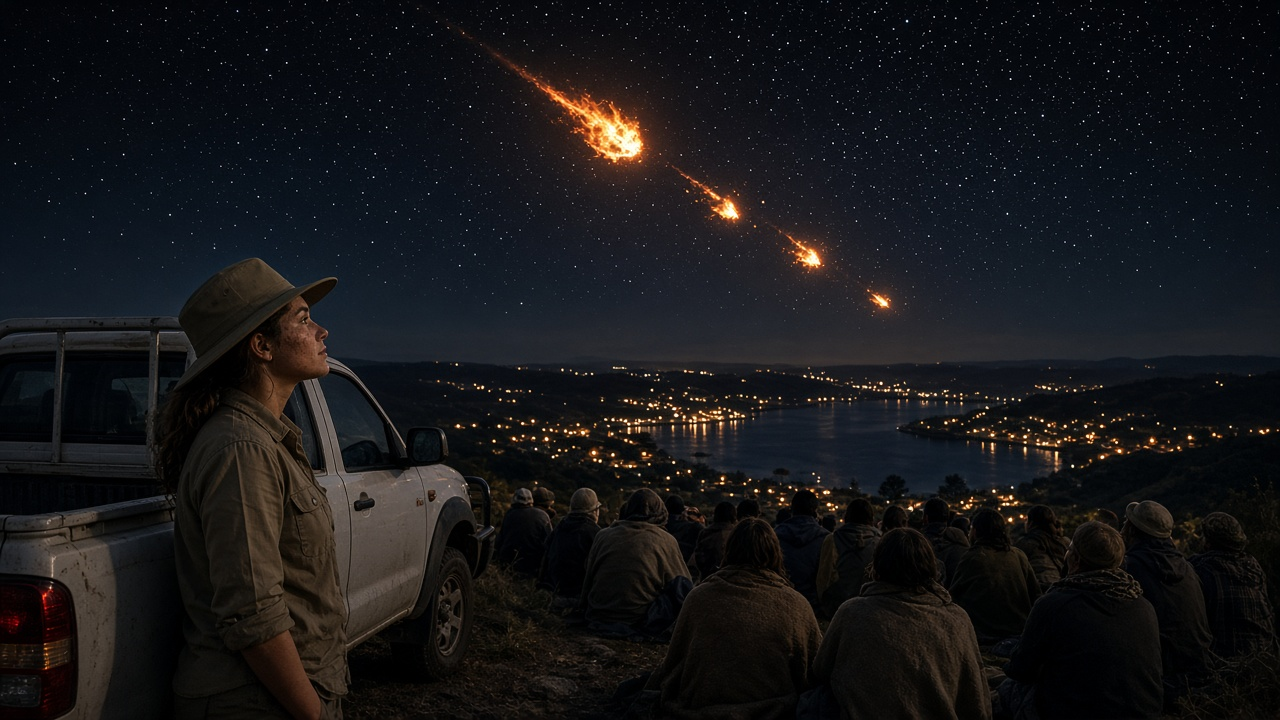
I was on Wireless Hill in the ranger's ute, because somebody had to keep the crowd off the road. About two hundred people had come up in pajamas and footy jumpers, with blankets, thermoses and phones held high. After all, everybody wanted to see the old American telescope come home.
At first it was just a bright star moving fast from the sea. Then it split into five, then ten, then too many to count. Each piece had a long orange tail, as if somebody had thrown a fistful of sparks across the dark.
Then the booms came. Bang, bang, bang. The ute windows shook, and a baby cried. After that, the whole hill cheered like it was New Year's Eve.
My name is Megan, but nobody calls me that. On my first day, the senior ranger, Bluey, said I was small and annoying and always buzzing about, like a midge. So I was Midge. I had been a shire ranger for three weeks, and mostly I did dogs and parking.
My phone rang at 12:45. It was the Shire President.
"Midge," he said. "Did you see that?"
"Everybody saw it, Mr. President."
"My old man drove all night in '79 looking for a bit of Skylab," he said. "He never found a scrap. Not this time, Midge. Not this time."
Fifty-Two Years After Skylab
Everybody in Esperance knows the Skylab story. In fact, we tell it to tourists before they even ask.
In July 1979, the big American space station fell out of the sky, right over our town. It broke up in the middle of the night, so pieces landed all over the farms and the scrub, out past Balladonia. Back then, hardly anyone had seen space junk falling to earth on a town. Even so, nobody was hurt. Not one piece hit a house or a cow.
Then a shire ranger wrote NASA a fine for littering. It was four hundred dollars, and it was a joke, but the whole world laughed with us. NASA never paid it, so after three months the shire let it go. Thirty years later, a radio show in America took up a collection from its listeners and paid it anyway.
Today there is a big sign at the museum about it. Of course, our President loves that sign. Every year he has his photo taken under it, with a bakery coffee in his hand.
Now, fifty-two years later, it was happening again. An old American telescope called Lantern had been sinking for two years. A private robot ship had tried to catch it and push it higher, but the robot broke down. So the agency in America shut the telescope off and let it fall.
At first the experts said it would probably come down in the ocean. Instead, it came down on us.
Five Pieces in the Moon Paddock
Fitz rang the shire at 6:10 that morning.
Fitz runs sheep and barley on a big dry station north of town, out past Scaddan. He is sixty-something and thin as a fence post, and he talks like every word costs him money. Besides, he has a kelpie called Tilly who bites everyone except Fitz.
By the time I got there, it was seven. The sun was up, so the paddock was gold and gray. Fitz met me at the gate with his tea in a dented thermos lid.
"Some idiot left my gate open," he said. "Half my ewes were on the road. I've been chasing them for an hour."
"Who?"
"If I knew, I'd shoot him." He looked at me. "Not really. Probably."
Then he walked me out to the far paddock. His family calls it the Moon Paddock, because nothing grows there but salt bush and stones. There were four burnt holes in a rough line across it. In each one sat a piece of telescope, black and twisted, still smoking a little.
"There were five," Fitz said.
"Five?"
"At first light, me and Tilly walked the whole line. I counted them with my torch. Five holes, five pieces." He pointed at the last hole, out near the fence. "That one was the pretty one. It was shiny, like gold."
But the fifth hole was empty.
Space Junk Falling to Earth, Again
I knelt down by the empty hole. The rule for space junk falling to earth is simple: you don't touch it. The Australian Space Agency puts that on its website in big letters, because some parts can hold gas or nasty fuel. In fact, Bluey had made me read it twice.
So I didn't touch anything. Instead, I looked.
There were boot prints in the dust, and they were not Fitz's. While his boots were old, with flat soles, these had a neat little pattern, like good town shoes. Next to the hole there was a white plastic lid from a takeaway coffee cup, the kind the bakery on Dempster Street uses.
I put the lid in a bag. Honestly, I did it only because it was litter, and I am a ranger. Then I rang Bluey.
Bluey was on leave, fishing at Duke of Orleans Bay, so he sounded half asleep.
"Somebody's pinched a bit," I said.
"Course they have," he said. "In '79, half the town had a bit of Skylab in the shed by Christmas. Ring the cops. Tape it off. And Midge?"
"Yeah?"
"Don't let anyone make you famous."
At the time, I did not know what he meant.

The Lady from Houston
The agency woman arrived the next day, on the morning plane from Perth.
Her name was Dee. However, the President called her "the Lady from Houston" before she even landed, and it stuck. Dee was about thirty, with a sunburned nose and a laptop under her arm. Since she had been awake for two days, it showed.
For a while she stood at the edge of the Moon Paddock and looked at her list.
"Four," she said. "There should be five."
"There were five," I said. "Fitz counted them at dawn."
Her face went tight. "Which one is missing?"
So I described it. Shiny. Gold. Round, like a short pipe.
Then Dee sat down on the tailgate of my ute, as if her legs had quit.
"That's the mirror," she said. "It's the eye of the telescope, a set of thin gold shells, one inside the other, like the rings of an onion. The edges are sharp enough to cut you to the bone. Also, it's the one piece our people really need, because they want to know why Lantern sank so fast. Besides, under the treaty your country has to give it back to us."
"So it's important."
"Midge, if that piece walks away, it's not a littering story. Instead, it's an international story. My boss's boss will be on the phone to Canberra by tonight."
Cowboy Hat
By lunchtime, I had a suspect. Actually, everybody did.
A man from Perth had flown in on the same plane as Dee. He wore a huge white cowboy hat and filmed himself everywhere he went, and he had two million followers online. Before he even landed, he had promised fifty thousand dollars to the first person who brought a piece of Lantern to his live stream.
That was an old trick too. In 1979, a newspaper in San Francisco offered ten thousand dollars for the first piece of Skylab, and a local teenager won it. So the whole town knew how it worked. By two o'clock, there were utes on every farm track north of town.
That night, I caught Cowboy Hat climbing Fitz's fence with a torch and a shovel.
"Mate, mate, I'm just looking," he said. He turned his phone toward me. "Say hi to the people."
"Off the property," I said. "Now. Otherwise I'll tell Tilly where you are."
Tilly growled from the dark, so Cowboy Hat left fast.
He had a shovel, a phone, and three cans of energy drink. However, he did not have the mirror. Later I searched his hire car with a cop standing beside me. It was full of chip packets, and that was all.
The Call in the Corridor
On Friday morning, I went into the shire office to write my report. As I passed, I heard the President through his open door.
"I don't care what it is," he was saying. "It fell on us, it's American, it gets a ticket. Four hundred dollars, same as '79. Sunset at the jetty, cameras, big cardboard fine."
Someone else said something quiet.
"No, not Bluey. Bluey's fishing. The new girl, Midge." He laughed. "TV loves a young face. She hands it to the Houston lady, everybody claps, and then we're on the news in London."
There was another quiet voice. I think it was the CEO.
"Look, tourism is down a third this year," the President said. "The caravan park is half empty. This town needs a laugh, and it needs the money that comes with it. So nobody is going to cry over one missing bit of tin."
After that, the CEO came out and found me in the corridor. She is a kind woman with a tired face.
"Your probation review is Monday," she said gently. "So do this well, Midge. Smile for the cameras."
Fitz Sends a Bill
That afternoon, Fitz came into town in his good shirt. Like Dee, he had a list.
One water tank, crushed. Forty meters of fence, burnt. Two days of chasing ewes off the highway. One gate, left open by "some idiot".
"Who pays for this?" he asked Dee.
"We do," Dee said at once. "That's the law. When our junk breaks something on the ground, we pay for it. Every bolt."
Fitz blinked, because he had come ready for a fight.
"Then what's the fine for?"
"The fine is for TV," I said.
Dee looked at me. Fitz looked at me too. Even Tilly looked at me, from the back of the ute.
"Sorry," I said. "But it is."
Dee rubbed her eyes. "I don't mind the fine. Honestly, I think it's funny, and I'll pay it myself. But I can't fly home without that mirror, Midge. I've got until Sunday. After that, it's not my problem anymore. Then it's lawyers."

The Lid in the Bag
That night, I sat in the ranger's ute outside the shire depot and looked at the bag on my dashboard.
It was just a white plastic coffee lid. Still, I kept looking at it.
Fitz drinks tea from a thermos. Meanwhile, Cowboy Hat drinks energy drinks from a can. The cops on the gate had come out at eight, after the bakery opened. And the bakery on Dempster Street opens at half past five.
So somebody had driven out to Fitz's place in the dark, with a fresh coffee, in good town shoes. In fact, it was somebody who knew which station it was before the news did. They had walked past four black, ugly pieces to take the one pretty gold one. Then, on the way out, they had forgotten to shut the gate.
Then I knew who it was. Of course I did. I had known since the hill, and I just hadn't wanted to.
I put my head down on the steering wheel.
"Oh no," I said to nobody. "Oh, no, no, no."
Sunset at the Jetty
On Saturday, the sun went down pink and orange over the bay, as if the town had ordered it.
There was a little stage by the jetty, a big banner, and three TV cameras. Meanwhile, a crowd of maybe four hundred people was eating sausages in bread. The President stood in the middle in a new blue shirt, with a coffee in his hand. Next to him, someone held a giant cardboard fine with FOUR HUNDRED DOLLARS on it in red.
Dee stood beside them, smiling like a person at the dentist.
The President's white council car was parked behind the stage, close to the museum. There was a gray tarp over the back.
"And now," the President said into the microphone, "our newest ranger, Midge, will do the honors. Just like 1979!"
Everyone clapped, and the cameras turned to me.
So I took out my real fine book. Although my hands were shaking, I wrote very neatly. Then I tore the page out, walked up onto the stage, and handed it to the President, not to Dee.
At first he smiled for the cameras. Then he read it, and the smile stopped.
Paid in Full
"What's this?" he said quietly.
"Littering," I said. "One coffee lid, from the bakery. Fitz's Moon Paddock, Wednesday, about half past six in the morning. Four hundred dollars."
The crowd laughed, because they thought it was part of the show. However, the President did not laugh, and neither did Dee. She looked at his face. Then she followed his eyes to the white car behind the stage.
"And you left Fitz's gate open," I said. "His ewes were on the highway for an hour."
For a long moment, nobody moved. Finally, the President set his coffee down on the edge of the stage.
"I only wanted one bit to stay," he said, so softly that only Dee and I heard. "Just one bit, for the museum. For the town. They always take it all home."
"I know," I said. And I did know. In a way, that was the worst part.
Then he took out his wallet. In front of three cameras and four hundred people, the Shire President of Esperance counted out four hundred dollars in fifties and put it in my hand.
"Paid in full," he said.
After that, I walked down off the stage, across the grass, and lifted the tarp.

Leave a Reply