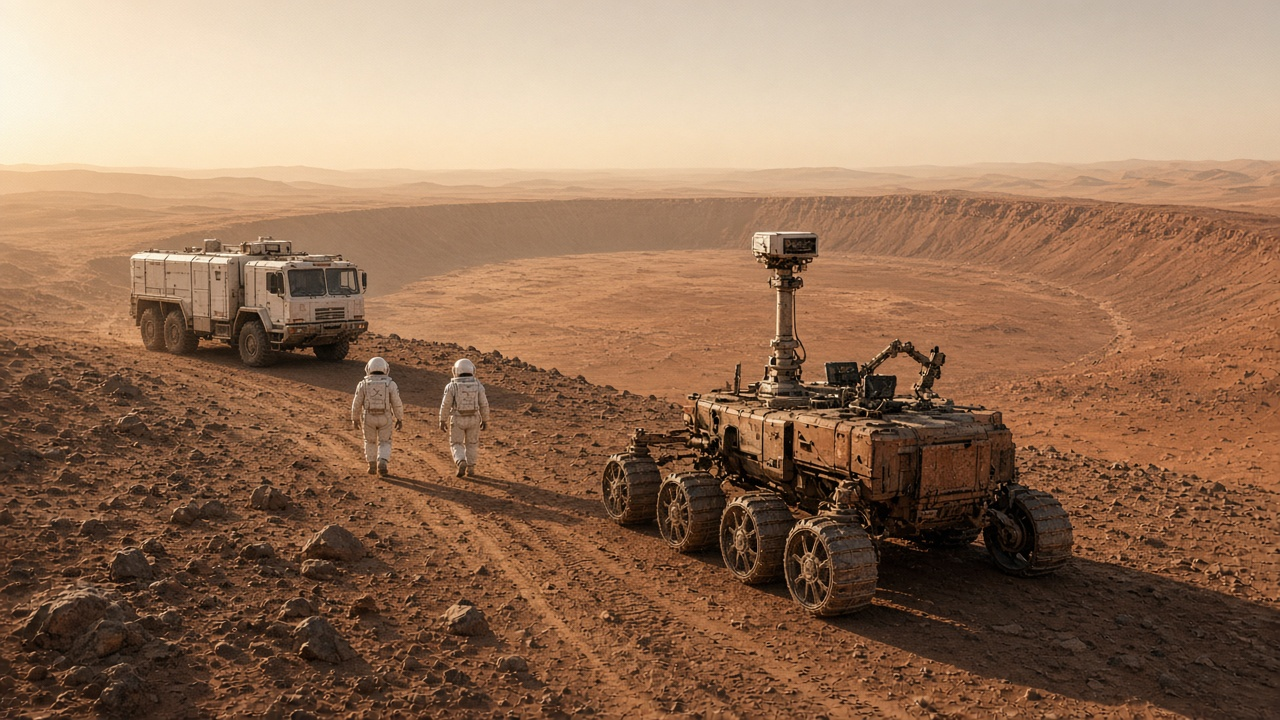
A life on Mars story, told as a short story: in the year 2059, the newest member of a cheap private crew on Mars helps pull a famous rock sample out of a long-dead rover. This is fiction, so the people, the company and the show are made up. However, the rock is real. In 2024, NASA's Perseverance rover cored a rock called Cheyava Falls, with odd "leopard spots" on it, and in September 2025 NASA said the sample, named Sapphire Canyon, may hold signs of ancient life. Then, in January 2026, the money to bring it home ran out.
The Rock in the Dead Robot
The most important rock in history was locked inside a dead robot, and I was the one holding the screwdriver.
My name is Dorothy, but nobody on Mars called me that. To them, I was Dot. I was the smallest person in camp, I was twenty-three, and I talked too much. Doc said I would talk to a rock if it stood still long enough.
"It will," I told her. "Rocks are good listeners."
She didn't laugh. In fact, Doc almost never laughed.
There were three of us at Camp Jezero. It was a tin can of a base on the floor of an old crater, with one lab, one truck, and one bad coffee machine. We worked for a small company in Houston called Redline. Redline had won the job of picking up the old rock samples, mostly because nobody else wanted it, and also because Redline was cheap.
Thirty-Three Years of Waiting
Here is how it happened. Back in the 2020s, a NASA rover named Perseverance drove all over this crater. Everyone called her Percy. She drilled rocks, sealed the cores in little metal tubes, and waited for a ride home.
The ride never came. In January 2026, the money to bring the tubes back to Earth ran out. As a result, the rocks sat on Mars for thirty-three years, while people on Earth argued about budgets.
Meanwhile, Percy kept driving. At one point, she drove farther than any machine had ever driven on another world. Then, one winter, she stopped, high on the crater rim, and she never woke up again.
Inside her belly, she still carried the best tube of all. It was called Sapphire Canyon, and it came from a red rock with strange pale spots on it, like a leopard. Some scientists thought those spots were made by tiny living things, billions of years ago. Others thought it was just chemistry. Either way, it was the closest anyone had ever come to proof of life on Mars.
Now, at last, somebody was going to open it. That somebody was us. Of course, there was also a TV show, because on Mars, everything costs money, even history.
Doc's Rule
Doc was sixty-three. She had a long gray braid, reading glasses on a string, and a bag of ginger candy she never shared. Before Mars, she spent thirty years in clean labs, looking for germs in places germs should not be.
On my first night in camp, she sat me down in front of the glove box. It was a glass case with two long rubber gloves hanging into it, so you could touch things without really touching them.
"Do you know about the camera on the Moon?" she asked.
I didn't, so she told me.
In 1967, a robot lander set down on the Moon. Two years later, astronauts walked over to it, cut off its camera, and brought it home. Afterward, a lab on Earth said it found germs inside the camera. These were mouth germs, the kind that live in everybody's spit. For a while, people said they had lived on the Moon the whole time.
"Did they?" I asked.
"Probably not," Doc said. "Later, most people decided it was the lab. Somebody breathed on it. Somebody talked over it. Under the microscope, those germs look like tiny beads on a string. Lovely little chains." She tapped the glass. "So here is my rule. Never talk over an open sample. Talking is just slow spitting."
"Even a little?"
"Especially a little, Dot."

The Mule
Percy had stopped forty kilometers away, up on the rim. So we drove out in the Mule, our big six-wheeled truck, with Mack at the wheel.
Mack was fifty-five, wide as a door, and he sang old country songs badly. In addition, he talked to the truck like it was a horse. "Easy, girl," he said on every hill. "Easy now."
The crater floor was rusty orange, with gray rocks and long soft dunes. Soon, we found Percy's old wheel tracks. On Mars, there is no rain to wash them away, so they were still there after thirty years, a little blurred by dust but plain to see.
We followed them for hours. After a while, Mack stopped singing. Even I stopped talking, which Doc said was a first.
"Mack," I said finally, because I couldn't help it. "What happens if we break her?"
"Then Redline sells the Mule, and I go home and drive a bus," he said. "And you go home and talk to the passengers."
Finally, we came over a low ridge, and there she was.
Percy
She was smaller than I expected. She was about the size of a car, covered in fine red dust, with her camera head still up, as if she was looking at something far away. Her six wheels were dented and torn. One of them had a hole you could put your fist through.
"Hello, old girl," Mack said quietly.
For a minute, none of us moved. It felt like walking into a church.
Then the work began. I climbed under her in my suit, lying on my back in the dust, and found the panel the old drawings showed. It had six screws. Each one took me ten minutes, because my gloves were fat, the screws were tiny, and thirty years of dust had packed into every thread.
Inside, in a little rack, the tubes stood in a row like pencils in a box. Each one still had its tiny code stamped on the side, so I checked every code twice against the list on my wrist. After all, nobody was coming back for the wrong one.
At last, I found Sapphire Canyon. It was a thin silver tube, about as long as my hand. When I pulled it free, my heart was banging so hard I could hear it in my helmet.
"Got it," I whispered.
"Don't drop it," Doc said in my ear.
"I won't."
"Then stop shaking."
Of course, I didn't stop shaking. Still, I didn't drop it either.

The Message From Houston
On the drive back, a message came in from Mr. Hale.
Mr. Hale ran Redline. Earth was so far away that a message took about twelve minutes to reach us, so we never really talked to him. Instead, he sent us little videos, and we sent little videos back, like letters.
Doc played it on the screen in the front of the Mule. She didn't know I was awake in the back.
"Doc," Mr. Hale said. He looked tired. "Good news first. The sponsors loved the pictures of Percy. Now, here's the hard part. I know you want the tube on Earth, in a proper clean lab, and in a perfect world, I'd agree with you. But Earth is two years and a lot of money away, and this trip already cost more than this company is worth."
He rubbed his face.
"So we open it there, on Tuesday, live. And listen, Doc, the glass on that glove box makes a glare. The cameras hate it. I need the lid off for the shot. I need Dot's face, too. She's young, she's from Tulsa, and people love her. Let her hold the tube and say a few words. One good picture pays for everything. No picture, and there is no next trip. For anyone."
The screen went dark. For a long time, Doc sat there without moving.
Quiet in the Back
Meanwhile, I lay very still in the back and thought about my own contract. It was for one trip only. If the show went well, Redline would sign me for five more years, and that money would pay off my mom's house in Tulsa. If it didn't, I would fly home in two years with nothing but a good story and a bad cough from the dust.
So I didn't say anything. For once in my life, I kept quiet.
The Deal
The next morning, Doc sent a long message back. I don't know everything she said. However, I know Mr. Hale's answer, because she read it out loud in the lab with her lips pressed thin.
"Fine," he said on the screen. "Clean hood, filtered air, gloves, all your rules. But no glass, and no masks on the young one. People need to see faces."
So that was the deal. We would open the tube on the open clean bench, under the hood with the fan running, instead of in the glove box. Doc would wear a mask anyway, because she didn't care what the cameras liked. I would hold the tube up to the light, say my few words to the cameras first, and then hand it to her.
For two nights, I practiced my words in my bunk. I said them to the wall, then to my pillow, and then to a pebble on my shelf. Mack said through the wall that the pebble was very moved.
On the last night, Doc stopped me at the lab door.
"You say your words before the seal is cut," she said. "After that, you don't talk. Not one word while that tube is open. Do you understand me?"
"I understand."
"Say it back."
"I don't talk," I said.
Even so, she looked at me over her glasses for a long moment. Then she gave me a ginger candy, which she had never done before.
Life on Mars, Live
On Tuesday, the lab was full of lights. Mack had set up three cameras and a big screen on the wall, and the screen showed the feed going out to Earth. In twelve minutes, millions of people would watch it. Kids in schools would watch. So would people in bars, and my mom in Tulsa, in her blue chair.
"Thirty seconds," Mack said.
My hands were wet inside my gloves. Above us, the fan hummed.
"Ten."
When he pointed at me, I said my words. I said that a robot had waited thirty-three years on a cold hill, so that people could find out if we were alone. Then I lifted the tube into the light. It flashed silver. Behind me, I could hear Mack breathing through his nose.
"Go," he said.
Doc took the tube and cut the seal with a small steel tool. It made a tiny hiss. Then, very slowly, she tipped it, and a little gray-red crumb of rock slid out into a glass dish.
It was the first look inside the most famous rock on Mars.
I didn't talk. I want to be clear about that. After the hiss, I held my breath, bit my tongue, and kept my mouth shut. Only once, when that crumb tumbled out into the light, I leaned in close and whispered, very softly, the way you would to a puppy.
"Hello, you."
Doc didn't hear, because she was too busy. Besides, the fan was loud.
Green
Next, Doc broke the crumb into a drop of water and added a dye. This was only the safety check, the boring part. Doc had explained it a hundred times: before any real tests, you make sure nothing in the sample is alive. Nothing would be, of course. Whatever made those leopard spots had died billions of years ago. The dye was simple and old, and it turns living cells bright green. So if the screen stayed dark, we could move on to the real work.
She slid the dish under the microscope, and the big screen on the wall changed.
At first, there was only gray dust floating in water. Then, at the edge of the picture, something glowed.
It was green.
Mack made a sound like a man who has been punched. Then he whooped, and he grabbed my shoulders and shook me.
"Green!" he yelled. "Dot, that's green! It's alive! Doc, it's alive!"
I couldn't speak. On the screen, more green spots were lighting up, one after another, like a town at night. Somewhere in Houston, Mr. Hale was going to see this in twelve minutes, and so was my mom, and so was the whole world.
Smiling so hard it hurt, I turned to Doc.
Doc was not smiling.
Beads on a String
She had pulled her mask down. Her face was white. She was staring at the screen, and she did not look like a woman who had found life on Mars. Instead, she looked like a woman who had seen a ghost.
"Doc?" I said.
She leaned closer to the screen and turned the little wheel on the microscope. Slowly, the picture got sharper.
The green spots were not just spots. They were tiny round beads, joined together, one after another, in long, curling chains.
Like beads on a string.
Then Doc turned and looked at me. She didn't yell. She didn't need to.
"Dot," she said, very quietly. "Did you say something?"
All at once, I thought of the camera on the Moon. Then I thought of a lab in 1970, and somebody leaning in too close. Finally, I thought of two small words, said softly, the way you would to a puppy.
Slowly, I looked back at the screen.
As far as anyone knew, nothing on Mars had been alive for three billion years. Even so, there they were, glowing bright green in one drop of water, curling and lovely, little chains of beads from the inside of my own mouth. And twelve minutes away, on a blue dot in a black sky, the whole world was about to start cheering.



Leave a Reply