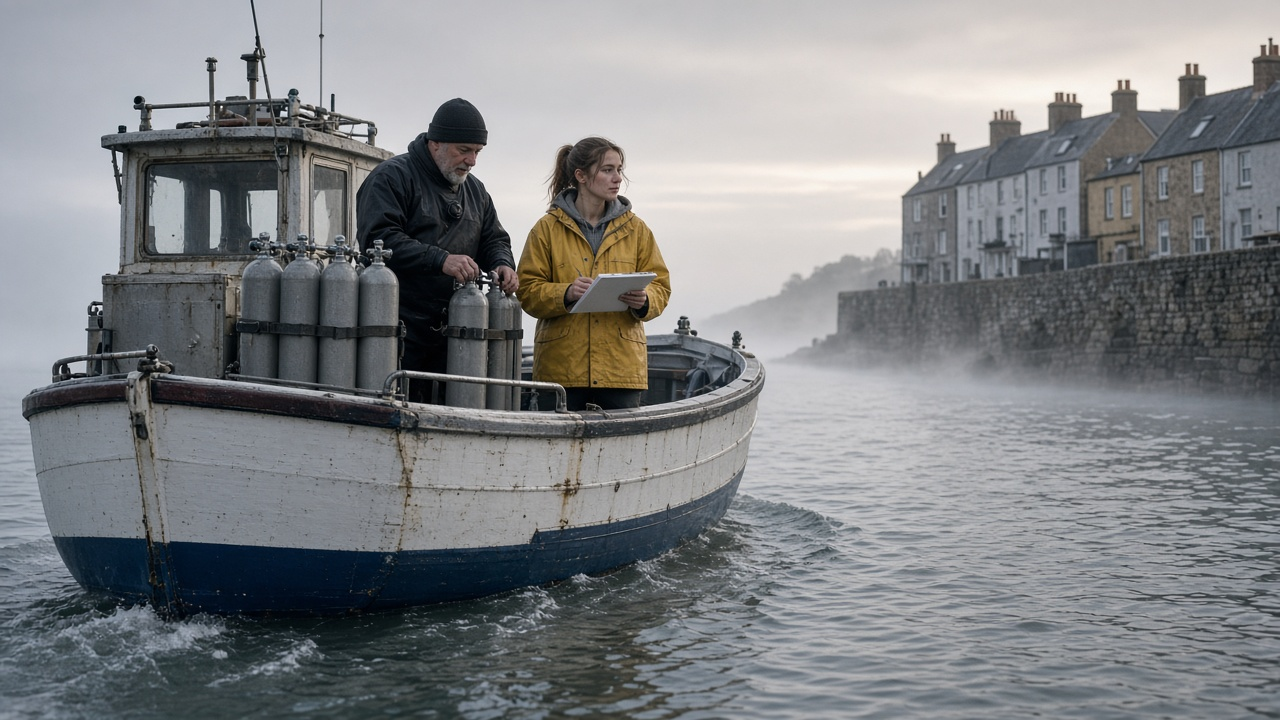
A u-boat wreck story, told as a short story: a rookie boat hand in a broke Plymouth dive club helps put a name on a lost German submarine, while a TV man waves money at the club. This is fiction, so the people, the club and the TV show are made up. However, the wreck is real. In October 2026, the BBC reported that a Plymouth dive team had identified U-672, about 20 miles off Salcombe in Devon, in roughly 70 meters of water. The navy's 1944 record had put it about 46 miles away.
Twelve Minutes, Not Twenty-One
The first thing I ever wrote in the club log almost killed two men.
It was my third trip on Mabel, our old club boat, and my job was the slate. When a diver came up and called out his time on the bottom, I wrote it down, so the next dive could be planned from it. That's all. A child could do it.
Chalky came up, spat out his mouthpiece and shouted, "Twelve minutes at forty."
I wrote twenty-one.
He saw it ten minutes later, when he and Spud were planning their second dive. He didn't shout. Instead, he held the slate up in front of my face and waited until I saw it myself.
"I swap numbers," I said. My face was on fire. "I always have. At the chip shop, too. Seventeen becomes seventy-one. I'm sorry."
"Don't be sorry, Kid," Chalky said. "Be careful. Check it twice. Numbers kill divers."
Then he wiped the slate clean with his thumb and handed it back to me. After that, I checked everything twice. Then I checked it a third time, just to be sure.
That's how I got my name, too. I was twenty-three and the newest member of the Barbican Dive Club by about fifteen years. So I was Kid, and I stayed Kid.
The Club With No Money
Our club met in a damp shed by the harbor in Plymouth, behind the fish market. It smelled of rubber, diesel and old tea. On the wall, there was a chart of the English Channel covered in little pins, one pin for every wreck the club had dived since 1971.
Chalky was the diving officer. He was sixty-four, a retired welder from the dockyard, with a gray beard, a bad left ear, and a woolly hat he wore even in August. Meanwhile, he had been diving deep wrecks since before I was born, and he ate a pasty on the boat every trip, even at six in the morning.
Spud was his dive buddy. He was tall and quiet, and besides, he only talked about the weather.
Then there was the Duchess. She was seventy, she ran the club's money, and she wore pearls under her fleece. Nobody knew her real name anymore, or at least nobody used it.
At the August meeting, she stood up with a sheet of paper.
"I'll be quick," she said. "We have two hundred and twelve pounds in the bank. Mabel needs a new engine, and a new engine costs eleven thousand. Also, the harbor wants more rent for this shed in January. So unless someone has a rich aunt, this club has one more winter."
Nobody had a rich aunt. Instead, we had Chalky's wreck.
The Sailing Ship That Wasn't
For years, the charts had shown an old wreck about twenty miles off Salcombe, in seventy meters of water. Everyone said it was a sailing ship from the First World War. Since it was very deep and very boring, nobody bothered with it.
Then, in July, a team of deep divers from Portland went down and found something else. It was long, thin and made of steel, and it lay on its side in the sand.
It was a submarine. Even so, nobody knew which one.
"There aren't many left," Chalky told me that night, while I swept the shed. "Divers have named almost every German U-boat in the Channel. One more mystery, out there, at seventy meters. Imagine that, Kid."
He imagined it so hard that he called the Portland skipper the next morning. The Portland team gave us their blessing to go and try. Soon after that, the Duchess found a man in London who wanted to pay for it.
The Man With the Teeth
He came to the shed on a Tuesday, in white sneakers that had never seen a boat. Also, he had the whitest teeth I had ever seen, so of course I called him Teeth, but only in my head.
The man made history shows for TV. He had a laptop, a nice coat, and a lot of words.
"Here's my offer," he said. "Eight thousand pounds for your first footage of the u-boat wreck. It has to be ours, first, before anyone else gets it. On top of that, when you've got a name for it, you give us the exact position. We'll take our own boat out and lay a wreath on the water for the crew. Lovely shot. Sunset, if we can."
The Duchess looked at Chalky, while Chalky looked at the chart on the wall.
"Eight thousand," the Duchess said quietly, "is most of an engine."
So the club voted. It was eleven to two. Chalky voted yes. However, he didn't look happy about it.
Seventy Meters
You don't just dive seventy meters. Instead, you plan it for weeks.
At that depth, the water is dark and cold, and normal air turns to poison in your head. So Chalky and Spud dove on special gas mixes, with rebreathers on their chests and spare tanks on their sides. They could stay on the bottom for twenty minutes, maybe twenty-five. After that, they would need about three hours of slow stops on the way back up, just hanging in the blue, so their bodies would not fizz like a shaken bottle of pop.
Also, they could only go down at slack water, when the tide stops pulling for a little while. Miss it, and the current can rip a diver off the line like a flag in the wind.
We missed it the first day. After that, the weather turned, and we lost a week.
Meanwhile, the engine on Mabel coughed every time we started it. Whenever it did, the Duchess closed her eyes.
On the second try, we got it. I dropped the shot line, a heavy weight on a rope with a buoy on top, as close to the wreck as I could. Then Chalky and Spud rolled backward off the side, and the sea closed over them.
My job was to watch their bubbles, keep the time and check it twice. So I checked it about forty times.

Three Hours of Waiting
Three hours is a long time to stare at bubbles.
The sea was gray and lumpy all day. Meanwhile, Spud's girlfriend, who had come along to help, was sick over the side twice. Our skipper, an old fisherman called Dad who was nobody's dad, smoked and said nothing.
Then, finally, two heads came up beside the buoy.
As soon as Chalky pulled off his mask, I saw he was grinning like a boy.
"Kid," he shouted across the water, "write this down. Twenty minutes on the bottom. Not two, not two hundred. Twenty."
"Two zero," I shouted back. "Got it."
Back in the shed that night, we plugged Spud's camera into the old TV. The whole club stood around it, still in their coats.
At first, the picture was green and dark. Then the wreck came out of the gloom. It was a long steel hull lying on its side, all eaten up by eighty years of sea, with fish and white anemones and a big crab sitting on the deck like it owned the place.
"That's her," Chalky said softly. "Now we have to prove who she is."
Clues on the Bottom
It turned out that naming a u-boat wreck is like naming a face in an old school photo. You need small details.
The Duchess knew a retired naval historian in Portsmouth. Everyone called him the Prof. He looked at the video at two in the morning and sent us a list of questions at four.
First, was there a snorkel? That was a tall breathing pipe that let a U-boat run its engines just under the surface.
Next, was there a big round can on deck for a rubber life raft? Some later boats had one.
And had anyone seen anything strange near the tower?
I watched that video until my eyes hurt. Since I was the one with no gas to blend and no gear to wash, it became my job. I watched it at the chip shop between orders, on my phone, with vinegar on my fingers.
Eventually, I found three things.
First, near the tower, there were steel bottles lying in a row, like big thermos flasks. Second, a broken pipe lay in the sand off to one side, with a strange round top on it like a ball in a cage. Third, there was no life raft can at all, just three neat holes in a row in the outer skin.
I sent the times on the video to the Prof. Of course, I checked them twice.

His answer came back in an hour.
A Name at Last
"The bottles held gas for a radar trick," the Prof wrote. "The crew filled balloons that carried strips of metal foil, so the British planes saw fake targets on their screens. Then the round top on the pipe is an early kind of snorkel head, so that cuts the list down a lot. Finally, no raft can means she sank before they were fitted. Put it all together, and you have one boat. U-672."
The shed went very quiet.
Chalky took off his woolly hat. I had never seen the top of his head before. It was bald and pink, like a baby's.
"Read the rest," he said.
So I read the rest out loud. U-672 was built in Hamburg and launched in 1943. In July 1944, a British frigate caught her off the coast and hit her hard. After that, she was leaking, and she was in deep trouble.
"Then she's a grave," the Duchess said. "Poor boys."
But I kept reading, and my voice went funny.
"No," I said. "Listen. The captain waited as long as he could. Then, after dark, he brought her up to the top. The crew got out into life rafts, and they opened her up and let her sink. The next day, British boats and a plane picked them up out of the sea. All of them. Fifty-two men. Every single one went home after the war."
Nobody said anything for a while. Then Spud, who only ever talked about the weather, said, "Well. That's a good day."
The U-Boat Wreck in the Wrong Square
The next morning, I had one more question for the Prof. Why had nobody found her before?
"Because the record put her in the wrong place," he wrote. "The navy's position for the sinking was about forty-six miles east of where she really lies. For decades, people called it a clerical error. However, one researcher guessed years ago that two numbers had simply swapped places when somebody wrote it down. Also, the place where the crew were picked up fits the real spot, not the written one."
Then I read that line three times.
Two numbers had swapped places.
Somewhere in 1944, some tired clerk at a desk had written seventeen instead of seventy-one, or something like it. Because of that, a whole submarine had been hiding in the wrong square of the map for eighty-two years.
I laughed out loud at the chip shop, and the man waiting for his cod looked at me like I was mad.
"Someone like me," I told Chalky that night. "Someone like me hid a submarine."
"No," he said. "Someone like you found one."
What Teeth Said in the Alley
Teeth came back on Friday to collect the footage. He also wanted the position, because his boat was booked for Sunday.
While the Duchess counted the money twice, he stepped out into the alley behind the shed to take a call. I was out there too, behind the bins, having my tea. He didn't see me, and I didn't move.
"Yeah, we've got it," he said. "No, listen. Lose the survivors bit. Nobody watches a show where everybody lives. It's fifty-two men in an iron coffin, that's the line. Wreath, sunset, music."
He listened for a moment and laughed.
"And Gaz goes down Sunday with the cutters. There's a broken pipe in the sand with a funny top on it. I want that on my desk. Report it? Who checks? It's just old junk on the seabed."
Meanwhile, my tea went cold in my hand.
You don't take bits off a warship. Chalky had told me that on my very first day. Also, anything you bring up from a wreck and land in Britain has to be reported to the Receiver of Wreck. That's the law, and every diver knows it.
The snorkel head was the very thing that told us her name. It had waited on the bottom since 1944. Now it was going to sit on a desk in London, next to a coffee mug, because of a show that pretended the men had died.
Check It Twice
Finally, I went back inside. I opened my mouth to tell Chalky about the alley. But the Duchess was smiling, and the money was in an envelope on the table, and Mabel would have her new engine by Christmas. So I shut my mouth again.
"Kid," the Duchess said, "you've got the best handwriting. Write down the position for our friend, would you?"
"Just the official one, love," Teeth said. "Numbers on a bit of paper."
So I wrote it down for him, and I checked it twice. Then he folded the paper into his coat without even looking at it.
Sunday in the Shed
On Sunday, the club sat in the shed and watched the TV boat on my phone, on one of those ship tracking apps. It was a little arrow on a blue screen, heading out of Weymouth. Then it kept going south, straight out into the middle of the Channel.
At about four o'clock, the Duchess's phone rang. She held it away from her ear, and we could all hear Teeth shouting.
"There's nothing here! The sonar's empty! Sand, sand and more sand! Your girl gave us the wrong position!"
The whole club turned and looked at me.
"Sorry," I said. "I swap numbers. Everyone knows that."
At first, Chalky didn't say anything. Then he walked over to the chart on the wall and found the spot where the arrow on my phone had stopped. It was forty-six miles east of our wreck, and he stood very still.
"Kid," he said quietly. "Did you check it twice?"
"I did," I said. "Twice. He asked for the official position, Chief. So I gave him the navy's own numbers. From 1944. Exactly as they wrote them."
For a second, nobody breathed. Then Chalky started to laugh, and he laughed so hard he had to sit down on a gas bottle. After that, Spud laughed, and finally even the Duchess laughed, with her hand over her pearls.
The Wreath
Teeth got his show in the end. The footage was ours and it was real, so the club kept the money. However, the snorkel head is still lying in the sand, seventy meters down, just where it fell.
Later, we gave the true position the right way, to the people who look after wrecks. Of course, it was checked twice.
Teeth's crew laid the wreath anyway. They'd paid for the flowers, and the light was lovely, so they filmed it right there.
Still, on slow nights at the chip shop, I sometimes watch that part again on my phone.
A small white boat sits far off on a calm gray sea. The sun is going down behind it. A big ring of red flowers floats on the water, all alone, rising and falling on the swell.
There is nothing under it but sand, because nothing has ever been under it. It is the exact square where the navy said U-672 went down in 1944. So there it floats, a wreath for fifty-two men who all came home, forty-six miles from the place where they left her.




Leave a Reply