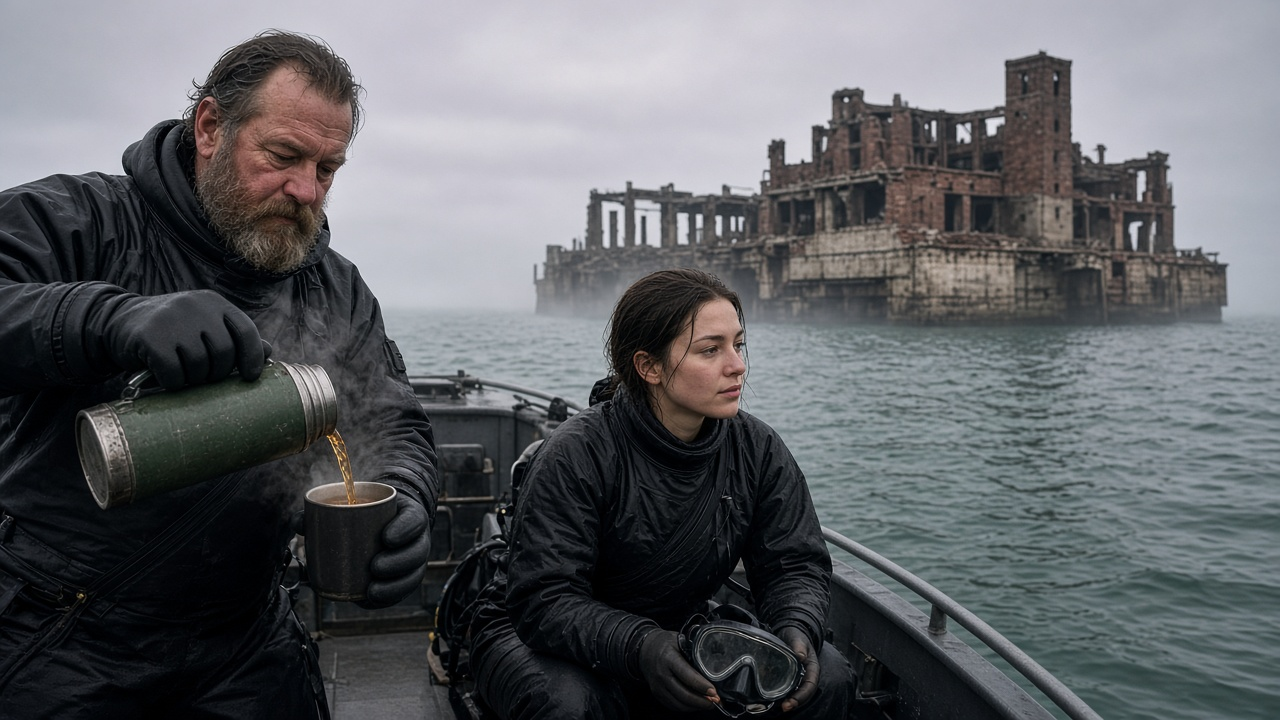
A Lancaster bomber story, told as a short story: a rookie navy diver in Gdynia, Poland, is sent to tag what is left of a lost World War II bomber before a museum lifts its engine. This is fiction, so the people are made up. However, the wreck is real. In early October 2026, divers reported an RAF Lancaster lying in 11 meters of water between the port of Gdynia and the old torpedo station. It was most likely shot down in August 1944 while laying sea mines, and its seven crewmen have not been named yet.
The Stones
Every Monday, the Bear sat on his stone and said good morning to the boys.
I saw it on my very first Monday in the dive group, when we were at eleven meters, off the old torpedo station north of the port. The water was brown and green, like cold tea. Also, I could see my glove, and that was about it.
"Breathe, Mouse," said the Bear on the radio in my mask. "The dark is just water with the lights off."
He called me Mouse on day one, because I was small and because I squeaked the first time a flounder touched my leg. Soon, the whole group called me Mouse. Even the Lieutenant did.
First, we did the training lap around the Stones. That was what everyone called the lumps on the bottom out there. They were big, round shapes under mussels and weed, so we used them to practice search lines in the murk.
At the end of the lap, the Bear swam to one stone set off by itself. It was long and low, like a sleeping seal. Then he sat on it the way a man sits on a park bench.
Then he took out his dive knife, turned it around, and knocked twice on the stone with the handle.
Tonk. Tonk.
"Good morning, boys," he said.
For a stone, it had a strange voice. I remember thinking that, and then forgetting it, because a cod swam into my mask and I squeaked again.

The Bear's Chair
Back on the boat, I asked about it. However, the Bear only laughed and poured coffee from his old green thermos. As always, he put four sugars in it.
"Ask the boys," he said.
So I asked the boys. Tomek, who had six years in the group, told me the story while we washed the gear.
"The Bear has dived that spot every Monday since 1995," he said. "His old chief did the same thing. He said good morning to the boys, too. Nobody knows why."
"Which boys?"
Tomek shrugged before he answered. "Old fishermen used to say a British plane fell in the bay in the war. They said the boys were down there somewhere. But nobody ever found anything. That area has been checked a hundred times."
"So he talks to a legend."
"He talks to a stone," Tomek said. "That is why we call it the Bear's Chair."
The Bear was fifty-eight. He had a gray beard, hands like shovels, and thirty-one years in the navy, so he had earned his habits. Furthermore, this was his last autumn. In December, he would retire to a little house near Hel and, as he put it, "watch the sea from the dry side."
My dad drives one of the electric trolleybuses in Gdynia, and when I told him about the Bear, he laughed.
"Every job has one," Dad said. "On my line, it's a man who waves at the same tree."
A Ship That Was a Lancaster Bomber
Then, in the first week of October, the bay gave something back.
A team of wreck divers had gone down at a spot the navy had passed them, right between the port entrance and the old torpedo station. On a sonar map from 2012, the spot was a broken ship. Instead, they found three big engines, blades from the propellers, and pieces of a very large plane with two tails.
Because the engines were in-line V12s, it was a British Lancaster bomber. The papers said it was most likely shot down in August 1944, flying low over the bay at night to drop sea mines into the port. At the time, Gdynia was a big German navy base. Sadly, all seven men on board were killed. Nobody knew their names yet.
The Bear read the story on his phone three times. After that, he went quiet for a whole afternoon. That was a first.
"Two hundred meters," he finally said. "It was two hundred meters from my chair the whole time."
"So the boys were real," I said.
He did not answer. Instead, he screwed the lid on his thermos very tight.
The Museum Man
On Tuesday, the museum man came to the base. His name was Mr. Lis, which means fox, so naturally we called him the Fox. He was polite, with a tweed coat and wet shoes, and he wanted an engine.
"One Merlin engine, with its propeller, for the hall," he said. "We open the new room on November eleventh. Independence Day. Families will come. Children will see it."
It was a good plan, and honestly, I liked him. Still, there were rules. The Maritime Office had started the paperwork to protect the site. Nothing could be lifted until the site was surveyed. In other words, every piece needed a tag, a photo, and a place on the map.
That job went to us. More exactly, it went to the Bear and me.
"Why me?" I asked the Lieutenant.
"Because you have small hands and good eyes," she said. "And because the Bear asked for you."
Friday
Then the port called.
That morning, I was in the hallway outside the Lieutenant's office, holding a box of tags. Meanwhile, her door was open. The voice on her speaker was loud and tired, and it belonged to someone at the port.
"A crane barge in my approach is fine for three days," the voice said. "Three days, Lieutenant, not ten. The ferry has a schedule. The container ships have a schedule. Survey your old plane, tag what is there, and don't go looking for extra work."
"We tag what we find," the Lieutenant said.
"Then find it by Friday."
After the call, she saw me in the hall. Still, she did not pretend I had not heard.
"Friday," she said. "Tag what is there, Mouse. Don't guess."
"The Bear says touch, don't guess."
"Then touch fast."
Touch, Don't Guess
The wreck was not like the movies. There was no plane lying on the sand with its wings out. Instead, there was a field of junk, spread wide and low, under eighty years of weed.
On the first day, I tagged forty-one pieces. There was a strip of metal with rivets in a row. Next to it lay a curved bit that might have been part of a turret, and then a propeller blade, bent back like a flower petal. Each one got a yellow tag on a plastic tie, a number, and a photo.
The engines were the worst and the best. Each one was huge, the size of a small car. Mussels covered them like black frost. However, when I put my glove on one, I could feel the shape of the cylinders under the shells, one after another, in a row.
"Touch, don't guess," said the Bear on the radio. "Your eyes lie in this water. Your hands don't."
We found no one. I had been afraid of that, and also, in a strange way, hoping. But then, the bay had had eighty years. It keeps everything, the Bear said, it just doesn't tell you.
At the end of the dive, he did not swim back to his chair. That was another first.

The Anchor Plan
On Wednesday night, the barge crew sent the anchor plan. The crane barge would sit over the engines on four anchors. Each anchor spot had to be checked before it went down, so that nobody dropped two tons of steel on part of the wreck.
Soon, the Lieutenant pinned the map to the wall. Anchor point C was a small red cross, east of the wreck field.
Tomek leaned in and laughed. "Look at that. Anchor C is right next to the Bear's Chair."
"Good," the Bear said. "The boys will keep it company."
He meant it as a joke. Even so, he did not smile.
Anchor Point C
On Thursday, I went down alone to check the anchor points, with the Bear on the radio from the boat. At first it was easy, because A, B, and D were just sand and old shells.
Then I swam to C. The Bear's Chair rose out of the brown water in front of me, long and low, like always.
I almost turned away. After all, everyone knew what it was. It was a stone. It was a famous stone, with a famous old man's seat on it.
But the anchor would land three meters from it, so I did my job. I put both gloves on the chair and moved them slowly along it, the way he taught me.
The top was smooth. Indeed, it was very smooth, worn down in one spot like an old step. The sides were rough with mussels. However, under the mussels, the shape did not feel like a stone. It felt straight, almost like a long can.
At the far end, half under the sand, my fingers found a rim. Even though it was half buried, it was a hard edge, perfectly round, like the lip of a big pot.
Stones do not have rims.
Next, I took out the handheld locator and held it close. Instantly, the needle jumped all the way to the end and stayed there.
"Bear," I said. My voice came out like a mouse. "Bear, I need you to listen to me very carefully."
The Word
Back on the boat, nobody said it at first.
First, I described the shape. After that, I described the rim and the needle. Meanwhile, the Lieutenant listened on the radio from the base, and Tomek stopped coiling the rope.
The Bear sat on the gear box with his thermos in his hands. He was not drinking from it.
"Thirty years," he said quietly. "Every Monday."
"Touch, don't guess," I said. "I touched."
For a long moment, nobody moved. Then the Bear stood up, pulled on his mask, and went down with me.
Together, we fanned the sand away with our hands, very slowly, one handful at a time. We did not use the knife. Slowly, under the sand, the rim became the end of a long steel can. On it, under the rust, were rows of old bolts.
The Bear put his glove flat on top of it, right on the worn spot, where he had sat every Monday since 1995.
"Good morning, boys," he whispered. Then he said, "Surface."
On the boat, he took the radio from Tomek and called the base himself.
"Lieutenant," he said. "Mine. Probably British, air-dropped, from the war. Close the area. The barge stays out."
From her end, there was a short silence. Then she said, "Copy, Chief. Area closed." After that, she called the port and said the word again, and this time nobody argued about Friday.
The Boys
The clearance team took it away a week later, slowly and carefully, the way they had already done with the other British mines found up and down this coast. It was three meters long, and it still held hundreds of kilos of explosive.
The experts said the plane had most likely been hit just as it dropped its load. As a result, the mine had fallen with it and landed beside it. Then, for eighty years, it waited at eleven meters in the cold, two hundred meters from its own plane.
"They came to close this port," the Bear said that night, at the long table in the mess. "Eighty years later, they almost did."
"They didn't," I said. "You were sitting on it."
For the first time all week, he laughed, a real Bear laugh. Then he poured me coffee from the green thermos, with four sugars, and slid it across the table.
In the end, the Fox got his engine for November eleventh. A small sign beside it says that seven men were lost here in August 1944, and their names are still being searched for. Under that, in smaller letters, it thanks the navy divers of Gdynia.
The Bear retires in December. Until then, every Monday, we still do the training lap around the Stones. At the end, he swims to the empty spot where his chair used to be, and he knocks twice on the sand.
But that is not the picture I keep. The one I keep is the photo I took on Thursday, at eleven meters, before we called it in.
The Bear's Chair
The water is brown and green, like cold tea. A diver's light shines on a long, low shape on the sandy bottom, half buried, crusted in black mussels.
The sand has been fanned back from one end, where a round steel rim shows through the rust, with a row of old bolts. It is not a stone. It never was.
On top, the mussels are gone in one smooth, worn patch, the size of a big man sitting down.
And next to the patch, a cluster of bright little scratches shines in the steel, right where a knife handle knocked twice every Monday for thirty years.


Leave a Reply