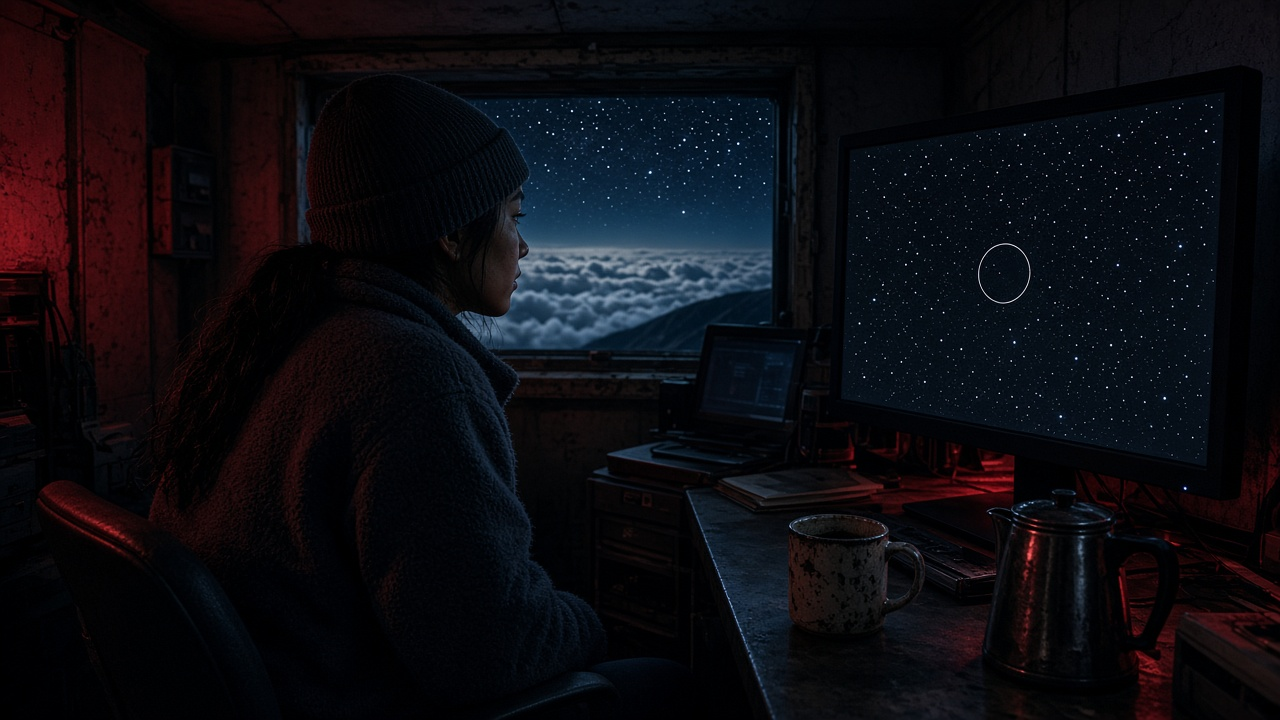
An asteroid near Earth, told as a short story: on Maui, a young night observer finds a faint new object while her boss needs a big headline before Friday. This is fiction, so the people, the telescope and the object are made up. However, the way it is checked is real, and so are the close passes. In fact, on October 9, 2026, a real small asteroid near Earth was spotted the same day it flew past us, closer than the Moon.
The Night Shift at Ten Thousand Feet
My name is Kaila, but everybody calls me Kai. I am twenty-six, and I work nights on top of a volcano.
The volcano is Haleakala, on Maui. When you reach the top, it is ten thousand feet high and very cold. Most nights, the clouds sit far below you like a soft white floor. Above you, the sky is so dark and clear that the stars look close enough to touch. That is why the telescopes are up here.
Most of the big domes on the summit belong to big programs. Ours, however, does not. Our telescope is small and old, and everybody calls it the Goose, after the nene geese that walk along the park road. It belongs to a tiny nonprofit team, so we have one grant, a few kind donors, and a coffee pot that leaks.
Every night, the Goose takes pictures of the same patches of sky, again and again. Then my software compares them. Stars stay still. However, anything that moves between the pictures might be an asteroid.
My job is to watch the dots that move, because some of them matter. After that, I have to decide which ones are real.
Gramps and the Steel Watch
At the end of every shift, I drive down the mountain to Kahului. The road twists down through a long chain of switchbacks while the sun comes up behind me. Then I stop at Gramps's house for breakfast.
Gramps is my grandpa, Walt, and he is my favorite person. He is eighty-four, and he still mows his own lawn. Since Grandma Lani died, he lives alone in a little green house near the old sugar mill. Every morning he makes eggs, rice, and coffee so strong it could wake the whole island.
He came to Maui in 1969, with Grandma. Before that, he worked at the Convair plant in San Diego. "I painted airplanes," he always says. After that, he changes the subject.
He also wears the same steel watch every single day, since Grandma gave it to him a long time ago. On the band, there is a tiny white fleck of paint, stuck between two links.
"Gramps, you could clean that," I told him once.
Instead of answering, he only smiled. "That fleck has been there sixty years," he said. "Good paint outlives the hand that puts it on."
Then he poured me more coffee, as usual. And, as usual, I did not ask what he meant.
A Small Asteroid Near Earth
On Monday night, a little after two, my software flagged a dot.
At first, it was just a faint smudge. Still, it moved in a straight line across four pictures, so it was not a glitch. When I checked the speed and direction, my heart beat faster. The dot was close, closer than anything I had found before. In fact, it was much closer than the Moon.
Small asteroids pass near Earth all the time. Many are no bigger than a house, and plenty go by before anybody sees them. Even so, every new asteroid near Earth has to be reported fast, because the sky does not wait.
So I did what every survey does. First, I gave the dot a temporary name of my own. Then I sent our measurements to the Minor Planet Center in Massachusetts. That is the office that collects asteroid sightings from all over the world.
In a few minutes, my dot was on their confirmation page. It is a public list of new objects that need a second look, so other telescopes check that page all night, all over the world.
Before dawn, a telescope in Arizona had found it too. Then one in Australia did. Finally, I knew my dot was real.

The Boss and the Money
Our director is a man named Mike Brooks, but everybody calls him the Boss. He is fifty-eight, tall and always tired. He wears a Hawaiian shirt on Fridays and worries about money every other day.
On Tuesday, he was waiting for me at the door of the control room.
"Is it true?" he said. "We found one that comes close?"
"Closer than the Moon," I said. "But it's small. It's maybe ten meters."
But he did not hear the word small. Instead, he looked at the big screen like it was a winning lottery ticket.
Here is the thing about the Goose. Our grant ends in March, unless it is renewed. On Friday at ten, the Boss has a video call with the people who decide if it goes on. If they say no, the Goose goes dark, and three of us lose our jobs. Of course, I am one of the three.
"Do you know how long it's been since we found anything big?" he said quietly. "This could save us, Kai."
I wanted it to save us too. That was the problem.
The Number on the Screen
At JPL in California, a computer called Scout watches the confirmation page. For each new object, it works out a rough orbit as soon as there are a few sightings. Then it gives a rating for the chance of hitting Earth.
On Tuesday afternoon, my dot got a rating of Small.
When he saw it, the Boss nearly jumped out of his shirt. "Small is not zero," he said.
"No," I said. "But Scout warns you about this itself. With less than a day of data, the numbers are rough. The rating is there to point out interesting objects. It is not a real chance, at least not yet."
"I know that," he said. "But a reporter won't."
By Wednesday morning, more telescopes had reported. As a result, the orbit got sharper, and the rating dropped to Negligible. Soon after that, the Minor Planet Center gave my dot an official name.
After that, the Boss was quiet for a minute. "Fine," he said. "No impact. But it's still a close one, and we found it first."
He started writing a press release anyway.
Slow, Like It Was Waiting
That night, I looked at my dot again. Even so, something about it bothered me.
To begin with, it was slow. Most rocks that pass Earth go zipping by, many miles each second. This one, though, was barely moving compared to us. Its path around the Sun was almost exactly like Earth's own path. It was as if it had been following us, a little behind, for years.
Then there was the light. Since the dot was close, I could measure its brightness every few seconds. Rocks tumble, so they get brighter and dimmer slowly. My dot did not. Instead, it flashed. Bright, dim, bright, dim, every few seconds, sharp and regular, like a tin can turning in the sun.
I sat back in my chair. Meanwhile, outside, the wind pushed against the dome.
There are a few things in space that move slowly around the Sun, near Earth's path, and flash. Some of them are rocks. However, some of them are not rocks at all. Instead, they are things that people made.
I did not want to say it out loud yet. After all, I had no proof.
What I Heard Through the Door
On Thursday morning, I went to tell the Boss anyway. His office door was half open, and he was on the phone. So I waited in the hall.
"Yes, the TV people called again," he was saying. "The Honolulu station wants a story for tonight. Everybody is talking about asteroids this week."
He listened for a moment.
"Listen," he said. "If it's a rock, it's a headline. If it's junk, it's nothing. Nobody says junk until Friday. Not me, and not my night girl. After ten o'clock, I don't care what it is."
My face went hot. Night girl. I had worked for him for three years.
At first, I walked back down the hall slowly. Then I walked back up it loudly, and knocked.
"Come in, Kai," he said, like nothing had happened.
"I think my object might not be natural," I said. "It's too slow. It flashes like metal. I need more data before anybody writes a story."
For a moment, he just rubbed his eyes. "Then get your data," he said. "Just get it after Friday."
Pushed by Sunlight
But I could not wait until after Friday. Something else was wrong.
By Thursday night, telescopes had watched my dot for four days. When I fit the orbit with just gravity, it almost worked. Every day, though, the dot drifted a tiny bit off the path. It was being pushed, very gently, away from the Sun.
Sunlight does that, even though most people never think about it. It actually pushes on things in space, but only a tiny bit. A solid rock is too heavy to notice. On the other hand, something big and hollow and thin is light enough for sunlight to shove it around.
A rock is heavy. A can is hollow.
So I needed to know what it was made of. For that, you need a spectrum. You split the light into its colors, the way a prism makes a rainbow. Each material leaves its own marks in those colors, like a fingerprint. Rock looks like rock. Likewise, metal looks like metal.
The Goose cannot do that. Then again, there is a telescope that can, two islands away.
So I called Bo.
Bo's Night on Mauna Kea
Bo is Bonnie, my friend from college. She studies asteroids at a university office in Hilo, on the Big Island. Twice a year, she gets nights on NASA's infrared telescope on Mauna Kea. That telescope is built for exactly this. It reads the colors of faint things.
As luck would have it, Thursday was one of her nights.
"How long do you need?" she asked.
"An hour," I said. "Maybe less. It's bright right now, because it's close."
She was quiet, because her own targets were waiting, and her time was precious. Finally, she sighed. "You owe me malasadas," she said. "A whole box."
At midnight, Bo sat in a control room in Hilo and steered the big telescope from far away, the way many observers do now. Meanwhile, I sat on Haleakala and watched her screen on mine. Between us, the ocean was black, and the stars were very bright.
At first, the light came in weak and noisy. Then, little by little, the spectrum grew out of the noise, like a photo in a darkroom.
Suddenly, Bo stopped talking. That is never a good sign with Bo, or maybe it is a great one.

Steel and White
"Kai," she said at last. "This is not a rock."
Rocks have a certain look in a spectrum. They show the marks of the minerals they are made of. But my dot had none of those marks. Instead, the colors rose in a steady red slope.
"That slope is steel," Bo said. "Stainless steel. I have seen it before."
Then she pointed at three small dips in the line. "And those dips look like white plastic film. The kind they used to wrap old rockets in."
Neither of us said anything for a while. Somewhere above the clouds, a hollow steel thing was turning in the sun, flashing every few seconds, coming close to the planet that made it.
It was not an asteroid. Actually, it was the opposite of an asteroid. It was a piece of us coming home.
"Junk," I whispered.
"No," Bo said. "History."
Before I did anything else, I saved every file twice. Then I wrote one page for the Boss. It said what we knew, what we didn't know, and what we could prove. At five in the morning, I put it on his desk.
Friday at Ten
The Boss read my page standing up. After that, he read it again. Then he sat down and looked out the window at the clouds for a long time.
"This kills the headline," he said.
"Yes," I said. "But it's true."
"And the grant?"
"I don't know," I said. "But if we tell them a rock is coming, and next week the whole world finds out it's a rocket, we lose more than a grant."
At ten, he went into his office and shut the door. I sat in the hall, which was not the plan. Yet the walls are thin, and I am only human.
"Before we start," I heard him say, "I have to change the story I was going to tell you today."
Then he told them the truth. He told them about the slow orbit, the flashing, the sunlight, and Bo's spectrum. Twice, he said my name. Not night girl, but Kai.
When he came out, he looked ten years younger.
"They want to know whose rocket it is," he said. "Honestly, so do I."
A Close Pass in 1967
I was not alone in wondering. All over the world, people who track objects in space had seen the same strange motion. Soon, a man at JPL who had run orbits for thirty years emailed me back.
He had also run my object's orbit backward. Back and back it went, around the Sun, year after year, until it came very close to Earth one more time. It was the spring of 1967.
"That lines up with a Moon launch from Cape Kennedy that spring," he wrote. "An Atlas rocket with a Centaur upper stage. The Centaur was stainless steel, with a white plastic cover on its back dome. Your spectrum fits. We think it's the Centaur."
A rocket stage from the time of the first Moon landers. Since then, it had been going around the Sun for almost sixty years, all alone. Now, for a few months, Earth's gravity would hold it close, like a tiny extra moon. After that, it would drift away again.
The Minor Planet Center took it off the asteroid lists. After all, it was not a minor planet anymore.
That night, the Honolulu station ran a story after all. The title said: Maui Telescope Finds Lost Moon Rocket. The Boss watched it three times, and so did I.
Gramps saw it too. Before the story even ended, my phone rang.
"Take me up there," he said. His voice sounded thick and strange, like he had a cold. "Tomorrow night. I want to see it with my own eyes."
He had never once asked to see one of my asteroids.
Gramps Comes Up the Mountain
On Saturday night, I brought Gramps up the mountain. The doctor had said one hour at the top, no more, and a warm coat. Of course, he wore two.
Outside, the clouds lay silver under the Moon, and the cold bit our faces. Inside, he stood in the control room in the red night light, very straight, with his hands behind his back. On the screen, a tiny dot crept across the stars.
"Why this one, Gramps?" I asked. "You never cared about my asteroids."
"This isn't an asteroid," he said. He kept his eyes on the screen. "I painted airplanes, like I told you. But only for a few years. Then, in '66, Convair moved me across town to the rocket plant on Kearny Mesa. That's where we built the Centaurs. I put the white covers on their back domes. Every one that left the plant that year went through my hands."
My throat went tight.
"Which month was the launch?" he asked.
"Spring of '67," I said.
For a long time, he was quiet. Then he took off his steel watch and held it in the light, so I could see the white fleck on the band.
"We weren't allowed to sign anything," he said softly. "But the night before that one shipped to the Cape, your grandma said yes to me. So I took a little brush, and I painted a W and an L on the white cover. White on white. Nobody would ever see it."
He touched the screen, very gently, right beside the dot.
"That's my paint."


Leave a Reply