A dead satellite short story: in Colorado Springs, a young night analyst watches an old Soviet weather satellite break apart, while her boss wants a doomsday press release by morning. This is fiction. The people and the company are made up, but the breakup is real. In fact, a dead Soviet satellite really broke apart in orbit this week.
The Night Shift at Owl Eye
My name is Joanna, but everyone at work calls me Jo. I am twenty-five, and I watch the sky for a living. To be exact, I watch the junk in it.
Owl Eye Space is a small company in Colorado Springs. We rent two rooms above a bike shop, and we have four small telescopes in the New Mexico desert. On top of that, we buy radar data from bigger companies. Then we sell one thing: warnings. For example, if a piece of junk is about to pass too close to your satellite, we try to tell you first, so you can move it.
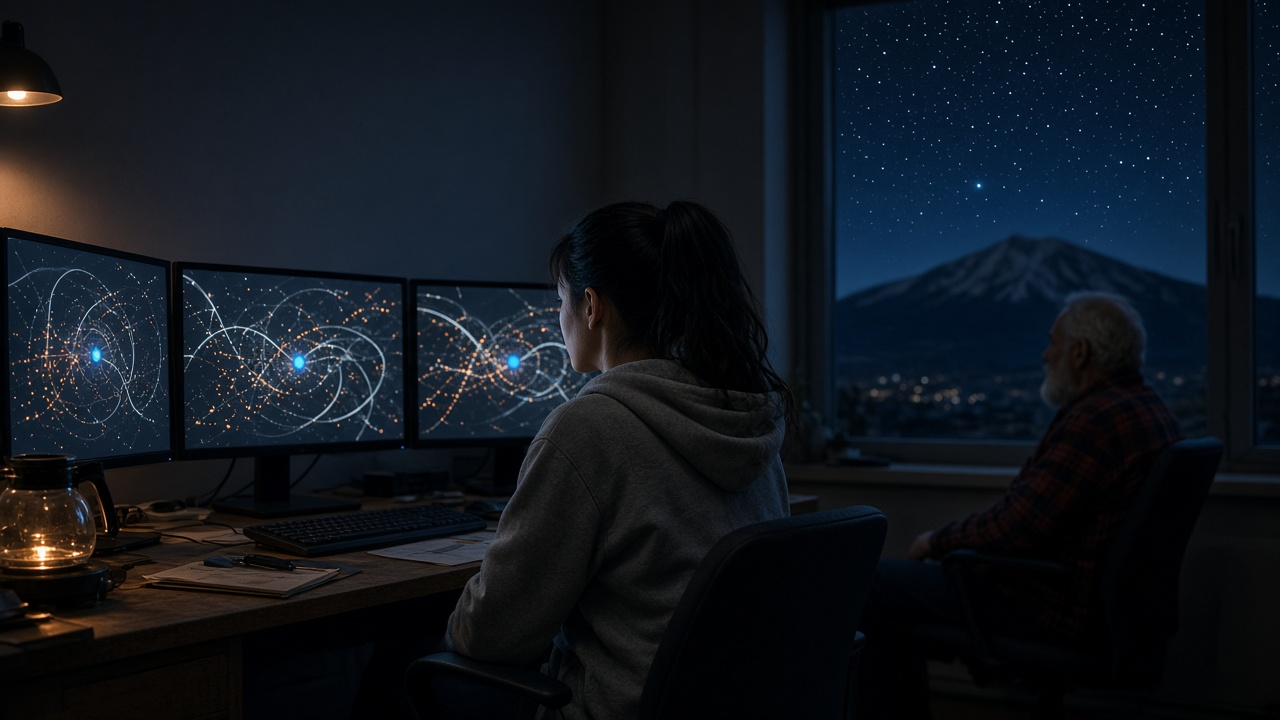
The night shift is mine. From ten at night until six in the morning, it is just me, three screens, and a coffee pot that clicks when it gets too hot. Most nights, Moose comes in, too.
Moose is sixty-six. He is tall and slow, with a gray beard and a red flannel shirt that he wears every single day. Before Owl Eye, he spent thirty years doing orbit math at NORAD, here in Colorado Springs, first for Canada’s air force and later as a contractor. Now he works part time, mostly because he cannot sleep.
“Old men and owls,” he likes to say. “We do our best work in the dark.”
He also eats sunflower seeds all night and spits the shells into a coffee cup. Even so, he is the smartest person I have ever met, and he never once made me feel dumb for asking a question.
The Morning the Dead Satellite Broke
On Monday, October 5, at a quarter to six in the morning, my screen turned orange.
At first, I thought it was a glitch. The alert was for an old weather satellite called Meteor 2-7. The Soviet Union launched it in 1981, back when my mom was a baby. In fact, it has been a dead satellite for decades. Still, it circles the Earth about 530 miles up, where the junk is thickest.
Next to the big blue dot, there were new dots. They were small and orange, and there were a lot of them.
“Moose,” I said. “Come look.”
He took his time, as always. Then he leaned over my shoulder, and his coffee went cold in his hand.
“Breakup,” he said quietly. “That old thing broke once before, in 2004. Now it’s doing it again.”
By noon, the news had it, too. A big radar company had picked up “tens of fragments” from a site in Western Australia. Experts called it part of a worrying trend, because an old American spy satellite had broken apart just last month.
After my shift, I went home, but I did not sleep much. Instead, I kept seeing those orange dots every time I closed my eyes.

Sunny Has a Plan
Our boss is named Sean, although nobody calls him that. We call him Sunny, because he is always smiling, even when the rent is late.
When I came in on Monday night, he was still there. That was a bad sign, since Sunny never stays past five.
“Jo!” he said. “Big week. Huge week.”
He turned his laptop toward me. On the screen, there was a press release with a giant headline: THE KESSLER CASCADE HAS BEGUN.
Of course, I knew the term. Everyone in my job does. It is the nightmare where one crash makes junk, and then the junk causes more crashes, until the whole sky fills up. In the worst version, nobody can launch anything for a hundred years.
“Sunny,” I said, “one breakup is not a cascade.”
“It’s the start of one,” he said. “Maybe. Possibly. Who knows?”
“We would know. That’s our whole job.”
After that, his smile got a little thinner. Then he told me the real reason. On Thursday, he had a meeting in Denver with three investors. If they said yes, Owl Eye would get four million dollars. If they said no, we had money for about two more months.
“Fear sells, Jo,” he said. “Calm doesn’t. So I need your numbers by Wednesday night, and I need them to be scary.”
When he left, I sat in the dark for a long time. Meanwhile, Moose was in his usual chair by the window, cracking seeds.
“You heard all that?” I asked.
“Every word,” he said. “Do you want to hear a story about scary numbers?”
A Fireball Over Yellowknife
Moose grew up in Yellowknife, in Canada’s far north. His dad was a bush pilot who flew a little yellow plane with skis.
“January 24, 1978,” he said. “I was seventeen. My dad had an early charter, so we were out by the plane before five in the morning, warming the engine. Up there in winter, it’s pitch black at that hour. Then the sky lit up. A long, bright streak went over the trees and broke into pieces.”
That was Kosmos 954. It was a Soviet satellite with a small nuclear reactor inside, and it fell on the frozen north of Canada. As a result, bits of it landed across hundreds of miles of snow and ice, near Great Slave Lake and beyond.
“People went crazy,” Moose said. “The radio said we’d all glow in the dark. Meanwhile, my dad flew the search teams for weeks. They called it Operation Morning Light. Men walked the ice at forty below with Geiger counters, picking up pieces one by one.”
“Was it dangerous?”
“Some of it, yes. Most of the panic, though, was not.” He cracked a seed. “Here is what I learned that winter. Panic is cheap, because anyone can make it. Facts take a long time, and they are cold work.”
Then he said one more thing, and I almost did not notice it.
“Funny name, Kosmos. The Soviets used it for anything. A science satellite, a spy satellite, it all got the same name. That way, nobody knew which was which.”

Counting the Pieces
So, on Tuesday night, I did the cold work.
First, I pulled every scrap of data we had. Our telescopes in New Mexico caught some of the pieces at dusk, while the radar data filled in the rest. One by one, I gave each fragment a number and a path.
By two in the morning, I had forty-one pieces. Most were tiny, smaller than a dinner plate. In addition, almost all of them were already falling, very slowly, toward the Earth.
“Look at that,” Moose said, pointing at my plot. “See how they all sink a little?”
At 530 miles up, the air is so thin that you would never feel it. Even so, it is there. As a result, it drags on every piece of junk, the way a soft wind slows a kite. Over many years, the pieces drop lower and lower. Finally, they burn up like shooting stars.
Moose tapped the screen with one finger.
“Dead things fall,” he said. “They never climb.”
I wrote that on a sticky note and stuck it on my monitor. At the time, though, I thought it was just a nice line.
The Honest Numbers
By Wednesday night, I had my report. It was not scary. To be honest, it was boring.
Yes, the breakup was real. Yes, it made the sky a little more crowded, and that matters. However, none of the pieces were heading for the space station. Also, none of them would hit a working satellite this year. In other words, there was no cascade.
I sent it to Sunny at nine. He called me at nine-oh-four.
“Jo, I can’t take this to Denver,” he said. “Nobody pays four million dollars for ‘a little more crowded.’”
“It’s true, though.”
“True doesn’t pay your salary.” He sighed. “Listen. Just change one word. Instead of ‘unlikely,’ write ‘possible.’ After all, anything is possible, right?”
For a while, I looked at the sticky note on my screen. Then I thought about Moose’s dad, walking the ice at forty below with a Geiger counter.
“No,” I said. “I’m sorry, Sunny. I won’t.”
He was quiet for a moment. “Then I’ll write it myself,” he said, and he hung up.
Later that night, his version landed in my inbox. The word “possible” was in it four times. Moose read it over my shoulder, but he did not say a thing. Instead, he just put another seed in his mouth and went back to his chair.
Two in the Morning
On Thursday, the meeting was at ten in the morning. Since I could not sleep, I came in early, at midnight. Moose was already there, which did not surprise me at all.
“Couldn’t sleep either?” I asked.
“Never can,” he said. “Let’s do one more pass.”
So we did. I ran the new data, piece by piece. Number one was falling. Then number two was falling, and so was number three. All the way down the list, every orange dot sank a tiny bit, just like before.
Then I got to number thirty-eight.
At first, I thought I had made a mistake. Number thirty-eight was higher than it had been on Tuesday. It was not much, only about a mile. Still, it was higher.
“Moose,” I said. “Is this a bad fit?”
He leaned in. For a long time, he said nothing at all. Then he made me run it again, with new data and a different method. After that, he made me run it a third time.
Every time, it came out the same. Number thirty-eight had climbed.
Dead Things Fall
My mouth went dry, and I looked up at the sticky note.
Dead things fall. They never climb.
“So it’s not junk,” I said slowly.
“No,” Moose said. “Junk can’t push itself. So something up there has a motor, and a fuel tank, and somebody on the ground telling it where to go.”
Suddenly it all made sense, and it made me cold. Something small had been parked right next to that old dead satellite. Maybe for years, it had sat quietly in its shadow, while nobody looked twice. Then the old satellite broke apart, and a cloud of junk spread out around it. And the small thing slipped out with the junk, like a man walking out of a fire in a crowd.
“Who does it belong to?” I asked.
“That’s not our job,” Moose said. “Our job is to tell the people whose job it is.”
The Real Press Release
At three in the morning, I called Sunny. To my surprise, he picked up on the first ring, because he had not slept either.
I told him everything. When I finished, the line was so quiet that I thought the call had dropped.
“Jo,” he said at last, and his voice was strange. “Do you know what this is? THIS is the press release. Forget Kessler. ‘Startup finds secret satellite hiding in debris.’ The investors will throw money at us.”
“No,” I said. “Sunny, it’s not a story. It’s a real thing in the sky, and it belongs to somebody, and we don’t know who. If we put it on the internet, we could start a fight that nobody can take back.”
“So what, then? We just sit on it?”
“No,” Moose said, loud enough for the phone. “We call the Space Force squadron in California, the one that keeps the official list of everything in orbit. That’s how it’s done. Facts first. Quietly.”
There was a long pause. Then I heard Sunny take a deep breath.
“Okay,” he said. “Okay. Make the call. And Jo?”
“Yes?”
“Send me your boring report again. The real one. I’ll take that to Denver instead.”
Then, while I listened, he deleted the Kessler press release. It never went out, not to the investors and not to anyone.
Morning Light
I made the call at 3:20 in the morning. The woman on the other end was calm and polite, and she asked very good questions. Then she took every number I gave her. Afterward, she thanked me and asked us to keep it to ourselves for now.
When I hung up, Moose was standing by the window. Outside, the sky over Pikes Peak was starting to turn gray.
“Your dad would like that,” I said. “Facts first. Quietly.”
He smiled, but his eyes stayed on the sky.
“Jo,” he said. “Run thirty-eight one more time.”
So I ran it. Then I stared at the screen, and I could not breathe.
Number thirty-eight was still climbing. However, it was no longer alone. Two more dots had stopped falling. Now number twelve and number twenty-nine were rising, too, side by side, slow and steady, in a perfect little line.
It was not one hidden satellite. It was three.
“Kosmos all over again,” Moose whispered. “Same name for everything, so nobody knows which is which.”
Above Colorado, the last stars went out. Meanwhile, far above them in the dark, the dead were falling, and three small living things were climbing out of the cloud.

Leave a Reply