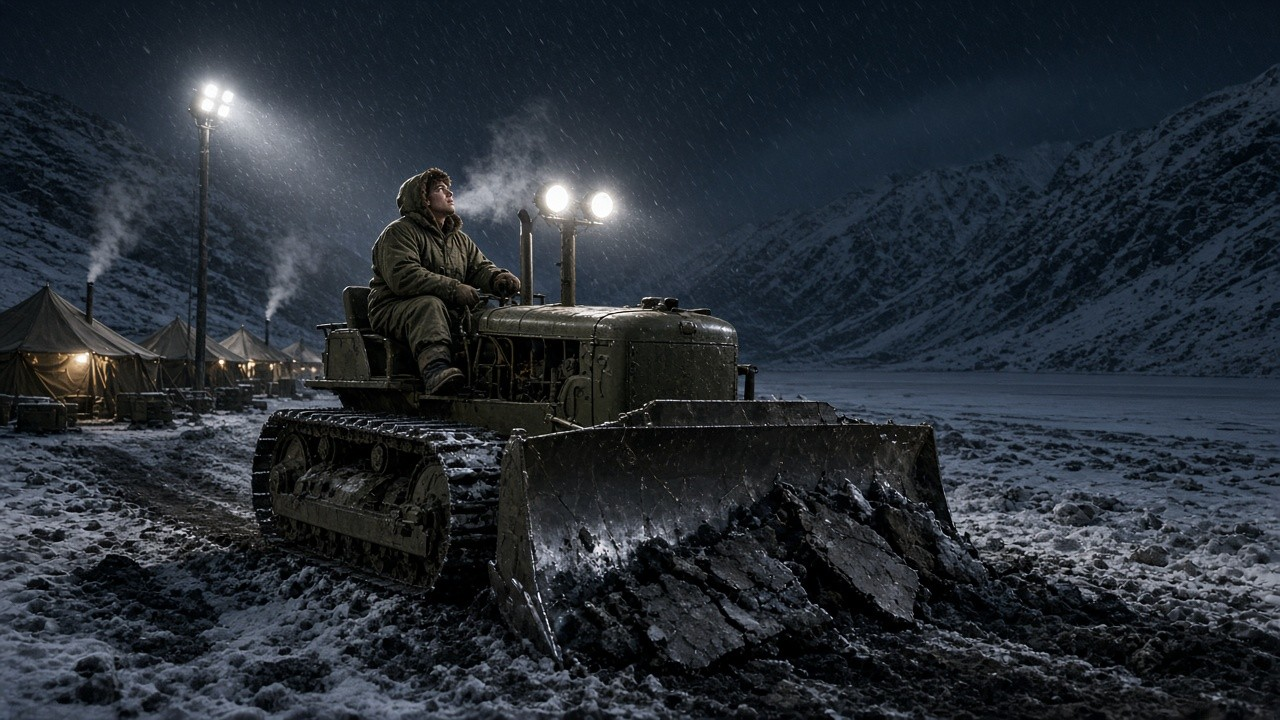
A war short story about the Battle of Chosin Reservoir in North Korea, in the winter of 1950. Scoop, Skeeter, Hoot, Pills, Butter, Yardstick and the Captain are made up. However, the airstrip is real: Marine engineers scraped it out of frozen dirt while the battle went on around them, and in six days planes flew more than four thousand wounded men out. Read the real story of the Hagaru-ri airlift. (For another Korean War story, read A Soldier's Lost Name.)
Lights On
The first time the Chinese came for my runway, I was sitting on a bulldozer with the lights on.
It was the night of November 28, 1950, at a place called Hagaru-ri, a little mud town at the south end of the Chosin Reservoir. The thermometer on the tent pole said twenty below. We ran the dozers all night under big floodlights, because the ground was too hard to wait for morning. Of course, anyone in those hills could see us. We knew that, and we worked anyway.
Then the whistles started on the hills to the southwest. After that came the bugles, and then the shooting.
Hoot, our gunnery sergeant, ran down the strip yelling for everybody to kill the lights. "Leave the iron! Grab a rifle!"
So I jumped off the dozer and pulled my rifle from behind the seat. The oil in it had gone thick as honey in the cold. Even so, it fired. Twenty of us engineers lay down in a ditch at the edge of the strip and shot at shapes in the snow until the sky went gray.
I won't tell that part better than it was. It was loud and cold, and some men I knew did not get up. Butter, who drove the other dozer, took a bullet through the leg and lay in the ditch all night cussing in his slow Georgia voice.
By morning the hills were quiet again. Hoot walked down the ditch, counted us, and pointed at the dozers.
"Back to work," he said. "That strip won't build itself."
Frozen Dirt
My name is Ray Doyle. That winter I was twenty, a corporal in the Marine engineers, and I drove a bulldozer. Everybody called me Scoop.
I got the name in Wichita, Kansas, where my uncle ran a road crew. I started on his dozer at fourteen. By sixteen I could cut a ditch so straight you could roll a marble down it. So when I joined the Marines, they took one look at my hands and put me on the big machines.
We started the strip on November 19. The plan was simple. The whole First Marine Division was strung out up one road into the mountains, and that road was the only way in or out. If it got cut, planes would have to bring in food and bullets and take out the wounded. For that reason, the generals wanted a runway long enough for a C-47 cargo plane.
The trouble, though, was the dirt. It was good black farm dirt, but it was frozen like iron. At first my blade just bounced off it. The ripper teeth on the back of the dozer snapped like crackers. In the end we used dynamite to crack the ground, and then we pushed the pieces around like broken plates.
Meanwhile, the hills around Hagaru filled up with men we never saw in the daytime. The front line was three hundred yards from the end of my runway. On a still night you could hear them singing. I used to wonder if they were as cold as we were. Later I learned they were colder.

Mail From Home
Mail came up the road in sacks until the road closed. My last letter from Mom came on November 20, and I kept it in my parka for the rest of the war.
As always, Mom wrote the way she talked, all in one long breath. The wheat was in. Dad's back was bad again. The church was doing a turkey dinner. Then, at the bottom, she wrote this:
"Joey is still with that moving outfit out west. He says it keeps him hopping. Don't be sore at him, honey. He says he'll tell you all about it himself."
Joey was my little brother. At seventeen, he was so skinny that Dad called him Skeeter, like a mosquito. Skeeter was always buzzing around, always into something, and always eating Tootsie Rolls. Every nickel he ever had went to the drugstore on Douglas Avenue. In fact, he kept one in each pocket, the way a cowboy keeps bullets.
Back in August, he had quit school and gone off to California with a moving company. He had not written me one line since. That made me sore. I had told him to finish school. I had also told him that one Doyle boy far from home was plenty. Instead, he quit to carry couches for strangers by the ocean.
So I folded the letter, put it away, and didn't write back. I figured I would yell at him at Christmas. Back then, everybody was still saying we would be home by Christmas.
The Man With the Yardstick
On November 30, the Air Force sent a man up to look at our strip.
He was a captain, tall and clean, with a new parka and a little notebook. First he walked the whole runway with a measuring tape and a wooden yardstick. Then he measured the bumps, and after that the slope. So of course we called him Yardstick.
At the end, he did some math and shook his head.
"The book says a C-47 at this height needs thirty-nine hundred feet," he said. "You've got about twenty-nine hundred, and it's as rough as a plowed field."
"Then tell them to land short," Hoot said.
Yardstick didn't smile. "I'm thinking about the planes, Sergeant. Every plane I bend is one less plane for the whole war."
Later that night, I was fixing a track by the radio tent. I wasn't trying to listen. Still, a canvas tent doesn't hold much in.
"I won't put a crew down on a cow path," Yardstick said into the radio. "Not until it's done. I don't care who's asking."
Then our Captain answered, low and tight. "Division says the first. Not the second. The first. We have six hundred wounded in those tents right now, and more coming down the road."
There was a long pause. After a while the Captain came out, saw me by the dozer, and stopped.
"You hear that, Scoop?"
"No, sir."
"Good," he said. "Push faster."
Chosin Reservoir Cold
People ask me about the fighting. However, what I remember most about the Chosin Reservoir is the cold.
At night it got to thirty below. The wind came down off the frozen lake like a slap. Our canned rations froze into bricks, so we ate them half thawed off the engine block. Our rubber boots made our feet sweat in the day, and then the sweat froze at night. As a result, half the men in the hospital tents weren't shot at all. Instead, their feet had turned white, then purple.
Pills, our Navy corpsman, kept his morphine shots in his mouth so they wouldn't freeze. He talked around them like a man with a cigar.
"Your toes okay, Scoop?" he asked me every morning.
"They're fine."
"Show me."
So every morning I took off my boots in the snow, and every morning he said, "Lucky."
Meanwhile, the tents by the strip filled up. First there were two hundred men, then four hundred, then six hundred. Butter was in there, on a stretcher by the stove. They lay in rows, close together for the heat. Even from the dozer seat, I could see the tents. Each time I pushed a load of dirt, I told myself it was one more man out.
Candy From the Sky
Around then, our mortar men ran short of shells. Over the radio, they used a code name for mortar shells: Tootsie Rolls. So they asked for more Tootsie Rolls.
The next morning, big cargo planes flew over and dropped crates on parachutes. When the boys cracked them open, they found candy. Real Tootsie Rolls, thousands of them. Somebody far away had taken the code word at face value.
At first the mortar men cussed. Then they started laughing, because it turned out candy was exactly what we needed. You couldn't eat frozen food, but you could warm a Tootsie Roll in your mouth until it went soft. It was sugar, and sugar was heat.
Besides that, it worked as glue. The radiator on my dozer had a pinhole leak. I chewed a Tootsie Roll, stuck it over the hole, and it froze as hard as a rivet. It held for a week.
That night I sat on the dozer with my cheek full of candy and thought about Skeeter. He would have loved this. He would have stood in the middle of that drop zone with his mouth open like a baby bird.
For the first time since the letter, I wasn't sore at him. I just missed him.
Forty Percent
On December 1, the engineers said the strip was forty percent done. It was too short, too narrow and too rough. Even so, the general decided to try one plane.
At half past two that afternoon, the whole camp came out to watch. Men stood in the snow in their parkas. Wounded men sat up on their stretchers, and the cooks came out of the kitchen tent. Still, nobody said much.
The C-47 came in low over the dike at the north end. It hit hard, bounced, came down again, and rolled. It bumped and shook over my frozen ridges. Finally, it stopped with room to spare, and a cheer went up that I can still hear.
Then came the harder part. They loaded twenty-four wounded men into it, and the pilot turned it around to take off to the south, toward the hills.
The engines roared, and the plane ran and ran. It ran past the spot where it should have lifted. I stood up on my dozer and held my breath. At the very last second, the tail came up, the wheels left the ground, and it cleared the hills by what looked like a few feet.
Yardstick stood next to me with his notebook closed.
"Well," he said. "I'll be."
Later that day, a heavy Marine plane full of ammunition came down too hard and folded its landing gear right in the middle of my strip. We couldn't push it, so we unloaded it by hand, box by box, while the light went. It cost us maybe a hundred men who could have gone out that day. I still think about that.

Over the Ice
That evening, the Army men started coming in from the east side of the reservoir.
By then they had been cut off for four days. Some came across the frozen lake on foot in the dark, while others came on trucks and sleds. Our people drove jeeps out onto the ice to bring them in. Many of them still couldn't walk. Their eyes looked like they belonged to old men.
The next day, December 2, we flew out almost a thousand men. Planes landed and took off all day long. At first only two could fit on the ground at once, but later six could. The general said it looked like LaGuardia Airport. Meanwhile, I filled holes and pushed snow between landings, and every time a plane lifted, I felt it in my chest.
They carried Butter out that morning. He grabbed my sleeve as the stretcher went by. "Tell my mama I was a hero," he said. "Lie if you have to."
Yardstick stopped measuring things. Instead, he stood at the end of the strip with two flags and waved the pilots in, all day, until his voice was gone.
Tickets
By December 3, some men tried to cheat. A man with a sore ankle would grab a blanket and a stretcher, lie down by the planes, and groan. If nobody checked, he got a free ride to Japan.
So the doctors made tickets. From then on, nobody got on a plane without a doctor's paper.
That night, the Marines from the far side of the mountains finally came down the road into Hagaru. They had fought their way fourteen miles, and they walked in with their wounded tied on the hoods of their trucks. Some of them were singing. I will never forget that sound.
On December 4, Hoot found me in the dozer tent and held out a ticket.
"Your feet," he said. "Pills says they're bad."
I looked at the paper for a long time. Then I handed it back.
"Somebody has to keep the strip open," I said. "Give it to a kid."
Hoot looked at me for a while. Then he tore it in half and put the pieces in his pocket.
The Wrong Way In
December 5 was the busiest day of all. We were leaving in the morning. The whole division was going to walk out down the mountain road to the sea, and everything we couldn't carry would burn.
After that, planes came and went all day. Some were flown by Greek pilots, a long way from home. Every one of them landed full of supplies and left full of wounded.
Late in the afternoon, one plane was different. When the door opened, men climbed down instead of being carried up. They had clean parkas, new rifles and pink cheeks. Each one looked around at the smoke, the snow and the mountains like he had stepped off a train in the wrong town.
They were replacements. Eighty-one fresh Marines flew in that day, to fill the holes in the line before we walked out.
"Who flies into this?" I said to Hoot.
He shrugged. "Kids."
The last one down the ladder was the skinniest Marine I had ever seen. His parka hung on him like a tent. He had a seabag on his shoulder and a grin on his face, and he was checking every face on the strip like he was hunting for somebody.
Then he saw me, and he stopped.
He dug into his pocket, pulled out a Tootsie Roll, and held it up.
"Hey, Ray," Skeeter said. "Heard you boys were short on candy."
Behind him, the plane was already filling with wounded for the trip out. All week I had built that runway so men could leave. My kid brother had used it to come the wrong way in.



Leave a Reply