A science fiction short story about a two-seat tow tug, a dead rocket stage and an insurance policy with one hard rule. Gus, Kit, Jo, the Magpie and the Drum are made up. However, the job is real: twenty-year-old rocket stages still tumble over our heads, and companies in Bremen are building machines to catch them. Read about the real debris removal mission. (For another night in orbit, read The Ghost at Ten Past Three.)
The Garage
The garage in Bremen still had a sign for car repairs. Underneath it, somebody had painted a second sign by hand: WESER TOW. ORBIT AND ROAD.
Gus always said the road part paid for the orbit part. Jo said the road part paid for everything, because the orbit part had never paid for anything at all.
Jo was his sister. Besides that, she ran the office, the money and, mostly, Gus. When I walked in on my first morning, she looked at my shoes before she looked at my face.
"Those are new," she said.
"The agency told me to look nice."
"The agency told you wrong. Coffee is in the back. Don't touch the blue mug."
So that was Jo. Gus, however, was easier. He was sixty-one, with big gray hands and a voice like a truck in low gear. Everybody called him the Chief, even the man who delivered the bread. When we met, he shook my hand once, hard, and pointed at a picture on the wall.
"That's the Magpie," he said. "She's older than you. Be polite to her."
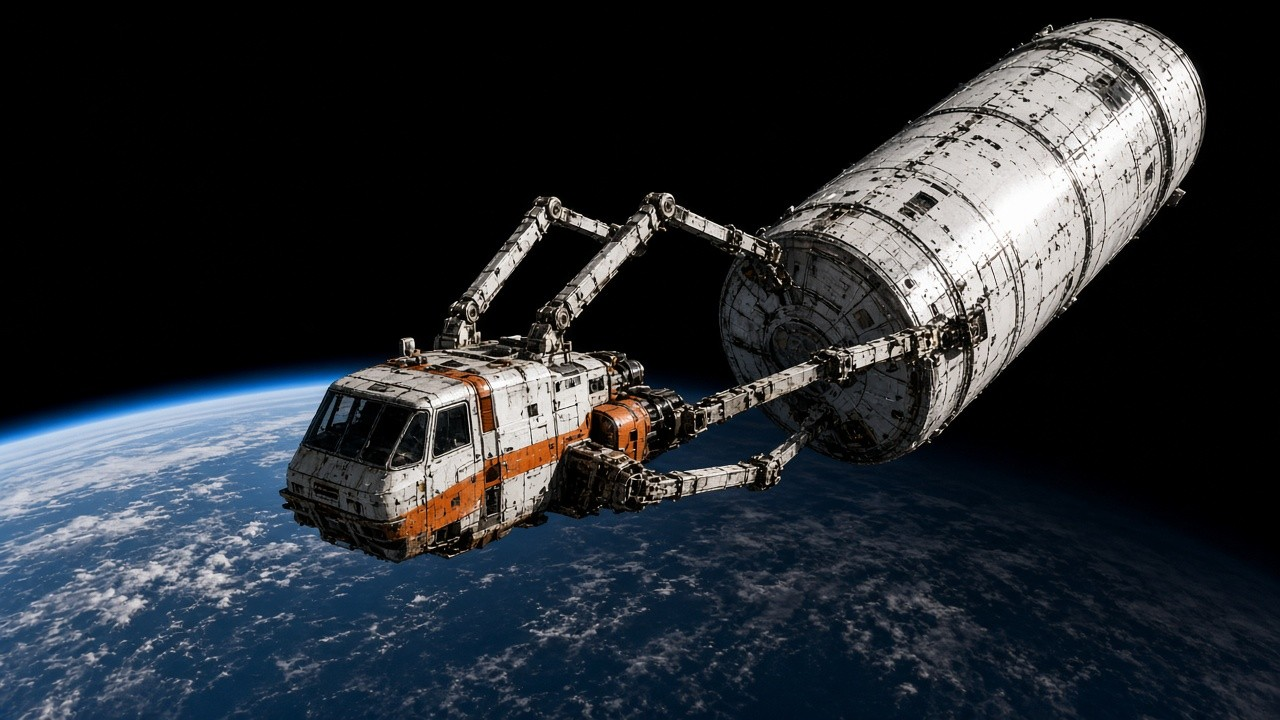
The Magpie was our tug. Basically, she was a two-seat ship about the size of a delivery van, with four long arms folded under her belly like a sleeping spider. She grabbed dead things in orbit and pulled them down to burn. Most days she lived up at the depot, three hundred kilometers over our heads. On this day, though, she was all anybody in that garage could talk about.
Every Space Junk Story Starts With Money
There is no romance in this space junk story. There is only a bill.
The job was a rocket stage. Twenty years ago it had gone up, dropped its satellite, and then died. Since then it had tumbled end over end at eight hundred kilometers, slowly and stupidly, like a drunk falling down stairs that never end. Gus called it the Drum, because it was round and empty and it boomed when you hit it.
Now a big company wanted it gone before it smashed into something worth money. They had hired Weser Tow because we were cheap. Then their insurer had written the contract, and the contract had a rule.
"Clause nine," Jo said. She did not need to look at the paper. "We get paid if we catch it on the first try. If we bump it, miss it, or back off, we get nothing. Not one cent."
"Why?" I asked.
"Because a bad grab can break the thing into a hundred pieces," Gus said. "Then you haven't removed one piece of junk. Instead, you've made a hundred."
"And then the insurer pays for a hundred," Jo said. "So they make sure they never pay at all."
That night I heard her on the phone in the office. The door was half open. I did not mean to listen, but the garage was quiet and she was not.
"Friday," she said. "Yes, I know what day it is. If this job pays, you get all of it. If it doesn't, then you can have the building, the trucks and my brother's stupid spaceship, and I hope you choke on them."
She hung up. After that she sat for a long time with her hands flat on the desk.
The Policy
The next day, Gus and I went over the grab twenty times on the trainer. He flew. I watched the numbers and called them out.
"You read the policy?" he asked once, without looking at me.
"Twice," I said.
That was a lie. I had read it closer to forty times.
"Good," he said. "Then you know they were supposed to send a man. An inspector. Some fat guy with a tablet, riding along to watch me fail." He grinned. "He got sick. So now they have to take my word for it."
"Lucky," I said.
"Lucky," he agreed. Then he crashed the trainer into the Drum, because he was laughing too hard to fly.
We flew up on Wednesday. The ride to the depot was the usual shared bus, full of tired technicians and a man who threw up twice. Then we crossed into the Magpie through a tube that smelled like old socks and hot plastic.
Inside, she was even smaller than the picture. In fact, my knees touched the screens. Two seats. A wall of screens. Somebody had taped a photo of a dog over the fuel gauge.
"Jo's dog," Gus said. "Dead now. He's good luck."
"How is a dead dog good luck?"
"He never once fell off a rocket," Gus said, and he started the engines.
The Drum
It took nine hours to climb up to the Drum. For most of that time, nothing happened. We ate soup out of bags. Gus slept for two hours with his mouth open while I watched the screens. Meanwhile, Earth turned under us, blue and white and very far away.
Then, at last, the Drum came up over the edge of the world.
At first it was only a spark. Soon it was a white shape, and finally it was a long, scratched tube as big as a city bus, turning end over end against the black. Each turn took exactly eleven seconds. The sun flashed off it each time it came around, like a lighthouse that had lost its mind.
"Ugly," Gus said softly. He said it the way some men say beautiful.

His job was to match the spin. First, he would bring the Magpie in close, turn her in the same slow circle as the Drum, and then reach out with all four arms at once. If he did it right, the Drum would hold still in our arms like a sleeping baby. If he did it wrong, it would hit us or break apart. Then the job was over either way.
By then, Jo was on the radio from Bremen. Also, a man from the insurer was in the office with her. I could hear his voice behind hers, smooth and polite.
"Mister Falk says good luck," Jo said, in a voice that meant she would like to hit Mister Falk with a chair.
"Tell Mister Falk to watch closely," Gus said. "He won't see this twice."
Something Small
We closed in slowly. Two hundred meters. Then a hundred. Then fifty.
Soon the Drum filled the window. I could see old burn marks on its skin and a long split where a seam had opened in the cold. At the top end was the ring where the satellite had once sat. As it came around, something flashed inside the ring. It was small, and it was blinking.
"Chief," I said. "There's something on it."
"Junk."
"Junk doesn't blink."
He leaned forward. The Drum turned again. This time we both saw it: a little box the size of a shoebox, caught in the ring by one bent antenna. A red light blinked on its side, steady as a heartbeat.
So I put the radio on scan. A thin, cheerful beeping filled the cabin. Under the beeps, a recorded voice spoke in Portuguese, then in English. It was a child.
"Greetings from Class 6B," the voice said. "Hello, space. Is anybody there?"

Gus closed his eyes.
"School satellite," he said at last. "Kids build them. They throw them up with the big rockets and listen for the beeps. This one must have drifted and got hooked. It's been hanging on that ring for who knows how long."
"If you grab the Drum now…"
"The arms close right over that ring," he said. "That little box gets crushed, or it gets flung off into the junk belt. Either way, those kids lose it." He opened his eyes. "And it becomes one more thing I have to catch next year."
Thirty Seconds
The radio clicked.
"Magpie, Bremen. You are in the window," Jo said. "Thirty seconds."
Gus did not answer her. Instead, he looked at me.
"You read the policy," he said. "Forty times, I'd guess. So tell me. If I back off now, what happens?"
Of course I knew the answer. In fact, I could have said it in my sleep.
"Then you made no contact," I said. "But you didn't catch it on the first try, either. It's your call, Chief."
He breathed out through his nose. Then he did the thing that no pilot in a garage with a Friday bank loan should ever do.
He backed off.
The Second Pass
For a while, Bremen went silent. After that, Jo came on again, and her voice was very thin.
"Gus. What did you do?"
"Saw something," he said. "Give me ten minutes."
Behind her, Mister Falk said something polite. I heard only two words: "clause nine."
So Gus switched off the radio.
What he did next took fifty minutes, not ten. First, he parked the Magpie off the end of the Drum, turning with it, close enough to touch. Then he reached out with one thin arm, the small one he used for screws and bolts. He waited for the ring to come around. Eleven seconds. Eleven more. Then again.
At first he missed four times in a row. The fifth time, the arm's fingers closed on the little box as gently as a hand picking up an egg. Very carefully, he pulled it free of the ring. Finally he drew it in, tucked it into the tool bay, and shut the door.
Still, the beeping went on, safe and cheerful, inside the Magpie.
"Now," Gus said, rolling his shoulders. "Let's catch a drum."
As a result, the second grab was the best flying I have ever seen. He matched the spin so smoothly that the Drum seemed to stop turning and the whole sky seemed to turn instead. All four arms closed at once. There was a deep boom, like a church bell under water. Then nothing moved at all.
"Got it," he said. He sounded tired and old and completely happy. "Bremen, Magpie. We have the Drum."
Nobody cheered on the radio. Jo only said, "Okay." Then, much later, "Come home."
The Report
We burned the Drum two days later over the empty South Pacific. It went down in a long orange streak, and then it was gone. The little school box rode home in my lap, still beeping.
The garage was dark when we got back. Jo was sitting at her desk with a letter from the bank. Mister Falk had left. On his way out, he had told her the insurer's inspector would file the report by Friday, and that she should not get her hopes up.
"It's fine," Gus told her. "We'll sell the trucks."
"We can't sell the trucks. The trucks are the only thing that works."
They argued like that for an hour. Meanwhile, I made coffee. I did not touch the blue mug.
Clause Nine
Later, when they had both gone upstairs, I sat at the end of the bench with my tablet. I opened a form that I had not shown anybody. It had a gray logo at the top and a lot of small print at the bottom.
I knew clause nine word for word. It did not say first pass. It said payment is due if capture is made on the first attempted contact with the target object.
However, the Chief had never touched the Drum before that second pass. He had only touched a shoebox that belonged to Class 6B.
So I wrote it down exactly as it happened. Capture made on first attempted contact. No damage. No new debris. One extra object recovered, at no cost to the insurer. Recommend payment in full.
Finally, I signed it, the way they had trained me to in Hamburg, and took my name badge out of my bag for the first time in two weeks. I set it on the bench beside the beeping box.
HANSE ORBITAL MUTUAL. CLAIMS INSPECTOR. K. WOLF.
The fat guy with the tablet, it turned out, had never been sick at all.


Leave a Reply