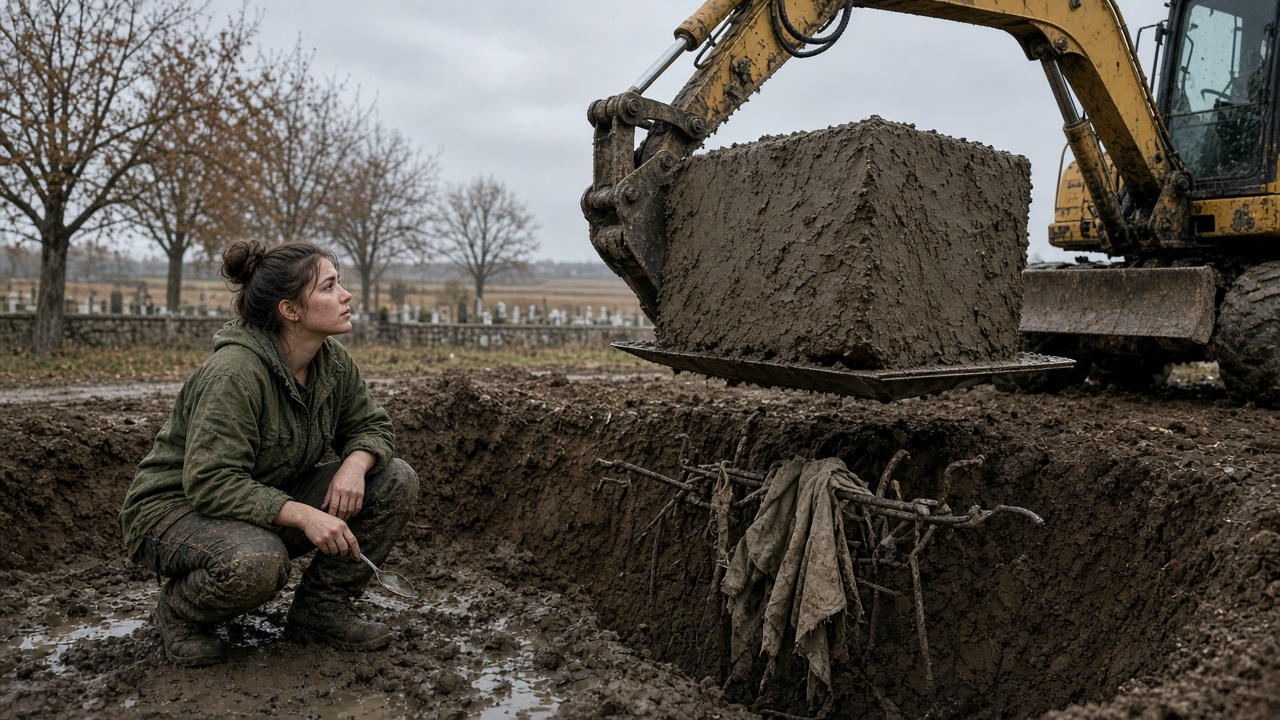
A ww2 short story about a ww2 plane found under a Hungarian farm field, told as a short story. The village, the plane, the pilot and the people in it are made up. However, the dig is based on real news. In October 2026, a team in Hungary lifted a Soviet Yak-1 fighter from about 17 feet down at Tortel, and the pilot's signed book was among the finds. That pilot jumped by parachute and was taken prisoner. So this story imagines a different plane, in a different field.
The Spoon
The machine took the field one block at a time.
Big Feri drove the digger like a man cutting cake at a wedding. He sank the steel box into the clay, pulled it up full, and set it down on a wooden pallet as gently as a baby. Every block was the size of a kitchen table, so we wrapped each one in plastic and gave it a number.
Then the blocks came to me.
My name is Dora, but on that dig nobody used it. On my first morning, the Boss watched me clean a block with a teaspoon from my mom's kitchen drawer. After that, I was Spoon. I was twenty-two, a student from Szolnok, and it was my first paid dig. It was also probably my last, unless somebody gave the museum more money.
The field belonged to Uncle Jozsi, and it sat at the edge of Diosret, a farm village between Cegled and Szolnok, south-east of Budapest. There was a church, a pub, a cemetery with a long row of walnut trees, and miles of flat brown earth.
Eighty-two years ago, a fighter plane had fallen into that earth nose first. It came down so fast that it drove itself five meters deep, like a nail.
A WW2 Plane Found Under the Wheat
Everybody in Diosret knew the story, but nobody had ever seen the plane.
That changed because of Uncle Laci.
Uncle Laci was ninety-five, but he still wore a gray hat, a brown coat and polished shoes every day, even in the mud. He lived alone in a yellow house by the cemetery, and he walked with two sticks. Back on November 1, 1944, he was only thirteen years old. It was All Saints' Day, so the whole village was at the cemetery with candles and chrysanthemums for the graves when the planes came over.
"Sixteen of them," he told us on the first day. "Eight and eight, round and round, like swallows. Then one came down, and the ground jumped."
Last spring, he wrote a letter to the museum in Budapest in his careful school handwriting. Also, he drew a map with the walnut trees, the cemetery wall, and an X in Jozsi's field. Finally, somebody listened. A man came with a metal detector, and the X screamed.
So now there was a dig. A real ww2 plane found under a wheat field is not common, the Boss said, and a Yak-1 is very rare. That was the Soviet fighter, and since it was built of steel tubes, wood and painted cloth, most of it should have rotted long ago. However, our clay was thick and wet and greedy. It kept things.
Anything Paper?
From then on, Uncle Laci came every morning at eight, on his two sticks. Jozsi's grandson pushed a garden chair to the edge of the hole for him, and he sat there in his hat and watched me work.
"Anything paper yet, Spoon?" he asked every day.
"Not yet, Uncle Laci."
"Paper keeps in clay," he said. "Paper is patient."
At first, we found what you find in a plane. There were bent steel tubes, part of the landing gear, and pieces of wooden wing as soft as wet bread. Then, in the second week, we found a long strip of the cloth skin. It still had paint on it, part of a red star. Even the Boss went quiet when she saw it.
The Boss was Kati, from the museum, and she was fifty, small and tough, with gray hair under a baseball cap and clay on her glasses. She did not smile much. Still, she said thank you every time anyone handed her anything, even a bucket.
"First photograph it," she said. "Then wrap it, label it, and nobody breathes on it."
Next, we found the engine. It was a huge, crushed lump of metal, and under the rust there were numbers, so the Boss sent them to Budapest. Two days later, the answer came back. Even after eighty-two years, the numbers matched one plane, one regiment, one pilot.
"So did he jump?" I asked.
"The record only says he did not come back," she said. "That's all we have."
Above us, in the garden chair, Uncle Laci shook his head.
"He walked," he said.
Nobody answered him. After all, he was ninety-five.

The Tie
The ministry man came on Tuesday.
He drove a black car that was much too clean for our road, and he wore a blue suit with a yellow tie. Within an hour, the whole crew called him the Tie. Then he shook every hand, even Big Feri's, which was muddy to the elbow.
"Beautiful," he said when he looked into the hole. "The minister will love it."
To him, a ww2 plane found in a village field was a gift for television, because it had everything: mud, history and an old man in a hat.
The plan was simple, and it was not ours. On Friday, the minister was coming with TV cameras, because a minister always needs a good picture. There would be a white tent by the hole, a table with the red star under glass, and a short speech. Most of all, there would be Uncle Laci, the boy who saw it fall.
That afternoon, I went behind the tool container to eat my sandwich. Meanwhile, the Tie was on the other side, on his phone, and he didn't know I was there.
"No, it's perfect," he said. "Ninety-five, a hat, a tear in his eye. He says he saw it fall, and that's all he says. No history lesson, just the red star, the old man, and the minister's hand on the glass. Done by lunch."
He listened for a moment.
"Then tell the museum," he said. "No pictures, no new money. They know how it works."
After that, I put my sandwich back in its paper, because suddenly I was not hungry.
Jozsi's Wheat
That evening, the Boss sat on an upside-down bucket and rubbed her eyes.
"The museum needs a new roof," she said to nobody. "It needs a new van too. Also, I need Spoon for the winter, and the winter costs money."
"So we smile on Friday," said Big Feri.
"We smile on Friday."
Soon, Uncle Jozsi came over with his hands in his pockets. He was a big, slow farmer of about sixty, and he was not a bad man. However, he was paid by the day to keep his field empty, and the days were running out.
"I have to sow by the end of the month," he said. "If the wheat doesn't go in, I don't eat next summer, ministry or no ministry."
"Friday," said the Boss. "Then you can have your field back."
He nodded and walked off. Halfway to his truck, though, he turned around.
"My grandfather filled that hole," he said. "He did it the very next morning, with a shovel, all alone. However, he never said why he was in such a hurry. Instead, he only said a hole in a field is a hole in your bread."
Block Nineteen
On Wednesday, I opened block nineteen.
It was not a deep one, since it came from about two meters down, far above the engine. Mostly, the upper blocks were boring, just plain brown clay that had fallen back into the hole, with some glass and old roots. So I was working fast, too fast, with my spoon.
Then the clay changed color.
There was a black line in it, like a pencil mark across the block. When I looked closer, I saw it was ash, and inside the ash lay a hard, flat, square lump the size of my hand.
For a second, I forgot to breathe. Then I called the Boss.
She knelt next to me for a long time. She used a wooden stick, then a soft brush, then her own breath. Slowly, the lump became a book. Although it was swollen and black, its cover was still soft as old leather. When she lifted one corner with the stick, there was pencil on the first page, a few letters in a shaky hand.
"Cyrillic," she said. "Russian letters. A signature."
"The pilot's?" I asked.
"Maybe," she said, and then she frowned. "But it's in the wrong place."
"What do you mean?"
"Everything from the crash is down there." She pointed into the hole, at the engine layer, three meters below us. "This came later. In fact, it fell in on top, after the fire."
Up in the garden chair, Uncle Laci had gone very still. He had both hands on his sticks, and he was looking at the book as if it might run away.
Under Glass by Friday
The Tie was delighted.
"A signed book!" he said into his phone. "It's the enemy pilot's own book, so I want it on the table, open, under the lights."
"It can't be opened," said the Boss. "Not this week, because it needs weeks in the lab, maybe months. If you force those pages, they turn to dust."
"Then open one page," said the Tie. "Just the first one, with the name, at ten o'clock on Friday."
He smiled at her, and she did not smile back. Still, she had a roof and a van and a Spoon to pay for.
So on Wednesday night, I drove the book to Budapest. It sat on the seat next to me in a plastic box of wet foam, with the seat belt across it. I drove ninety kilometers at exactly the speed limit, and I talked to it the whole way, like a dog in the back seat.
Glass met me at the museum door at eleven at night. She was the paper conservator, very old and very tall, and everyone called her Glass because her glasses were as thick as the bottoms of jam jars. Then she carried the box inside as if it were full of eggs.
"Go home, Spoon," she said. "I'll call you when I can read it."

What Glass Read
She called at five in the morning on Thursday.
"Where are you?" she asked.
"In my car. Outside."
At that, she laughed, for the first time. "Then come in."
The book lay in a glass tray under a cold white lamp, but she had not opened it all the way. Instead, she had eased up the cover and the first page, just a crack, and propped them on tiny glass wedges.
"Now look," she said. "But don't tell me what you see. Tell me what you read."
So I bent over the lamp. The page was brown, with dark spots like spilled coffee. However, the print was still clear, and the words were not Russian at all. They were Hungarian.
In fact, it was a school reader. Back then, every village kid had one, with poems, stories about horses, and a picture of a stork on a roof.
Under the title, someone had written a name in ink, in careful school letters. Then below that, in pencil, in a different and shakier hand, were the Russian letters, and one more word.
"Kolya," Glass read. "That's a nickname, just like your Spoon. And this word is spasibo, which means thank you."
I read the ink name three times. After that, I sat down on the floor of the lab, because my legs had stopped working.
The Boy Who Saw It Fall
On Friday, the white tent went up by the hole.
By ten, there were three cameras, two police cars, and the minister's black car. There were also folding chairs for the village, coffee in paper cups, and the red star under glass on a table with a white cloth. Next to it, in a glass box with damp foam, lay the book. Glass had driven it down herself, and she stood beside it like a guard.
The Tie put Uncle Laci in the chair at the center of the table, in front of the lights.
"Just tell them you saw it fall," the Tie whispered. "Keep it short and sweet, sir, and thank you."
First, the minister made his speech. It was about history, and courage, and our village, and it was short. Then he turned to Uncle Laci, and all three cameras turned with him.
"Sir," said the minister, "you were thirteen then. So tell us what you saw."
For a long time, Uncle Laci looked at the book in its box.
"I saw it fall," he said, and the Tie smiled.
"Then I saw him come down," Uncle Laci went on. "He came on a white parachute, into our plum trees, behind the cemetery wall. Nobody else saw him, because everybody was looking at the smoke."
At that, the Tie stopped smiling.
Spasibo
Uncle Laci talked for ten minutes, and nobody stopped him.
"The pilot was hurt in the leg," he said. "He was not much older than my big brother. When he sat on a grave, he shook all over. I had the watering can from my grandmother's grave, so I gave him water. Then I gave him my bread."
Then he had to stop for a moment.
"He wanted to write something, but I had nothing except my school reader in my coat pocket. So I gave him that, and he wrote his name in it. Then he gave it back and pointed at me, as if to say, you keep this. You remember I was here, alive."
"After that, soldiers came in a truck from the road and took him away. He went quietly, and he even waved to me."
The Hole Was Still Smoking
"What happened to him?" somebody asked from the crowd.
"I don't know. I never knew," he said, and he shook his head. "My mother found the book that night. When she saw the Russian letters, she was so afraid. After all, those were bad days for everyone, and people talked. She said, if men come asking, this book is a rope around your father's neck. So I ran to the hole. It was still smoking, and I dropped the book in."
Then he looked at Uncle Jozsi.
"Your grandfather saw me do it, though. In the morning, he filled the hole all alone, before anybody could come and look. And he never told a soul."
Slowly, Uncle Jozsi took off his cap.
"I promised that pilot I would keep it," said Uncle Laci. "For eighty-two years, I told everyone about the plane, but I never told anyone about the book. That's why I finally wrote to the museum. I only wanted to keep my promise."
Two Names
Glass bent down and switched on the small lamp inside the glass box.
All three cameras leaned in, and so did the minister. Meanwhile, behind them, the Tie slowly put his phone in his pocket.
"Keep rolling," he said quietly to the camera man.
Under the lamp, the brown first page of a Hungarian school reader glowed like a candle on a grave. At the top, in careful ink, was the name of a thirteen-year-old boy from Diosret: Laszlo Kiss, seventh class.
And under it, in shaky pencil, a young pilot who walked away from our field had written his thank you.



Leave a Reply