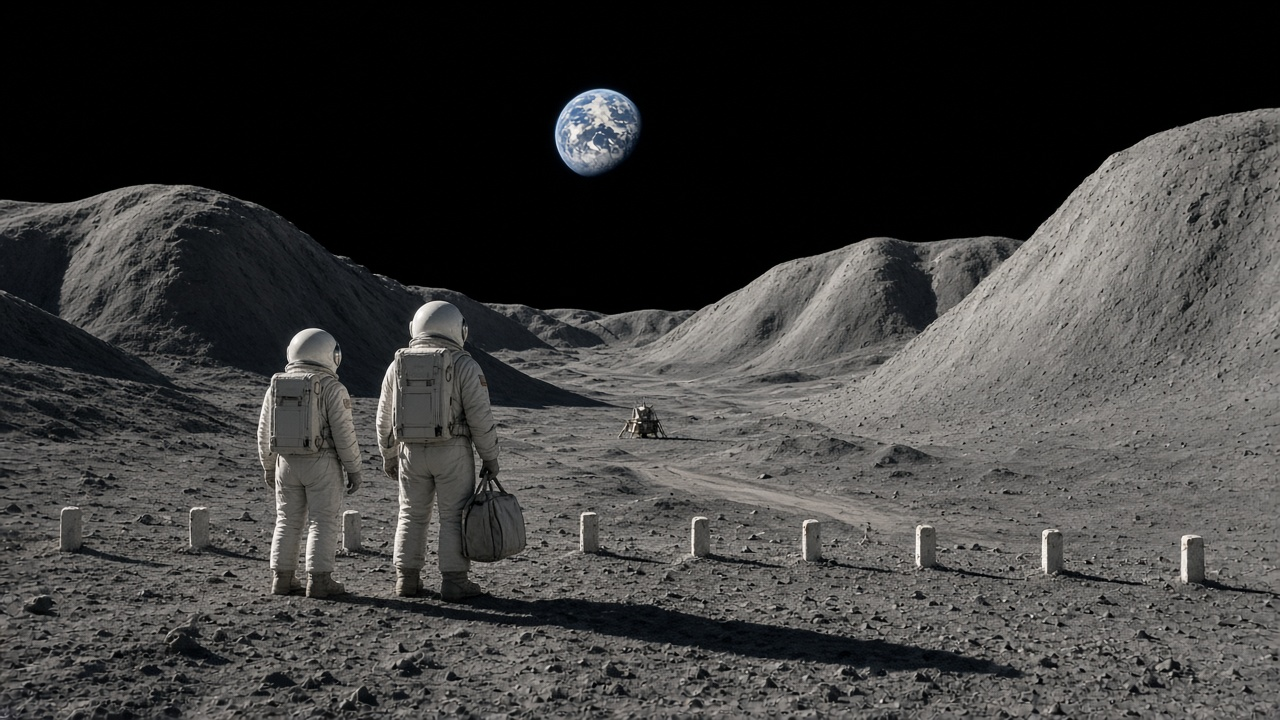
A moon footprints story, told as a short story: in the year 2072, a young ranger works the 100th birthday of the last Apollo landing, in the valley where the last footprints on the Moon are kept like a treasure. This is fiction, so the people, the park and the quakes are made up. However, the science is real. In October 2026, a Smithsonian-led study mapped more than 10,000 young faults and found that the Moon's radius has shrunk by about 45 meters over the last 400 to 800 million years, as its insides slowly cool. Because of that, moonquakes can happen anywhere on the Moon.
The Footprint on the Big Screen
The most famous footprint in history is on a big screen in the lodge, and every guest stands in front of it like it is a church window.
I was the newest ranger at the Apollo 17 Heritage Park, so I gave the talk four times a day. Behind me, the screen showed a live picture from a camera on a thin mast. The camera looked down at the gray ground beside the old lander's ladder. Right there, in the dust, was one sharp bootprint with deep, neat lines across the sole.
"That is the last step," I told the guests. "On December 14, 1972, the last man to walk on the Moon climbed that ladder. He never came back. Nobody did, for a very long time."
The guests always went quiet at that part. Some of them cried, because many had saved for twenty years to stand in our valley.
Then a boy in a green cap put up his hand. His name was Ollie, he was nine, and he had asked eleven questions already.
"It looks new," he said.
"Good eye," I said. "That is because there is no wind on the Moon and no rain. So moon footprints can stay sharp for a very, very long time."
Ollie nodded, but he kept staring.
Across the room, Dusty was polishing the brass rail by the window. He stopped for a second. Then he went on polishing, and he did not look up at the screen.
He never did.

Dusty
Dusty was seventy years old, and he had been a ranger in the valley since 2049. He was tall and thin, with a gray beard cut short so it fit in a helmet. Also, he had a bad left knee, so he walked like a man going down stairs, even on flat ground.
He named me on my very first day, too. I had picked up a little gray stone outside the airlock, just to feel it, and he made me put it back exactly where it was.
"Not one pebble, Pebble," he said. "Everything in this valley is somebody's history."
After that, everyone called me Pebble, even the cook.
Dusty had one rule for new rangers. "Look at the hill, not at the hole."
At first, I didn't get it. Later, I did. You see, our lodge sat in a long valley between two huge gray mountains. The guests only wanted to look at the old lander and the footprint. However, Dusty always pointed at the low cliff that ran across the valley floor, a few kilometers to the west.
"That is a fault," he would say. "The Moon is cooling inside, so it is getting smaller. Slowly, like an old man. And when it shrinks, the skin cracks."
I knew about that from school. Back in 2026, scientists counted more than ten thousand young cracks like ours all over the Moon. Our cliff had a name, too, from the Apollo days. Old rocks that rolled down our mountains told the same story: the ground here had shaken before.
"How often?" I asked him once.
"Not often," Dusty said. "But not never."
The Rule for Moon Footprints
Only one person was allowed to walk near the lander. That was Dusty.
The old rule came from NASA back in 2011. It asked visitors to stay at least 225 meters away from the Apollo 17 lander, so that the moon footprints, the rover tracks and the old tools would stay just as they were. Later on, our park kept that rule like a law. Our lodge stood outside the line, and our viewing walk ended at a row of small white posts.
So, once a month, Dusty suited up, took his heavy gray bag, and walked in alone on one marked path to clean the camera on the mast. Moon dust is sticky. It clings to glass like flour.
"Can I come?" I asked, the first time.
"You can watch from the posts," he said. "That is how I started."
So I watched. He walked in slow, careful steps, and he came back two hours later with dust up to his knees. When I asked what took so long, he only said, "The camera is old, and so am I."
His bag always looked heavier on the way back. I thought that was just Dusty being tired.
A Hundred Years
In December 2072, the Moon threw a birthday party, and we were the party.
Apollo 17 had landed in our valley on December 11, 1972. It had left on December 14. Exactly one hundred years later, forty guests came in on the shuttle from the south pole base. Each seat cost more than my mom's house in Tucson.
Also, the company sent the Boss.
Her name was Mrs. Lane, but everybody called her the Boss, even on the menus. She ran the Valley Heritage Company from Houston, and she had built the lodge, the shuttle deal, and the whole party. She was not mean. Instead, she was busy, and busy can look like mean from far away.
On the first night, I went to the suit room to check the spare helmets. The door was half open, and the Boss was on the big screen talking to Dusty. Because radio takes more than a second to cross from Earth, every answer came a little late.
"Forty guests, Dusty," she said. "Two news crews. The insurance people are watching too. And the Shackleton Town people have already booked the spring."
"I know," Dusty said.
"So, nobody says moonquake," she said. "Not this week. If the picture fails, you fix the picture. Is that clear?"
There was a long gap, longer than one second.
"Clear," Dusty said.
I backed away from the door before either of them saw me. That night, I lay awake and tried to remember if I had ever heard Dusty say yes so quietly.
The Bell
The quake came on the second night, at dinner.
At first, it was only a hum in the floor. Then the forks began to buzz on the plates. A glass of water walked across a table all by itself, and a lady from Ohio grabbed it just before it fell.
"Everybody stay seated," I said, louder than I meant to. "This is normal. We are safe."
That was half true. The lodge was built for it. The walls were thick, and the domes were made to flex. Still, nothing in my training felt like this.
An earthquake on Earth shakes you and stops. However, the Moon is dry, cold rock, and dry rock rings. So a shallow moonquake keeps going, like a bell after you hit it. The old Apollo instruments had recorded twenty-eight shallow quakes between 1969 and 1977, and some of them rang for more than ten minutes.
Ours rang for eleven.
Meanwhile, Ollie held his mom's hand and counted out loud. Dusty stood by the big window with one hand on the rail and his eyes on the hill to the west, the way a sailor watches a wave.
Finally, the hum faded away. The forks went still, and the guests started to laugh in that shaky way people laugh after a scare.
Then somebody pointed at the big screen. It was black.
Fix the Picture
The camera on the mast was down, so the picture was gone. Maybe the mast had tipped, or maybe a cable had shaken loose. From the lodge, we couldn't tell.
The Boss called within five minutes. I was in the control room, so I heard every word this time.
"The last-step moment is the day after tomorrow," she said. "At 4:54 in the afternoon, Houston time, a hundred years to the minute since they left. Forty people, two cameras, and the whole world watching that footprint. Dusty, I need that picture."
"I'll go in the morning," Dusty said.
"Tonight," she said.
Dusty rubbed his bad knee. "Tonight, then."
"I'm going with you," I said.
They both looked at me. Even with the delay, the Boss said no first.
"I mean to the posts," I said. "Safety buddy. Nobody walks out alone after a quake. That is your rule, too, Dusty."
He looked at me for a long time. Then he nodded.
"To the posts," he said. "Not one step past."
Two Hundred and Twenty-Five Meters
Outside, the valley was silent. It is always silent, of course, because there is no air to carry sound. Still, after the quake, it felt like a held breath.
The sun was low, and every rock threw a long black shadow. Above the mountains, the Earth hung blue and white in the black sky. It never moves much from there. It just watches.
First, we walked to the white posts. Dusty checked my oxygen, then his own. Then he picked up his heavy gray bag.
"Stay," he said, like I was a dog. I didn't mind.
Then he went in. He took slow steps along the marked path, toward the old lander with its gold legs turned pale by a hundred years of sun.
Soon, I zoomed my helmet camera in as far as it would go. The mast was standing, but it leaned to one side. Dusty reached it after twenty minutes. He fixed a cable, wiped the lens, and set the mast straight. Then he radioed the lodge.
"Picture?" he asked.
"Black," said the control room. "Still black."
Dusty didn't answer. Instead, he slowly walked around the lander's leg, to the ladder side, where my zoom couldn't follow him. For a long time, I saw only his shadow on the ground. It was kneeling.

Forty Minutes
He was behind the lander for forty minutes.
I called him twice. Both times, he said, "Working." Once, his breathing on the radio was so heavy that I almost broke the rule and went in after him.
Then the control room shouted, "Picture! We have picture!"
At once, I switched my visor to the feed. There was the gray dust. There was the ladder. And there, beside it, was the bootprint, as sharp and perfect as ever, every neat line across the sole.
Back in the lodge, I heard later, the guests clapped. Some of them cried again.
Later, Dusty came back along the path, and his bad knee was worse than ever. He had dust to his thighs this time. His bag swung in his hand, and it looked heavy.
"Good job," I said. "The print is fine. The quake didn't touch it."
He didn't answer that. He only said, "Let's get inside, Pebble. I'm cold."
The Locker
Once we were inside the suit room, Dusty peeled off his gloves and sat down hard on the bench. He looked a hundred years old himself.
"Go to bed," he said. "Big day after tomorrow."
But I couldn't sleep. Something about the picture kept itching at me, the way Ollie had stared at it.
So at two in the morning, I went back to the screen in the empty lodge and pulled up the saved pictures. There was the print from last month. There was the print from tonight. They matched line for line, down to one tiny pebble beside the toe.
That should have made me happy. Instead, it made me cold.
Only hours before, the Moon had rung like a bell for eleven minutes. It had walked a glass across a table and tipped a steel mast. Yet not one grain of dust in that print had moved?
I sat in the dark for a long time. After that, I went to the suit room.
Dusty kept the code to his locker on a sticky note inside mine, "for emergencies," he had said on my first week. I told myself this was one.
The door opened with a soft click.
The Last Step
"Christmas 2049," Dusty said behind me. I hadn't heard him come in. "My first year. The quake rang for nine minutes. In the morning, the print was gone. Just a soft gray dent, like a thumb in bread dough."
"And the company…"
"The company said people had saved their whole lives to see it." He sat down on the bench. "Nobody says moonquake, Pebble. They didn't say it then, either."
"So for twenty-three years," I said, "every person who stood in front of that screen…"
"Cried at my foot," Dusty said. "Yes."
He didn't look away from me, even though I could see how much he wanted to.
"Look at the hill, not the hole," he said softly. "The Moon is still moving. It's only people who want it to stand still."
I looked down into his locker again.
There, on the top shelf, sat a heavy gray boot, a copy of the old Apollo kind, with deep, neat lines across the sole. The lines were still packed with fresh gray dust from tonight. Next to it lay two paper tags in Dusty's slanted writing.
One said Dec 2049.
The other said Dec 2072.


Leave a Reply