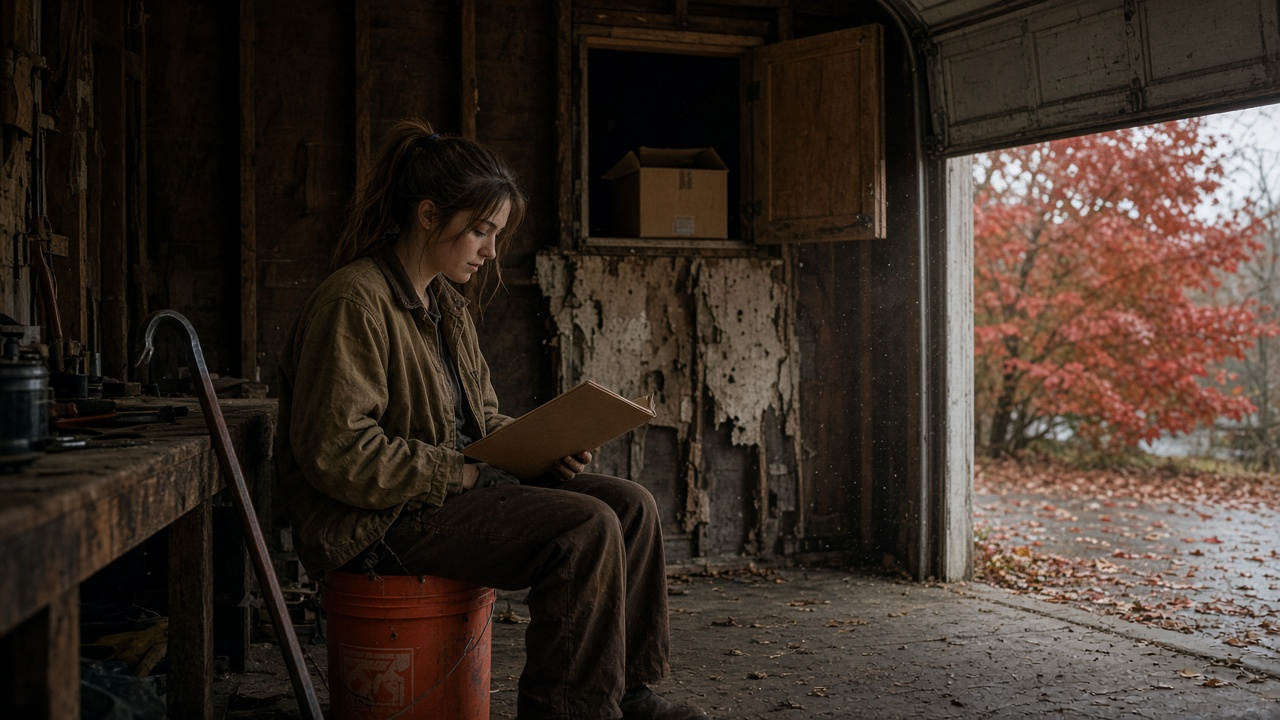
A prisoner of war story, told as a short story: in Waterloo, New York, a young house flipper finds a box of secret 1945 pages behind a garage wall, while her uncle has a buyer waiting and a collector offering cash. This is fiction. The people, the house and the box are made up. However, a real box of secret WWII POW pages was found in a Waterloo garage, and today it is safe at the National Archives.
The Last Flip of the Year
My name is Brianna, but nobody calls me that. I am Bree, I am twenty-six, and I fix up old houses with my Uncle Sal.
First, we buy them cheap. Then we fix them fast, and after that we sell them. At least, that is the plan. Most of the time, the plan even works, as long as nothing goes wrong.
This fall, we bought a gray two-story house in Waterloo, New York. It sits on a quiet street a few blocks from the Seneca River, with a big red maple out front and a sagging garage out back. Waterloo is a small town in the Finger Lakes. Even so, it has one proud fact. As the signs at the edge of town tell you, it is the birthplace of Memorial Day.
Uncle Sal is fifty-six. He has big hands and a bad knee. He also drives a gray truck that smells like coffee and sawdust. This year, he is short on money, because the last flip went over budget. To be honest, he is short on money most years.
"This one has to go clean, kid," he told me on the first day. "The bank loan is due at the end of the month. If this house doesn't close, I'm done."
Gus and the Recipe Card
Taped to his dashboard, there is an old recipe card. It is soft and yellow, since it is older than I am, and the corners are gone. The writing on it is tall and slanted, with a long hook on every t. Still, it says only one line: Always bake one more loaf.
That card belonged to Gus, my great-grandfather. He was Uncle Sal's grandpa, so Uncle Sal still calls him Pop. For forty years, Gus ran a little diner on Fall Street in Seneca Falls. I was only six when he died, but I still remember him. He smelled like bread, and he always kept a heel of bread in his apron pocket, just in case. In fact, nobody ever left his diner hungry, not even the guys who could not pay.
In our family, everyone said the same thing about Gus. He was a cook who never saw the war. At least, that is what he told us. He peeled potatoes in England, he said, and that was all he ever said.
The Box Behind the Garage Wall
The buyers were a young couple from Rochester, about an hour west. They wanted the garage empty and clean before their final walk-through on Saturday morning. So on Wednesday, I was out there with a crowbar, a shop vac and a dumpster.
The back wall was covered in old pegboard. When I pulled down the last sheet, I found a small wooden door, about the size of an oven door. It had been painted over so many times that it looked like part of the wall.
Behind it, there was a crawlspace. It was low and dark, and it smelled like dust and mice, so I held my breath. I pointed my flashlight inside. There were two dented milk cans, a coil of old rope, and a cardboard box tied up with string.
At first, I almost threw the box in the dumpster. It was soft with age, and the string broke when I touched it. Still, something made me lift the lid.
Inside, there were folders. They were brown and stiff, and they were packed with paper. Then I saw the top folder. Across it, someone had stamped one word in faded red ink.
SECRET.

A Prisoner of War Story in Every Folder
I sat down on an upside-down bucket and started to read. Soon, I forgot all about the dumpster.
The pages were forms from 1945. Each one had printed questions, and each one was also filled in by hand. Some answers were in pencil, while others were in ink. In fact, a few were so faint that I had to hold them up to the light.
They were written by American soldiers and fliers who had been prisoners of war in Germany. By then the war in Europe was over or nearly over, and they had just been set free. So the Army asked them what had happened in the camps, and they told it.
In other words, every page was a prisoner of war story. Some were very short. For example, one man wrote only this: "Not enough food. No heat. Lice." Others filled every line and then kept going up the side of the page.
Many of the forms named the same camp: Stalag Luft 3. Later, I learned that this was how the Germans wrote it. The famous book and movie about the Great Escape turned it into Stalag Luft III, and that name stuck.
That night, I looked it up. The camp was near a town called Sagan, about a hundred miles southeast of Berlin. Since the war, the town has been part of Poland. At the time, the camp held thousands of Allied airmen, and the Americans there were mostly officers. In March 1944, a group of mostly British airmen crawled out through the famous tunnel called Harry. By then, though, the Americans had been moved to other parts of the camp.
After that, I read until midnight, and I kept finding towns I knew. Elmira. Auburn. Geneva.
The News on Thursday Night
On Thursday night, I was eating cold pizza in front of the TV when the Rochester news came on.
It was a story about another garage in Waterloo. While a man was cleaning out his garage, he had found a hidden crawlspace. Inside was a box with more than three hundred handwritten pages from 1945. They were questionnaires from freed American prisoners of war, and they were marked secret.
Of course, I almost dropped my pizza.
According to the reporter, a local museum told the man to call the National Archives. Then people from the Archives came up to look. They said the pages were real originals, and so they took them. After that, the Archives scanned every page, marked them unclassified, and put them online for anyone to read. Meanwhile, a law professor said the forms were meant to gather proof of war crimes.
Even so, nobody knew how the pages got into that garage. One idea was an old Army officer who once lived next door.
I looked at my box on the kitchen table. Then I looked back at the TV again.
"Okay," I said to nobody. "Okay."
Nine Thousand Dollars, No Questions
The next morning, I told Uncle Sal. As it turned out, that was my first mistake.
At first, he did not say much. Instead, he took one folder, turned it over in his big hands, and snapped a picture with his phone. Then he walked out to the driveway.
I did not mean to listen. However, the garage has thin walls, and Uncle Sal has a loud voice.
"Rick, it's Sal. Yeah, the guy with the old Army stuff… No, it's real. It says secret right on it."
For a while he was quiet. Then he laughed, but it was not a happy laugh.
"Nine thousand? Cash?… No, no paperwork. Nobody needs to know where it came from… Saturday, eight o'clock, before the walk-through. Good."
When he came back in, he would not look at me.
"Rick buys old war stuff," he said. "Medals, helmets, letters. He'll give us nine grand for the box."
"Uncle Sal, those pages aren't ours," I said. "It was on the news last night. The National Archives took a box just like this one."
"Took," he said. "Right. So they took it, and what did that guy get for it? A thank-you note?" Then he rubbed his bad knee. "Nine thousand dollars, Bree. That's the bank. That's my house. You want to call Washington, fine. But that box goes with Rick on Saturday."
After that, he went back to work, and he swung his hammer much harder than he needed to.
Calling the National Archives
At lunch, I sat in my car and opened the National Archives website on my phone, since I had no idea where else to start.
As it happens, it has a page about missing records. It says the Archives works with people who find old government papers, and its staff will help decide if they belong to the United States. If they do, the Archives asks for them back. It also warns that buying or selling lost or stolen government papers can cost you money, and even land you in court.
So I sent an email to the address on the page. I wrote down where I found the box, and I added a few photos. Then I waited, and I felt sick the whole time.
That afternoon, a woman called me back. She had a calm, kind voice, like a librarian, and she asked a lot of questions before she said anything else. Where exactly was the crawlspace? Had anyone taken pages out? Had anyone tried to sell them?
"Not yet," I said.
"Good," she said. "Please keep them dry and flat. Don't sort them, and don't try to fix them. Keep them in the order you found them, because the order can tell us things."
We Don't Pay for History
"Do we get anything?" I asked. "My uncle has a buyer."
She was quiet for a second before she answered. "We don't pay for federal records," she said gently. "If these belong to the public, then they already belong to all of us. But I can promise you one thing. If they are what they look like, people will read them for a very long time."
Next, she explained the steps. First, someone would come up to look at the pages. Then, if they were real federal records, experts would check them against the Army records the Archives already holds. They would also review the old secret stamps before anything went online. It would take time, she said, maybe months.
However, Saturday was the next morning.
What Earl Remembered
On Friday evening, old Earl came across the street with his little brown dog. Earl is eighty-six, and he has lived on that street since the day he was born. When he got to our porch, he leaned on the rail and looked at the box through the window.
"You found the Major's box," he said. It was not a question.
"Who was the Major?"
"Fellow who lived here after the war," Earl said. "Army lawyer. He came home in forty-six or so, and he never talked about his work. My dad said he'd read things no man should have to read." Then he shook his head. "He used to sit out in that garage at night with the door shut. Just sitting."
"Why would he hide a box like that?"
"Maybe he couldn't stand to throw them out," Earl said. "And maybe he didn't know where else they could go. Some of those boys were from around here, I bet. Geneva, Auburn, Seneca Falls. He'd have known their mothers."
Then he tipped his cap and walked his dog home. For a long time, I just stood on the porch. Instead of going inside, I kept thinking about the Major, alone in the dark with all those pages.
The Page About the Bread
That night, I could not sleep. So I sat at my kitchen table, put on cotton gloves from the hardware store, and read until two in the morning.
Many of the forms came from men who had walked out of Stalag Luft 3 in the snow. Each prisoner of war story matched the next one, page after page, so soon I could put the whole thing together.
Late on the night of January 27, 1945, the guards marched the prisoners out of the camp, because the Russian army was getting close. It was one of the coldest winters anyone could remember, and the snow was about six inches deep. After that, the men walked for days, with only short stops, to towns called Bad Muskau and Spremberg. Then they were packed into cattle cars on a freight train.
The Train From Spremberg
One page stopped me cold. It was page two of somebody's form, and page one, with his name, was missing. Even so, the writing filled every line.
"I was a navigator," he wrote. "I was 20 years old."
First, he wrote about the snow. Then he wrote about a German farm woman who ran out to the road with a pot of hot coffee. He took one cup, and then he thanked her in bad German. He never forgot her, he wrote, because she was crying too.
After that, he wrote about the train.
"There were about 50 of us in the car. We could not all sit down. Next to me was a young flier from Ohio, just a kid. He had a fever, so he could not stop shaking. When they gave us bread, I gave him mine. I did it again the next time too. Even now, I do not know if he lived. I do not know his name, either. Still, I think about him every day."
At the bottom of the page, there were only a few more lines. The train had taken them south to a huge camp at Moosburg, in Bavaria. It was built for fourteen thousand men, but by spring it held about one hundred thirty thousand. Finally, on April 29, 1945, American tanks rolled in and set them free.
"Please find out about the boy," he wrote. That was the last line.
I read it four times before I put it down. Afterward, I laid my head on the table and cried, and I did not even know why.

Saturday, Eight O'Clock
On Saturday morning, the sky over Waterloo was low and gray. Wet maple leaves were stuck to the driveway, and Uncle Sal's truck was there before seven.
I had the box in my arms when he came into the garage. As soon as he saw me, he held out his hands for it.
"Rick's coming at eight," he said. "Then the buyers at ten. Let's go."
"The Archives called me back," I said. "They said they don't pay. They said…"
"I know what they said." He took the box from me, not roughly, but firmly. "Bree, I've got a loan, a bad knee and fifty-six years. I don't have room for a lesson."
Page One
He set the box on the workbench. Then, because Uncle Sal cannot stand a sloppy job, he started to tidy it up before the sale. He lifted out the folders, one stack at a time, and set them down in order.
At the very bottom of the box, something was stuck flat to the cardboard. It was a single sheet of paper, dark with an old water stain. It must have slipped out of its folder years ago, long before we ever bought the house.
Uncle Sal peeled it up with his thumbnail. Suddenly, he went very still.
"What is it?" I asked.
The Same Hand
He did not answer. Instead, he walked out to his truck, and he came back with the old recipe card from the dashboard. Carefully, he laid it on the workbench, right next to the page.
The same tall, slanted letters. The same long hook on every t.
Slowly, I read the top of the page. In the box for the name, it said August Costa. Under rank, it said Second Lieutenant. Under home town, it said Seneca Falls, New York.
So this was page one, the missing half of the bread page. It was Gus.
"He told us he was a cook," Uncle Sal whispered. "He said he never saw the war."
Outside, a car door slammed. It was only ten to eight, so Rick was early.
For a long time, Uncle Sal did not move. Then he picked up his phone.
"Rick," he said. "Don't come in. It's not for sale. It was never for sale."
When he hung up, he looked at me with wet red eyes.
"Call your lady at the Archives," he said. "Tell her there's one more thing she has to find out." Then he touched the old page very gently, the way you would touch a sleeping baby. "Pop wanted to know about the boy."
All those years, Gus had kept a heel of bread in his apron pocket. Just in case.



Leave a Reply