A Kyrgyzstan satellite short story: days after the country's first satellite reached orbit, a young night-shift engineer in Bishkek sees a glacier lake swelling above her grandmother's village. Meanwhile, her boss wants one perfect photo for the launch ceremony, and the satellite has only one pass left that can see both.
Night Shift With a Loaf of Bread
My name is Aiya, but everyone at work calls me Ace. I am twenty-four, and so far I am the youngest engineer at our new mission control center in Bishkek.
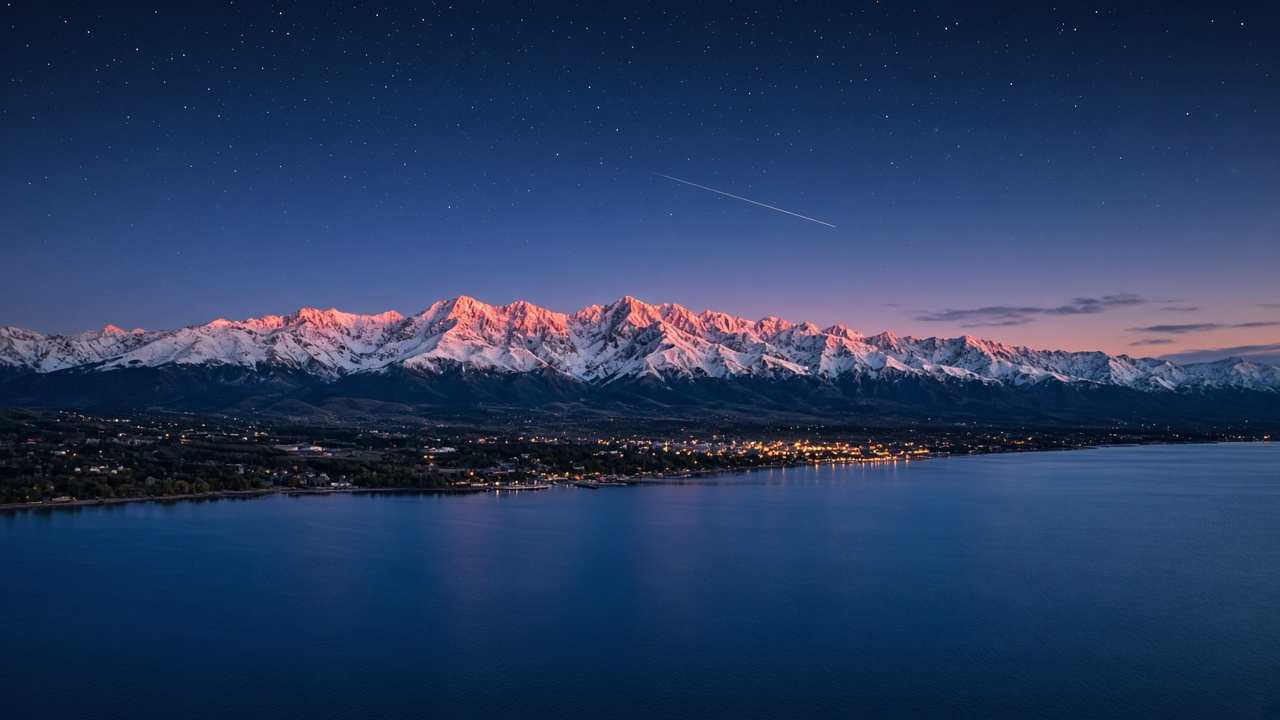
The room is small. It has only six desks, four big screens, and a kettle that clicks too loud at night. Outside the window, the Tian Shan mountains stand black against the stars. When the nights are clear, the snow on top glows a little, like old silver.
Our satellite is small too, even though it is the first Kyrgyzstan satellite ever built. In fact, it is about the size of a loaf of bread, so we call it the Loaf. It weighs about five kilograms. Before launch, a team of around ten engineers spent two and a half years building it, and I was the one who carried the coffee.
On the night of the first of October, we watched it lift off from California on a Falcon 9 rocket. Because of the time difference, it was half past midnight here. The Loaf rode up with more than a hundred other small satellites, as one passenger on a very full bus. When the screen said it was in orbit, Tim hugged me so hard my headset fell off.
Tim is the oldest operator on the night shift. His real name is Timur, but nobody uses it. He is fifty-six. He drinks tea with four sugars, and he can also hear a bad radio signal the way a doctor hears a bad heart.
"Now the real work starts," he said, while everyone else was still clapping. "Now we have to talk to it, so pay attention."
Granny Calls on Sputnik Night
Three nights later, on the fourth of October, my phone buzzed at ten. It was Granny. She calls every night at ten, because that is when the village shop closes and the signal on her hill gets better.
Granny is seventy-eight. She lives alone in a small house above Lake Issyk-Kul, in the hills over Cholpon-Ata, with forty sheep and one very proud dog. She raised me there after my parents moved to Russia for work. To this day, I can smell her bread when I close my eyes.
"Is your star still up there?" she asked.
"It is, Granny. We talk to it four times a day."
"Good." Then she went quiet for a moment, so that I could hear the wind in her phone. "Tell me something. Can your satellite see a stone? One as big as a sheep?"
I laughed, because I could not help it.
"Granny, one dot on our picture is bigger than your whole house. So it cannot see one sheep. Maybe it could see a thousand sheep, if they all stood in a long line."
"Hm," she said. "A thousand."
After that, she asked if I was eating, and if the boys at work were polite, and if I had a coat. Then she said good night and hung up. I put the phone down and smiled at the screens. That was Granny, after all. She always asked strange questions, and then she never explained them.
The Star That Was Really a Rocket
"Do you know what today is?" Tim asked. As usual, he was eating sunflower seeds and dropping the shells in a paper cup.
"Sunday?"
"Sputnik day. October fourth, 1957. Sixty-nine years ago, the first satellite went up from Baikonur, right next door in Kazakhstan. It went beep-beep on the radio, and soon the whole world listened."
I told him that Granny had seen it. Back in 1957, she was nine. One cold night, her father, a shepherd, took her up the hill to watch the new star cross the sky.
Tim grinned. "She probably saw the rocket, not the satellite. Sputnik was a tiny ball, so it was very hard to see. However, the big rocket stage flew right behind it, and that was bright. Most people who saw 'Sputnik' really saw the rocket."
"Don't tell her that," I said. "She loves that star."
It was true. In fact, Granny told that story every winter. Her father had said the new star could see everything, so she must be good. As a result, she climbed the hill every night for a week and waved her white headscarf at it, so the star would see her too. She was nine, after all, and very serious.
"Did the star answer?" I used to ask, when I was small.
"No," she always said, and laughed. "Stars are busy."
The First Pictures From Space
On Monday, the fifth of October, the Loaf sent us its first test pictures.
At first, they were not pretty. The camera was still being tuned, so the colors were a bit wrong, and one corner was blurry. Still, they were ours. The first strip ran over the north side of Lake Issyk-Kul, and I could see the blue water, the brown shore, and the mountains above it, folded like a dark blanket.
Then I saw something else.
High in the hills above Cholpon-Ata, where the snow begins, there was a small lake. It was bright turquoise, like a drop of paint, because glacier lakes look like that. Ice grinds the rock into fine powder, and the powder turns the water that strange milky blue.
That was not the problem, though. The problem was that I knew that valley. It was Granny's valley. After all, her stream came down from up there, and I had never heard of a lake that big at the top.
So I pulled up older free pictures from Sentinel-2, the European satellites, from the end of August. In those pictures, the lake was there, but it was small. In our picture, it was more than twice as long.
"Tim," I said. "Come and look at this."

A Lake That Is Not on the Map
For a long time, Tim just looked. Then he put his tea down, which he never does.
"That is a new lake," he said. "The glacier pulls back, and water fills the hole it leaves. Some of these lakes are only a few years old, so they are not even on the map yet."
"Why did nobody see it?"
"Clouds, maybe. The Sentinels pass every few days, but in autumn the clouds sit on those peaks for weeks. This time we just got lucky, since we caught a clear day."
He pointed at the lower end of the lake. It was held back by a long hump of loose rock and gravel, the kind a glacier pushes ahead of it like a bulldozer.
"That is the dam," he said. "It is not rock in one piece. Instead, it is rubble, maybe with old ice inside. If the water rises too fast, it can cut through. Then the whole lake comes down at once. Mud, rocks, trees, everything."
Of course, I knew the words for this. Everyone in Kyrgyzstan does. In our country, the ministry watches more than two thousand mountain lakes, and hundreds of them are on the dangerous list. In August of 2024, a lake called Zyndan burst above a village on the south shore of Issyk-Kul. As a result, hundreds of people had to leave their homes in one night.
"These lakes usually break in July or August," Tim said. "Not in October."
"But it has been warm," I said. "And it rained all last week."
For once, he did not answer. Instead, he picked up his tea again and held it without drinking.
The Director and the Ceremony Photo
On Tuesday morning, I showed the pictures to the Director.
The Director is not a bad man. I want to say that clearly. He is tired and careful, and he has worked sixteen hours a day since summer. He wears a gray suit that is always a little too big, and he keeps a photo of his twin daughters taped to his screen.
"Ace," he said, after he looked. "This is good work, truly. But listen to me."
Then he pulled a chair close.
"Tomorrow at half past ten, we have the ceremony. The guests are here, the partners from the Emirates, the press, people from the ministries. At ten forty-eight, the Loaf passes over Bishkek. We take our first official picture, and it comes down live on the big screen. So every pass this week is booked for that. Bishkek, the mountains, the city in sunshine."
"I know," I said. "But the lake…"
"The lake is real, and I believe you." Then he held up one finger. "But we are not the warning service. Warnings go through the ministry. They have the experts, the maps, and the people on the ground. Therefore, they decide who leaves a village, not us."
"Then send it to them. Today."
"I will send it right now." And he did. While I stood there, I watched him type the email and attach my picture.
"And Ace," he added at the door, softer. "The camera has been up there less than a week. If we shout 'flood' with a new camera and we are wrong, nobody will trust our pictures again. Do you see?"
I did see. That was the worst part, because every word he said made sense.
What I Heard in the Hallway
That evening, I went to fill the kettle. Meanwhile, the Director was in the hallway on his phone, with his back to me. I did not mean to listen, but the hallway is small, and his voice was tight.
"Yes. The first image at ten forty-eight, live. Bishkek in sunshine. The weather looks clear."
After that, he listened for a while.
"No, no problems. There is one small thing, a glacier lake in the Issyk-Kul hills. We sent it to the Emergency Ministry this morning. They have their process, of course."
Again, he listened.
"Of course. Nothing on the screen tomorrow but Bishkek. I understand."
Then he made a second call. This one was shorter, and I heard him say thank you three times. Afterward, he stood alone in the hallway and said one word to the wall, very quietly.
"Monday."
Later, I found out what it meant. The duty officer at the ministry had thanked him for the picture. They would add the lake to their list. Then a team could go up after the weekend, once the trail was safe. It was October, after all, and the high paths were already icy. Nobody was being lazy. It was simply the process, and the process walked on foot.
Granny Will Not Leave Her Sheep
At ten that night, I called Granny before she could call me.
"Granny, there is a lake above you, at the top of your stream. It is big, and it is still growing."
"I know," she said.
For a second, I almost dropped the phone. "You know?"
"I took the sheep up for the last time in September. The water was too high, and it was talking. Since then, the stream has turned gray. When night comes, it sounds like a truck. Old women have ears too, Ace."
"Then you have to go down. Go to Cholpon-Ata. Stay with Auntie."
"And my sheep? And the neighbors? The village head wrote a letter weeks ago, but letters take time." Then she sighed. "Paper walks, my girl. A picture flies."
"Granny, please."
"Half the village is up on the hill with me every day now," she said. "Even the boys from the school. We are busy, so don't worry about us."
At the time, I thought she meant the sheep. In autumn, the families bring the flocks down from the high pastures for winter, and everyone helps. I pictured the boys in the cold, running after lambs, and I felt worse.
"Did your star look at my hill yet?" she asked.
"No, Granny. It is booked, because tomorrow it looks at Bishkek."
"Then look at my hill once," she said. "Just once. Promise me."

The Kyrgyzstan Satellite Pass We Stole
After the call, I sat in the dark with Tim and the humming screens. Neither of us said anything for a while.
Finally, Tim pulled up the orbit plot. Slowly, he traced the thin line the Loaf would draw across the map tomorrow.
"Look at this," he said. "At ten forty-eight, the track runs right down the middle, with Bishkek on the left and the lake on the right. On Wednesday, this is the only pass that can reach both."
"The ceremony pass," I said.
"The ceremony pass." He rubbed his eyes. "The plan has six frames of Bishkek, just in case of clouds. But the sky will be clear. We only need four."
Suddenly I understood, and my heart started to pound.
"After Bishkek, the Loaf could tilt east," I said slowly. "Only two frames, for forty seconds. Meanwhile, the city stays on the screen. Nobody loses their photo."
"Nobody loses their photo," Tim said. "But if the Director asks, it was my idea. I am old, so they cannot fire me. I know where they keep the good cups."
After that, we built the new plan together. Since the Loaf can only take orders when it is above us, the plan had to go up on the 23:40 pass. I typed the numbers, while Tim checked every one of them twice. At 23:44, the little green light blinked. Now the Loaf had our orders.
Then the plan was locked. Until morning, there was nothing anyone could do.
Ten Forty-Eight
The ceremony room was full the next day. By ten, the guests had name cards, and the press had cameras on tall legs. Somebody had put flowers on my desk, and somebody else moved them.
At half past ten, the Director gave a short speech. He spoke about water and fields, and also about early warnings for floods and mudflows. Then he said the first Kyrgyzstan satellite would help us see our own land with our own eyes. People clapped, and he looked happy, truly happy, for the first time in months.
At ten forty-eight, the Loaf rose over the mountains, invisible in the bright blue sky. At once, the antenna on the roof turned to follow it. Meanwhile, Tim sat very still, with one hand on the desk.
The first frame came down in slow stripes, line by line.
Bishkek. The wide streets, the green parks, the big square, and the mountains behind it, white and sharp. It was beautiful, so the room let out one big breath, and then everyone clapped again. Soon there were two, three, four frames, all clear. Then the Director shook hands with everyone near him.
Then the fifth frame began to come down.
What the Star Saw
At first, the Director did not notice the change. Then the screen filled with brown hills and the white tongue of a glacier, and the room went quiet.
High in the frame was the glacier lake, swollen and turquoise, much bigger than on Monday. Just below it, the old rubble dam looked thin, like a wet sugar cube.
And on the bare slope under the dam, there was a line.
At first, I thought it was snow. However, snow does not fall in a straight line. The line was longer than three football fields, and at the top it split into two short arms. It was an arrow, made of white stones, thousands of them. Each line was as wide as a road. Like a finger, it ran up the hill and pointed straight at the water.
I heard myself make a small sound.
A thousand sheep, if they all stood in a long line. Granny had asked me how big, and I had told her. Then she and her whole village, old women, shepherds, and school boys, had spent a week carrying stones up the hill, so the new star could finally see them.
"What is that?" one of the guests asked the Director.
I answered before he could.
"That is my grandmother," I said.
The Director looked at the screen for a long moment. Then he looked at me, and then at Tim, who was staring at the ceiling like a man waiting for bad news.
"Send it to the ministry," the Director said. "Send the full frame now, and put my name on it." Then he took out his phone and walked into the hallway. This time, he did not speak quietly.
Sixty-Nine Years Later
By sunset, rescue teams from the Emergency Ministry were in the village. Together they walked everyone down to the school in Cholpon-Ata, with forty sheep and one very proud dog.
Granny called me from the school that night at ten, as always.
"Did your star see it?" she asked.
"It saw it, Granny."
For a moment she was quiet. Then she laughed, the same laugh from every winter story.
"Sixty-nine years," she said. "Finally, it answered."
Two nights later, the old dam gave way. The mud came down the empty valley and buried the stream, the road, and the lower field. Still, nobody was hurt.
People still ask me what our first photo was. They expect Bishkek in sunshine. However, the one on the wall of our little room is this one.

Leave a Reply